
A brief arrived in September with a TikTok clip attached and four lines underneath it: KSM-66, 500 mg, two gummies, strawberry, sixty count. The artwork was already finished. The clip had been doing the rounds since the summer.
The first question back was not about price. It was which distributor sold them the KSM-66, and whether the invoice carried a batch number that could be matched to a drum.
KSM-66 is a registered trademark owned by Ixoreal Biomed in India. It is not a synonym for ashwagandha, and a gummy carrying it is carrying somebody's licensed material. An OEM supplement manufacturer that quotes an ashwagandha KSM-66 gummies brief without asking that question is quoting a product it cannot legally label.
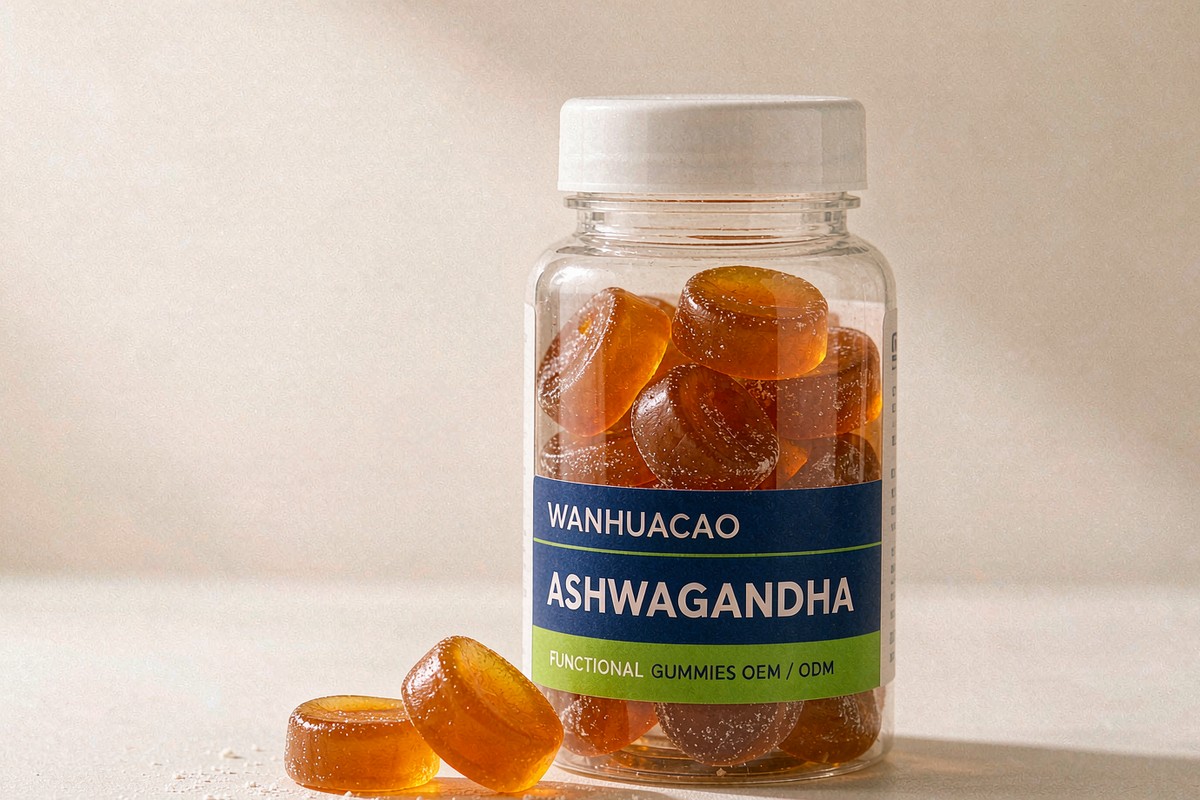
What an OEM supplement manufacturer checks before quoting
Four lines come back from us before a number does, and the fourth one is the one brands forget.
- Material and licence. KSM-66 root extract, with the distributor named and the trademark permission in hand, or a generic root extract quoted as such.
- Withanolides and weight. Milligrams of extract a serving, and the withanolide figure the certificate states, because 5 percent and 2.5 percent are different products at the same milligram count.
- Format. Pieces a serving, piece weight, sugar-free or sugared, bottle or pouch.
- Market list. The countries the finished product will be sold in, written down before the artwork is signed.
That last line decides more than the first three in this category. Ashwagandha is not in the same regulatory position in every European country, and a formula built for the British market can be unsellable in Denmark on the day it lands.
KSM-66 is a licence, not an ingredient name
The extract is made from root only, with no leaf added, extracted with water and heat rather than alcohol or another solvent, and standardised to at least 5 percent withanolides by HPLC. Withaferin A is held below 0.1 percent, which is the compound most often named when liver reports are discussed. Those four facts are the reason the material costs what it costs, and the reason a brand wants the name on the front of the pack.
Using the name on ashwagandha KSM-66 gummies requires permission. Ixoreal licenses it, and the licence runs to a defined product and a defined market. A brand that prints KSM-66 on a carton without that permission has a trademark problem on top of whatever else goes wrong.
The supply side is where the real work sits. Root extract from a non-licensed source sold as KSM-66 is the common failure in this category, and it is not always deliberate; a trader can pass a drum along with a copied certificate. When a drum reaches Bozhou we run withanolides by HPLC against the reference standard, check the plant part by microscopy, and match the batch number to the distributor's dispatch note.
Leaf is the other substitution. Ashwagandha leaf carries more withaferin A and a different withanolide profile from the root, and it is cheaper. A 2026 regulatory review of the liver case reports found they clustered around non-standardised and multi-ingredient preparations rather than root-only extracts with a declared withanolide figure. That finding leaves the safety argument where it was. It does explain why regulators and buyers both ask for the root-only specification.
Fitting 300 to 600 milligrams into two pieces
The published human trials behind ashwagandha KSM-66 gummies mostly sit between 300 and 600 mg a day, with 500 mg the figure that comes up most often. Two pieces a serving at 250 mg each is the shape most brands ask for, and it fits.
The load fits. A 2.0 g piece carrying 250 mg of extract sits at 12.5 percent of the finished weight, which the gel system handles without complaint. What the load does to the bite is the part brands argue about.
- 250 mg a piece. The extract reads as a background note under blackberry or cherry. This is the comfortable band.
- 350 mg a piece. The bitterness arrives at the back of the tongue and the piece needs a salt note and a acid shift to stay drinkable.
- 500 mg a piece. One piece a serving, and the texture moves toward a chew. Brands that want 500 mg usually accept two pieces of 250 mg once they taste both.
Overage is quoted separately from the label figure. Withanolides degrade slowly through curing and shelf life, so a product declaring 500 mg of extract at release is dosed above that at depositing, and the stability curve is what sets the percentage. The number on the stability summary, not the number on the formula sheet, is what the label can defend at month eighteen.
Moisture, bitterness, and heat
Three properties of a water-extracted root powder decide how this gummy is built.
The powder is hygroscopic and fine, with a large surface area for its weight. It pulls moisture out of the air in the weighing room, so it is dispensed into sealed liners and added to a closed vessel rather than scooped from an open drum.
The taste is earthy, faintly bitter, and slightly soapy at the back. Masking it with flavour alone does not work, because the bitterness sits under the aroma rather than in it. What works here is a darker fruit base, blackberry, cherry or mixed berry, with a small amount of sodium chloride and a citric and malic blend that lifts the top note. Strawberry is the request that causes the most trouble, and it can be done, but the result tastes like strawberry over something, and buyers notice.
Heat is the third. Withanolides are stable enough for a gummy but not for a long cook. The syrup comes off the kettle at 78 to 80 Brix, drops to below 70 °C for the acid addition that sets pH between 3.2 and 3.6, and the extract goes into the cooled buffer below 60 °C, minutes before the depositor head. The batch record carries the addition temperature and the hold time, because a batch held warm before depositing is a batch with less in it than the label says.
Curing runs 24 to 48 hours at 22 °C and 45 percent relative humidity, releasing at a water activity of 0.60 to 0.62. At that activity the piece is stable in a sealed bottle with a desiccant, and it stays soft enough to chew. Push the load and the activity up together and the piece starts to sweat inside the bottle within a month.
Where the product can legally be sold
This is the section that separates an ashwagandha brief from a magnesium brief, and it changes every few months.
The United Kingdom. Legal in food supplements, and not treated as a novel food because of consumption history before 1997. The Food Standards Agency ran a call for evidence in 2024 and said in June 2026 that a risk assessment with the Committee on Toxicity would follow. Health claims are the tight end: the GB register carries no authorised ashwagandha claim.
The United States. Permitted as a dietary ingredient, sold with a supplement facts panel, a structure function statement and the DSHEA disclaimer.
Denmark. Banned in food supplements since 2023, on the basis of a 2020 assessment from the Technical University of Denmark that concluded no safe intake level could be established.
France. Restrictive measures from ANSES in 2025, with published accounts differing on whether the scope amounts to a ban.
The Netherlands. A 2024 precautionary advice from RIVM against use, and a proposed amendment to the Commodities Act that would ban it in supplements if enacted.
Poland. Permitted, with a daily ceiling of 3 g of root or root extract and 10 mg of withanolides under resolution 7/2020, and warnings required for children and for pregnancy.
Germany. Under review at BfR, with some retailers delisting voluntarily.
At European Union level. In June 2024 the heads of the national food safety agencies recommended that the Commission open the Article 8 procedure under Regulation 1925/2006, which could end in an EU-wide prohibition. As of late 2026 that procedure had not been formally started, so national rules still decide. The European Food Safety Authority holds ashwagandha claims on mental function, stress and sleep, and adaptogenic properties as pending a risk managers' decision, which means they are not authorised claims and cannot be used as if they were.
The practical consequence for an OEM supplement manufacturer is that the market list has to arrive with the ashwagandha KSM-66 gummies brief. A single formula can serve the UK, the US, Poland and most of the remaining member states. It cannot serve Denmark. A brand planning a European launch that includes Denmark and Poland in the same run is planning something that does not exist, and it is better to hear that at quotation than at customs.
Four documents that travel with the pallet
Every ashwagandha KSM-66 gummies shipment from Bozhou leaves with four papers, and a brand working with an OEM supplement manufacturer for the first time can ask for any of them before the deposit clears.
The licence page. Food production licence SC11434160205012, with gel candy among the permitted categories, and SGS certificate CN23/00007035 covering the same scope.
The material chain. The distributor invoice, the material COA with its batch number, and our incoming HPLC result for the same batch. Three documents that have to agree, because the trademark permission is worth nothing if the drum behind it cannot be traced.
The finished-product COA. Withanolides by HPLC on the finished piece, not on the incoming powder, run after curing. Extract that tests correct on arrival can lose a measurable share through depositing and drying, and the finished figure is the one that goes on the specification.
The release record. Signed by our QA manager, with the buyer's company named as the firm releasing the product for its market.
The line, the laboratory, and what they change
An ashwagandha KSM-66 gummies brief is a dosing and degradation problem with a fruit flavour over it, so the equipment at an OEM supplement manufacturer decides more than the formula sheet does.
The gummy halls run 1.6 billion pieces a year on fully servo-driven depositors with in-line drying drums. Servo control holds deposit weight to roughly two percent across a shift, and that tolerance is the extract figure per piece once the load is fixed. In-line drying shortens the window between depositing and curing, which matters for a hygroscopic powder that skins over quickly.
The site sits in Bozhou, Anhui: 160,000 square metres of campus, 20,000 of it production workshop, 23 automated lines and close to a thousand staff across research and development, quality, production and supply chain. Ten formats run here, so a brand can add a capsule, a powder stick or a herbal tea to the same purchase order without a second supplier and a second audit.
The laboratory occupies 3,000 square metres, staffed by more than fifty graduates, and validates over 2,000 test items in-house. HPLC for withanolides and microscopy for plant part are both run here, which is the difference between a substitution question answered in an afternoon and one that waits a week for an outside lab. Water activity, texture and colour sit on the same bench, so a formula change is measured rather than argued about.
The group holds 56 production patents and more than 10,000 formulas kept for reuse, works with Beijing University of Chinese Medicine on formulation and with Bozhou University on laboratory staffing, and carries the national High-Tech Enterprise designation together with a provincial technical centre. An ashwagandha brief here starts from a base that already has a working mask for root extract, a blackberry note that holds twelve months, and a stability history that says what overage to budget.
What #ashwagandha asks for
The hashtag is one of the most watched in the supplement side of TikTok, and the searches underneath it arrive in the inbox as sentences rather than keywords. Most of them open with a clip and end with a request for ashwagandha KSM-66 gummies at a dose the clip never states. Six of them come up often enough that we keep an answer ready.
- Ashwagandha gummies before and after. The clip usually shows a sleep score or a mood tracker. What the buyer needs from us is a serving size that matches the clip, because a 300 mg product compared against a 600 mg routine is a comparison of two different purchases.
- Do ashwagandha gummies work. The honest reply is that the trials behind this extract used capsules at 300 to 600 mg, and a gummy delivering 500 mg is delivering the studied dose. A gummy delivering 100 mg is not, and it should not be priced or positioned as though it were.
- Ashwagandha for anxiety. Anxiety is a medicinal claim in the European Union and cannot sit on a food label, and in the United States it moves a supplement toward a drug claim. What can go on the pack is the market's permitted wording, which is narrower and gets checked before the artwork, not after.
- Ashwagandha cortisol. Cortisol figures come from trials, not from labels. A brand can cite the trial in its own content and cannot put the number on the carton as a product claim in either market.
- Ashwagandha dosage. This one is answerable, and it is the question worth answering well: 300 to 600 mg of root extract a day, with the withanolide figure stated, is the range the research sits in.
- KSM-66 vs regular ashwagandha. The difference is root only, water extraction, a declared withanolide figure and a traceable batch. A generic root extract can be a fine material; it is not the same material, and the price difference is where that shows.
None of the six has a catalogue answer, and the brand that gets a catalogue answer is being sold to rather than quoted.
Terms
An ashwagandha KSM-66 gummies project runs from 1 metric ton, sampling is free, and quoted lead time is 15 to 20 days after the deposit clears. Bottles, pouches and cartons are in scope, and the packaging proof is where launch dates slip, so it is worth starting that file while the sample is still in the drying room. Quality checks sit at raw material, packaging, work in progress and finished goods.
Bulk orders ship as finished bottles or as bulk pieces for brands filling elsewhere. The gummy range is on functional gummies, the extract identity question is written up in the ashwagandha gummies note, and the document side of contract manufacturing is in the supplement manufacturer guide.
Ding Shaohua, Foreign Trade Manager at Wan Hua Cao, Bozhou, Anhui. Food production licence SC11434160205012 covers gel candy among its categories, and SGS certificate CN23/00007035 covers the same scope. The same person answers on WhatsApp, TikTok, LinkedIn and Facebook.
Frequently asked questions
Is KSM-66 the same as ashwagandha?
It is a specific root extract of Withania somnifera made by Ixoreal Biomed, standardised to at least 5 percent withanolides, extracted with water, and licensed by trademark. Generic ashwagandha root extract is a different material at a different price, and the label has to say which one is in the bottle.
How much KSM-66 goes into a gummy?
Between 250 and 350 mg a piece in most ashwagandha KSM-66 gummies we run, so a two piece serving lands at 500 to 700 mg against trials that used 300 to 600 mg a day. Past 500 mg a piece the texture moves toward a chew and the bitterness needs a darker fruit base to carry it.
Can ashwagandha gummies be sold in Europe?
In most member states, yes. Denmark has banned it in supplements since 2023, France has restrictive measures from 2025, the Netherlands has a proposed ban, and Poland permits it with a 3 g root and 10 mg withanolide daily ceiling. An EU-wide Article 8 procedure was recommended in 2024 and had not been opened as of late 2026, so the market list decides what can ship.
What does an OEM supplement manufacturer need before starting?
The four lines from the top: the material with its licence and distributor, the extract weight and withanolide figure per serving, the format with pieces and piece weight, and the list of countries the product will be sold in. Add the artwork deadline, because the label wording depends on the market list and cannot be finalised before it exists.