
A buyer sends a photograph of a bottle, not a specification. The label says Defense, the front panel shows three purple gummies and a sprig of berries, and the question underneath is always the same: can you make this. The honest answer takes about twenty minutes, because two of the three ingredients on that label behave nothing alike in a depositor, and the third one carries a legal problem in Europe that has nothing to do with taste.
Behind those twenty minutes are three separate engineering problems wearing one label, and the formula is the easy part.
A brand word with a formula underneath
Defense is a brand word. Walk the shelf and it appears on products from a dozen companies, none of which own it, and none of which can tell you what it means nutritionally. It appears in no regulatory category, no nutrient table and no permitted-claims register. What it does is give a marketing team a way to say immune support without printing the word immune on the front of a bottle, which in some markets is exactly the point.
Underneath the word sits a real formula, and that formula is almost always the same trio: black elderberry, vitamin C, zinc. The combination has been on shelves long enough that it has its own shorthand in procurement, and buyers describe it as a defense gummy the way they describe a car by its colour.
Two things follow from that, and the second one costs money when it is discovered late.
The first is that the name is free. A brand can call a product Defense, Daily Defense, Winter Defense or Defense Plus, and no one will object, provided the nutrition panel and the claims on the back are true. The second is that the name commits the formula to a story. A defense gummy that contains no elderberry will confuse the shelf, and one that contains elderberry at a level too low to taste will be returned by consumers who bought it for the taste of berries. Naming a product after an ingredient is a promise about the recipe.
Vitamin C: the one that leaves during cooking
Ascorbic acid is the cheapest of the three and the hardest to keep in the piece.
A gummy base is cooked. Sugar, glucose syrup and water go to between 105 °C and 120 °C to drive the solids up and the moisture down, and the batch then has to be cooled, coloured, acidified, flavoured and deposited. That is a heat history measured in tens of minutes, and ascorbic acid degrades steadily across it, faster in the presence of oxygen and trace metals, faster still at the pH a fruit-flavoured gummy actually needs.
The fix is old and unglamorous: cook the base first, cool it to 60–70 °C, and add the vitamin at the end, just before the depositor. Staged addition like this is standard in any plant that has run a vitamin line, and it is the difference between a product that hits its label claim and one that needs a large overage to get there. Vacuum cooking helps for a different reason, since it removes water at a lower temperature rather than shortening the hold, and the two techniques are usually combined.
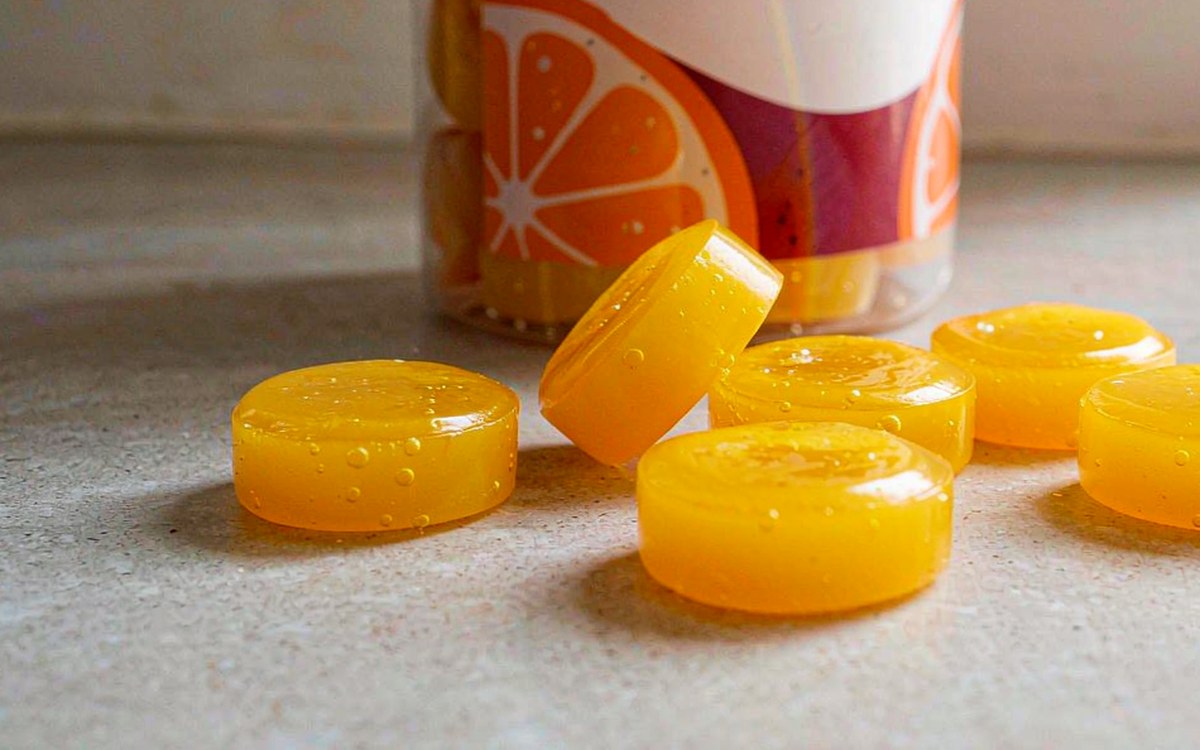
Every plant will tell you it does low-temperature addition. The question that separates them is the loss baseline measured on its own equipment, for its own base. A depositor with a long manifold and a slow cycle holds the syrup hot for longer than a compact one, and the loss figure from a different factory tells you nothing about this one.
Zinc: the one that tastes like a penny
Zinc is where a defense gummy usually fails on the tongue rather than on the certificate.
The forms that go into a gummy are zinc citrate, zinc gluconate, zinc bisglycinate and, on cheaper programmes, zinc oxide. All of them carry a metallic, drying, slightly astringent sensation that becomes obvious at a few milligrams per piece and unpleasant not far above that. A two-gummy serving delivering 10 mg has to hide 5 mg in each piece, and the piece has about 2.5 g to work with.
Masking it is a formulation problem with several levers: a stronger acid profile, a dark berry flavour with enough body to sit over the metal, a citric or malic balance that reads as tart rather than flat, and the choice of zinc form itself. Bisglycinate is the gentlest and the most expensive; oxide is the cheapest and the most detectable.
There is also a ceiling that has nothing to do with taste. The tolerable upper intake level for zinc in adults sits at 40 mg a day, and a gummy marketed for daily use has to leave room for zinc from food and from anything else in the stack. A formula at 15 mg per serving is already committing the consumer to a large share of that ceiling, which is why high-zinc defence products tend to be positioned as short-course rather than daily.
Elderberry: the one that has no legal claim in Europe
The split between the two markets falls on elderberry.
In the European Union, vitamin C and zinc both hold authorised health claims. The wording is fixed and narrow: they contribute to the normal function of the immune system. It can be printed, it is defensible, and it is the same sentence on every compliant label in twenty-seven countries.
Black elderberry holds no such authorisation. There is no approved claim for Sambucus nigra in the EU register, which means a European label can name it in the ingredients list and can describe the product honestly, but cannot attach the immune sentence to it. A bottle sold in Germany and a bottle sold in Ohio, made from the same batch, carry different back panels for this reason alone.
The second elderberry problem is what the number on the label actually counts. Fruit juice powder, a 4:1 extract, a 10:1 extract and a 64:1 concentrate are all sold as elderberry, and 100 mg of one is not 100 mg of another. A 4:1 extract at 100 mg represents 400 mg of dried fruit; a juice powder at 100 mg represents 100 mg of juice solids; a 64:1 concentrate at 100 mg represents the solids of a great deal of fruit but delivers a different spectrum of anthocyanins. None of these is wrong. They are simply not interchangeable, and the specification has to say which one is being bought.
Practically, the extract route is the one that survives a gummy. Juice powder at a level high enough to taste brings sugar and moisture with it, and moisture is the enemy of a chewy texture over eighteen months. Extracts are darker, more concentrated and easier to dose, at a cost that shows up immediately in the price per piece.
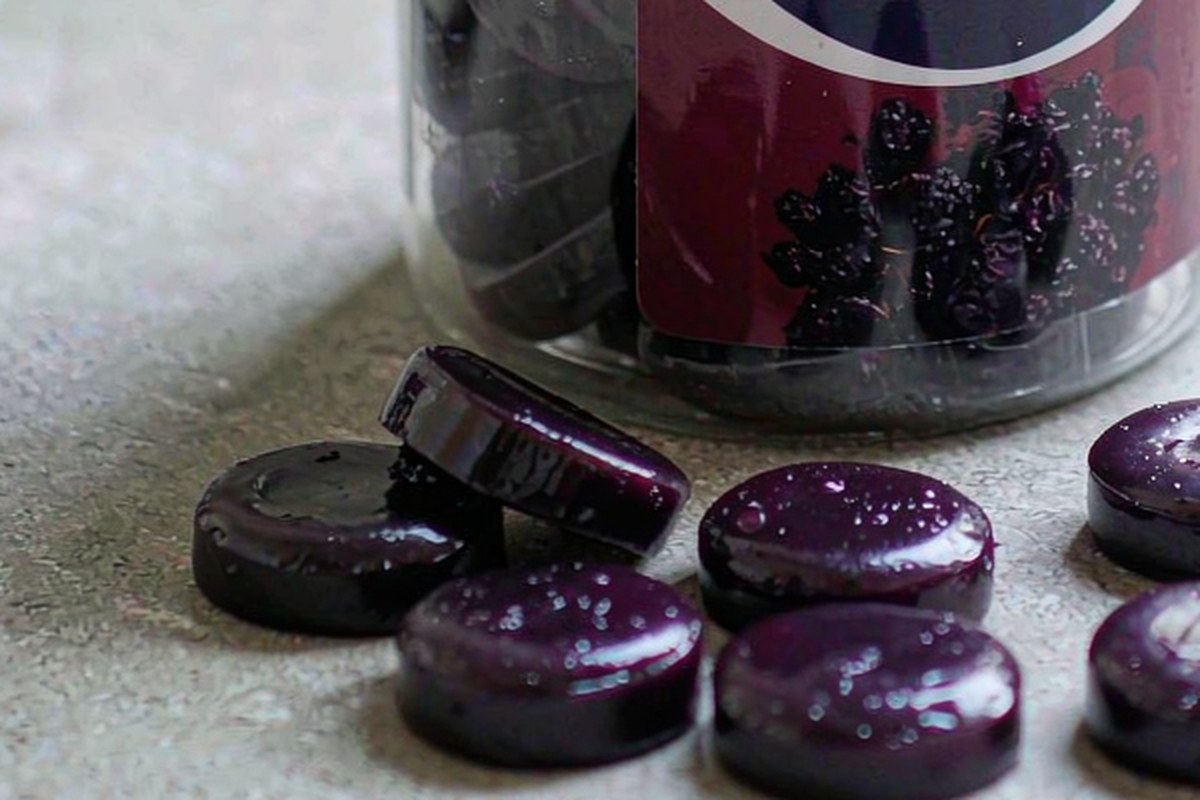
The arithmetic of a 2.5 g piece
A finished gummy weighs between 2 and 3 g, and almost none of that is available for actives.
Roughly 70–80% is sugar and syrup, because that is what makes it a gummy rather than a tablet. Water sits at 12–18% depending on the base and the drying regime. Gelatin or pectin, citric and malic acid, natural colour, flavour and a glazing or sanding finish take another few percent. What remains, often under half a gram, has to carry vitamin C, zinc, elderberry extract and, in most modern formulas, vitamin D3 as well.
This is why the specification conversation converges so quickly. A formula asking for 200 mg of vitamin C, 15 mg of zinc and 200 mg of elderberry extract per two-gummy serving is asking for roughly 415 mg of actives across two pieces that together weigh 5 g. It can be done. It cannot be done while also delivering 3 g of sugar per piece, a clean berry flavour and a texture that survives a summer in a warehouse. Something gives, and the buyer chooses which.
The usual resolution is a serving of two pieces rather than one, a vitamin C level in the 60–120 mg range per serving, and an elderberry extract dosed for flavour and colour rather than for a headline number. None of these is a compromise on quality; they are the shape of the format.
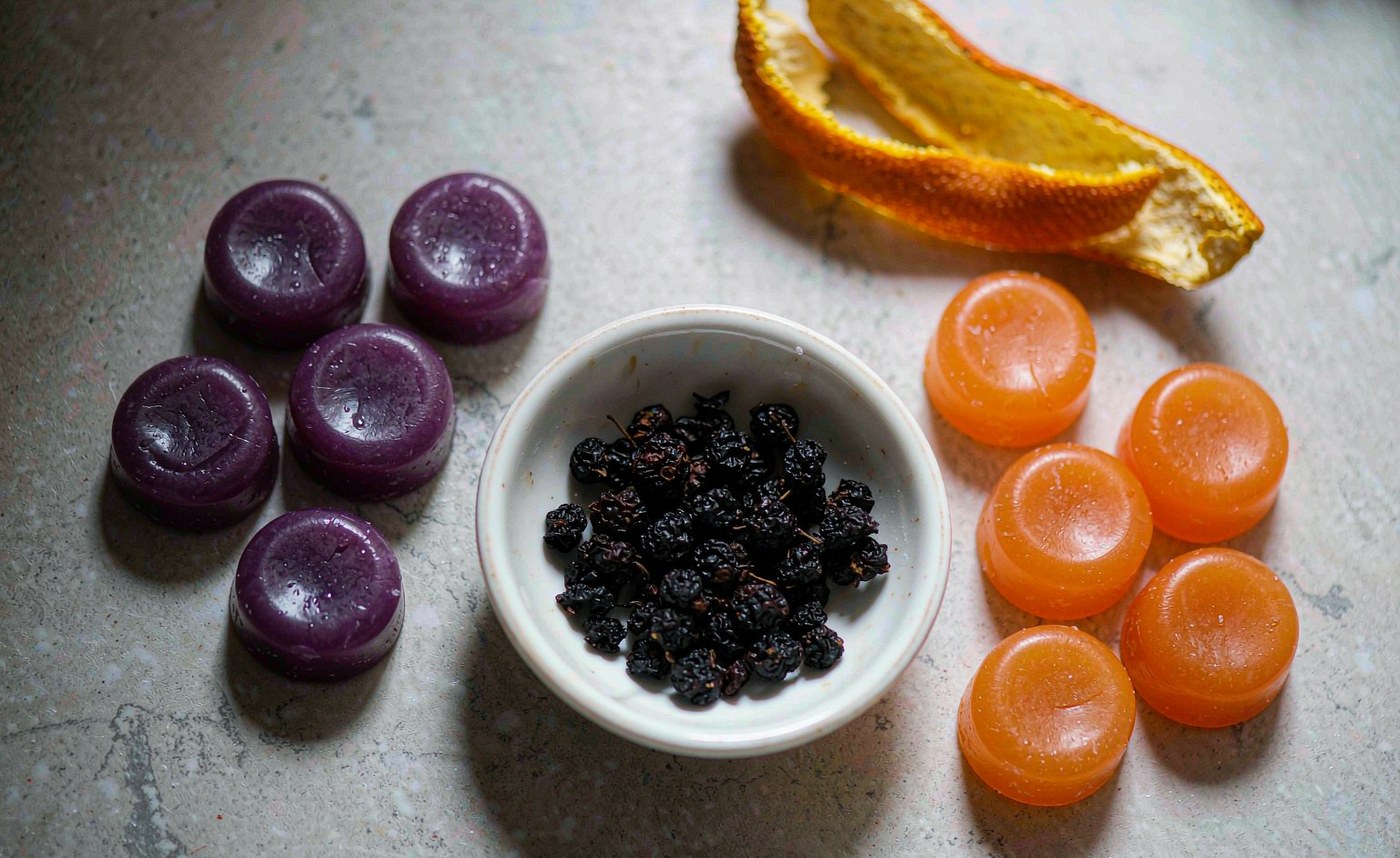
Five versions buyers order
The trio appears in a handful of recognisable variants, and each one has its own production note.
- Adult daily. Two pieces, 60–120 mg vitamin C, 5–10 mg zinc, elderberry extract for colour and flavour. Dark berry or cherry, pectin base for a vegan claim, 60 or 90 count.
- High-potency. Vitamin C raised to 250 mg or more per serving by shrinking the piece count and accepting a sharper acid profile. Zinc stays low, because the ceiling arrives before the flavour does.
- Kids. Smaller pieces at 1.2–1.5 g rather than half a large one, with zinc at 2–3 mg and no extra vitamin C beyond the label. Children chew slowly and taste metal sooner.
- Sugar-free. Maltitol or erythritol with pectin, which changes the water activity and the drying curve. Sugar-free gummies need a longer cure and are less forgiving of a humid warehouse.
- Extended. Vitamin D3 and selenium added, sometimes quercetin or echinacea. Each addition costs weight in a fixed-size piece, and D3 at a meaningful dose is the one that most often forces the serving size up.
For buyers weighing a gummy against a capsule or a powder for the same formula, the dietary supplements pages carry the dose-per-gram arithmetic for the other formats, and the functional gummies pages carry the piece weights and pack formats this line runs.
What the stability data has to show
A defense gummy is judged at the end of its life, not on the day it is made.
Vitamin C falls across the shelf life, elderberry anthocyanins fade toward brown, and zinc does not move at all. The first two have to be dosed above the label claim to still be there in month eighteen, and the size of that overage is the single number most likely to be argued about in a supplier meeting.
Accelerated testing at 40 °C and 75% relative humidity is where most projects start, and it is a useful screening tool, not an answer. Heat-driven degradation and time-driven degradation are not the same curve, and a formula that passes six weeks accelerated can still miss its claim at month twelve on a real shelf. The overage that holds is the one set against retained samples stored at ambient conditions and pulled at intervals, which means the data arrives late and cannot be rushed.
For a buyer, the practical question is what the plant retains and for how long. A factory that keeps a retention room and pulls samples on a schedule can tell you what its vitamin C actually did over two years on its own base. One that cannot is guessing, and the guess usually shows up as a market complaint in the second winter.
Six things to settle before a deposit
Most defense projects that go wrong do so at the specification stage rather than in production, and the six items below are the ones that come back to cost money when they are left open.
- Which elderberry, and counted how. Juice powder, 4:1, 10:1 or concentrate, and whether the number on the spec is extract weight or fruit equivalent.
- Vitamin C per serving, and per piece. The two are not the same when the serving is two gummies, and the label claim has to match the market's rounding rules.
- Zinc form. Citrate, gluconate, bisglycinate or oxide, since the choice moves both the taste and the cost per piece.
- Target market, because the back panel differs. EU claims for vitamin C and zinc, none for elderberry; US structure-function language with the FDA disclaimer.
- Shelf life and storage. Eighteen months at ambient is a different formula from twenty-four, and a product sold through Amazon in a Florida summer is a different brief again.
- Piece weight and pack. A 2.5 g piece in a 60-count bottle is a different cost structure from a 2 g piece in a stand-up pouch, and artwork follows the pack, not the other way round.
Send those six and the answer comes back specific: a piece weight, a serving size, a flavour direction, a sample date. Without them, the reply is a brochure. The contact page reaches the people who run the line, and the sample questions tend to arrive by WhatsApp first.
Ding Shaohua, Foreign Trade Manager, takes enquiries for this line. The same person answers on WhatsApp, TikTok, LinkedIn and Facebook.
FAQ
Can you make a defense gummy with no elderberry?
Yes, and some buyers prefer it. Vitamin C with zinc, or vitamin C with D3 and zinc, produces a clean orange or lemon piece with no dark colour and no berry flavour to mask. What it loses is the story the shelf expects, since the word defense and the picture of berries have travelled together for long enough that a pale gummy reads as a different product.
What is the minimum order for a custom defense gummy?
It is set per line rather than per product. Gummy programmes start at one tonne of finished pieces for a custom formula, and lower for a formula already running, where only the colour, flavour and label change. Exact quantities for a 60-count bottle programme are quoted once the piece weight and pack are fixed.
Does the elderberry level have to match a competitor's label?
No, and matching it literally is usually a mistake. Two products can both print 100 mg of elderberry while one carries a 4:1 extract and the other a juice powder, which are not the same material at the same weight. What has to match is the sensory result and the cost target, and the specification should name the extract ratio rather than only the milligram figure.
Can the same formula be sold in the US and the EU?
The formula, yes. The back panel, no. Vitamin C and zinc carry authorised immune-function claims in the EU and structure-function language in the US, while elderberry carries an authorised claim in neither and is described as an ingredient rather than as a benefit. The front of the pack can say Defense in both markets, since it is a brand word rather than a nutrient claim.