Open a pharmacopoeia at the monograph for processed aconite and there are two numbers on the same page, pointing in opposite directions. The diester alkaloids must not exceed 0.020%. The monoester alkaloids must not fall below 0.010%.
One is a ceiling and everyone expects it. The other is a floor, and it is the more interesting half of the specification, because it says out loud what a supplier who only reports "below limit" is leaving out.
The detox is a reaction you can write
The toxicity in that material is carried by a small group of diester diterpene alkaloids, and the reason processing works is that heat and water break two ester bonds in sequence.
Remove the acetyl group at C8 and the diester becomes a monoester. Remove the benzoyl group at C14 as well and it becomes an amino alcohol. The monoester is reported at somewhere between one fiftieth and one five hundredth of the toxicity of the diester, and the amino alcohol at between one two-thousandth and one four-thousandth.
That is a chemical transformation, not a wash. It happens at a rate that depends on temperature, time, water and pH, which means it can be measured, modelled and validated like any other unit operation. It also means the word "processed" is not a description of safety on its own. It is a description of a set of conditions, and the conditions decide how far the reaction went.
The conditions are the specification
The published behaviour of that decoction is a useful illustration of how narrow the window is. The diester content falls quickly in the first part of boiling and then levels off, while the monoester content rises and peaks somewhere around four to six hours. The traditional instruction to boil for four to six hours is not folklore; it is the interval in which the reaction has gone far enough without going further.
Co-processing with liquorice moves the same reaction by another route, with reported reductions of diester alkaloids around 98% and a corresponding rise in monoesters, partly through a lipid exchange and partly through precipitation with the liquorice acids.
Everything in that paragraph is measurable. Temperature, duration, the ratio of the auxiliary material, the water content, and the analytical result at the end. A certificate that reports one figure has reported one end of a two-ended specification.
Why there is a floor
The floor exists because the reaction does not distinguish between the compound that causes harm and the compound that makes the material worth buying.
Push the hydrolysis all the way and the result is a material that is safe and inert. Both ends of the molecule are gone, and so is the reason anyone extracted it. The specification's lower bound is the trade written into the standard: enough conversion to remove the hazard, not so much that the material has nothing left.
Every detoxification process carries that trade-off, whether the compound is an alkaloid, an irritant or a glycoalkaloid. A supplier who reports only the ceiling has told a buyer that the hazard is controlled. They have not told the buyer whether the product still exists.
A limit or a prohibition
Once a toxic class is identified, regulators choose between writing a limit and writing a prohibition, and the choice changes what a supplier can say.
Pyrrolizidine alkaloids got numbers. Regulation (EU) 2023/915 sets the maximum level for food supplements containing botanical preparations including extracts at 400 µg/kg, for dried tea at 150 µg/kg, and for dried herbal infusions at 200 µg/kg, with 400 for the specific herbs listed in the entry. The figure refers to the lower-bound sum of 21 alkaloids plus 14 more that co-elute with them under current methods, which is a detail worth reading twice: the number is defined by a list and by an assumption about everything below the quantification limit.
Hydroxyanthracene derivatives got a prohibition instead. Regulation (EU) 2021/468 placed aloe-emodin, emodin, danthron and aloe leaf preparations containing those substances in Part A of Annex III to Regulation 1925/2006, the list of substances whose use in food is prohibited. The same regulation placed rhubarb, senna and buckthorn preparations in Part C, under Union scrutiny, because the science on those specific materials was not settled enough for either a number or a ban.
For a prohibited class there is no compliant level. "Below the limit" is not a sentence that can be written, because no limit was set.
The doorway that is left open
The prohibition is not absolute, and the exception is written in the recitals rather than in the article. The regulation notes that during manufacture these substances can be removed from a botanical preparation by a series of filtering processes, leaving them present only at trace levels as impurities.
A senna or aloe preparation cannot be sold as a source of the compound. It can be sold as a material from which the compound has been removed, provided the removal is demonstrated. Some national authorities have turned that into a practical requirement, asking for a certificate of absence with the quantification limit for aloin A and aloin B at or below 1 ppm, together with the analytical method used.
That difference shows up in the claim as much as in the assay. A product that contains the substance at 0.4 ppm is not a low-dose version of a prohibited ingredient. It is a different product, and the paperwork has to say so.
What removes a compound
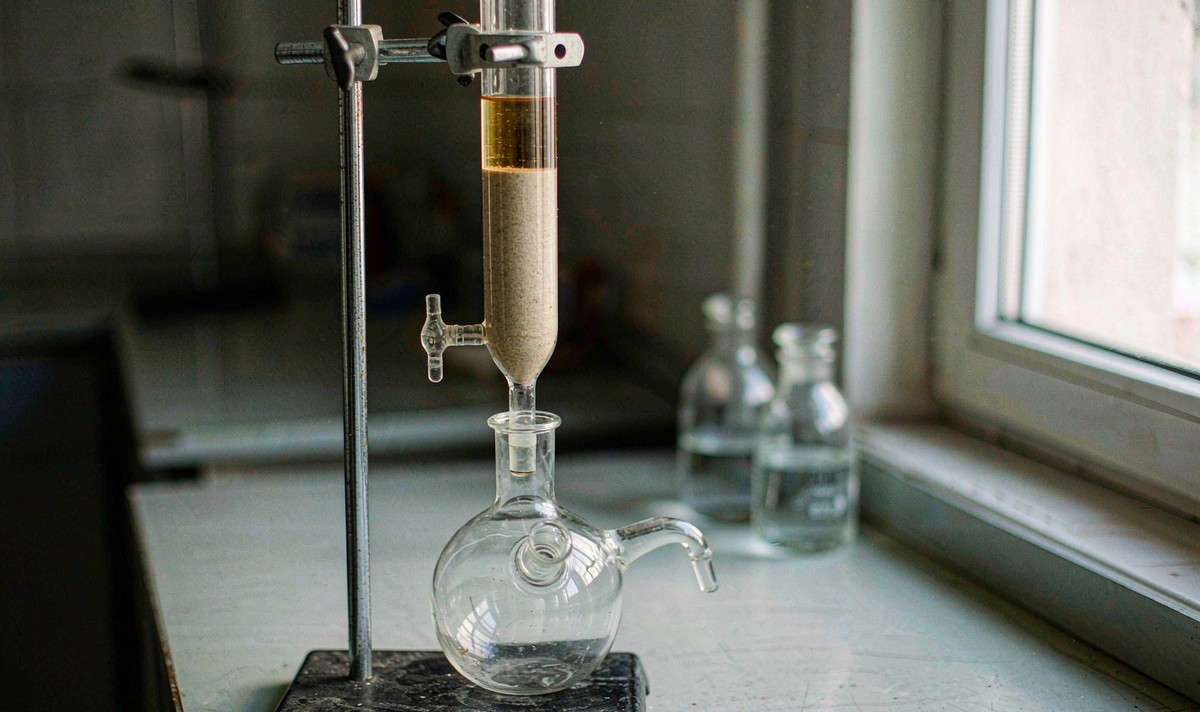
The unit operations are ordinary, and each one has a cost in yield.
Hydrolysis is the first, and it is the one that changes the molecule rather than moving it. Heat, water and pH do the work, and the product is a different compound with a different safety profile, which is why it has to be validated with a method that can see both the parent and the products.
Adsorption is the second. Polymeric resins and activated carbon bind a fraction of the unwanted compound and are then regenerated or discarded. It is effective for some alkaloids and some pigments, and it is also effective at removing the compounds a buyer wants, which is why the yield loss has to be measured on the marker and not only on the weight.
Liquid-liquid partition is the third. Two solvents, a difference in polarity, and a separation that depends on the partition coefficient of each compound. It scales well and it leaves solvent residues that then have to be controlled under their own limits.
Membrane filtration is the fourth. Ultrafiltration and nanofiltration separate by molecular size, which works where the unwanted compound is much smaller or much larger than the wanted one, and works poorly where they are similar.
Supercritical carbon dioxide is the fifth. It is excellent at removing lipophilic material, which is why a spore oil produced that way can be almost free of triterpenes, and why a "triterpene" figure on such an oil is measuring something else. The same selectivity that removes a contaminant can remove the active.
Validating a removal rather than a content
In a detoxified material the analytical question runs the other way. Instead of proving that a marker is present, the work is proving that a marker is absent, or present below a stated level, in the finished dose.
Three things follow from that.
The marker has to be the toxic compound, not the active one. A method validated for the compound you are selling tells you nothing about the compound you are removing, and the two are frequently measured by different techniques.
The spike has to go through the real process. Adding the analyte to the finished powder proves the instrument works. Adding it to the raw material and running the extraction, hydrolysis and drying proves the process works, which is the claim being made.
And the result has to be expressed on the dose. A limit written per kilogram of powder is not the same as a limit per daily serving, and a 20:1 extract moves material from one basis to the other. The arithmetic is simple and it is skipped constantly.
What to put in the specification
Six lines turn a detox claim into something an auditor can check.
- The toxic marker. Named, with the method, because the compound being removed is not the compound being sold.
- The ceiling. The limit and the basis it is expressed on, per kilogram or per daily dose.
- The floor. The minimum content of the marker that makes the material worth buying, stated as a lower bound.
- The process as parameters. Temperature, time, pH, auxiliary material ratio, and the step at which each is controlled.
- The removal evidence. Spike level, recovery through the process, and the batch results that followed.
- The class check. For prohibited substances, a certificate of absence with a stated quantification limit, and the method behind it.
A material that meets a ceiling and a floor is a material with a process. A material that meets only a ceiling is a material with a number, and the number may describe a product that no longer contains what was ordered.
The botanical extract production lines page shows the extraction, concentration and drying steps where these operations sit, the identity testing article covers what happens when the material itself is not what the certificate says, and the contact page reaches the people who run the validation.
Ding Shaohua, Foreign Trade Manager, takes enquiries for this line. The same person answers on WhatsApp, TikTok, LinkedIn and Facebook.
FAQ
Why would a specification set a minimum for a compound that is being removed?
Because the reaction that removes the hazard also removes the reason to buy the material. Full hydrolysis of a diester alkaloid gives an amino alcohol that is far less toxic and far less active, so a product pushed too far is safe and empty. The floor is the other half of the specification: enough conversion for safety, not so much that the material has nothing left. A supplier reporting only the ceiling has reported half a process.
Is a prohibited substance the same as a substance with a very low limit?
No, and the difference is practical. A limit can be met by dilution or by a cleaner raw material; a prohibition cannot be met at any level, and the only route to market is to demonstrate that the substance has been removed and remains only as a trace impurity. That is why the paperwork for a prohibited class asks for a certificate of absence with a quantification limit, rather than a result compared against a maximum.
Can a resin step remove the toxic compound without touching the active one?
Sometimes, and it depends on how different the two molecules are in size, charge and polarity. Resins are not selective by name; they are selective by chemistry, so a resin chosen for an alkaloid may also bind the polyphenols or the saponins that give the material its value. The only way to know is to measure the yield on the marker rather than on the weight, which is a step that is easy to leave out of a process report.
Does a lower toxic marker always mean a better material?
Only up to the point where the active content starts to fall with it. Below that point the two numbers move together, and a lower figure describes a more thoroughly processed material rather than a safer one. The comparison that matters is between two materials at the same active content, which is why the specification has to carry both bounds and both assays on one page.