
A jar reached us in October with a label reading 400 mg magnesium glycinate per serving, a moon, three stars, and no elemental figure anywhere on the panel. The brand had already printed the cartons.
Elemental magnesium in that jar came back at 56 mg a serving on our ICP-MS. Four hundred milligrams of the compound carries roughly 14 percent magnesium; the rest is glycine and water. The label was legal in the country it was printed for.
A magnesium glycinate sleep gummies brief runs into that arithmetic inside the first email. What follows is the formula, the process, and the point where a private label supplement manufacturer has to stop a claim.
What a private label supplement manufacturer asks before quoting
Sleep gummies arrive as a mood board more often than a specification. A competitor's panel, a screenshot of a review, a colour reference pulled from a phone case. The first reply from us is four lines, because until those four lines exist there is no price to give.
- Form. Magnesium bisglycinate, buffered chelate, or a blend that carries oxide for the elemental figure.
- Elemental dose. Milligrams of magnesium per serving, not milligrams of compound.
- Co-actives. Melatonin, L-theanine, GABA, ashwagandha, or magnesium alone.
- Base and pack. Sugar-free or sugared, piece weight, bottle colour, desiccant.
Those four lines set the mould, the drying time, the label and the shelf life. A private label supplement manufacturer that answers with a price range instead of those four questions is quoting a product it has not seen. The conversion from compound weight to elemental magnesium is written up separately on this site, and it is the first thing we send a brand that arrives with a competitor panel.
What a magnesium glycinate sleep gummies brief has to settle
Sleep is a positioning, and positioning reaches into the kettle. Three decisions separate a night product from the daytime gummy on the same line.
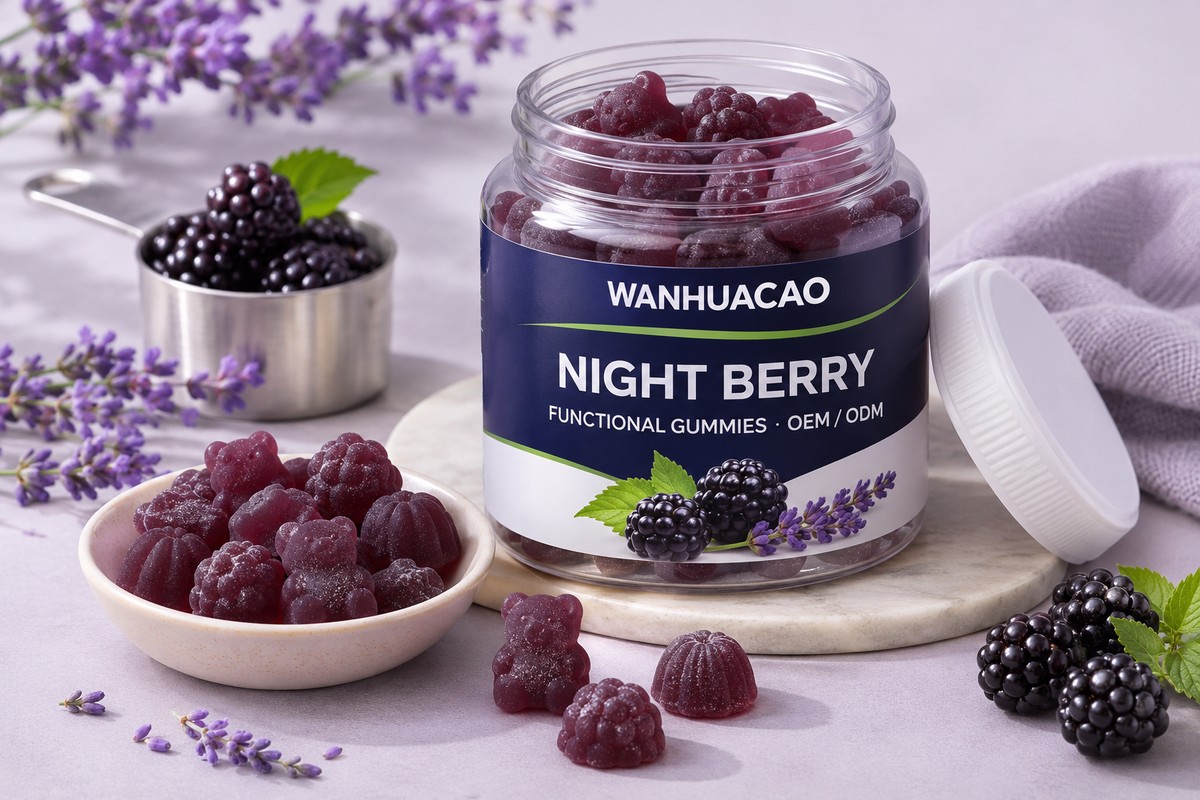
Flavour goes first. Citrus, mint and ginger read as morning; they are the same notes that sit in energy and immunity products. A night brief moves to blackberry, raspberry, lavender, chamomile and vanilla, and the lavender has to be dosed carefully because the oil turns soapy past a few parts per million. We keep a night flavour set on file and adjust the acid blend rather than the top note when a brand wants it brighter.
Sugar goes second. A sugared gummy at eight grams a serving is a dessert eaten at bedtime, and brands selling into the sleep category hear about it in reviews. The sugar-free base here is maltitol and erythritol with steviol glycosides, held under six grams of polyols a serving so the laxative threshold stays out of the label conversation.
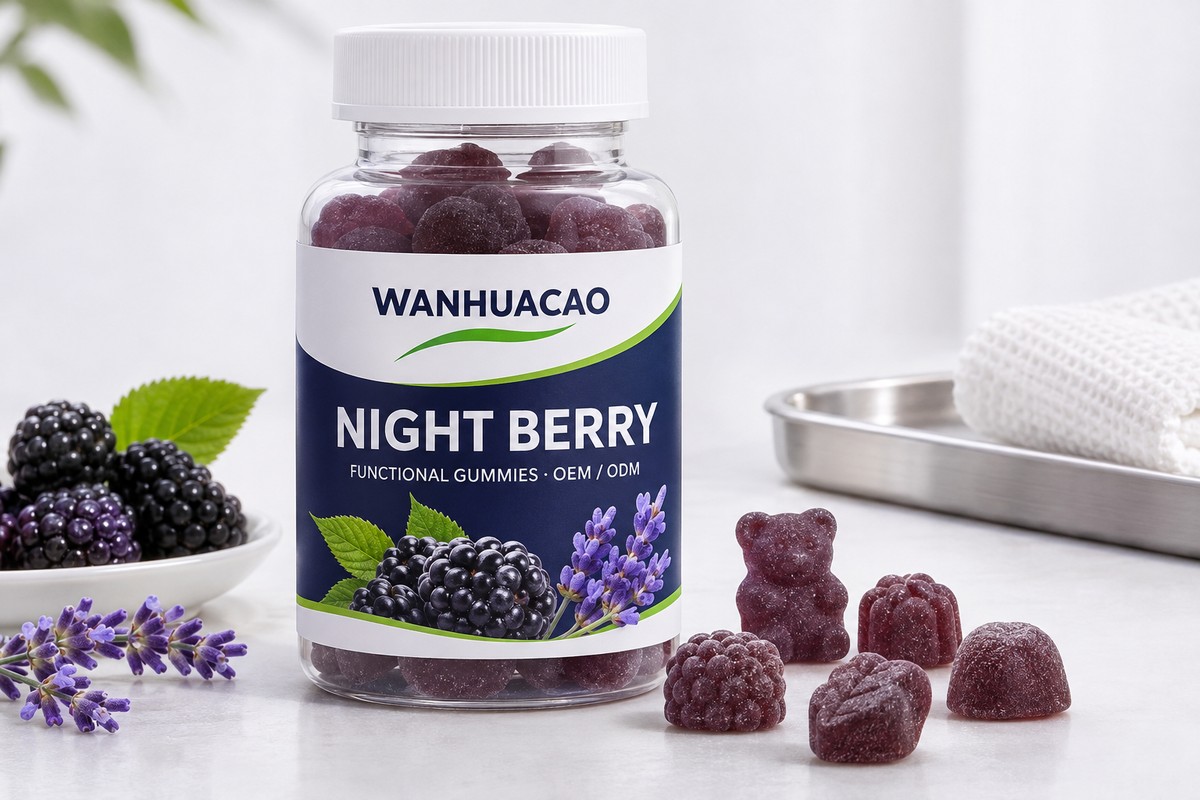
Pieces go third. Two pieces a night reads as a ritual; one large piece reads as a pill that failed. That choice fixes the cavity, and the cavity fixes how much magnesium salt the piece can carry.
The alkalinity problem behind a magnesium glycinate sleep gummies batch
Magnesium bisglycinate in solution sits around pH 9 to 10. Pectin sets at pH 3.2 to 3.6 and gelatine at 4 to 5. Pour the chelate into an acid gel at full load and the pectin drops out of suspension before the depositor ever sees it.
This is the step that separates a sample that works from a batch that does not, and it is where most of our development time on this matrix goes. Three things make it behave.
The chelate is pre-dispersed into a portion of the syrup before it meets the acid, which keeps the pH shock local instead of dumping it into the whole batch. The gel system moves from straight pectin to a carrageenan and gellan blend that holds structure across a wider pH band. And the load comes down: a piece carrying 709 mg of bisglycinate for 100 mg of elemental magnesium sits near 35 percent of the dry weight, and past that line the bite goes short and the surface dulls.
Two pieces a night, and the arithmetic behind them
The arithmetic is short. Anhydrous magnesium bisglycinate is 14.1 percent elemental magnesium, so 100 mg of elemental magnesium needs 709 mg of the salt. At two pieces a serving and a 2.0 g piece, that is 709 mg inside 4 g of finished gummy, which the blend above handles.
Push the serving to 200 mg elemental and the salt load doubles to 1,418 mg. The piece then carries more mineral than gel, texture flattens, and the surface picks up a chalky bloom within a month. We quote 200 mg when a brand insists, with a texture spec sheet signed off at the sample stage so nobody is surprised later.
Shelf life sits on top of that, and it is where a magnesium glycinate sleep gummies project usually loses its first timeline. Magnesium salts are hygroscopic, and a piece with a high mineral load pulls moisture through the bottle faster than a plain fruit gummy. Our night pieces release at a water activity of 0.55 to 0.60 rather than the 0.60 to 0.62 we run on standard lines, and the desiccant is sized for a 24 month claim rather than the 18 months that usually gets quoted.
Where the melatonin cannot go
Most sleep gummies in this category are not magnesium products. They are melatonin products with magnesium on the panel, and melatonin is the ingredient that decides the process.
Melatonin degrades under heat and ultraviolet light. It cannot go into the kettle; ours is added to the cooled buffer below 45 °C, minutes before depositing, into a vessel that is covered and stirred without aeration. The room lights over that section are filtered, and the batch record carries the addition temperature.
The bottle changes too. An amber or opaque high-density polyethylene bottle with a foil induction seal, or a clear bottle inside an opaque carton, which is what most brands end up choosing because the piece colour sells the product. What does not work is a clear bottle on a lit shelf, which is how a melatonin gummy loses potency in a warehouse before it ever reaches a customer.
There is a second constraint that brands discover late. Melatonin is not a permitted ingredient in an ordinary food in every market, and several European countries treat it as a medicine rather than a supplement. A magnesium only gummy travels more easily than a magnesium plus melatonin gummy, and the formula that ships to the widest set of markets is usually the one without it.
Four documents that travel with the pallet
Every magnesium glycinate sleep gummies shipment from Bozhou leaves with four papers, and a buyer working with a private label supplement manufacturer for the first time can ask for any of them before the deposit clears.
The licence page. Food production licence SC11434160205012, with gel candy inside the permitted categories, and SGS certificate CN23/00007035 covering the same scope. A sleep gummy sits in the gel candy category, so this is the page a buyer's compliance team wants first.
The finished-product COA. Elemental magnesium by ICP-MS on the finished piece, not on the raw material, with the chelation share beside it. A raw material certificate says nothing about what survived depositing and curing, and buffered chelates are where the gap between the two widens.
The stability summary. Accelerated data at 40 °C and 75 percent relative humidity at three and six months, plus real-time figures once the batch is old enough. For a product with melatonin in it, the assay curve is the document that decides the expiry date.
The release record. Signed by our QA manager, with the buyer's company named as the firm that releases the product for its market. Under 21 CFR Part 111 that responsibility stays with the brand that sells it.
The line, the laboratory, and what they change
A magnesium glycinate sleep gummies brief is a moisture and temperature problem wearing a berry flavour, so the equipment at a private label supplement manufacturer decides more than the formula sheet does.
The gummy halls run 1.6 billion pieces a year on fully servo-driven depositors with in-line drying drums. Servo control holds deposit weight to roughly two percent across a shift, and deposit weight is the elemental magnesium figure per piece once the load is fixed. In-line drying shortens the gap between depositing and curing, which is what keeps a hygroscopic piece from skinning over before it sets.
The site sits in Bozhou, Anhui: 160,000 square metres of campus, 20,000 of it production workshop, 23 automated lines and close to a thousand staff across research and development, quality, production and supply chain. Ten formats run here, so a brand can add a herbal tea or a capsule to the same purchase order without a second supplier and a second audit.
The laboratory occupies 3,000 square metres between the halls and the warehouse, staffed by more than fifty graduates. It validates and runs over 2,000 test items in-house, ICP-MS among them, which is the difference between an elemental magnesium question answered today and one answered next week by an outside lab. Chelation share is run on incoming chelate, because a buffered supplier can deliver a blend that tests correct on total magnesium and low on the bound fraction.
The group holds 56 production patents and more than 10,000 formulas kept for reuse, works with Beijing University of Chinese Medicine on formulation and with Bozhou University on laboratory staffing, and carries the national High-Tech Enterprise designation, granted against audited research spending, patent count and technical staff share. A night brief here starts from a base that already holds a working carrageenan blend, a lavender note that survives twelve months, and a stability history that says what overage to budget.
Weight management, metabolic health, and the one claim that survives
Two phrases show up in the briefs now that did not appear two years ago: weight management and metabolic health. Both come off social feeds, usually attached to a clip about magnesium and blood sugar, and both arrive as a request to put the phrase on the front of the pack.
The only claim that survives is the one already authorised. Magnesium contributes to normal energy-yielding metabolism, and in the European Union that sentence is available on a food supplement when the daily serving supplies at least 15 percent of the nutrient reference value, which for magnesium means 56 mg. A gummy carrying 100 mg of elemental magnesium a serving clears that bar with room to spare. It says nothing about weight.
Weight management is not an authorised magnesium claim in the European Union, and in the United States a weight loss statement on a supplement moves the product toward a drug claim unless it meets the structure function conditions. What a private label supplement manufacturer can do with those briefs is separate the formula from the copy. The formula can carry magnesium, chromium or fibre. The label carries the energy metabolism sentence, the disclaimer the market requires, and nothing that promises a smaller waist.
Marketing teams in this category are usually fine with that once they see the alternative. A claim that gets a listing pulled costs more than a claim that never ran.
Two label files for one formula
The same night gummy can leave this site with two different back panels, and the difference is not cosmetic.
In the European Union the text is restricted to the authorised list. Magnesium contributes to a reduction of tiredness and fatigue, to normal psychological function, to the normal function of the nervous system. Each one needs the 15 percent reference value condition met and the wording cannot be paraphrased into something stronger.
In the United States the same product carries a supplement facts panel, a structure function statement, and the DSHEA disclaimer that the statement has not been evaluated by the Food and Drug Administration. Melatonin can sit on that panel as a dietary ingredient. In the European Union the same milligram of melatonin can turn the product into a medicine in several member states.
One formula, two files, and the two cannot share a batch record if the labelling differs. That is why the market list has to come with the brief rather than after the artwork.
Terms
Gummy projects run from 1 metric ton, sampling is free, and quoted lead time is 15 to 20 days after the deposit clears. Bottles, pouches and cartons are in scope, and the packaging proof is where launch dates slip, so it is worth starting that file while the sample is still in the drying room. Quality checks sit at raw material, packaging, work in progress and finished goods.
Bulk orders ship as finished bottles or as bulk pieces for brands filling elsewhere. The gummy range is on functional gummies, the elemental magnesium arithmetic is in the magnesium gummies note, and the document side of contract manufacturing is in the supplement manufacturer guide.
Ding Shaohua, Foreign Trade Manager at Wan Hua Cao, Bozhou, Anhui. Food production licence SC11434160205012 covers gel candy among its categories, and SGS certificate CN23/00007035 covers the same scope. The same person answers on WhatsApp, TikTok, LinkedIn and Facebook.
Frequently asked questions
How much elemental magnesium is in a magnesium glycinate gummy?
Between 50 and 100 mg a piece in most commercial products, which is 350 to 700 mg of the bisglycinate salt. Our standard night brief is 50 mg a piece across two pieces, so a serving lands at 100 mg and clears the European reference value threshold for the authorised claims.
Can you put melatonin and magnesium in the same gummy?
Yes, and the melatonin decides the process. It goes in below 45 °C under filtered light, the bottle turns opaque, and the stability work gets longer because the assay curve sets the expiry date. Several European markets treat melatonin as a medicine, so a magnesium only version usually ships to more countries.
Do magnesium glycinate sleep gummies actually help you sleep?
Magnesium is authorised to claim a reduction of tiredness and fatigue and normal psychological function. Sleep itself is a medicinal claim in the European Union and cannot go on a food label. What a brand can say is narrower than what a review section will say, and the honest brief works from the narrower version.
What does a private label supplement manufacturer need before starting?
The four lines from the top of this page: the magnesium form, the elemental dose per serving, whether melatonin or other actives are in, and the base with its pack. Add the market list, because the same formula carries two different labels and the artwork cannot be finalised before that list exists.