Two emails arrive in the same week.
The first is a listing forwarded from a retailer's shelf. Sixty count, lion's mane and cordyceps across the front, $19.99, a three-line disclaimer at the bottom of the panel. The buyer asks whether we can match it at a lower landed cost.
The second is four lines long and mentions no price at all. It asks whether the gummies can be "the ones that actually do something", and whether the cartons can leave the plant blank.
Both emails are about mushroom gummies. The words inside them are the same six or seven, and they are not describing one product. They are describing three, and only one of the three can be made in a food plant.
One nickname, three shelves
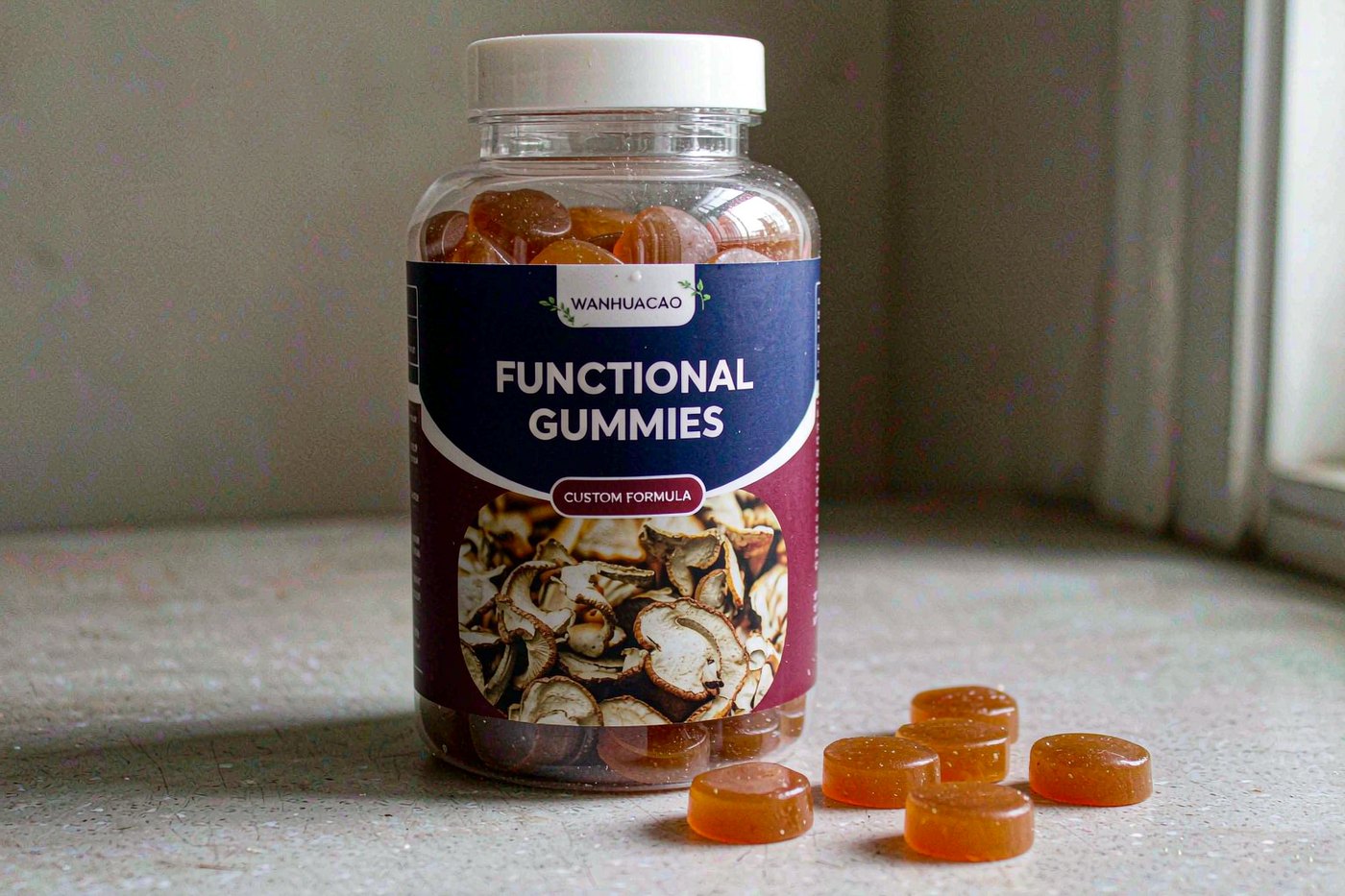
In American English the short word has been attached to three unrelated things inside about five years. The first is the grocery-store product: lion's mane, reishi, chaga, cordyceps, turkey tail, sold as a supplement, no psychoactive effect, legal in every state.
The second is Amanita muscaria, the red-capped mushroom from illustrations, whose active compound is muscimol. It is not psilocybin and it is not a scheduled drug. The third is psilocybin itself, Schedule I under federal law since 1970, with supervised access programmes in Oregon and Colorado and nothing resembling ordinary retail.
A search for the nickname returns all three on the same page, in the same bottle-shaped photography, at the same price point. So the first question on a mushroom gummy project is which of the three the buyer thinks they are ordering, and that question arrives before any formula does.
Amanita stopped being a grey area in December 2024
For several years muscimol sat in a gap. Not scheduled, so not a controlled substance; sold in smoke shops and online next to CBD and delta-8. The gap closed without a scheduling action.
In December 2024 the FDA concluded that Amanita muscaria, its extracts, muscimol, ibotenic acid and muscarine do not meet the GRAS standard. A substance that is not GRAS and not an approved food additive makes any food containing it adulterated under the Federal Food, Drug and Cosmetic Act. The agency's tools are the ordinary ones: recall, seizure, injunction.
Louisiana had already banned the mushroom for human consumption. Several other states have added age gates or format restrictions. The commercial consequence is narrower than the headlines suggest and more serious: a product can be non-scheduled and still be an adulterated food, and the two facts are decided by different parts of the law.
The 2024 Diamond Shruumz outbreak is the case everyone in the category now knows by its numbers. Around 180 reported illnesses across 34 states, 73 hospitalised, three deaths. FDA testing of the products found psilocin and acetylpsilocin, the prescription drug pregabalin, and kava compounds. A customer buying what the label described got a controlled substance instead. No factory that intends to keep its export registration wants its name anywhere near that chain of facts.
Legal is a lower bar than it sounds
Lion's mane and reishi gummies sit under DSHEA as dietary supplements. There is no premarket approval, no filing that clears the formula. The firm is responsible for safety and for the label, and the FDA acts afterwards.
That arrangement puts unusual weight on the carton wording. A structure or function claim is allowed with the standard disclaimer. A disease claim moves the product into unapproved drug territory, and the ingredient does not change. An FDA warning letter to a mushroom supplement company cited cordyceps claims about respiratory disease and reishi claims about tumours, and the products became drugs on the strength of a web page.
The claim decides what the product legally is, and it makes that decision before the artwork does.
Beta-glucan is the number that separates a mushroom from a bag of oats
Most mushroom material on the market is not mushroom. It is mycelium grown on sterilised grain, dried with the grain still attached, and milled. Rice and oats are cheap, and starch is a polysaccharide, so a certificate can report a satisfying polysaccharide figure that came from a field.
The useful test splits the two. Total glucan is hydrolysed and measured, then alpha-glucan (starch and glycogen) is measured separately, and beta-glucan is the difference. Fruiting body extracts usually land somewhere between twenty and forty percent beta-glucan. Grain-grown mycelium products often come in under five percent, with twenty-four to forty-five percent starch sitting alongside.
Two powders labelled mushroom extract, one at 30% beta-glucan and one at 30% polysaccharides, are different products with the same words on the sack.
The extraction decides which compounds are in the powder at all
Hot water pulls the water-soluble beta-glucans out of the chitin. It does not pull the fat-soluble fraction: the ganoderic acids that give reishi its character, the hericenones in lion's mane fruiting bodies, the erinacines in its mycelium. Those need alcohol.
A water-only extract is a real product and a common one, because it is cheaper and because the beta-glucan number still looks respectable. It is also incomplete in a way the specification rarely mentions. Dual extraction, hot water followed by alcohol, is the route that captures both fractions, and the two liquids are usually recombined and dried together.
Which means "10:1 extract" says almost nothing. The ratio describes how much raw material went in. It does not say what solvent took what out, and a 10:1 water extract and a 10:1 dual extract are different powders.
A 2.5 g gummy holds less than the front of the pack implies
A gummy weighs about two and a half grams. Extract load competes with gel strength, sweetness and shelf life, and most commercial mushroom gummies land between 250 and 500 mg of total extract per serving, because above that the texture stops behaving.
That figure is where the arithmetic gets uncomfortable. A six-species blend at 400 mg gives each species about 40 to 65 mg. The human studies most often quoted used a single species at 500 mg and up, and the lion's mane trial that started the category used three grams of fruiting body powder a day for sixteen weeks.
The first decision on the brief is whether the product is one species at a dose worth printing or six species at a token weight. Flavour comes after that. Both sell. Only one of them can be described accurately on a panel that shows the milligram figure per species.
Adding a polysaccharide changes the gel, not just the nutrition panel
Beta-glucan is a hydrocolloid. Put several hundred milligrams of it into a pectin or gelatin base and it starts behaving like one: viscosity rises in the kettle, the depositor runs slower, and the finished piece sets firmer than the trial batch did.
Water activity is the number that decides whether that matters commercially. A gummy above roughly 0.65 aw is a mould risk in a warm warehouse, and a fibre-rich extract holds water differently from a sugar syrup. Stickiness in the bottle follows, then caking, then a customer complaint about a sixty-count that arrived as one lump.
None of this appears in a formula on paper. It appears in the third week of a stability run, which is why the first sample should come with hardness and stickiness data at twelve weeks rather than a photograph of a glossy piece on a white background.
Colour and bitterness arrive before the flavour does
Reishi is bitter, and the bitterness comes from the triterpenes that make it worth using. Chaga is nearly black and carries oxalates. Lion's mane is mild and pale, which is why it dominates the category: it is the one that can go into a peach or mango gummy without a fight.
Masking a bitter extract takes weight: caramel, cocoa, roasted coffee, dark berry. A sugar-free version is harder still, because the polyols bring their own cooling effect and there is no sugar to round the edges. The taste panel that matters is not the one on the day of production. It is the one at month three, on a piece that has been in a sealed bottle at 30 °C, because bitterness grows as moisture moves.
What the specification should say before a batch is booked
The species in Latin, not the marketing name. The part used: fruiting body, mycelium, or mycelium with substrate. The extract ratio and the solvents, in order. Beta-glucan percentage and starch percentage, with the method named. Milligrams per gummy, and the overage that covers the loss between depositing and month twelve.
Then the tests that travel with each lot: heavy metals, pesticides, microbial, and a species check, since the same trade has seen powders sold as one mushroom and delivered as another. A supplier who cannot name the part and the solvent usually does not know, because the material has passed through two traders before it reached them.
A certificate can be accurate and still answer nothing
Mushrooms pull metals out of whatever they grow on. Cadmium and lead accumulate in the tissue, which is why every serious buyer of a mushroom powder asks for heavy metals by lot rather than once a year, and why the answer "our supplier tests it" is the start of a longer conversation.
The certificate itself is a small document with a large dependency: who issued it. A trader's COA covers the sack the trader bought. It does not cover what happened between the dryer and the mill, and it rarely names the assay behind a beta-glucan figure. A manufacturer's COA has a lot number that matches a retention sample, and that sample is the only thing that can settle a disagreement eleven months later.
Species is the other place a certificate can be accurate and useless. Dried powder has no cap and no stem, and the trade has a history of one species being delivered as another. An ITS sequence or a species-specific PCR answers it in a way no photograph can, and the cost is small next to a recalled batch.
Where our documents stop
We hold an SGS report, CN23/00007035, which lists four product categories. Gummy confection is one of them, which is the line a pectin or gelatin mushroom gummy sits on in our plant. The production licence behind it lists eight dosage forms and gummies are not among them, which is correct rather than a gap: a gummy is a food, and the licence covers the capsule, tablet, powder, granule, tea, softgel and oral liquid lines.
The mushroom extract itself is a purchased raw material, and its certificate belongs to whoever bought it. What we can add is the part buyers usually have to assemble themselves: a beta-glucan figure with the method attached, a starch figure beside it, the solvents used, the species confirmed, and a retention sample that can be re-tested if a customer's own lab disagrees.
For a European launch there is one more split worth knowing before the formula is fixed. The Commission's novel food consultation list, updated in September 2026, treats lion's mane and reishi fruiting body powder extracts as not novel, while dehydrated mycelium powders from the same species remain in the novel category. Same mushroom, same genus on the label, different regulatory queue, decided by which part of the organism was dried.
The first email that gets a project moving is short: destination market, species and part, milligrams per piece, pack format. Send it through the contact page and it reaches the people who run the line. If the format question comes first, the functional gummies programme covers what our depositing lines can hold, and what a multivitamin gummy can physically carry is the same arithmetic applied to a different ingredient.
Ding Shaohua, Foreign Trade Manager, takes the enquiries that arrive this way. The same person answers on WhatsApp, TikTok, LinkedIn and Facebook, and the sample questions usually arrive by WhatsApp first.
FAQ
Are shroom gummies legal?
It depends which of the three products is in the bottle. Functional mushroom gummies are dietary supplements and legal throughout the United States. Amanita muscaria gummies are not scheduled drugs, but since December 2024 the FDA treats the mushroom and muscimol as not GRAS, which makes a food containing them adulterated, and Louisiana bans them outright. Psilocybin gummies remain Schedule I at federal level.
What beta-glucan figure should a mushroom gummy show?
Fruiting body extracts commonly test between twenty and forty percent beta-glucan. Grain-grown mycelium products often sit under five percent, with a large starch fraction that inflates the polysaccharide number on the certificate. The useful request is beta-glucan and alpha-glucan reported separately, with the assay method named.
Fruiting body or mycelium?
They are different raw materials with different compound profiles and, in Europe, different regulatory status. Fruiting body powder extracts of lion's mane and reishi were added to the not-novel side of the Commission's consultation list in September 2026; dehydrated mycelium powders of the same species were not. The choice belongs in the specification, not in a marketing line.
Can the same plant make a psilocybin gummy?
No. Psilocybin is Schedule I in the United States and controlled in most other markets, and a food or supplement line cannot handle it. The gummies we produce are functional mushroom products, and the extract is a purchased material with its own certificate of analysis.