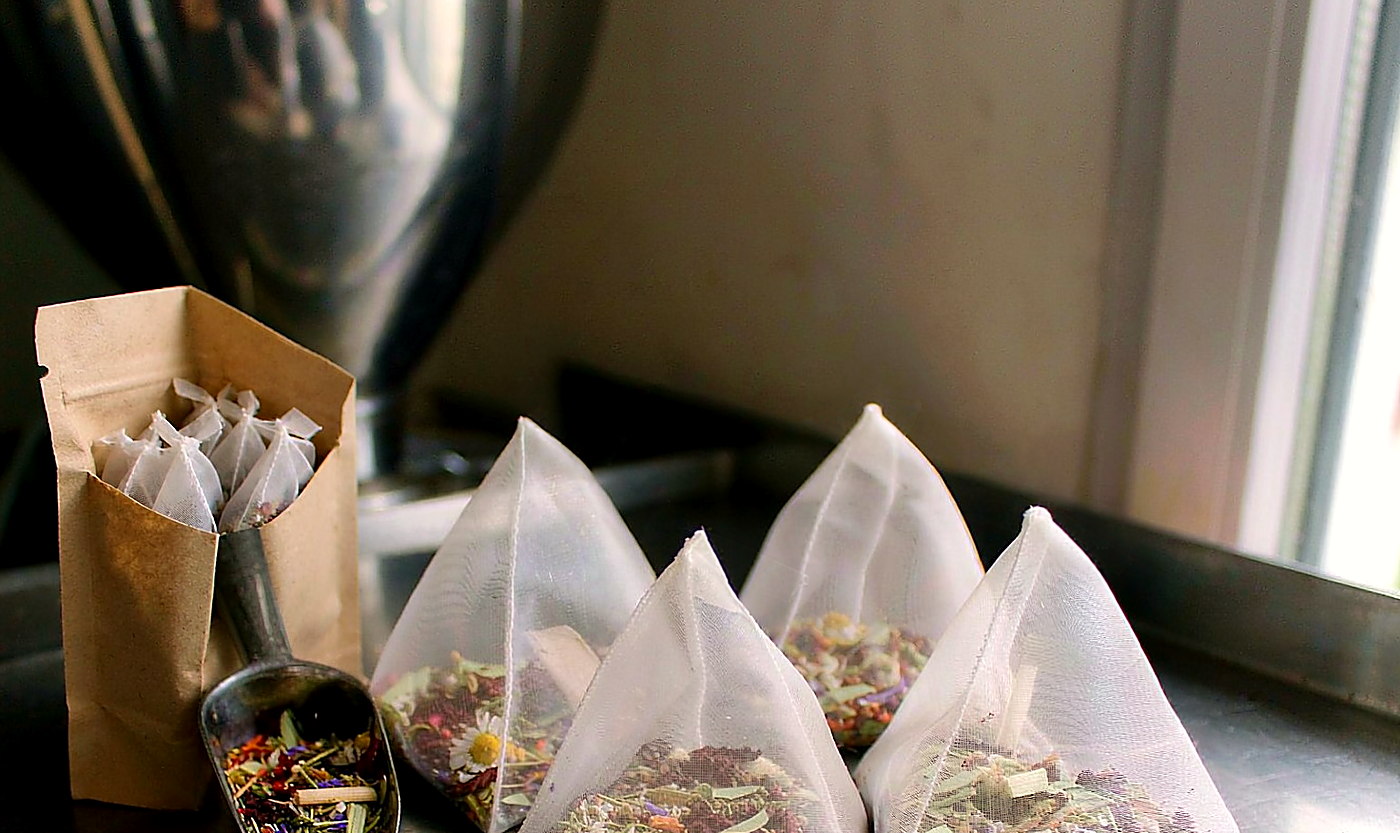
A herbal blend can look simple in a clear bag: a few leaves, pieces of fruit and dried flowers. Its behaviour in hot water is less simple. The pieces absorb water at different speeds, release different amounts of colour and may settle during filling. A private label project brings that blend together with a bag format and a pack that keep the intended serving consistent.
The plants in the blend
Herbal infusions can contain flowers, leaves, fruit or roots, with or without Camellia sinensis tea. The botanical name and the part used give more information than a broad common name. They also connect the blend to its raw-material specification, traceability and the ingredient information needed in its intended market.
The cut size and proportions help describe how those materials share a bag. A light leaf and a dense fruit piece can move differently during handling, even when the initial blend is uniform.
What changes in the cup
Cut size influences how quickly a blend brews and how much fine material escapes through the bag. A flower that looks attractive in a hand-filled sample may fracture during mechanical handling. Moisture and water activity are related but different measurements; one cannot be converted into a universal prediction of microbial behaviour or shelf life. These details are most informative when measured on the proposed blend and bag.
Contaminants and the blend composition
EU Regulation 2023/915 distinguishes categories of herbal infusions for pyrrolizidine alkaloid limits. The dried-product limits include 200 micrograms/kg for a general category and 400 micrograms/kg for specified herbs and mixtures composed exclusively of them. Changing a blend can change the applicable category. These figures are not a complete contaminant specification; the regulation and its current amendments also define the scope and calculation basis.
The bag material
Paper, nylon, polypropylene and PLA bags differ in structure and sealing behaviour. A 2024 teabag particle study measured material released under its experimental conditions. It does not provide a general ranking of the health safety of every bag material. EFSA’s overview discusses the uncertainties in microplastic exposure and measurement. For a particular pack, material identity and food-contact documentation remain relevant alongside brewing tests.
Words on the carton
Flavour descriptions and health claims have different requirements. The EU Court’s 2025 Novel Nutriology judgment illustrates why a botanical claim being on hold is not blanket permission to use it. The exact wording and any transitional provisions matter. Describing the ingredients and the cup is a different exercise from promising a health effect.
Tea projects at Wan Hua Cao
Tea and bagged tea form part of our work at Wan Hua Cao, with flavour and ingredient proportions developed around the brief. A machine-made sample, when available for the project, adds information about fill consistency and the condition of the blend after handling. Our herbal tea page describes the current product range.
FAQ
Does a pyramid bag brew better than a flat bag?
The result depends on the blend, fill weight, material and brewing conditions. A larger shape can provide space for expansion, but shape alone does not establish the quality of a cup.
Can a small blend change affect the specification?
Yes. A changed plant or percentage can alter flavour, fill behaviour and the regulatory category. The updated specification can reflect all three rather than only changing the ingredient list.
Final Thoughts
The blend, bag and carton belong to the same product, even though they are often developed separately. Bringing them together early leaves more room to adjust the cut size, the serving and the flavour before printed packaging is fixed. A good sample then becomes a practical reference for the cup and pack that the finished batch is intended to reproduce.
Ding Shaohua, Foreign Trade Manager, takes the enquiries that arrive this way. The same person answers on WhatsApp, TikTok, LinkedIn and Facebook, and the sample questions usually arrive by WhatsApp first.
All News