
The enquiry reads: 500 mg shilajit gummies, 60 count, black, berry. Four requirements, one sentence. Purchasing reads it and comes back with a question the sender did not expect. Five hundred milligrams of which of the three things sold under that name, and against what limit does the finished piece get released?
The brief is one line, the specification is not
Toll manufacturing dietary supplements runs on the assumption that the brand brings a formula and the factory brings the room. For most actives that holds. A creatine brief and a creatine purchase order look alike, because creatine monohydrate has a molecular formula, a reference standard and an assay two labs will agree on.
Shilajit removes all three. There is no reference standard, no agreed marker compound, and no single analysis that answers how much shilajit is in a drum. A laboratory can measure fractions and produce fingerprints, and those results support a judgement. So when a factory buys this material rather than receiving it, the specification has to be written from the analytical side inward: which form, which assay, which method, which contaminant limits, and which of those the finished piece can actually carry.
That work happens before a single sample is made, and it is the part of a shilajit project that decides whether the rest of it runs.
Three forms, and none of them converts by milligram
Resin is the traditional article: a tar-like mass, roughly 15–20% water, dark brown to black, sticky at room temperature and awkward to weigh cold. Powder is resin dried onto a carrier, usually maltodextrin or silica, which is why a "pure shilajit powder" can be half excipient by weight. A standardised extract is resin purified and assayed to a stated fulvic acid figure, commonly 20–50% on the label.
"500 mg shilajit" names none of the three, and the three behave differently in a 2.5 g piece. Resin at 500 mg would be a fifth of the piece and would act as a plasticiser. Powder at 500 mg brings 200–300 mg of carrier that contributes mass and nothing else. Extract at 500 mg in a single piece is more than most of the market attempts; the common 500 mg serving is two pieces of 250 mg.
For the factory the form settles three numbers that never appear on a label: what the purchase order is actually for, what the yield will be, and what dose the piece can hold.
Buying resin and buying extract are two different jobs
A resin purchase is a judgement about a supplier. The material has no assay that means much on its own, so what the buyer is really acquiring is a collection region, a purification method and a testing history. A certificate naming a region and a rock type is worth more than a photograph of a cliff, and both are worth less than three consecutive batch results from the same supplier.
An extract purchase is a judgement about a number. It can be specified, compared across suppliers and rejected on a certificate, provided the certificate names the method. That is why extract is the easier route for a factory that has to stand behind a label, and why the cheapest resin in a quotation is usually the one with the least paperwork.
Powder sits between the two and is the form most often mis-sold. A carrier-diluted powder quoted at a resin price is a price for maltodextrin with a story attached.
The fulvic acid figure depends on who measured it
Fulvic acid is the number the category is sold on, and it is the number least comparable between two suppliers. Purified resin typically assays around 15–20% by dry weight under a separation method. Labels in the trade routinely carry 60, 70 and 80%.
The gap sits in the method. ISO 19822:2018 separates the hydrophobic fulvic fraction on an adsorption resin, dries it under a defined temperature ceiling, corrects for ash and weighs what is left. Total organic carbon counts every organic carbon in the sample and commonly returns figures 20–50% higher. UV-Vis reads absorbance and cannot tell fulvic acid from the other coloured organics in the same solution. One sample can be reported across a range spanning tens of percentage points depending on which of the three produced the number.
A certificate reading "fulvic acid 45%" with no method attached is not a purchase specification. One reading "hydrophobic fulvic fraction 18.4% by ISO 19822:2018, ash-corrected" is. The first number always looks better on a front panel, which is the reason the second one belongs on the purchase order.
The fulvic acid that is a different legal question
Whole shilajit is listed in the EU Novel Food Catalogue under entry POL-NF-00522 with the status "not novel in food supplements", and novel in foods other than supplements. The entry follows a consultation Germany's BVL handled under Article 4 of Regulation (EU) 2015/2283, with the Commission recording the outcome in August 2020; Czechia reported use in supplements before the 15 May 1997 cut-off. A gummy sold as a food supplement sits inside that allowed use. The same gummy sold as confectionery, a snack bar or a drink does not.
Fulvic acid as an added ingredient is a separate question with a different answer. German consumer advice bodies record it as an unauthorised novel food, and "rich in fulvic acids" is not a permitted nutrition claim. A formula asking for 200 mg of shilajit extract plus 100 mg of isolated 95% fulvic acid is therefore not one project in the EU. It is one allowed project and one with no route to market.
For a factory this changes what can be quoted. An extract with a declared fulvic fraction is raw material with a specification. A drum of isolated fulvic acid powder is a different ingredient, sitting under a different entry, and a brief that treats the two as interchangeable has to be split before anything is ordered.
Dilution is not protection
The EU contaminant limits for food supplements in Regulation (EU) 2023/915 are set per kilogram of the finished product: lead 3.0 mg/kg, cadmium 1.0 mg/kg, mercury 0.1 mg/kg. Arsenic has no specific supplement limit, only the general requirement that the food be safe. Those are concentrations in the product, not intakes per serving, and the difference decides what specification the factory should be buying against.
Take an extract carrying 20 µg/g of lead, high for a rock exudate but not unheard of, and run it two ways.
- Gummy, 2.5 g, 250 mg extract. Each piece carries 5 µg of lead, which is 2.0 mg/kg in the finished piece, or 67% of the 3.0 mg/kg limit.
- Capsule, 500 mg, 250 mg extract. The same 5 µg now sits in half a gram, which is 10 mg/kg, more than three times the limit.
One material, one certificate, opposite answers. Turned around, the same arithmetic sets the purchase limit. For the gummy, 7.5 µg of lead per piece against 250 mg of extract allows up to 30 µg/g in the raw material. For the capsule, 1.5 µg against the same 250 mg allows 6 µg/g. A specification written for one format is five times too loose for the other.
The concentration test is not the same as the intake either. Two gummies deliver 500 mg of extract and 10 µg of lead, against a permitted daily exposure of 5 µg for lead from a supplement under USP 2232, and a California Proposition 65 reproductive level of 0.5 µg per day. A piece can pass the finished-product limit and still put the daily serving over a safety figure, because the regulation measures the product and the body measures the serving.
Cadmium and mercury limits are tighter again, at 1.0 and 0.1 mg/kg, so the margin a gummy buys is smaller for those two, and a panel average says very little about either.
Four metals is a panel, not the panel
A four-metal certificate covers lead, arsenic, cadmium and mercury, which is what most contract laboratories quote by default. Three gaps sit outside it, and each has recent evidence behind it.
Thallium. A 2025 study in BMC Chemistry measured thallium in 13 raw shilajit samples and five commercial supplements and found it in all 18. Raw material reached 0.226 µg/g, the supplements reached 0.5 µg/g, higher than the raw material in some cases, with up to 0.095 µg in a single capsule. The authors asked for routine standardised testing and did not call for a recall. A four-metal certificate is silent on it.
Mineral oil. In April 2026 a German state laboratory examined twelve shilajit products and found no excessive heavy metals. It did find mineral oil hydrocarbons in four of them, rated one product unsafe over aromatic mineral oil, and reported that three of the twelve showed little or no evidence of actual shilajit, with caramel indicated in four. A clean metal panel and a genuine material are two separate findings.
Identity itself. No single marker settles it. A 2026 study of eleven samples from Iran, India, Nepal, Russia and Kyrgyzstan quantified nine phenolic acids by HPLC-MS/MS and found gallic acid ranging from about 22 to 2,839 µg/g across the set. FTIR gives a fingerprint, ISO 19822 gives a fraction, hippuric acid and the dibenzo-α-pyrones serve as markers, and none of them alone confirms what a drum contains.
Each of these is a line item on a purchase order, not a footnote. Thallium testing and a mineral oil screen cost money per batch, and the decision to skip them belongs to whoever signs the specification. A specification that says "heavy metals: compliant" and stops there has decided, silently, that three known gaps do not apply.
Where the American file stands
The US file on shilajit has three parts worth knowing, and none of them is a heavy-metal finding.
An FDA new dietary ingredient notification for a "Shilajit Fulvic Acid Complex" was filed in January 2026 and answered on 1 April 2026. The agency could not establish the identity of the ingredient from the submission, citing inadequate evidence on starting materials, an inadequate description of the manufacturing process, and inadequate specifications including analytical methods; it could not establish safety either. The letter concludes that a product containing the ingredient may be adulterated. Two of those three deficiencies are documentation a manufacturer holds and a brand usually does not, which makes the file a joint exercise rather than a marketing one.
Import Alert 66-41 lists certain shilajit products from named firms, with entries from 2015 and June 2025, for unapproved drug claims rather than contamination. Import Alert 99-42, the toxic element list, did not include shilajit when it was checked in November 2026. In April 2026 a US firm recalled a liquid shilajit tonic, Class II, for possible under-processing with a botulism risk and for health claims on the label.
Then there is Proposition 65, which is where a lead result turns into an invoice. Private notices filed in 2017, 2025 and 2026 alleged lead exposure from named shilajit products without the state warning. The reproductive level is 0.5 µg per day, a tenth of the USP supplement figure, and any private party can enforce it.
What the resin does to the piece
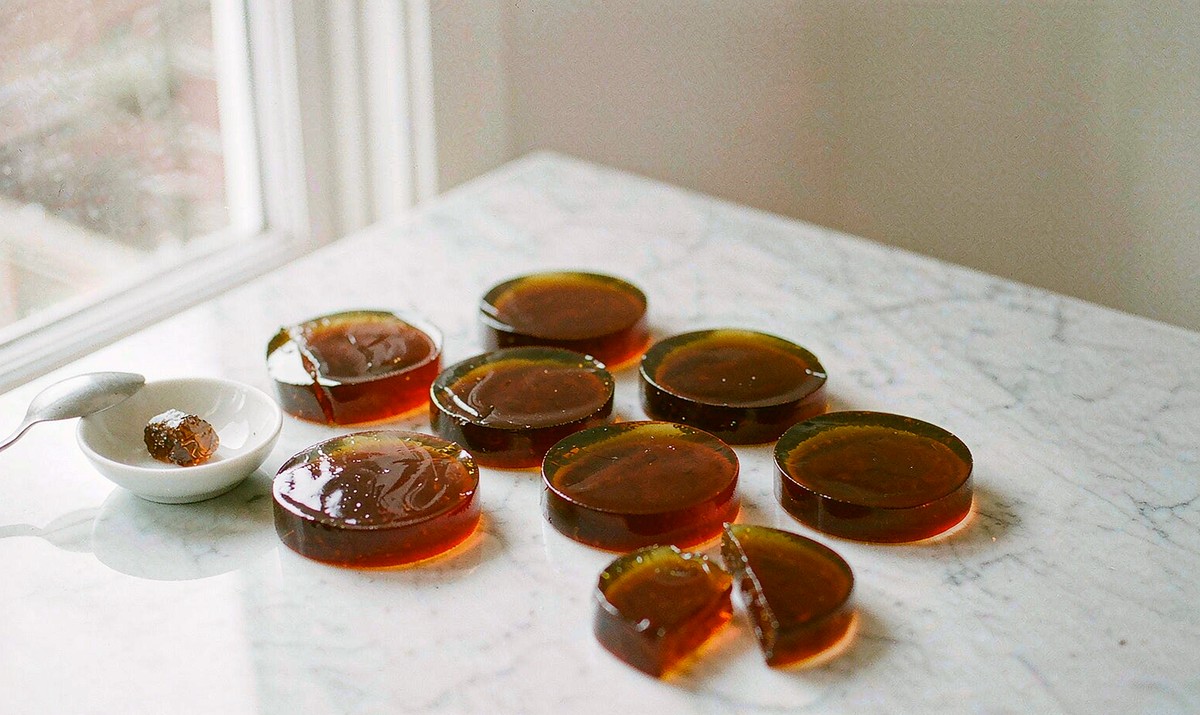
Shilajit at full dose drives a gummy to a very dark brown, near black once the piece is thick, and slightly soft. The colour is convenient, because it hides batch variation and makes the piece look uniform, and it also removes colour as a way to signal flavour. Whatever the piece tastes of has to arrive through aroma.
Texture is the constraint. Resin plasticises: at a meaningful dose the piece stops snapping and starts bending, and in a warm market it goes tacky in the bottle. Extract loads behave better because the carrier is not a plasticiser, but the extract still arrives with its own water and its own acidity. Pectin with a calcium source sets firmly enough for a dark piece. Gelatin works while the load stays modest and stops working as the load rises, which is why a formula that holds 200 mg of extract is not automatically a formula that holds 400 mg.
Heat is the other cost. Gummies are cooked, and the fulvic fraction is held at temperature for the length of the cook. Whether that costs a measurable share of the fulvic acid has not been settled in the published literature; a resin-in-honey format can claim an advantage here only in theory, because no comparison between formats has been published. A specification promising a fulvic acid figure "at end of shelf life" is promising something nobody has measured for this format.
Weighing resin is a process step
Cold resin does not pour. It has to be warmed until it flows, and warming an open vessel introduces two variables a purchase order never mentions: how long the material sat at temperature, and how much stayed on the wall of the melter.
A budget built on one loss percentage for the whole batch is an average of a sticky material and a free-flowing one. Extract and powder can be weighed to the gram and lost as dust; resin leaves a film on every surface it touches. The allowance belongs per form, and it should be costed before the quotation goes out, because the party who buys the material is the party who eats the loss.
The label dose gets decided in the same place. A brief asking for 250 mg per piece, on a run that holds back 4% on the melter wall, leaves two options. Accept pieces at roughly 240 mg against a 250 mg label, or charge the batch up to compensate and land near 260 mg. The first is a labelling problem. The second is a cost problem and a contaminant problem, because an extra 4% of the material brings 4% more of everything dissolved in it, metals included. Overcharging to cover a sticky wall quietly raises the lead per piece, which is the kind of thing a finished-product certificate reveals only after the batch exists.
Sea moss and shilajit in one piece
The two hashtags, #seamoss and #shilajit, travel together, and the reason is presentational. Both are mineral narratives, both photograph as dark gels and powders, and one product can carry both stories. Briefs asking for sea moss and shilajit in the same gummy arrive regularly.
Mechanically that is two materials with two contamination profiles in one article. Sea moss brings iodine, which has its own upper level and its own arithmetic per serving. Shilajit brings the metals above. Neither dilutes the other's risk, and when both are bought by the factory rather than supplied, both suppliers have to be approved against the same dose and the same piece weight, which is a harder conversation than approving either one alone.
The blend then needs a check that neither certificate reports: what the combination does to water activity and shelf life when the seaweed arrives as a gel rather than a dried powder.
Flavour is the easier half. Both materials are dark, bitter and marine-mineral in different proportions, and the same three levers work. A dark fruit with body carries the bitterness, malic acid reads rounder against a mineral note than citric does, and a small salt addition makes the profile taste deliberate rather than spoiled.
Four lines that turn the brief into a purchase order
- Form and assay. Resin, powder or extract, with the fulvic acid figure and the method behind it. This sets the price, the yield and the label dose.
- Limits, reverse-calculated. The contaminant limit for the raw material, derived from the finished-product limit at this piece weight and this dose, and printed on the specification.
- Panel and failure route. Which metals, whether thallium and mineral oil are included, and what happens when a result lands above the limit.
- Process loss, per form. Costed before the quotation, because the loss is the manufacturer's once the material is bought.
Send those four with a piece weight and a target market and the reply comes back with a dose that fits the format and a sample date. The contact page reaches the people who run the line. The functional gummies pages carry the piece weights and base options for this format, the dietary supplements pages carry the capsule arithmetic that makes the dilution point concrete, and the botanical extract lines cover the purification step that decides what arrives in the drum.
Ding Shaohua, Foreign Trade Manager, takes enquiries for this line. The same person answers on WhatsApp, TikTok, LinkedIn and Facebook.
FAQ
How much shilajit can a gummy hold?
Around 200–300 mg of standardised extract in a 2.5 g piece before texture and taste stop working. Resin is worse, since 500 mg of it plasticises the piece and the product goes soft in the bottle. Market products at a 500 mg serving usually deliver it across two pieces of 250 mg, which is the range the format supports.
Why can't a supplier simply ship 500 mg of shilajit?
Because "shilajit" names three materials with different water content, different carriers and different assays, and a purchase order has to name one. The fulvic acid figure is only comparable when the method is named, and the lead limit that matters shifts with the piece weight, so the specification has to be written for the product rather than for the ingredient.
Is shilajit legal in the EU as a gummy?
Whole shilajit is not novel in food supplements (entry POL-NF-00522) and is novel in other foods, so a gummy sold as a food supplement is inside the allowed use and the same gummy sold as confectionery is not. Added or isolated fulvic acid is a separate ingredient and is not authorised as a novel food, which makes a "high fulvic acid" blend a different project from a shilajit gummy.
Why do two labs report different fulvic acid percentages?
Because the common methods measure different things. ISO 19822:2018 separates the hydrophobic fulvic fraction and weighs it ash-free, while total organic carbon and UV-Vis count or read everything in the sample that responds. The numbers can differ by tens of percentage points on one drum, which is why a specification has to name the method next to the figure.