At half past six the receiving bay is the busiest corner of the site. A truck has come in from the Bozhou medicinal-material market with a load of dried honeysuckle, and nothing comes off it until a sampler has walked the pallets with a probe and sent a composite across the yard to the laboratory. The truck waits. On a site running twenty-three lines, a held truck costs money, and it is held anyway.
That habit is the reason this plant is worth describing in detail. Most buyers see a factory twice: once in a brochure, once in an audit after something has already gone wrong. What follows is the part in between. The floor, the laboratory, the documents, and the arithmetic behind the numbers on the front page.
The site began in a township industrial zone
Bozhou sits in the northwest corner of Anhui, and it is the largest trading floor for Chinese medicinal materials in the country. Prices for a good part of the national supply are formed in the same city. The group that owns this site started there in 2009, in the Dingdalou industrial zone of Wuma town, with a single product structure and no private-label business at all.
The sequence since then is short enough to read as a list.
- 2009. The group opens in Wuma town, Bozhou.
- 2013. E-commerce and social-commerce orders start coming in.
- 2015. Sales pass the RMB 100 million mark.
- 2017. Five health-food lines are added and brought into production.
- 2018. Private-label work begins, and finished goods reach Walmart shelves.
- 2019. A new plant is completed, the group moves in, volume production starts.
- 2020. Three further lines are certified; headcount passes 500.
- 2024. A 110,000 m² plant is built and commissioned.
- 2025. A maternal and infant line is added.
Two things about that list matter more than the dates. The first is 2018, when the group stopped being a maker of its own products and started making other people's. The second is 2024, when floor space roughly doubled. A private-label plant that doubles its footprint has usually just discovered that its bottleneck was never sales.
What 160,000 m² holds
The site covers more than 160,000 m². Of that, around 20,000 m² is production workshop, and the rest is warehouse, laboratory, utilities and yard. Twenty-three automated lines run across it, and close to a thousand people work here, split into four teams: research and development, quality, production, and supply chain. Management describes the company as four centres, management, marketing, manufacturing and R&D, with sales running nationally rather than through a single region.
Outside, the yard is organised around trucks rather than visitors. Ten freight partners work the site, among them SF Express, JD Logistics, Deppon, YTO and China Post, and a 50,000 m² warehouse sits behind the loading docks with racking mapped by location. A cold store runs below 10 °C for gummies and softgels, which is the difference between a product that arrives soft and one that arrives as a single block in July.

The cleanroom grade, stated plainly
The workshops are built to the 100,000-class standard, which in the European grading used by most auditors is Grade D, roughly ISO 8 at rest. That is a statement about air: how many particles of a given size are allowed in a cubic metre when the room is not running. It is not a statement about whether the people inside follow the batch record, and the two get confused constantly in supplier decks.
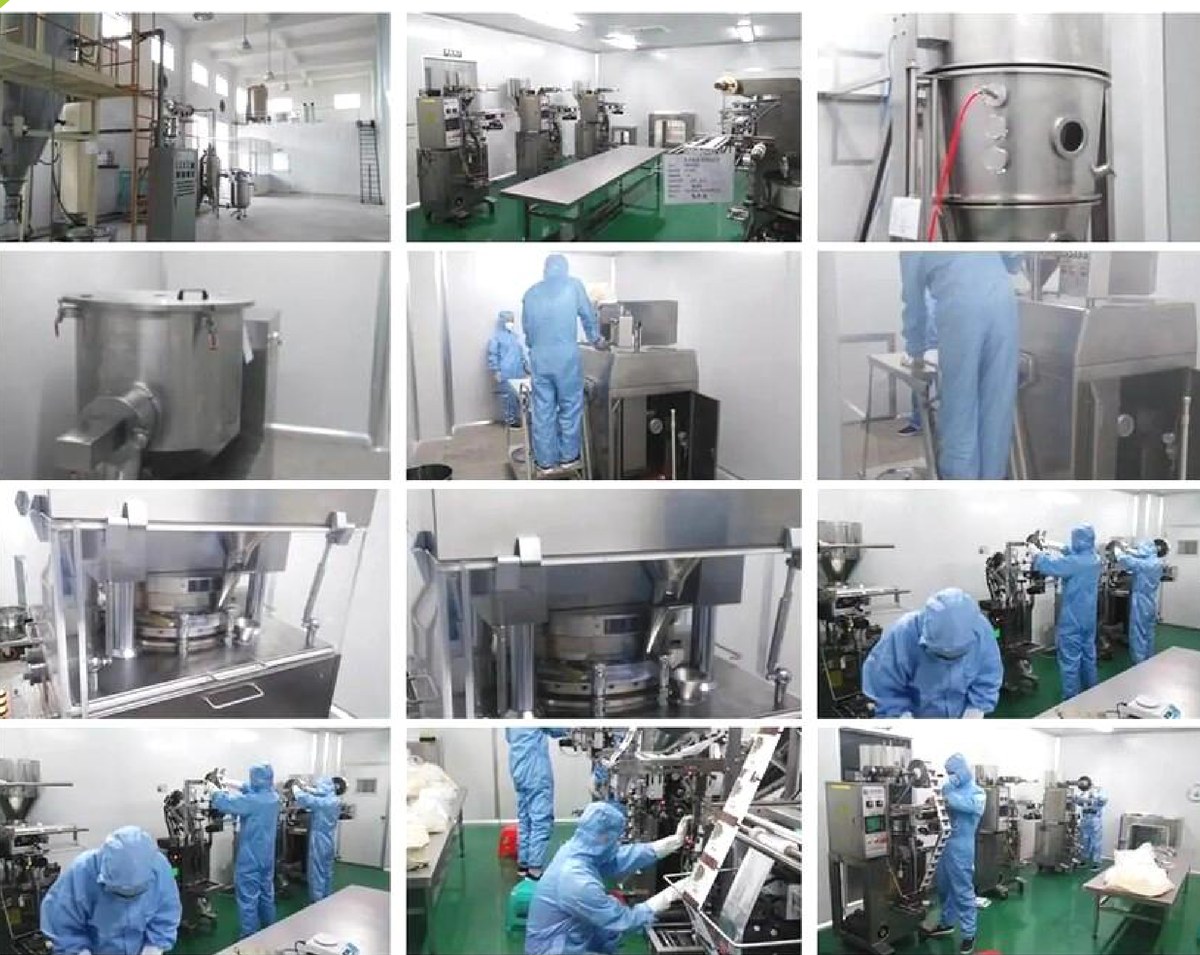
What the grade does buy a buyer is a shorter conversation at audit. The rooms are stricter than the 1,000,000-class standard that older food plants were built to, and the air handling is the part of a factory that is most expensive to retrofit later. Everything else, gowning, cleaning schedules, environmental monitoring, belongs to the quality system rather than to the certificate on the wall.
Five formats, five throughputs
The plant does not specialise in one dose form and subcontract the rest. It runs five, and each has its own equipment, its own staff and its own arithmetic.
- Plant beverages. 90 million servings a year, on high-speed integrated lines with UHT flash pasteurisation and CIP cleaning between runs. Ultrasonic extraction carries several process patents.
- Gummies and softgels. 1.6 billion pieces a year, set with carrageenan and pectin rather than gelatine, on fully servo-driven depositors with in-line drying drums.
- Herbal tea. 1 billion bags a year, across 150+ dedicated machines, with six process patents covering filling, drying and blending equipment.
- Tablets. 500 million tablets a year, granulated in a fluid bed and then compressed on high-speed rotary presses.
- Herbal pastes. 60 million servings a year, eight stages and 84 hours of cooking, extracted at 65 °C and concentrated between ten and a hundred times, then filtered through 200 mesh.
The pattern across those five numbers is worth pausing on. Tea and gummies are volume formats sold by the piece; pastes and beverages are the opposite, low piece counts and heavy process time. A plant that can hold both ends is unusual, and it is the reason a brand can move a formula between formats without moving supplier.
For buyers already working in one of these categories, the detail sits on the product pages rather than here: dietary supplements for capsules, softgels and tablets, functional gummies for the confectionery line, and herbal tea for bags and blends.
The laboratory
A 3,000 m² laboratory sits between the production halls and the warehouse, staffed by more than fifty people, all of them university graduates, a share holding doctorates or master's degrees and dozens at intermediate technician grade or above.

The instrument list is the part buyers ask to see. Two triple-quadrupole systems, one coupled to liquid chromatography and one to gas, handle trace quantification. Liquid and ion chromatography cover the routine work. Atomic fluorescence and atomic absorption carry the heavy metals. A UV-Vis spectrophotometer, biosafety cabinets and clean benches fill in the rest, more than a hundred instruments in total, bought with an investment the group puts above RMB 10 million.
In-house, the laboratory validates and runs over 2,000 test items. That figure is not a claim about how many tests every batch receives. It is a claim about scope: whether a pesticide panel, a glycoside assay or a microbiological count can be run inside the building, or has to be sent out and wait three days for the answer.
Incoming material, and the three machines at the gate
Bozhou's advantage is proximity to the market, and the group buys first-hand there rather than through traders. Across the year, more than a thousand suppliers feed the site, each with its own file and its own history of rejections.
Three devices guard the intake. A colour sorter rejects discoloured material before it reaches the scale. An X-ray metal detector handles the loads where metal contamination is a realistic risk, and a static separator pulls hair and fibre off botanicals that arrive from open drying yards. None of these replaces a person looking at the load, and the sampler at half past six is still the first check.
Formulas, patents, and three universities
Research runs out of Bozhou and a branch office in Wuhan, which is where much of the formulation work is done and where the group recruits from a deeper technical labour pool than a prefecture-level city can offer.
The count the group publishes is 56 production patents and more than 10,000 formulas held for reuse. Numbers like that are easy to inflate and hard to audit from outside. What can be checked is the partnership side: Beijing University of Chinese Medicine, where the group works with Professor Liu Yonggang's team on formulation for sleep and liver-support categories, Anhui University of Chinese Medicine, and Bozhou University, the local institution that supplies a steady share of the laboratory bench staff.
Five checks before a batch leaves
Every batch passes the same five gates: raw material, in-process monitoring, semi-finished goods, finished goods, and release. The standards applied at each gate are the group's own, written to sit tighter than the national standard rather than to match it, and the quality team holds several hundred of them alongside standard operating procedures for each step.
Third-party testing goes to SGS, which is also where the plant's food-grade GMP documentation was issued. Traceability runs backwards from a carton code to the batch record to the incoming lot, which is the chain an auditor follows when a market complains about one pallet out of forty.
The documents, and where they stop
Two companies sit behind this site, and their paperwork covers different things. Precision matters here, because a buyer's QA team will check scope before it checks anything else.
Anhui Wanhuacao Health Products Co., Ltd. holds food production licence SC11434160205012, covering eight dosage forms: tablets, powders, granules, tea, hard capsules, softgels, oral liquids, and sports nutrition supplements. It is valid to 25 August 2030.
Anhui Wanhuacao Biotechnology Co., Ltd. holds SGS food-grade GMP certification CN23/00007035, under Codex Alimentarius CXC 1-1969 (rev. 2020), covering substitute tea, solid drinks, instant cereal powder, and gel candy. It is valid to 24 December 2026.
Around those, the site lists ISO 22000, ISO 9001, ISO 14001, ISO 45001, HACCP, a BRCGS food safety audit, HALAL certification, and FDA registration documentation, and it publishes each original with its scope and dates attached rather than showing a wall of logos.
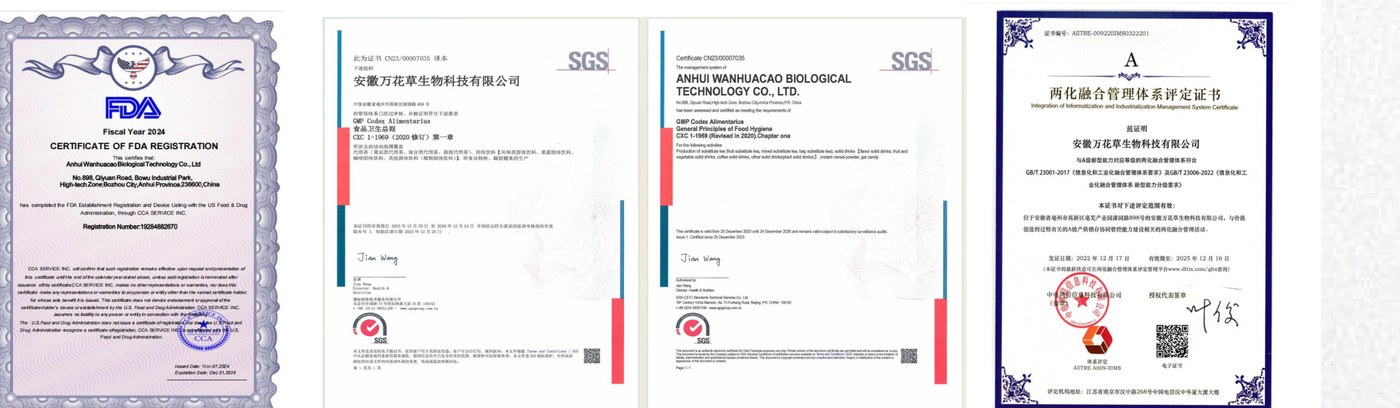
Two consequences follow, and both are worth saying out loud. A gel candy is covered by the SGS certificate and not by the licence, which is correct: ordinary gummies are confectionery, not a licensed health-food format. And a creatine gummy takes a separate route entirely, filed under GB 24154, the sports nutrition standard, which sets its own daily intake ceiling of one to three grams. Same depositing line, different compliance file, and the two cannot share a specification.
Three ways to work with the plant
Most projects arrive as one of three arrangements, and the difference between them is who owns the formula.
- OEM. The brand owns the formula and the trademark; the plant manufactures, packs and ships.
- ODM. The brand brings a market and a price point; the plant develops the formula, sources materials and manufactures.
- OBM. The brand distributes the plant's own formulations under licence, with packaging and logistics handled here.
In practice, most first orders sit between OEM and ODM: a brand arrives with a rough formula and a competitor's sample, the laboratory reformulates it for a cost target, and the result is signed off before a single batch is booked.
The sequence after that is unglamorous. Enquiry, project review, specification and quotation, contract, deposit, packaging artwork and physical samples, buyer sign-off, production, inspection, shipment, repeat order. The step that most often stalls a project is not manufacturing but artwork: a bottle that looks right on a screen can still fail a fill-line trial, and the packaging proof is where a launch date quietly slips.
Who the plant makes for
Four names the company publishes are useful precisely because a foreign buyer is unlikely to recognise any of them. Freshippo is Alibaba's supermarket chain. Yixintang is a listed pharmacy chain with several thousand stores. Gaoyi is a national pharmacy group assembled from regional chains. Xiaokuihua is a children's health brand with national distribution.
None of that is proof of quality. It is proof of volume and of the paperwork that a chain buyer demands before it will put a product on a shelf, which in practice means audits, batch documentation and a recall procedure that has been tested.
The growth figure the group reports is output value above RMB 400 million, with a compound annual rate above 30% across six years. The provincial recognitions sit alongside it, and they hang on a wall rather than sit in the deck.
The wall in the front office
Twelve plaques hang in the entrance hall, gold plates on dark wood, and they are worth reading closely because this kind of paperwork is often all a buyer ever sees of a supplier's standing. None of them is a product certificate. They describe the company as a legal entity, in the vocabulary of Chinese industrial policy, and knowing which is which saves an afternoon of guessing.
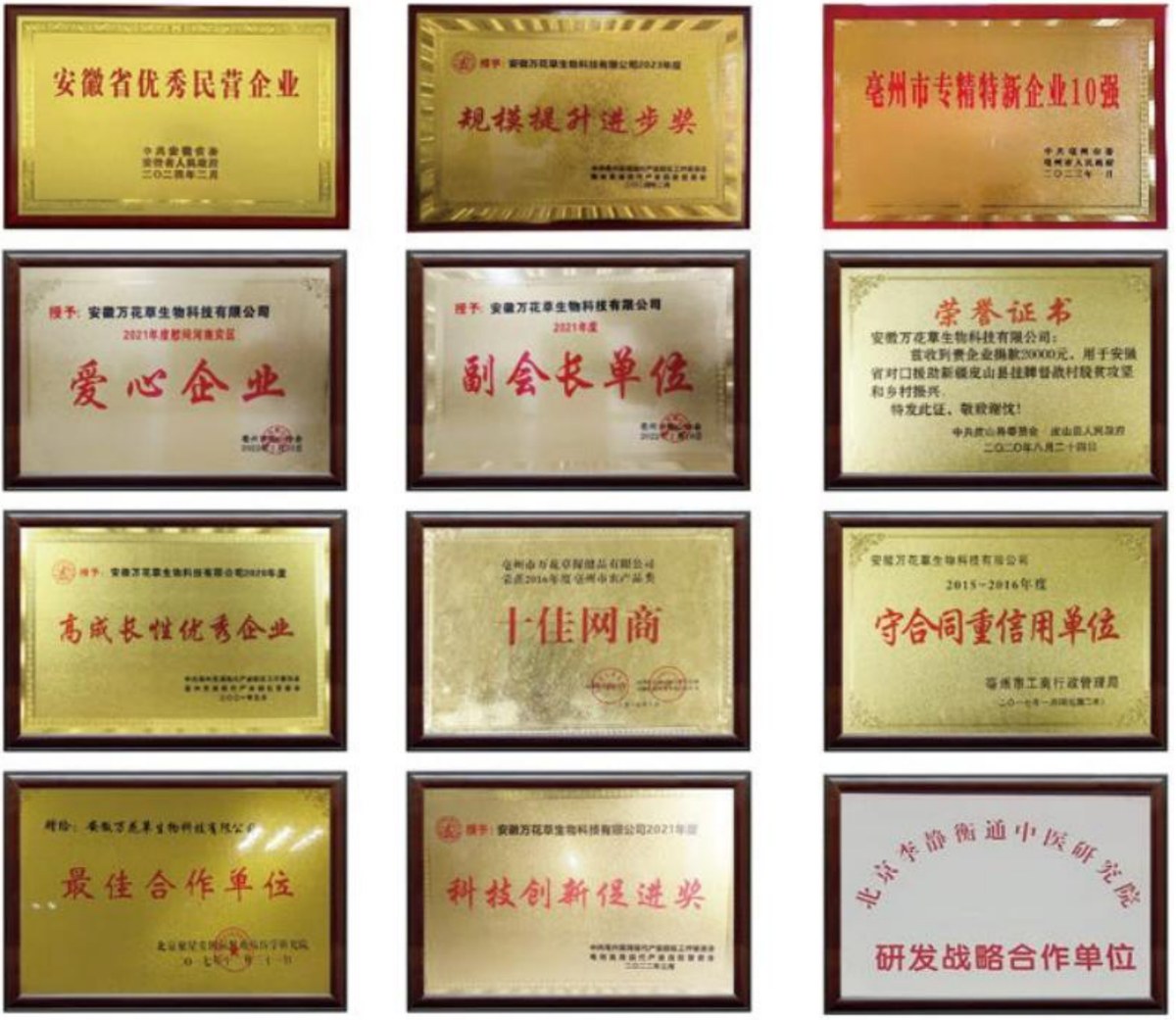
- Anhui Outstanding Private Enterprise. Issued by the provincial government, dated 2022.
- High-Tech Enterprise. A national designation administered through the provincial science and technology department, granted against audited R&D spending, patent count and the share of technical staff. It also changes the company's tax rate, which is why the figures behind it sit in filings rather than in a brochure.
- Provincial Enterprise Technology Centre. Recognition of the in-house R&D body rather than of any product.
- Green Factory. Measured at plant level on energy and water consumption, emissions and land intensity per unit of output. The numbers behind this one are metered.
- Leading enterprise, substitute tea category. The industry designation, and the plate that carries the most weight with a tea buyer.
- Contract credit. A market-regulator record of contract performance, and the closest thing on the wall to a commercial credit reference.
- Bozhou specialised-and-sophisticated top ten, high-growth enterprise, top-ten online seller, science and technology award. City-level plates, which date the company's growth more than they describe it.
What none of them says is whether a particular batch was made right. That is the work of the licence, the SGS certificate and the batch record, and those are in the section above. What the wall does say is that the entity has been examined on things a foreign buyer rarely sees from outside: how much it spends on research, how much energy it uses per tonne of output, and whether its commercial contracts have held up under review.
For a supplier nobody has visited yet, the wall is a usable first filter. It stops filtering as soon as the questions turn specific about a formula, and from there only a sample and an audit say anything.
The people the schedule depends on
The company's line for this is that you do one thing and stay with it for a lifetime. On a floor with twenty-three lines, that turns into something practical: a gummy depositor operator and a tea packer do not swap places on a Monday morning, and the people who can move between formats are the ones who stayed long enough to learn both. Headcount passed 500 in 2020 and now sits near a thousand, which says more about stability than anything printed in a brochure.
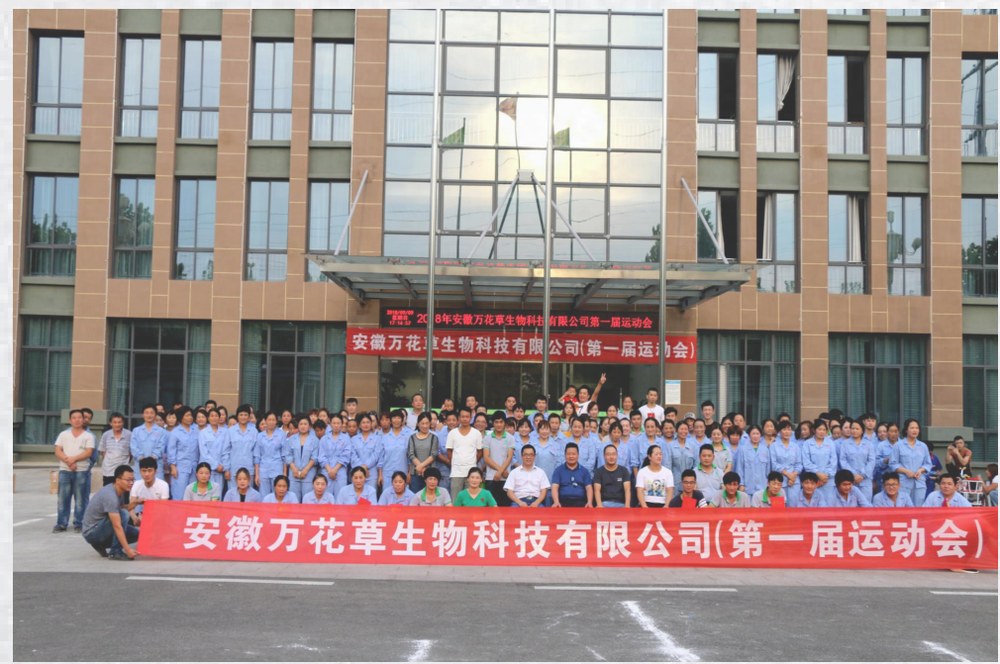
Once a year the plant closes the lanes for an afternoon and runs its own sports meet and skills competition, now in its eighth edition, with box packing and a workplace safety challenge among the events. It is the sort of thing a buyer reads as company culture and a production manager reads as a check on who can still work fast under a clock. The write-up from the November event is on this site.
What a first enquiry should contain
The enquiries that move fastest are short and specific: destination market, product format, fill weight or piece weight, the ingredients and their target levels, pack format, and the volume for a first run. With those six items, a plant can answer on feasibility, tooling and sampling without a meeting.
Send it through the contact page and it lands with the people who run the line rather than a sales inbox. Those six items are usually enough for a first answer on feasibility, tooling and sampling.
Ding Shaohua, Foreign Trade Manager, takes the enquiries that arrive this way. The same person answers on WhatsApp, TikTok, LinkedIn and Facebook, and the sample questions usually arrive by WhatsApp first.
FAQ
Where is the factory, and can a buyer visit it?
Bozhou, in the northwest of Anhui province. Visits are welcome, and the plant escorts them in full: the receiving bay, the workshops, the laboratory and the warehouse, in the order material moves through them.
What are the minimum order quantities?
They are set per line rather than per factory, because the changeover cost differs. Gummy projects start at one tonne, herbal tea at 10,000 bags, capsules and softgels at 100,000 pieces, and botanical extraction at one tonne of raw material. Tablets and powders are quoted by weight once the formula is fixed.
Which certificates can a buyer's QA team see?
The food production licence, the SGS food-grade GMP certificate, ISO 22000, ISO 9001, ISO 14001, ISO 45001, HACCP, the BRCGS audit report, the HALAL certificate and FDA registration documentation. Each comes with its scope and validity dates, since a certificate that does not name your product category is of limited use in an audit.
Does the plant make finished retail products, or only bulk?
Both. Finished goods leave in bottles, pouches, sachets, cartons and gift sets, with packaging design and artwork handled in-house, and the same lines also ship bulk for brands that fill elsewhere. Warehouse space is large enough that finished stock can be held and released in waves rather than shipped the week it is made.