
The line is running a vegan omega-3 gummy. The label says plant-based, the softgel on the same shelf says 500 mg of fish oil, and the brief says 250 mg of DHA per piece. Between the brief and the depositor, one of those numbers has to move, and it is almost never the depositor.
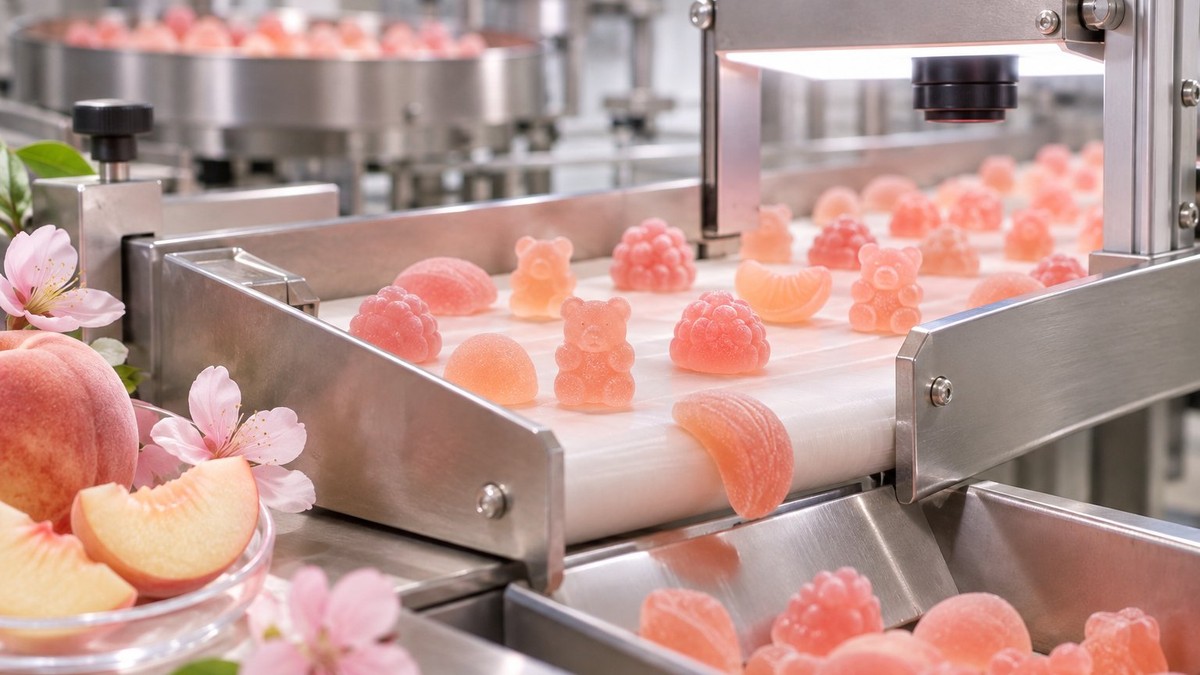
Three grams is the working weight of a gummy. Everything else in this article is downstream of that figure: the grade of algal powder bought, the number of pieces in a daily dose, whether the pack can carry a DHA claim at all, and what the piece smells like eight months after it was made.
The powder is the product, not the oil
Nobody deposits algal oil into a gummy. The oil goes in as a microencapsulated powder, and the powder is what the formula is actually built around.
A spray-dried algal powder is roughly one part oil to two or three parts wall material. At a 20 per cent DHA grade, the particle is about 20 per cent DHA and 80 per cent carrier — modified starch, maltodextrin, gum arabic, sometimes a protein. The carrier is not filler in the pejorative sense. It is what turns a liquid that would collapse a gel network into a free-flowing solid that can be weighed, blended and deposited.
Grades on the market run 10, 20, 30 and 40 per cent DHA, with 10 and 20 per cent the common ones and 40 per cent the premium end. The oil itself, before encapsulation, sits around 40 to 55 per cent DHA depending on the strain — *Schizochytrium* sp. is the usual fermentation organism, with *Crypthecodinium cohnii* and *Ulkenia* also used. Algal oil is naturally low in EPA, typically under 5 per cent, which matters later when the claim wording is chosen.
Two numbers on the specification sheet do the real work in a gummy: the assay, and the surface oil. Surface oil is the fraction of oil that did not get encapsulated and sits on the outside of the particle. It is the fraction that oxidises first and the fraction that tastes of fish. A tight spec is 1 per cent or below; 3 per cent is a loose one and will show up in the finished piece.
The arithmetic that decides the serving size
Take a three gram piece with a realistic powder load of 12 per cent. That is 360 mg of powder in one gummy. Not 1.2 g, not 2 g. Above roughly 15 per cent the powder starts to dull the texture and the piece stops reading as a gummy.
Now run the same 360 mg through the grades:
- 10 per cent DHA — 36 mg per piece. Seven pieces to reach 250 mg. No one ships this.
- 20 per cent DHA — 72 mg per piece. Three and a half pieces, so the label reads three or four a day.
- 30 per cent DHA — 108 mg per piece. Two and a bit, so two pieces cover 216 mg and the claim needs a third.
- 40 per cent DHA — 144 mg per piece. Two pieces reach 288 mg and the 250 mg condition is met.
That is the whole design decision. The powder grade sets the daily piece count, and the piece count sets the bottle size, the sugar per day and the price the buyer sees. A brand that has already committed to "two gummies a day" on the artwork has also committed to a 40 per cent grade, whether or not the purchasing team knows it yet.
The reverse also holds. A 20 per cent grade with a four-piece serving delivers 288 mg of DHA for 12 grams of gummy, which is around 40 kcal from sugar before anything else is counted. That is a legitimate product. It is also a different product from the one the brief described.
Where the vegan claim goes missing
Algal oil is vegan. The powder may not be.
Some 10 per cent grades in the market are built on lactose and whey protein powder as the wall and carrier system, with sodium caseinate appearing in others. Those are perfectly good powders for a general supplement and completely wrong for a product whose front panel says plant-based. The carrier is roughly 80 per cent of the particle, so it dominates what the piece is made of.
This is not a labelling technicality that can be waved through. A vegan claim that fails on the carrier is a claim that fails on the largest single ingredient in the formula.
The fix is a specification line, not a formulation trick: the powder must be declared as carrier-free of dairy and gelatin, with the wall material named on the specification. Modified starch, maltodextrin and gum arabic are the usual vegan-compatible systems. Gum arabic is the better of the three for encapsulation quality and the more expensive; modified starch is the workhorse.
There is a second vegan question in a gummy that has nothing to do with the powder. Gelatin is still the cheapest gelling system and the one that tolerates a high solids load best. A pectin or starch gummy will hold the powder, but it will not hold it at the same loading, which loops back to the arithmetic above.
Ninety degrees at the depositor
A pectin or gelatin gummy is deposited hot, usually somewhere between 90 and 95 °C at the nozzle. The algal powder is not designed for that.
The wall material softens as it heats. Some of it ruptures. Surface oil rises, and surface oil is the part that oxidises. A powder that arrived with a peroxide value of 2 meq/kg can come out of the depositor with a measurably higher one, and the change is not visible on the line. It shows up as a smell six months later.
Formulators handle this in three ways, none of them free:
- Late addition. Hold the powder out of the cook and blend it into the syrup after the temperature drops, accepting a shorter window before the mass sets.
- A tougher wall. Pay for a powder with a higher encapsulation efficiency and a heat-tolerant coating, which usually means a higher grade and a higher price.
- A cooler process. Run a starch-moulded or cold-set system where the deposit happens below the point that damages the wall — at the cost of a slower cycle and a different texture.
Whichever route is chosen, the deposit temperature belongs on the batch record next to the assay, because it is the variable that most directly moves the peroxide value between the raw material COA and the finished piece.
Oxidation is a smell before it is a number
DHA has six double bonds. That is what makes it useful and what makes it fragile — it oxidises faster than EPA, which has five, and far faster than the saturated fats the rest of the formula is built on.
The standard markers are peroxide value, anisidine value and TOTOX, the last being twice the peroxide value plus the anisidine value. A common incoming spec is peroxide at or below 5 meq/kg, anisidine at or below 5, TOTOX at or below 15. Those are the numbers on the certificate that arrives with the drum.
They are also, by themselves, weak predictors of what the consumer tastes. Peroxide value measures primary oxidation products, which are transient; as they break down the peroxide value can fall while the anisidine value, which measures the aldehydes, climbs. A powder can pass on peroxide and still be on its way to a fishy piece. That is why the specification has to be read as a pair and why the TOTOX figure exists.
The aldehydes — hexanal, nonanal, and the shorter chain products — are what the nose registers. In a capsule they are released in the stomach. In a gummy they are released in the mouth, at chewing, and there is no capsule shell to delay them. A gummy is a harder format to keep odour-neutral than a softgel, and the flavour system has to be built around a base that is already slightly wrong rather than a neutral one.
Water activity and packaging belong in the same conversation. The powder's stability data was generated in a foil drum, not in the pack the product ships in, and not at the water activity the finished gummy sits at. A clear jar shows the product and lets light in. Light accelerates the same reaction the peroxide value is measuring.
What the claim needs on the pack
The European claim for DHA and brain function, or DHA and vision, requires the food to contain at least 40 mg of DHA per 100 g and per 100 kcal. A three gram gummy at 144 mg DHA per piece sits far above that density threshold, so the density test is not the constraint.
The constraint is the second half of the condition: the consumer has to be told that the beneficial effect is obtained with a daily intake of 250 mg of DHA. That instruction is mandatory on any pack that carries the claim, and it is where the piece count becomes a regulatory matter rather than a marketing one. Two pieces at 40 per cent grade satisfy it. Four pieces at 10 per cent grade would need to be disclosed as such.
The heart claim is worded differently. EPA and DHA together contribute to normal heart function, and the food must be at least a source of omega-3 as defined in Regulation 1924/2006 — 40 mg of EPA plus DHA per 100 g and per 100 kcal for a solid food. Again the density is easy for a gummy; again the 250 mg daily intake has to be stated.
Two further claims, on triglycerides and blood pressure, sit at 2 g and 3 g per day of EPA plus DHA, with a requirement to state that supplementary intake should not exceed 5 g per day. Those are not reachable in a gummy at any sensible piece weight. A product marketed on omega-3 for the heart in the everyday sense is using the 250 mg claim, not the triglyceride one.
Algal oil itself sits comfortably in the food supply in the EU when it comes from the authorised fermentation sources; the strain and the process are part of what a supplier should be able to document, along with the novel food status if the strain is not one of the established ones.
What a 500 kg order settles
A 500 kg batch at three grams a piece is about 166,000 pieces, before losses.
At a 12 per cent powder load that is 60 kg of algal powder for the batch. If the grade is 40 per cent DHA, those 60 kg carry 24 kg of DHA and the batch yields roughly 115,000 two-piece servings. If the grade is 20 per cent, the same 60 kg carries 12 kg of DHA and the servings halve — the batch makes about 83,000 four-piece servings, and the bottle size doubles for the same daily dose.
That is what the purchasing decision actually buys: the same tonnage of powder, half the DHA, twice the pieces per day, twice the bottle, twice the freight per milligram.
The order also has to name the test that will be run on the finished piece, not just the incoming powder. Assay on the finished gummy by GC confirms what survived the deposit; peroxide and anisidine on the extracted oil confirm what the heat did. Running only the incoming COA leaves the two most important numbers in the project unmeasured.
For buyers comparing formats, the functional gummies line is where piece weight, powder load and daily dose are set together, and the testing that supports either arrangement is described under gummy quality control testing. The cure and shelf-life side, which decides how the piece behaves over twelve months in a clear jar, sits under gummy shelf life and stability.
Ding Shaohua, Foreign Trade Manager at WANHUACAO, works with brands and distributors on functional gummy programmes from brief to first shipment, in bulk and in private label, including omega-3 and vegan formulas. The plant operates under SGS CN23/00007035 for gel confectionery and SC11434160205012 covering eight dosage forms, sports nutrition supplements among them. Reach him on WhatsApp, TikTok, LinkedIn and Facebook.
FAQ
Can a gummy deliver 250 mg of DHA in one piece?
Not at three grams. A single piece would need the whole mass to be powder, with no gummy left. One piece reaching 250 mg needs a 6 to 8 gram piece at a 40 per cent grade, which is a chew rather than a gummy and carries the sugar that goes with that weight.
Is algal oil always vegan-friendly in a gummy?
The oil is. The powder may not be. Several 10 per cent grades use lactose, whey protein or sodium caseinate as carrier, and the carrier is most of the particle. The specification has to name the wall material, not just the oil source.
Why does an omega-3 gummy taste fishy when the certificate says the peroxide value is low?
Peroxide value measures primary oxidation products, which fall as they break down into aldehydes. Anisidine value measures those aldehydes, and it is the aldehydes that smell. A powder can pass on peroxide and still be on the way to a fishy piece, so the two numbers have to be read together as TOTOX.
What deposit temperature should be specified?
As low as the gelling system allows. A pectin or gelatin mass is normally deposited between 90 and 95 °C, which softens the powder's wall and raises surface oil. Late addition after the cook, or a cold-set system, keeps more of the encapsulation intact, and the actual temperature belongs on the batch record beside the assay.