
A buyer sends three quotation requests for the same apple cider vinegar gummies: 500 mg per serving, 60-count bottle, US label. Three prices come back, one of them a third of the others. The cheap one looks like a bargain until the label file arrives with "5% Acetic Acid" printed on the front panel, and the question becomes where that number is supposed to come from.
In 2026 two California complaints turned that question into a filing. One against Olly, over Metabolism Gummy Rings. One against Target, over its house-brand apple cider vinegar gummies. Both argue the same thing: the percentage on the front does not survive a lab test on the finished piece. Neither case has been decided. The arithmetic behind them, though, does not depend on a verdict.
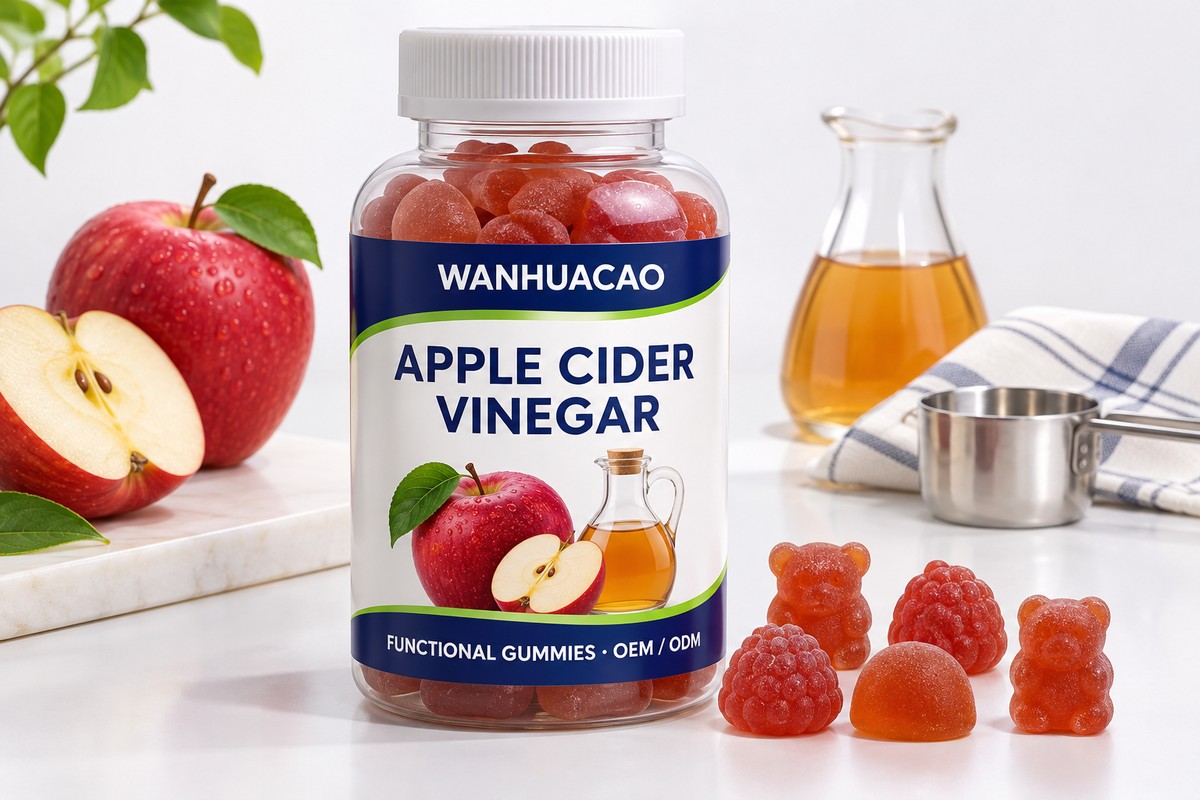
Two complaints, one number
Rodriguez v. Olly Public Benefit Corporation, filed 31 March 2026 in the Southern District of California, reports independent testing at 7.80 mg of acetic acid per gummy and about 2.6% concentration in the piece. The complaint also measures the bottle against a tablespoon of liquid vinegar at roughly 750 mg and arrives at about 1%. On top of that it alleges the gummies are around half sugar by weight, which does not sit well beside a metabolism claim.
Banks v. Target Corp., filed 30 January 2026 in the Northern District of California, is narrower. Up & Up apple cider vinegar gummies are labelled 5% acetic acid. Testing on twelve samples came back under 2.5% on average.
Read both complaints and the disagreement is not about whether vinegar is good for anyone. It is about a number a formulator wrote on a specification sheet, which a designer then set in bold on a front panel, which a laboratory then failed to find in the product.
That chain is worth understanding, because it does not start with bad intent. It starts with two different documents being read as one.
Where the 4% comes from, and where it stops
The 4% that both complaints lean on is real, and it comes from FDA Compliance Policy Guide 525.825. The guide says the vinegars it lists, cider vinegar among them, should contain 4 grams of acetic acid per 100 mL at 20 °C, and that vinegar diluted with water has to be labelled with its actual acid strength, never below 4%.
Read the nouns. The policy is about vinegar: a liquid, sold as vinegar, in a bottle. The number is grams per 100 millilitres. It is not a rule about a gel candy that contains vinegar solids.
Then there is the older piece both complaints reach for, and it is the more interesting one. In 1924 the US Supreme Court held, in United States v. 95 Barrels, More or Less, Alleged Apple Cider Vinegar, that vinegar made from dried apples was not the same article as vinegar made from fresh apples, and that the name could not be used for it. Drying changed the identity of the product.
A century later that reasoning is a ladder. If dried apples cannot make apple cider vinegar, the argument goes, then spray-dried vinegar on a maltodextrin carrier is not apple cider vinegar either, and a gummy built from it cannot borrow the acid strength of the liquid it came from.
Whether a court accepts that chain is unresolved, and no gummy brand should plan around a guess. What is settled is smaller and more useful: the front panel of an apple cider vinegar gummy is a place where a supplier's number and a customer's expectation meet, and nobody in that chain has been checking the division.
The arithmetic that makes 5% impossible
Take an ordinary piece at 2.5 g. That is 2,500 mg of finished gummy, and it has to hold sweetener, gelling agent, water, colour and flavour before anything else.
Five percent of 2,500 mg is 125 mg of acetic acid. Now ask what has to go in to deliver it:
- With 5% powder —— 2,500 mg of powder, which is the entire weight of the piece before a single gram of syrup
- With 8% powder —— about 1,560 mg, or 62% of the piece
- With 10% powder —— about 1,250 mg, or half the piece
- At the 4% floor —— 100 mg of acid, so 2,000 mg of 5% powder, or 80% of the piece
There is no version of that list that produces a gummy. At 40% powder by weight the texture is already a chewable powder tablet, and at 60% it stops being food. So when a front panel offers 5% acetic acid on a 2.5 g piece, one of two things is happening: the piece is not 2.5 g, or the percentage is not about the piece.
Now set the Olly figure beside it. At 7.80 mg per gummy, the powder load works out near 156 mg of 5% powder on a 2.5 g piece, which is about 6% of the weight. That is a number a gummy can carry comfortably. It is also nothing like 5%.
The honest unit for Apple Cider Vinegar Gummies is milligrams per piece or milligrams per serving. It is measurable, it is auditable, and it does not move when someone changes the grade of powder. A percentage of the finished piece sounds stronger and is the harder number to defend, because anyone with a balance and a burette can check it. It is also the number #applecidervinegar videos rarely show, because it is printed nowhere.
What the powder certificate says
Apple cider vinegar powder is spray-dried vinegar on a carrier, most often maltodextrin, sometimes tapioca starch, acacia fibre or cyclodextrin. Suppliers quote it at 5%, 8% or 10% total acidity as acetic acid, verified by titration, or occasionally by HPLC.
The 5% is a property of the powder. In a 5% grade, 95% of what you are buying by weight is carrier and apple solids. That is not a defect; without the carrier the material is a sticky hygroscopic mass that will not flow through a hopper. But it does mean the grade describes the powder, not the product.
Two more details from the certificate matter downstream:
- Moisture —— usually specified at or below 5%, and that water is the difference between a free-flowing powder and a blocked feeder
- Solution pH —— a 1% solution typically lands between 2.5 and 4.5, which is the range the gel system will see once the powder is dissolved into the batch
And one process fact that gets lost. Acetic acid boils at 117.9 °C and is volatile well before that, which is why powder is dried at low temperature, commonly quoted around 40 to 50 °C, to keep the acid in the particle. A gummy cook runs hotter than that. So the acid that enters the kettle is not the acid that leaves the drying tunnel, and the difference is not a fixed percentage anyone can apply as a rule. It has to be measured per formulation, per batch. That is the whole reason the finished-good assay exists.
The acid meets the line
Here is a distinction that changes how a factory is judged. A gummy line does not pump liquid vinegar. It handles powder, and dry acid powder is not aggressive in the way a 5% vinegar solution is. Equipment life is not the main risk.
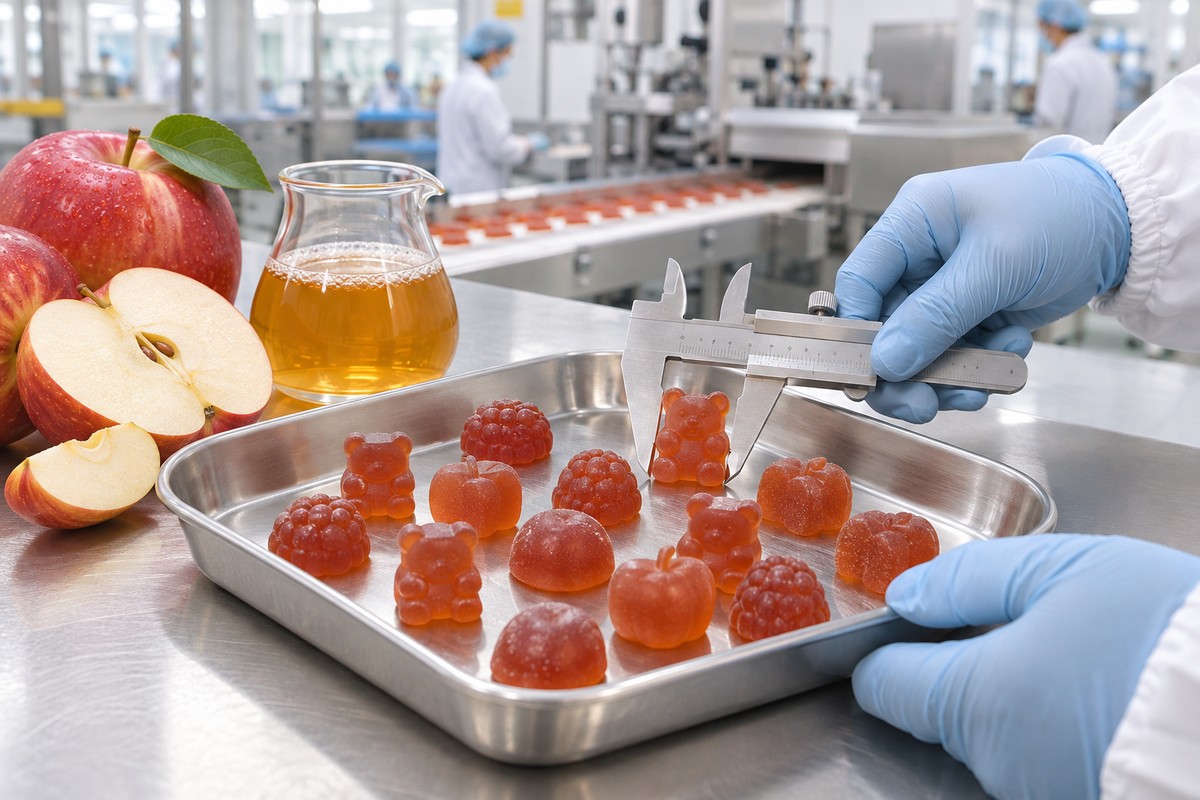
The risk appears where the powder picks up moisture. A damp acid film on a warm stainless surface is far more concentrated than the product ever is, and it sits exactly where nobody looks: under a gasket, in a weld that was not dressed, on the inside of a dust collection duct, on the shelf of a hopper that only sees powder during a changeover.
Three zones carry most of it:
- Dosing and dust extraction —— acid dust plus ambient humidity plus a surface that only gets wiped, not washed
- Cooker and holding sections —— hot, slow-moving, and full of dead legs where a film can concentrate for hours
- Cleaning —— the step where most corrosion actually begins, not during production
On material, 304 stainless is the default across food equipment and handles mildly acidic product at ambient temperature well, provided the surface is clean and passive. Its weakness is chloride. Pitting and crevice corrosion start where chlorinated sanitiser, salt or a stagnant acidic film is held against the surface, and chloride stress corrosion cracking becomes a real risk once chlorides meet elevated temperature. Grade 316L carries 2 to 3% molybdenum, which raises pitting resistance, and its low carbon stops chromium carbide precipitation at welds so the heat-affected zone is not left as a corrosion path.
Corrosion rate roughly doubles for every 10 °C, which puts the cooker at the top of the list, not the packing line.
The design details matter as much as the grade. Internal contact surfaces are usually specified to about Ra 0.8 µm; welds are ground flush and blended; drains sit at the lowest point; there are no dead legs; gaskets are chosen so they do not create a shielded gap. New and repaired surfaces are passivated before they see product. A line built to those rules outlasts a line built from the right alloy and the wrong geometry, and the second failure is far more common.
Metal migration is a release test, not a maintenance item
The reason to care about the alloy is not the price of a replacement nozzle. It is that a corroded contact surface puts metal into the product.
China regulates food-contact metal materials under GB 4806.9. Europe works through framework Regulation EC 1935/2004 with the material-specific measures beneath it. The US treats food-contact substances under the Food Contact Notification system. None of them approve an alloy in the abstract; they govern a finished article, its surface, and what migrates out of it.
So the test that belongs on a release sheet is migration from the finished contact surface, not a certificate that names a grade. A supplier who can name the alloy but not the migration result has answered the easy half.
This is also where an acid product earns its reputation in a plant. The same property that makes the powder useful, a low pH in solution, is what makes it unforgiving of a scratched surface or a weld that was ground and never repassivated.
The gel has to hold at pH 3
Pectin and gelatin both work in this category, and the choice decides which process window the batch lives in.
Gelatin sets by hydrogen bonding as the mass cools, and those protein chains are vulnerable to acid hydrolysis. Hold a gelatin batch hot at low pH and the chains shorten; the network that forms afterwards is weak, and the piece ends up soft or weeping. The damage happens in the kettle and cannot be inspected out later.
Pectin runs the other way. High-methoxyl pectin needs acid to set and needs sugar solids beside it, so it gels in a narrow band, commonly pH 3.2 to 3.6 depending on grade. Miss low and the batch sets early and turns grainy. Miss high and it never sets.
For an acid product the pectin route is the natural fit and carries the vegan and halal positioning much of this category wants, at the cost of a shorter bite and a tighter processing window. The full comparison, dose arithmetic and pH targets sit in our earlier piece on apple cider vinegar gummies; what belongs here is the interaction. Acid, heat and time act together, and a formulation validated at 20 minutes of hold is not validated at 50.
What an ODM quote should contain
This is where the abbreviation matters, because buyers use OEM and ODM as if they were the same relationship.
OEM means the brand brings the formula and the specification and the factory builds to them. The formula is the brand's asset, and so is the risk attached to it. ODM means the factory brings a formula from its own library, the brand chooses and adapts it, and the factory is the party that already knows how that formula behaves on its own equipment.
That difference decides who carries the assay. In a category where the disputed number is a test result, an ODM supplement manufacturer is valuable for one specific reason: it should already know what its own formula delivers in milligrams per piece, because it has made it before and tested it.
Five questions separate a real ODM answer from a price:
- Which formula number is this, and how many batches of it have run
- Which markets has it been sold into, and under what label wording
- How is the acetic acid measured, by titration or by HPLC, and on powder or on finished goods
- What does the finished piece assay at, in mg per gummy, on the last three batches
- Who signs the deviation, if a batch lands outside the declared range
A quotation that answers price and lead time but not those five is quoting a confectionery job. That is the whole distance between a factory that can run a depositor and an ODM supplement manufacturer that has already answered the question for its own product. The plant here runs 23 production lines at a capacity around 1.6 billion gummies a year, with servo-driven depositing and in-line drying, and holds a formula library of more than 10,000 alongside 56 patents and joint research programmes with two universities. The 3,000 m² laboratory, staffed by more than 50 people running over 2,000 test items, is the part that makes the fifth question answerable. A lab that can assay a batch is what turns "our powder is 5%" into "this piece carries 42 mg."
#applecidervinegar is a brief, not a keyword
#applecidervinegar has been running for years, and what it shows has changed twice.
The first wave was the shot. Scroll #applecidervinegar back far enough and the results settle into one scene: a tablespoon in water, first thing, face camera, no pleasure in it. That is the behaviour the gummy format was built to replace, and it is why the category exists at all. The second wave is the comparison video, gummy against capsule against liquid, with the bottle turned to show the front panel. That wave is the reason a percentage ended up in bold type on so many labels, and the reason #applecidervinegar now shows packaging as often as it shows a face.
#applecidervinegar has a third layer now, and it is the one a brand should think about before approving artwork. A Netflix drama titled Apple Cider Vinegar tells the story of a wellness influencer who claimed a diet cured her cancer. It concerns no brand and no supplement. It concerns the shape of a promise, and it arrived in the same period as the California complaints. The hashtag now carries a caution as well as a habit.
What the term does to a product brief is concrete:
- Colour —— deep amber through red-orange, opaque. A pale or clear piece does not read as vinegar in a photograph
- Shape —— apple, bear, disc. The apple silhouette is the most photographed and the hardest to demould cleanly at high speed
- Count and pack —— 60 and 90 count bottles dominate, with stick packs and single-serve sachets growing on the subscription side
- What the video needs —— a front panel that survives being zoomed in on, which is a design constraint before it is a compliance one
Trend terms expire. The shot went out of fashion once already. The division that decides whether a piece carries 8 mg or 42 mg does not expire, and #applecidervinegar will keep sending buyers who eventually open the bottle and count.
Put the number in the contract
Three things in this category have caused real damage recently, and only one of them was about acid.
In 2023 Nutracap Holdings recalled Goli apple cider vinegar gummies over potential microbial contamination. In 2024 PartyGuru recalled an apple cider vinegar and super greens gummy for an undeclared milk allergen. In 2026 the Philippines FDA issued a public health warning against an unregistered apple cider vinegar gummy brand. Three different failure modes, one common feature: by the time any of them surfaced, the batch was already in consumers' hands.
A specification that closes the acid question looks like this:
- Declared as mg of acetic acid per gummy and per serving, with the analytical method named
- Titratable acidity and acetic acid assay on every batch, powder and finished good, with the sampling plan written down
- A stated tolerance band, and a stated consequence when a batch falls outside it
- Water activity on the finished good, since acid load and surface moisture together decide whether a bottle blocks in a warehouse
- Migration testing on the contact surfaces, not just a material certificate
- A named party responsible for a recall decision, agreed before the first purchase order
None of that is exotic. All of it is cheaper than a class action, and all of it can be settled before a deposit, which is the only point at which it costs nothing.
Demand for Apple Cider Vinegar Gummies is not the constraint, and neither is the number of factories willing to quote one. What the category lacks is ODM supplement manufacturers who will put a measured number on the table and stand behind it, and buyers who ask for one. For brands working through the format question alongside the acid question, the wider range sits on the functional gummies page, the batch testing regime is described under gummy quality control, and the labelling side of crossing a border is covered in candy import regulations.
Ding Shaohua, Foreign Trade Manager at WANHUACAO, works with brands and distributors on apple cider vinegar and functional gummy programmes from brief to first shipment. The plant operates under SGS CN23/00007035 for gelatine confectionery and SC11434160205012 covering eight dosage forms. Reach him on WhatsApp, TikTok, LinkedIn and Facebook.
Frequently asked questions
How much acetic acid can a gummy actually hold?
At a 2.5 g piece, the practical ceiling is set by how much powder the texture will tolerate. A powder load around 6% of the piece weight is comfortable and delivers roughly 8 mg of acid from a 5% grade. Pushing to 25% powder by weight gets you near 30 mg and the chew has already changed. Anything advertised above that on a 2 to 3 g piece is worth asking about in writing.
Can the front panel say 5% acetic acid?
It can say what the finished product assays at, and that has to be measured on the piece. The 5% that appears on a powder certificate of analysis describes the powder, on a carrier, before it goes into a cook. Carrying it to the front panel turns a raw material grade into a finished-product claim, which is exactly the gap the 2026 complaints describe. Milligrams per gummy is the safer unit and the harder one to dispute.
Do apple cider vinegar gummies still contain the mother?
Spray-dried vinegar does not preserve a live culture. The bacterial and protein fraction that the category markets as the mother does not survive drying, and it certainly does not survive a cook at syrup temperature. A gummy made from powder contains vinegar solids on a carrier. Brands that want the phrase on the label need an ingredient that supports it, and the reformulation work that follows from using a liquid or non-dried concentrate.
What is the practical difference between OEM and ODM for this product?
With OEM, the brand owns the formula and the assay is the brand's problem. With ODM, the factory's formula library is the starting point, so the factory should be able to state what its own formula delivers in mg per piece across previous batches, and which markets it has already shipped into. For an acid product, that history is worth more than a lower unit price, because it is the only thing that predicts what the laboratory will find. That, and not the ability to pour a depositor, is what a buyer is paying an ODM supplement manufacturer for.