
Three physical facts decide whether berberine can be a gummy, and none of them is about efficacy. It tastes bitter at the dose required. It is a dye. And it is taken in grams, not milligrams.
A brief that ignores those three will produce a good looking sample, a bad tasting piece, and a specification that a factory cannot hold across a production run. The regulatory question then arrives on top, and in 2026 it arrived with a date on it.
400 mg is the number, and it is short of the trial dose
The clinical literature on berberine sits around 500 mg two or three times a day, which is 1 to 1.5 g daily. Most trials that report glycaemic outcomes used that range for eight to twelve weeks.
Gummies on the market carry less. A common configuration is 400 mg of berberine hydrochloride plus 200 mg of apple cider vinegar per serving, sugar free, with cinnamon and chromium alongside. Another sells a 2,000 mg "1:1 blend" per serving, which is 1,000 mg of berberine and 1,000 mg of Ceylon cinnamon.
Both are honest label arithmetic. Neither reaches the trial dose without asking the consumer for three or more pieces a day. That is the commercial decision sitting under the formula: a piece that carries 500 mg is 12.5 per cent active in a four gram gummy, and three of those is 1.5 g of a bitter yellow powder per day. A piece that carries 200 mg is easy to make and needs five a day to reach the same place, which no one does.
Bitterness does not scale with the claim
Berberine is a quaternary ammonium alkaloid, and it tastes bitter at concentrations far below the therapeutic one. In a chew there is nowhere for the taste to go.
Sugar rounds bitterness, which is why a sucrose based gummy is easier than a sugar free one. A polyol syrup is sweet but thin, and it leaves the alkaloid standing on its own at the back of the throat. The usual answer, a heavy flavour load of berry or citrus, does not remove the bitterness; it competes with it, and the competition gets lost at 400 mg. A sour mask at pH 3.3 works better than a sweet one, because acid shifts the perceived onset and gives the tongue something else to report.
The technical answer is a coating. A piece can be built with a seal coat and a finishing coat that keeps the active away from the tongue for the first two seconds, which is where most of the bitter perception happens. That is a depositing and panning decision, not a flavour decision, and it changes the piece weight, the cure and the cost. The range of options is set out under gummy coating technologies.
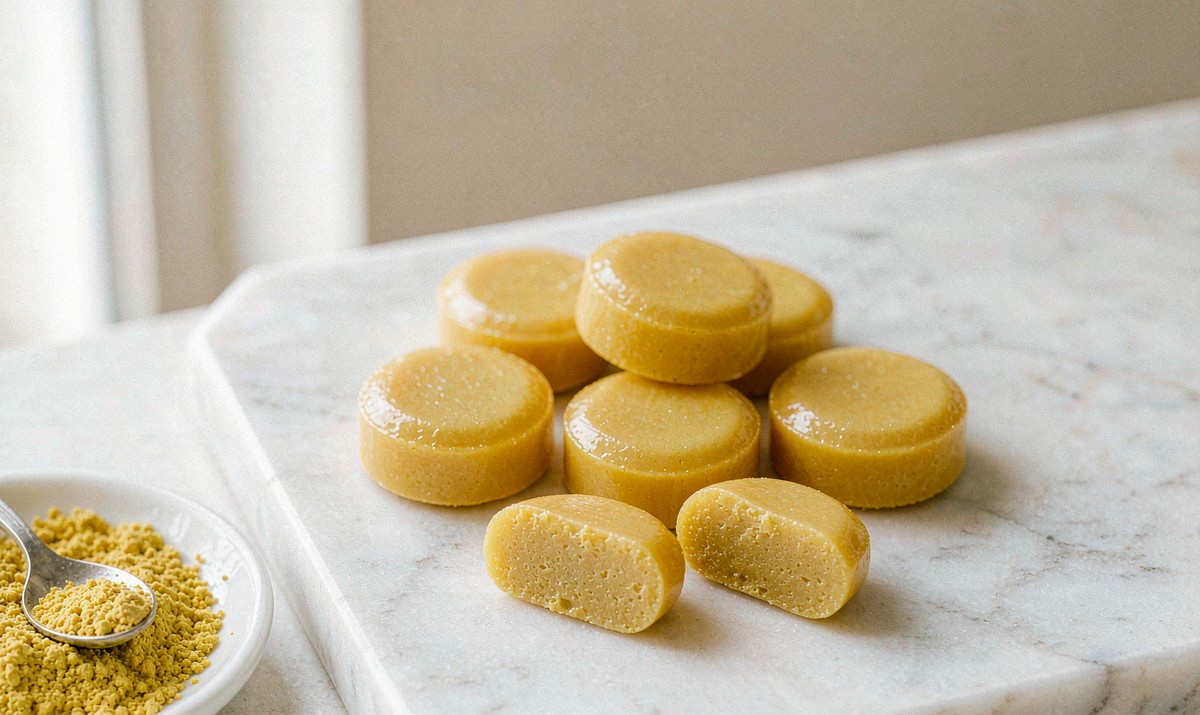
The form of the ingredient matters as much. Berberine hydrochloride is the cheap, bitter, poorly absorbed salt. A phytosome, a phospholipid complex, carries the alkaloid at a lower dose for the same plasma exposure, which reduces the bitterness problem by reducing the grams. Dihydroberberine is a different substance with its own absorption profile and its own regulatory position; it is not interchangeable with the salt on a specification sheet.
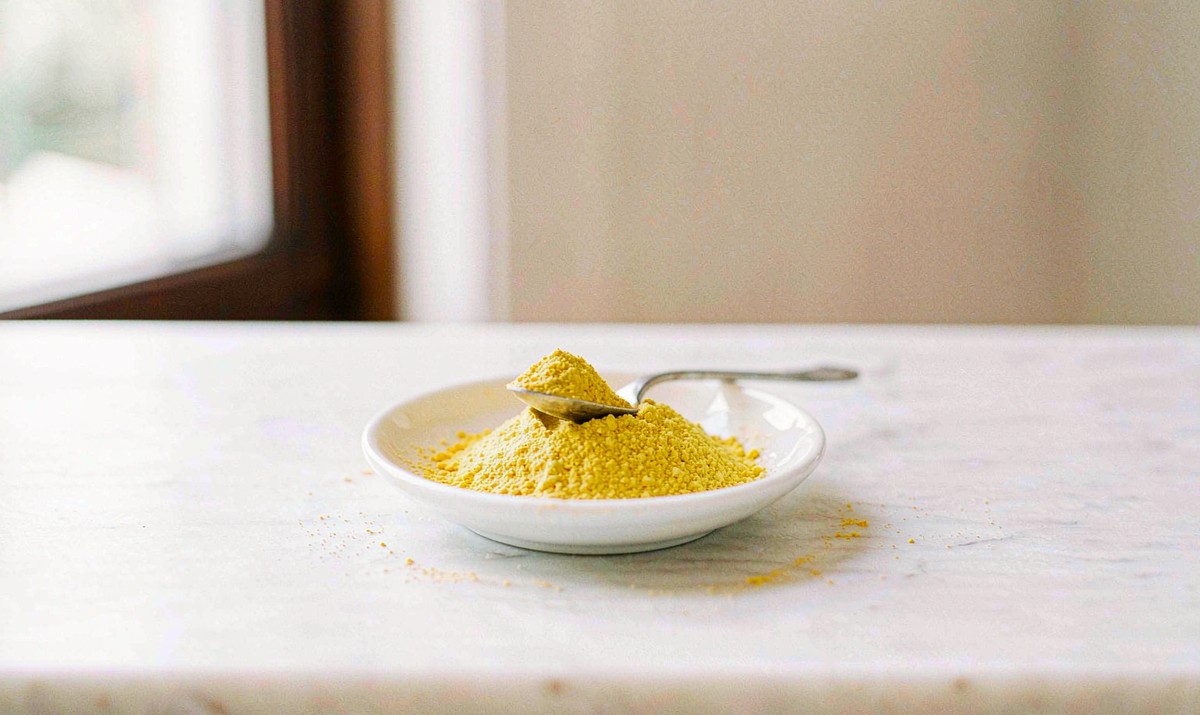
Yellow is the ingredient, not a colour you added
The powder is bright yellow and it colours whatever it touches. A gummy made with 400 mg of it is yellow without any colour being added, and "no artificial colours" on that pack is true.
That has three consequences the brief rarely anticipates. The first is the flavour story: a bright yellow piece reads as citrus, ginger or turmeric to a consumer, and a mixed berry flavour in a yellow piece creates a mismatch that no copy can fix. Formulations that work tend to lean into it, with lemon, ginger or orange.
The second is the plant. A yellow powder that stains is a changeover problem. It marks the depositor hopper, the transfer line, the scraper and the operator's gloves, and a rinse that satisfies a colour check on a white vitamin gummy will not satisfy one after this. Cleaning validation has to be written for a dye, not for a vitamin.
The third is lot to lot. Berberine content in a botanical extract varies, and the piece colour follows it, so a specification that holds the assay within a range will still produce a visible shade difference between lots. Either the colour is standardised on the extract, or a small amount of a permitted colour is added to bring lots into line. Both are defensible. Doing neither produces a complaint about batch variation that looks like a quality failure and is really a specification gap. Extract handling is covered under botanical extract powder caking.
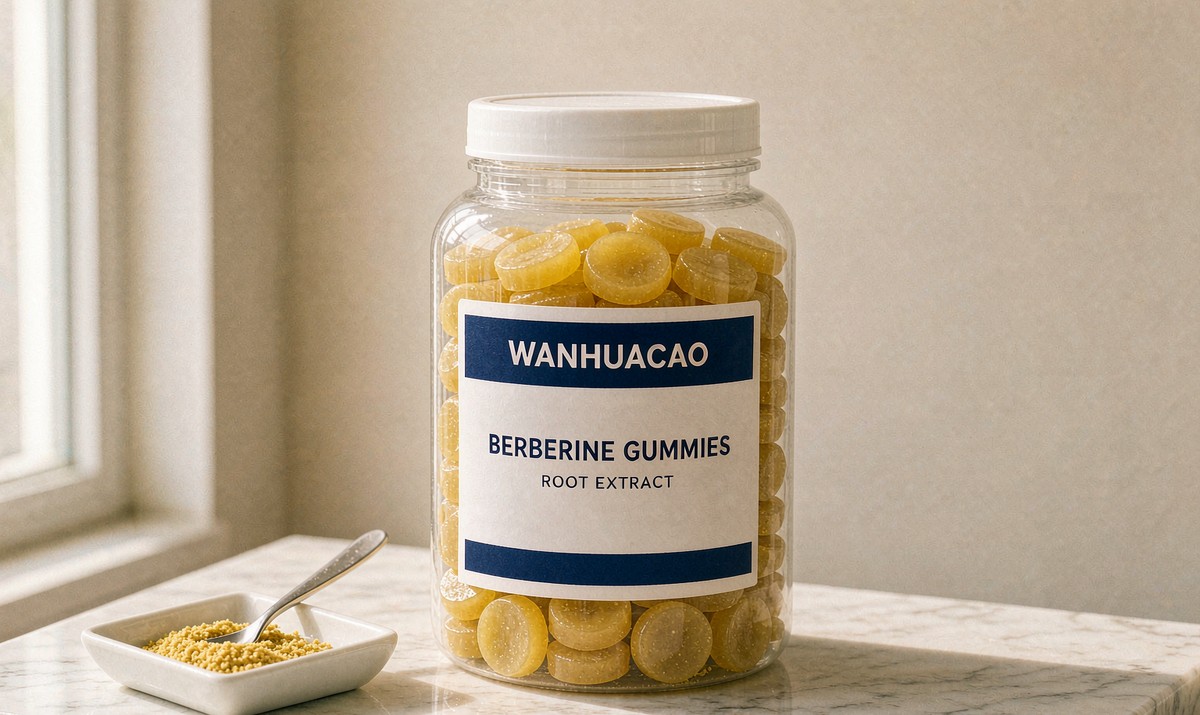
Almost none of it arrives
Berberine is poorly absorbed, and the reasons are known: it self-aggregates in the gut, it is a substrate for P-glycoprotein efflux, and what is absorbed undergoes hepatobiliary re-excretion. In a rat intestinal perfusion model less than 5 per cent crossed in two and a half hours, and blocking P-glycoprotein raised that six fold.
This is where a gummy cannot help. A gel matrix has no mechanism for improving permeability, and it has no way to hold a vesicle or a nanoparticle in a stable form through a twelve month shelf life. A chew can carry the dose honestly and it can make the dose pleasant to take. It cannot make the molecule absorb better.
So the honest claim for a gummy is about the format, not the pharmacokinetics: a fixed daily dose the consumer will finish, in a piece that does not taste like a medicine. Brands that push the front panel toward absorption are making a promise the format cannot keep, and it is the sort of promise a competitor's lab can test.
Piece count is where the price sits
A berberine product is sold by the bottle and bought by the gram, and the two numbers are not the same number.
At the trial dose of 1.5 g a day and 400 mg per piece, a consumer needs four pieces a day. A 60 count bottle lasts fifteen days. At three pieces with a 500 mg piece, the same bottle lasts twenty days. At one piece a day, which is what most labels instruct, the bottle lasts two months and delivers 400 mg a day, which is a third of what the trials used.
Whichever version a brand chooses, the box carries the same front panel and roughly the same retail price. That gap is the whole marketing problem of this ingredient, and and the flavour does not settle it.
It also decides the freight. Three pieces a day of a four gram gummy is 360 g a month, and a thirty day supply weighs 360 g before packaging, against 45 g for the same number of days in 500 mg capsules. A pallet of berberine gummies carries a tenth of the days of supplementation that the same pallet of capsules carries, and the landed cost per day reflects it.
The regulatory wall moved in 2026
The European Commission asked EFSA in June 2022, under Article 8(2) of Regulation (EC) No 1925/2006, to review whether preparations from berberine-containing plants could be linked to harmful effects and to advise on a daily intake that does not give rise to concern.
EFSA's nutrition panel endorsed a draft opinion on 29 January 2026. Its conclusion was that no safe intake could be established for any of the thirteen plant preparations assessed, citing in vitro signals for gene mutation and chromosomal damage, liver adenomas in rodents for goldenseal, rare liver injury associated with greater celandine, and the absence of repeated-dose toxicity studies that would support a benchmark. Public consultation ran from March into the summer, and the final opinion is not expected before 2027. After that the Commission chooses between prohibition, conditions of use, or continued scrutiny.
Nothing has been banned. What has changed is that the ingredient now carries an open question at Union level, and a brand planning European distribution in 2027 needs to know that before it prints a front panel.
The national layer was already uneven, and a factory quoting a European order should have it on the table. Belgium caps isoquinoline alkaloids expressed as berberine at 10 mg a day under a 1997 royal decree, and Poland applies the same limit. Italy does not authorise goldenseal in supplements. Germany does not recommend bark and root of berberine plants. Serbia, Slovenia and Greece do not authorise them, and Sweden and Hungary hold them on a negative list. France has no maximum, but its agency advised in 2019 that pregnant and breastfeeding women, diabetics, and people with liver or heart disorders avoid these products, extended that to children and adolescents, and stated that above 400 mg a day the effect is pharmacological, which puts the product on the drug side of that line.
A 400 mg gummy is therefore at the French line and forty times the Belgian one. Both facts belong in the same sentence as the market name.
Two more things sit on the label side. Regulation (EU) No 432/2012 contains no permitted claim on GLP-1, appetite or satiety, so the comparison that made this ingredient famous has no lawful wording in Europe. In the United States a structure/function claim is available, but obesity is treated as a disease, which makes a weight-loss claim a disease claim and moves the product toward drug territory. A UK advertising ruling in 2025 went the same way, treating a claim about GLP-1 production as medicinal.
A safety note that belongs in the quotation
Berberine inhibits CYP3A4, CYP2D6 and CYP2C9, and it inhibits P-glycoprotein. In a crossover study in seventeen healthy men, 300 mg three times daily for fourteen days raised midazolam exposure by 37 per cent.
That is a drug interaction profile, and the pack should carry it in the warning block, in the same type size as the directions. For a contract manufacturer it is also a contractual point: a brand that markets this product to people on prescription medication is carrying a risk that no stability study covers, and the label wording is the only control available.
What a list of the best private label companies does not answer
A buyer searching for the best private label supplement companies is usually comparing capacity, certifications and price per piece. Those three are necessary and none of them addresses this ingredient. The tags #contractmanufacturing and #CDMO come from a buyer at a later stage, past the list and asking for a development timeline. On this ingredient the timeline contains a regulatory step, and a plant that answers a timeline question with a capacity figure has not understood the question.
The first question a list cannot answer is who will still be holding the brief when the Commission acts. A plant that has run berberine for years in the United States and has never filed a European novel food position is not lying when it says yes; it simply has not priced the regulatory work. Ask what happens to your purchase order if the outcome is a maximum level.
The second is who signs. The stability study that supports the expiry date, the colour standard for the extract, and the claim wording on the front panel are three different signatures. A list ranks companies, and a project fails at the level of a signature.
The third is whether the line will take the powder at all. A yellow staining alkaloid at 12 per cent loading needs a changeover, a cleaning validation and an operator briefing. Some plants will quote it and run it after a white gummy with a rinse in between. That is the failure mode that shows up in month three as speckled pieces, and it is worth asking for the changeover record before the price.
Where the piece lands
Put the four constraints in one place and the formula writes itself. The dose wants grams. The bitterness caps the grams. The colour fixes the flavour family and the cleaning regime. The regulatory position decides which markets the product can be sold into at all.
A workable brief for a European brand in 2026 looks like a 400 mg piece in a citrus or ginger base, coated, with the national limit for the target market written into the specification, and a label that describes the ingredient without comparing it to a drug. A workable brief for a United States brand looks like the same piece with a structure/function statement and a warning about medication. Neither is a compromise on quality. They are the two products the ingredient supports.
Our functional gummies line runs pectin and gelatin bases on separate depositors, and a berberine batch is scheduled with its own changeover rather than at the end of a light coloured run.
Ding Shaohua, Foreign Trade Manager at WANHUACAO, works with brands and distributors on functional gummy programmes from brief to first shipment, in bulk and in private label, including alkaloid and botanical actives. The plant operates under SGS CN23/00007035 for gel confectionery and SC11434160205012 covering eight dosage forms, sports nutrition supplements among them. Reach him on WhatsApp, TikTok, LinkedIn and Facebook.
FAQ
Can a berberine gummy carry 1,000 mg in one piece?
Not in a four gram piece at a texture anyone would chew. A thousand milligrams is a quarter of the mass, and the sugar or polyol left over cannot form a gel that holds together. Products that advertise that number are quoting a blend weight across a multi piece serving, and the label arithmetic is worth doing before the sample is requested.
Why does a sugar free base make the bitterness worse?
Sucrose rounds the bitter edge as well as sweetening. A polyol syrup sweetens without rounding, so the alkaloid reads more sharply at the same load. Sugar free is achievable, and it usually needs an acid-forward flavour and a seal coat to get there.
Is dihydroberberine a way around the dose problem?
It is a different substance, absorbed differently, with its own regulatory status in each market. It can lower the grams per piece, which lowers the bitterness, and it is not a drop-in substitution on an existing specification.
Does the EFSA draft opinion ban berberine?
No. A draft opinion advises the Commission and does not by itself restrict sale. The final opinion is expected in 2027 and the Commission then decides whether to prohibit, set conditions of use, or keep the substance under scrutiny. National limits, some of them a decade old, apply today.