
The reference intake for calcium in the European Union is 950 mg a day for adults. A three gram gummy that carries 200 mg of the mineral is already two thirds calcium salt by dry weight, and five of those pieces are needed to reach the figure. So the format has a mass problem before it has a marketing problem, and the mass problem is not the interesting one.
The interesting one is that calcium is the only common mineral that reacts with the gummy itself. It sets pectin, it liberates gas from the acid used to mask it, and it sinks in the syrup. Those three facts decide the base, the flavour system and the depositor settings long before anyone discusses the label.
What a piece can physically carry
Calcium is sold as a salt, and the salt is two to eleven times the mass of the mineral inside it. Calcium carbonate is 40 per cent elemental calcium; tricalcium phosphate is around 39; calcium citrate tetrahydrate is 21; calcium lactate pentahydrate 13; calcium gluconate 9.
At 200 mg of elemental calcium that means 500 mg of carbonate, or 950 mg of citrate. In a three gram piece the carbonate version is 17 per cent of the mass and the citrate version is 32 per cent. Neither is a small addition: the calcium salt becomes the largest single ingredient after the syrup solids, and the piece weight is effectively chosen by the salt rather than by the mineral.
The daily figure makes the arithmetic harder. Five pieces at 200 mg reach 1,000 mg, which is the dose, and five pieces are 15 g of confectionery a day. A one-a-day calcium gummy cannot deliver 950 mg in three grams; the most a piece that size holds is somewhere near 200 mg, and even that requires a formula built around the salt.
This is why the calcium shelf is full of products at 120 to 200 mg. A hundred and twenty milligrams is 15 per cent of the reference intake, which is the threshold for the claim that calcium is needed for the maintenance of normal bones. The claim and the bone dose are two different numbers, and the format can reach the first one comfortably and the second one only by multiplying pieces.
Calcium sets pectin, because that is what calcium does
Low-methoxyl pectin gels through calcium bridges between the galacturonic acid chains. It is the standard way to make a pectin gel that does not need high sugar and low pH, and in a calcium gummy it is also the trap: the active ingredient is the gelling agent.
A batch that adds 60 kg of calcium carbonate to a low-methoxyl pectin base is adding a crosslinker at the same time. The syrup starts to build structure in the kettle, before the depositor, and the result is lumps, a short texture, or a gel that sets on the way to the mould. Formulators work around it with a sequestrant that holds the calcium until the piece is in the mould, or by keeping the calcium low enough that the pectin's own calcium allowance covers it, which is one reason the dose lands at 120 to 200 mg rather than at 300.
High-methoxyl pectin avoids the calcium sensitivity but needs a pH below about 3.5 and sugar above 55 per cent to set, and that acid is the second problem.
Gelatin is the base that tolerates the mineral. It has no calcium chemistry, it sets on cooling, and it holds a 15 per cent salt load without complaint. The price is the vegan position, and a calcium gummy that has to be plant-based ends up back at pectin with a sequestrant and a tight calcium budget.
Carbonate in an acid gel produces gas
Calcium carbonate plus acid gives calcium citrate, water and carbon dioxide. In a beaker that is a demonstration; in a depositor it is a defect. The gas forms bubbles that survive into the mould as pinholes, the density of the slurry changes as it de-gasses, and the pH rises as the carbonate is consumed, which moves a pectin system away from its setting window at exactly the moment it needs to be inside it.
The trap is that the acid is there for a reason. Calcium carbonate is chalky, and the usual way to cover chalk is a fruit acid with a strong top note — citric, malic, tartaric. So the ingredient that makes the piece palatable is the ingredient that makes it fizz.
Three routes exist, and each costs something. Use carbonate and keep the formula low-acid, relying on flavour rather than sourness to mask the chalk, which works for a creamy or vanilla profile and poorly for a fruit one. Use calcium citrate, which is already the neutralised salt, and pay in mass: 950 mg of citrate for 200 mg of calcium takes a third of the piece. Or use tricalcium phosphate, which is denser in calcium at 39 per cent and does not generate gas, but is gritty and practically insoluble, so it settles and it reads as sand on the tongue.
Whichever route is taken, the choice has to be made before the flavour brief is written, because the flavour brief is what decides how much acid the formula carries.
The mineral sinks
Calcium carbonate has a density around 2.7 g/cm³. A gummy syrup sits near 1.3. The difference is enough that a carbonate suspension stratifies in a standing hopper within minutes, and a depositor that draws from the bottom of that hopper puts more calcium in the first pieces of a run than in the last.
The fix is mechanical rather than chemical: continuous agitation in the hopper, a level control that keeps the head constant, and a deposit weight check that is frequent enough to catch a drift inside a batch rather than between batches. It is also the reason a calcium gummy needs a per-piece assay and not only a batch assay — a composite sample from ten pieces can pass while the piece-to-piece spread is wide enough to matter to a customer who weighs the product.
Uniformity testing on a filled piece normally covers weight, dimension, water activity and hardness. For a mineral at 15 per cent load, the assay on individual pieces belongs in the same list, and it is run by ICP or by titration on a digested sample rather than by the near-infrared method some lines use for organic actives.
The piece still has to chew at a third salt
A citrate route puts the salt at a third of the mass, and at that load the gel stops behaving like a gel. Elasticity drops, the piece reads hard and short, and hardness keeps climbing through the first two weeks of cure as the network finishes setting. Holding a soft chew at 15 per cent mineral load is a question of gelatin bloom strength, of plasticiser — glycerin with a little sorbitol — and of grinding the salt fine enough that the tongue does not find grit before the flavour arrives.
Sugar-free versions add a labelling constraint to the same piece. Polyols replace the syrup at 60 to 70 per cent of the mass, and under Regulation (EU) 1169/2011 a food with more than 10 per cent added polyols has to carry the statement that excessive consumption may produce laxative effects. At five pieces a day, a sugar-free calcium gummy is a product where that warning is not theoretical, and it belongs in the artwork review rather than in the small print review at the end.
Where the vitamin D goes
The D half of the formula is small enough to disappear into rounding. The reference intake is 5 µg, a source is 15 per cent of that, which is 0.75 µg, and a piece carrying 20 µg is 400 per cent of the reference intake and 800 IU. The tolerable upper level is 100 µg a day, so a 20 or 25 µg piece sits in the middle of the range with room on both sides.
Two forms are used: an oil dilution, which disperses into the fat phase of an emulsified system, and a spray-dried powder at 100,000 IU per gram, which behaves like any other fine powder and is easier to weigh into a small batch. The powder is the usual choice for a gummy because the dose is a few milligrams of powder rather than a millilitre of oil.
The reason the pair is worth putting in one piece is a sentence, not a synergy. Vitamin D contributes to the normal absorption and utilisation of calcium and phosphorus, and that claim sits next to the calcium claims on the same label. Both need only the source threshold, so 120 mg of calcium and 0.75 µg of vitamin D already carry the full set of authorised wording while delivering a fraction of the reference intake. Whether that is honest depends on the portion size printed next to it.
What the pack and the order have to fix
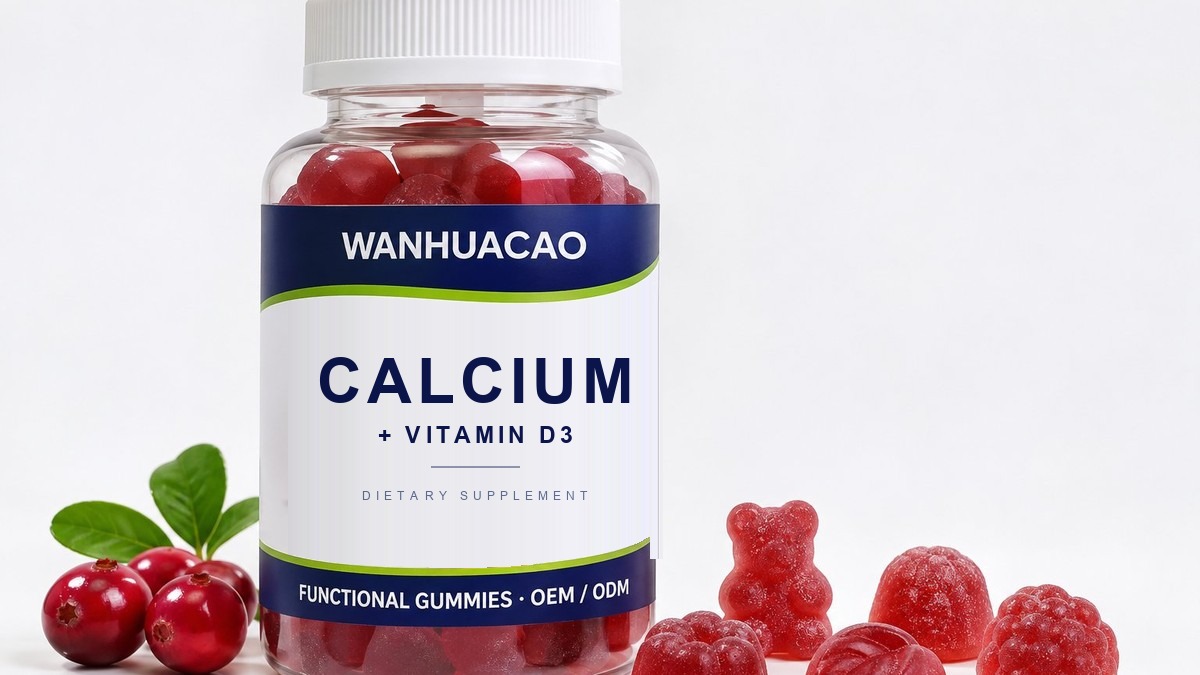
Four numbers decide a calcium project, and all four belong in the artwork and the purchase order rather than in a later email.
The portion, because everything else is expressed against it. The elemental calcium per portion and the salt it comes from, because the salt is what the customer is actually buying and what the label's ingredient list will name. The percentage of the reference intake, because that is the number a buyer compares across shelves and the number that decides whether the claim is available at all. And the form of the vitamin D, because a powder and an oil are not interchangeable in a depositor.
On a 500 kg batch of three gram pieces, 150 mg of calcium per piece takes 25 kg of elemental calcium, which is 62.5 kg of calcium carbonate, or 119 kg of citrate. The difference between those two figures is a truck, a warehouse slot and a cost line, and it is decided by the acid question rather than by the mineral.
The tags that bring this kind of enquiry, #B2BManufacturing and #ManufacturingPartner, describe two different relationships with the same plant. A manufacturing partner is told the formula and asked to run it; the plant's job is to hold the deposit weight, the assay and the water activity. A partner in the fuller sense is asked which of the three salt routes will survive the flavour brief, and answers before the first batch rather than after. The testing that supports either arrangement is the same, and is described under gummy quality control testing; the cure and shelf-life side sits under gummy shelf life and stability.
For buyers comparing formats, the functional gummies line is where the piece weight and the mineral load are set together.
Ding Shaohua, Foreign Trade Manager at WANHUACAO, works with brands and distributors on functional gummy programmes from brief to first shipment, in bulk and in private label, including mineral and vitamin formulas. The plant operates under SGS CN23/00007035 for gel confectionery and SC11434160205012 covering eight dosage forms, sports nutrition supplements among them. Reach him on WhatsApp, TikTok, LinkedIn and Facebook.
FAQ
How much calcium can one gummy hold?
Around 200 mg of elemental calcium in a three gram piece, which is 500 mg of calcium carbonate or 950 mg of calcium citrate. The salt, not the mineral, is what fills the piece, and five pieces are needed to reach the 950 mg reference intake for adults.
Why are most calcium gummies only 120 mg?
Because 120 mg is 15 per cent of the reference intake, the threshold for the authorised claim that calcium is needed for the maintenance of normal bones. It is a legal number rather than a nutritional one, and the portion size on the label is what reconciles the two.
Why not use pectin for a calcium gummy?
Pectin can be used, but low-methoxyl pectin gels through calcium bridges, so the active ingredient also acts as the gelling agent and the batch can set in the kettle. It is managed with a sequestrant and a calcium budget, or avoided by moving to a gelatin base, which costs the vegan position.
Does the vitamin D change the formula much?
At 20 µg the vitamin is a few milligrams of spray-dried powder, so the mass is negligible. What it changes is the claim set: vitamin D contributes to the normal absorption and utilisation of calcium and phosphorus, and that sentence is the reason the two nutrients share a piece.