
The specification comes back from the laboratory with a number on it. Collagen, 2.4 g per serving. The brand reads it as confirmation that the peptide it paid for is in the piece.
Then someone asks the question that should have come first. What is the gummy set with?
Gelatine. Which is collagen. Which means the assay has just counted the thing holding the sweet together as part of the ingredient being claimed. The 2.4 g is real, measurable, and partly a reading of the matrix.
No one is being cheated here. It is a property of the format, and it sits underneath every Collagen + Biotin Beauty Gummies brief that arrives without a base decision attached to it. The number on the certificate is only as specific as the method behind it, and in a gelatine gummy the method cannot tell the ingredient from the furniture.
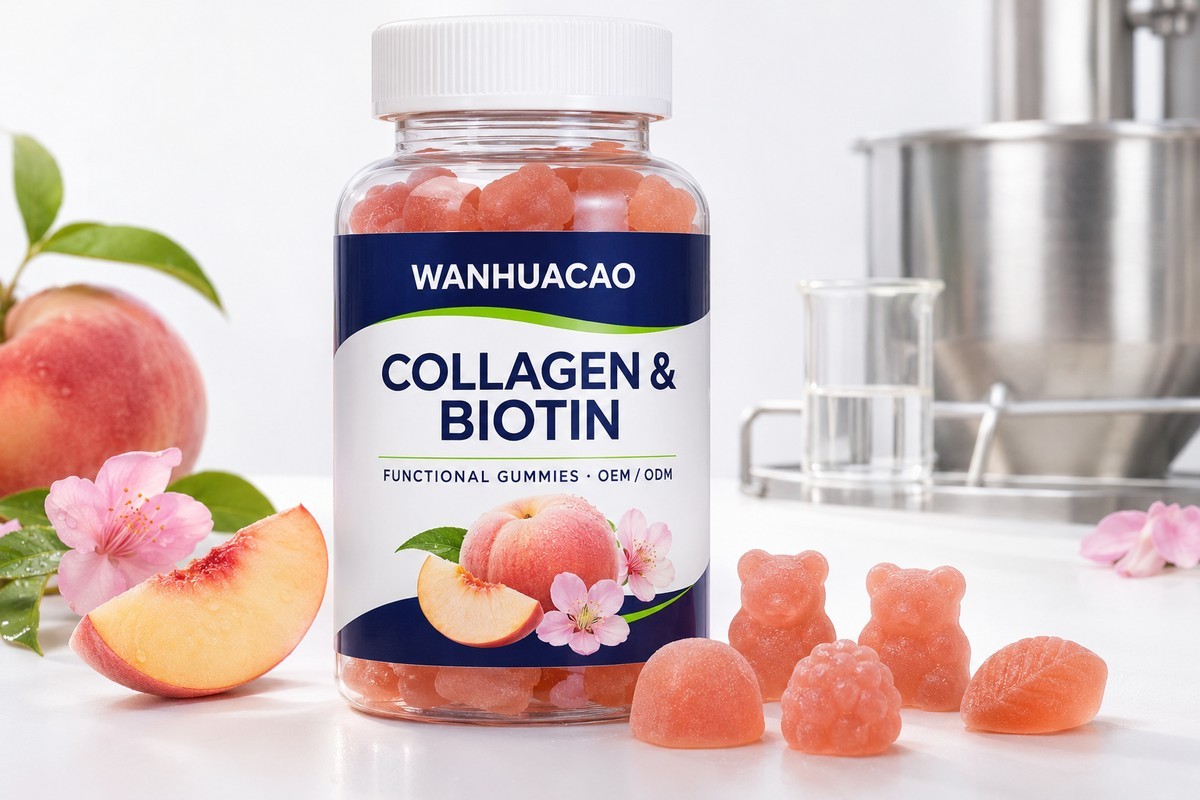
The test reads the base as an ingredient
Collagen has no single molecule to measure, so the industry measures a marker. Hydroxyproline is an amino acid formed after collagen is built, and it turns up in almost nothing else people eat: around 13.5% of mammalian collagen, 9 to 13% of a hydrolysed peptide, and under 0.5% of whey, soy or pea protein. Multiply the hydroxyproline result by eight and you have collagen content. That is the basis of AOAC 990.26 and ISO 3496, and it is a good method.
It is good at answering one question: how much collagen-type protein is in this sample. It is silent on a different question: whose.
Gelatine is collagen that has been cooked. It contains hydroxyproline at roughly the same rate as the peptide you bought. So in a gelatine gummy, the total hydroxyproline signal has two contributors, and a colorimetric read at 558 nm does not separate them.
Put numbers on it. A 4 g gummy at 7% gelatine carries about 280 mg of collagen-derived protein from the gel alone. Against a 2.5 g peptide claim, that is 11% of the reported figure arriving from the base. Published industry ranges put the same effect at 10 to 15% depending on formula and serving size.
Two ways out, and both cost something:
- Report the whole number as peptide. The label is then overstated by the share that came from the gel, and the overstatement grows with the gelatine load.
- Correct for the base. Now the certificate depends on an assumed gelatine ratio, and that assumption moves whenever bloom strength or lot moisture changes between deliveries.
Under 21 CFR 111.75 the finished-product method has to be scientifically valid for what it is supposed to measure. An assay that cannot separate the declared ingredient from the matrix is a difficult thing to defend in an audit, and a much more difficult thing to defend to a buyer who runs the test again.
The clean fix is a base with no hydroxyproline in it. Pectin is a polysaccharide, so the marker disappears from the matrix and the assay becomes specific to the peptide. The price is process tolerance: pectin systems are narrower on pH, soluble solids and calcium balance, and they do not forgive a warm room. That is the trade, and it is also the first question worth putting to a custom formula supplement manufacturer: which base, and is the method specific to it. The choice of gelling agent in a beauty gummy is a labelling decision that arrives dressed as a texture decision.
Two powders, and only one of them is allowed to speak
Open a European pack of Collagen + Biotin Beauty Gummies and the front panel is covered in collagen. The back panel is where the legal sentence lives, and it is usually about biotin.
The register writes that sentence, and the copywriter gets the front panel.
Biotin has seven authorised claims under Commission Regulation (EU) No 432/2012, and two of them are the reason this product exists: biotin contributes to the maintenance of normal hair, and to the maintenance of normal skin. Collagen has none. In 2013 the EFSA panel assessed an application from Gelita for a collagen hydrolysate and a change in skin elasticity, and concluded that a cause and effect relationship had not been established. The Commission recorded that outcome in Regulation (EU) No 1154/2014 and did not authorise the claim. An earlier opinion on collagen hydrolysate and joint maintenance reached the same place.
So the asymmetry is fixed at the level of law. One powder in the piece can say something. The other can be described, dosed, and photographed, but not credited with an effect.
The threshold is the part that surprises people. A claim needs the food to be at least a source of the nutrient, which under Regulation (EC) No 1924/2006 means 15% of the reference value per daily dose. Biotin's reference value is 50 µg, so the sentence is available from 7.5 µg.
A 7.5 µg gummy and a 5,000 µg gummy carry the same seven sentences, word for word. The other 4,992.5 µg buy nothing that a regulator recognises. What they buy is a front panel number that looks like potency, the kind that gets turned toward the camera in a #collagen video, and a laboratory interference problem that the buyer inherits at the pharmacy counter. We covered that interference in detail in the women's multivitamin piece, including the FDA's advice on stopping before a blood draw, and it is worth reading before signing off a 5,000 µg dose for a product whose buyer is a woman in her thirties with a thyroid test in her future.
There is a second gap in the register worth knowing. Biotin has no authorised claim for nails, because the data submitted were not sufficient. Zinc does. So a pack that wants to say skin, hair and nails needs a second nutrient at 1.5 mg, not a bigger biotin number. The combination on the shelf is a consequence of the claim list, not of anything that happens in the body when the two are taken together.
Three markets, three different answers about the same powder
The same peptide, the same piece, three regulatory personalities.
Canada allows function claims for hydrolysed collagen. The Natural and Non-prescription Health Products Directorate has accepted wording around collagen formation, including the material as a source of lysine necessary for collagen formation, at a recommended dose of 2.6 to 10 g per day for adults.
Japan treats collagen peptide as a food with a notified function, and the working figure in that market is 2.5 g a day over eight weeks.
China defines the material before it lets anyone describe it. GB 31645-2018 sets collagen peptide as a hydrolysate below 10,000 Da, and improving skin moisture is a registered health food function rather than something an ordinary confectionery item may print. A gummy sold as ordinary food cannot carry it, whatever is inside.
The United States permits structure and function statements with the standard disclaimer, and puts the substantiation obligation on the brand rather than on a pre-market reviewer.
Read those four together and a commercial problem appears that has nothing to do with formulation. The jurisdiction that lets collagen speak most freely sets its dose floor at 2.6 g. A 2.5 g gummy is the entire piece. To clear the Canadian floor on collagen alone, the daily serving has to be more than the weight of the sweet, before sugar, water, pectin and flavour are counted.
The label arithmetic that follows from that gap is set out in the biotin and collagen piece, which surveyed what commercial products actually put in the bottle against what the trials used.
That is the knot in this category. The claim exists in the market where the format cannot reach the dose, and the format works in markets where the claim does not exist. A brand that plans one formula for all four is planning four arguments.
What the hashtags sell
#collagen carries around 845,800 posts on TikTok and between 3.5 and 4.6 billion views depending on which tracker is asked. None of it reads as advertising. It is a person holding a tub next to their face, saying how many weeks, and turning the tub so the front panel is readable. Scroll #collagen for a minute and the pattern repeats: a tub, a face, a week count.
#beautyfromwithin is a different kind of tag, and the difference matters commercially. It is not a product tag, it is a claim tag. What gets filmed under it is a diary: day one, day thirty, split screen, same light, same angle. The pack is barely in shot. The evidence is the face.
A #beautyfromwithin diary is the most persuasive content in the category and the least defensible. A before and after pair for a food is an implied claim about appearance, and no wording in the European register covers it. The #beautyfromwithin tag generates exactly the content the label is not allowed to assert. A brand can publish it, and a brand can be asked to substantiate it, and those two events are usually a year or two apart.
The commercial numbers behind #collagen and #beautyfromwithin are ordinary and large. The collagen gummy segment is put at 441.6 million dollars in 2026, moving to 605 million by 2033. North America holds roughly 39% of it. Berry is the leading flavour at 35 to 40%, which is a masking decision as much as a taste one, because collagen has a mouthfeel that reads as savoury in a fruit base. Skin health is the largest functional positioning. Hybrid formulas pairing collagen with biotin, hyaluronic acid or vitamin C have accounted for more than 60% of new launches since 2023. Private label holds 18 to 22% of retail unit sales in North America.
For a brief, #collagen and #beautyfromwithin decide four things before anyone discusses formula: a 60 or 90 count bottle because the content shows a bottle, a pouch or stick pack if the channel is subscription, a berry flavour, and a milligram figure on the front. Three of those four are sound. The fourth is the number the assay cannot defend in a gelatine base, which is where the earlier sections and this one meet.
What the brief asks a custom manufacturer for
Most briefs for Collagen + Biotin Beauty Gummies ask for a custom formula and describe a stock one. The vocabulary has drifted, so it is worth being concrete about what changes when the formula is genuinely yours.
A stock formula already exists, is already validated, and is sold to anyone who meets the minimum. A custom formula is developed against a brief and paid for by the brand. The published comparisons put development at four to ten weeks plus stability time, development cost in the range of 1,500 to 8,000 dollars depending on complexity, and an added eight to sixteen weeks before finished goods ship. Minimums move further than anything else: stock gummy runs can start near a thousand bottles, while custom gummy minimums are commonly quoted at 600,000 to 1,000,000 pieces.
Then the question that decides whether any of that was worth paying for. Who owns it?
The default answer belongs to whoever did the work. Development work creates intellectual property, and in most jurisdictions the party that creates a work owns it until ownership is assigned in writing. A development fee buys work, not rights. A factory that waives the fee is usually keeping the asset and recovering the cost across the first three orders, which makes a waived fee the clearest available signal that the formula is not yours.
The route with the worst outcomes is the one most briefs actually describe: the factory's existing base, modified at the brand's request. Two parties contributed, nobody assigned the result, and the asset becomes contested at the exact moment it starts to be worth something.
For this product, five decisions come before flavour, and all five are formula decisions:
- The base. Gelatine for texture and cost, pectin for an assay that can separate the peptide from the matrix.
- The peptide. Species, tissue, molecular weight band, and the certificate behind it. The collagen peptide powder piece goes further into what those numbers mean than a gummy article can.
- The assay and its correction, written into the specification, including what happens when a gelatine lot arrives at a different bloom.
- The biotin dose, with the sentence it is meant to support written next to it.
- The destination market, because it decides whether the sentence exists at all.
A quotation that answers price and lead time but not those five is quoting a confectionery job. A custom formula supplement manufacturer that has run this category will have an opinion on all five before the sample stage, and will usually volunteer the pectin argument without being asked.
The sample proves the wrong thing
A sample proves that the piece sets, chews, and survives a warm bag. It proves nothing about the certificate, the claim, or who owns the file.
What is worth freezing at sample stage is short and unglamorous: the base and its bloom strength, the peptide source and molecular weight band, the assay method and the correction applied to it, the biotin dose, and the exact claim sentence for each destination market with the regulation cited beside it. Add one thing that buyers forget. Keep retained units from the approved lot.
Without a retained sample, a second factory can match every document and still deliver a different mouthfeel, a different colour after twelve months, and a different hydroxyproline result, and there will be no benchmark to argue with. The retained unit is the only physical record of what was approved. It costs a shelf and it ends arguments.
Where the number gets measured, piece by piece
In Collagen + Biotin Beauty Gummies a specification that says 150 mg of peptide per piece is a claim about distribution, not about a batch average. Two batches can both pass on a composite sample while individual pieces vary by a factor that a customer will notice across a bottle.
This is why the plant side of the question is about instrumentation rather than capacity. Our 23 lines run servo-driven depositing with inline drying at 1.6 billion pieces a year, and the weight window is held at plus or minus 2%, which is the tolerance that decides whether a 150 mg target arrives as 150 mg or as a range. Downstream, vision inspection reads every piece rather than a sample of pieces, which is also how a colour drift gets caught before it reaches a bottle. The 3,000 m² laboratory with more than fifty staff and over 2,000 test items is the other half of that, because a claim is only as good as the method that supports it.
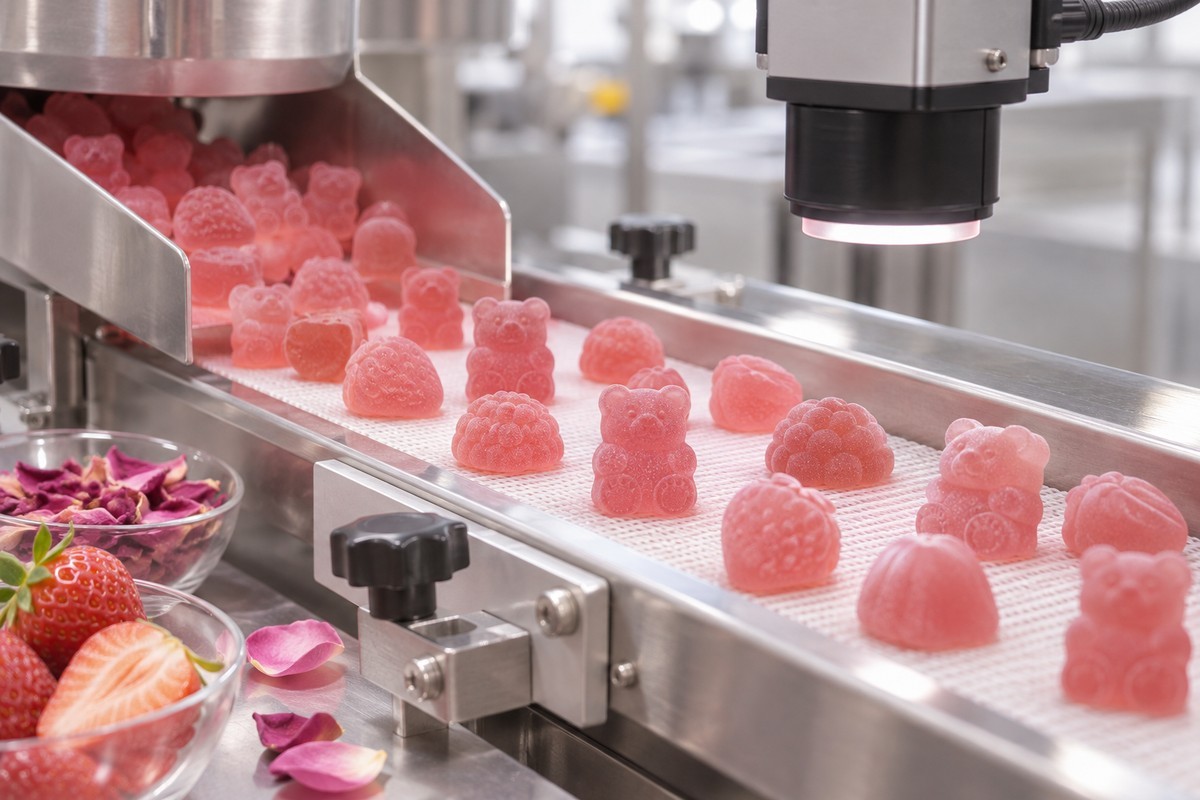
What the plant cannot do is worth stating as plainly. It cannot fit 2.5 g of peptide into a 2.5 g gummy. It cannot make a claim exist in a market that has not authorised one. And it cannot stop gelatine from being collagen, which is why the base decision belongs in the brief and not in the process sheet.
The clause that decides who pays in month twelve
Nearly every dispute in this category starts with a bottle that misses its claim at the twelve-month mark, and both parties arrive with a defensible story. The brand says the line ran hot. The factory says the peptide arrived already degraded. Without a written split, both are right and one of them pays anyway.
Five lines in the agreement close it:
- Who owns the specification, and what documents constitute it. Without a schedule, the formula is whatever the factory says it is.
- Who owns the claim, per market, with the regulation named.
- The assay method and the correction, including the acceptance range and who signs a deviation.
- The stability data, owned by the brand, generated on the brand's product rather than borrowed from a generic file.
- The transfer package, meaning the specification, batch record extract, supplier list and artwork files, deliverable within a stated number of days of termination.
Exclusivity, if it is wanted, is a separate purchase. The market rate runs at a per-unit premium of five to fifteen percent, a fixed annual fee, or a minimum volume commitment, and free exclusivity usually means exclusivity in a channel the factory does not sell much of.
None of that is exotic, and all of it is cheaper than the alternative, because it is the only version of the conversation that can be had while changing the answer is still free. A custom formula supplement manufacturer that cannot name its own assay method for this product has not made collagen gummies before, whatever the catalogue says.
Ding Shaohua, Foreign Trade Manager at WANHUACAO, works with brands and distributors on collagen, beauty and functional gummy programmes from brief to first shipment. The plant operates under SGS CN23/00007035 for gelatine confectionery and SC11434160205012 covering eight dosage forms. Reach him on WhatsApp, TikTok, LinkedIn and Facebook.
Frequently asked questions
Does a gelatine base make the collagen claim untrue?
No. The peptide you paid for is in the piece, and the hydroxyproline result includes it. What a gelatine base removes is the ability to prove how much of the result came from the peptide rather than from the gel holding the piece together. At a 4 g piece with 7% gelatine, the base alone contributes roughly 280 mg of collagen-type protein, which is around 11% of a 2.5 g claim. A pectin base contains no hydroxyproline, so the standard assay becomes specific again. Keeping gelatine and validating a size-exclusion method is the other route, and it costs more per lot.
Can a collagen gummy say it supports skin elasticity in Europe?
No. Collagen has no authorised health claim in the European Union. The 2013 EFSA opinion on a collagen hydrolysate and skin elasticity found that a cause and effect relationship had not been established, and Regulation (EU) No 1154/2014 records that the claim was not authorised. The sentence that survives on a European pack is the biotin one, and it is available at 7.5 µg per daily dose.
How much biotin does a beauty gummy need?
7.5 µg per daily dose is the threshold for the authorised hair and skin claims, because that is 15% of the 50 µg reference value. Most products in the category carry 2,500 to 5,000 µg, which buys no additional wording. The practical argument for a lower dose is laboratory interference rather than toxicity, since biotin can distort immunoassays at high intake and the FDA publishes advice on stopping before a blood draw.
What actually changes when the formula is custom rather than stock?
Four things, and none of them is the recipe. Ownership, because a development fee buys work rather than rights unless the agreement assigns them. Minimums, which move from around a thousand bottles on a stock run to 600,000 to 1,000,000 pieces on a custom gummy. Time, with eight to sixteen weeks added before finished goods ship. And the specification itself, which is the only document that lets the product move to a second factory later.