
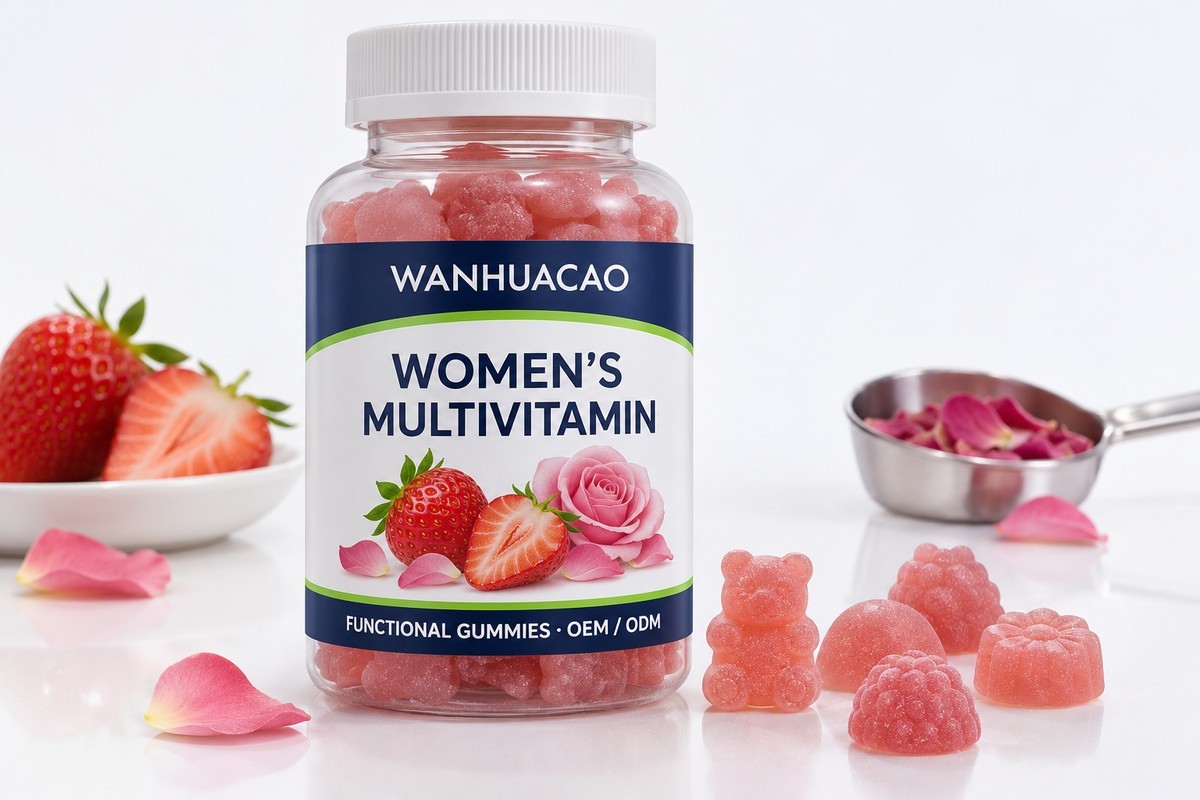
A brand sends over the panel it wants made: a women's multivitamin plus probiotic gummy, twelve vitamins, 5 billion CFU, iron for the tiredness claim, biotin at a hair-and-nail dose, and a translucent pink piece because the launch photography is already shot. Every line on that panel is a reasonable thing for a woman to want in one chew.
The problem is that those lines do not fail at the same rate, and two of them cannot both be satisfied in the same piece of gel. A gummy has one water activity, one cook temperature and one solids budget, and each ingredient on that list makes a different demand of all three. The formulator's job is not to fit twelve nutrients into 2.5 grams. It is to decide which of them will be under-delivered at month eighteen, and to say so before the artwork is printed.
Two lists, opposite demands
A women's multivitamin and probiotic gummy is two formulas that happen to share a mould.
The vitamin side wants a dry, cool, low-oxygen, low-water piece. Ascorbic acid hydrolyses and oxidises; thiamine is the fastest loser in a warm matrix; vitamin A palmitate is light-sensitive; folate sits in the middle and is pH-dependent. Every one of those losses is slowed by pulling water activity down.
The probiotic side wants the same thing, only more so. A dried culture is stable near a water activity of 0.2. A finished gummy sits between 0.55 and 0.65, which is three times the moisture the organism would choose.
So the two lists agree on direction. Where they collide is the cook. Vitamins tolerate a hot slurry if they are encapsulated and if the overage is set from measured retention. Vegetative Lactobacillus and Bifidobacterium do not tolerate it at all: at depositing temperatures they die in numbers that make the CFU claim meaningless, and no overage recovers a count that has gone to zero.
That single fact decides Women's Multivitamin + Probiotic Gummies before any marketing conversation starts.
Only one organism survives the cook
A pectin or gelatin base is cooked and deposited somewhere between 75 and 88 °C. A vegetative probiotic cell has a phospholipid membrane and a full complement of enzymes; at that temperature the membrane loses integrity and the cell lyses. Suppliers who work in this category put the loss at over 99% through a standard gummy process, which is why the retail shelf is almost entirely spore-formers.
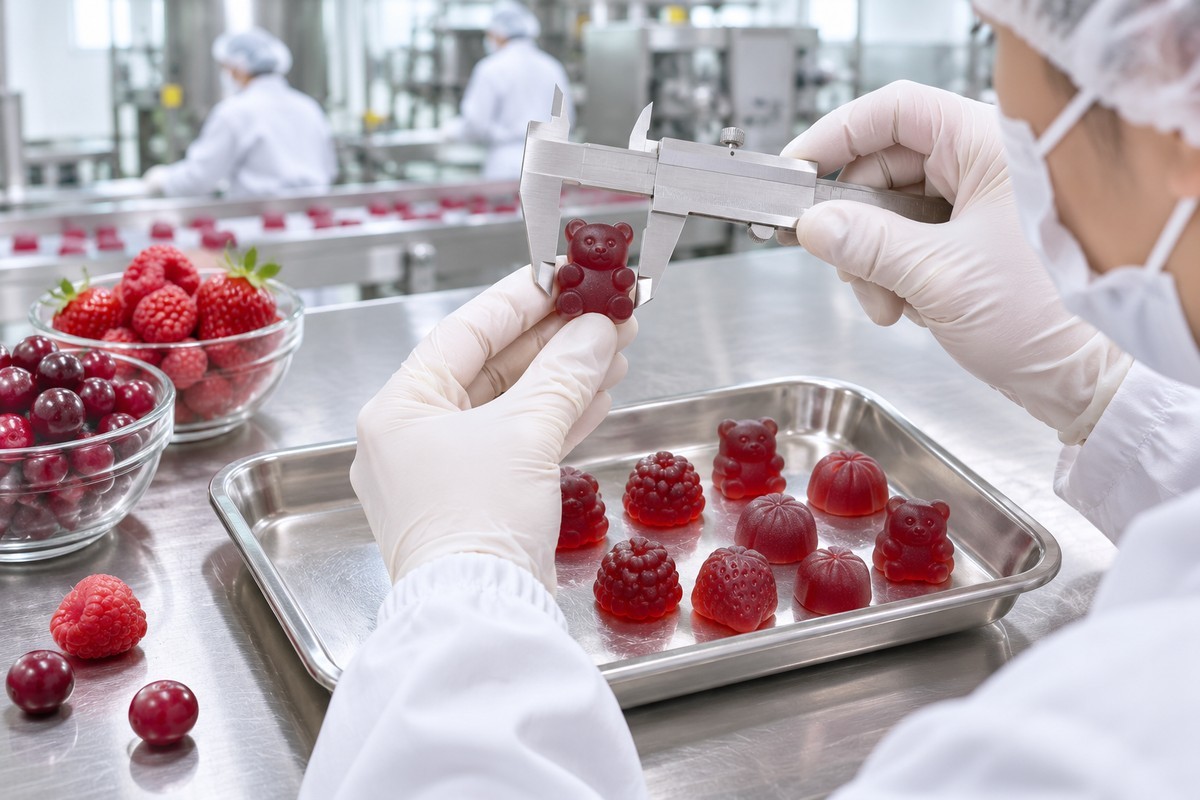
Bacillus coagulans and Bacillus subtilis form an endospore: a dormant core wrapped in a protein coat that shrugs off heat, desiccation, shear and gastric acid. That coat is what allows a gummy to carry a live organism at all.
The practical consequences are specific:
- Dose ceiling —— a 3 g piece can realistically hold a few billion CFU of a spore-former at end of shelf life; a claim of 10 billion or more in one gummy is usually spores, or a number counted at manufacture rather than at expiry
- Overage —— spore-formers need roughly 10 to 15% overage to hold a 24-month claim; a heat-sensitive strain needs 200 to 500%, which is a cost the unit price rarely reflects
- Dosing point —— spores go in downstream of the cook, through an in-line manifold just before the depositor, at 75 to 82 °C, with hopper residence kept under about 15 minutes
- Acid shock —— acid and buffer are injected after the spores, not before, so the organism never meets an unmixed low-pH pocket
A brand that wants Lactobacillus rhamnosus GG on the panel is not asking for a harder gummy. It is asking for a different dosage form, and the honest answer is a capsule, a stick pack or a drop.
Water activity is the shared variable
Water activity is the one number that every ingredient on the panel has an opinion about, and the opinions do not all point the same way.
For the spore-former, the ceiling is around 0.62. Above roughly 0.65 the spores can germinate inside the bottle, and a germinated cell in a dry environment then dies, so the count falls in a way no stability model predicts. That is a hard limit.
For the vitamins, lower is simply better. Hydrolysis and oxidation both slow as water activity falls, and the fat-soluble vitamins in particular benefit from a dry matrix and a good oxygen barrier.
For the texture, there is a floor. Below roughly 0.55 the piece turns hard and glassy; above 0.65 it sweats, blocks in the bottle and picks up surface tack during a warm container crossing an ocean.
Put those three together and the working window is narrow: about 0.55 to 0.62, with the probiotic setting the top of it. A sugar-free polyol base makes the window tighter still, because polyols hold water differently and the piece is more prone to surface crystallisation.
This is the number to put on the release sheet. Not moisture by loss on drying, which measures total water and says nothing about how much of it is available to react. Water activity, measured on the finished piece, batch by batch, with the instrument named.
Overage is where the vitamin side cheats
A gummy multivitamin does not contain what the panel says. It contains more, so that what is left at expiry matches the panel.
That practice is legitimate and universal. What varies is how it is calculated. A blanket overage of 20% across twelve nutrients is the lazy version, and it fails in both directions: it under-protects ascorbic acid, which loses the most, and it over-doses the nutrients that barely move, which costs money and pushes the finished assay above the tolerable upper intake for some of them.
Published loss figures for a gummy matrix run roughly like this over a 12 to 24 month shelf life:
- Vitamin C —— the widest range, from about 10% to over 40% depending on pH, moisture and whether the acid is encapsulated
- Thiamine (B1) —— 15% to 30%, the fastest of the B complex
- Folate —— 15% to 35%, strongly pH-dependent
- Vitamin A —— 15% to 30% if unencapsulated, far less with a starch or lipid coat
- Vitamin E —— 10% to 25%
- Vitamin D3 —— 5% to 20%, the most stable of the group
- B12 —— 5% to 15%
Those ranges are wide because the matrix decides them. A pectin base cooks hotter and runs a lower pH than a gelatin base, so the same vitamin loses more in one than the other. That is why an overage has to come from a retention trial on the actual base at the actual process temperature, followed by a finished-piece assay at month zero and month three, rather than from a table in a supplier brochure.
For a women's multivitamin specifically, there is a second trap. The panel usually carries a long list of nutrients at moderate doses, and each one has its own tolerable upper intake. Overaging biotin, B6 or folate to cover an optimistic shelf-life claim can push a daily serving past a level that a regulator or a retailer's own standard will not accept, which turns a stability fix into a labelling problem.
Iron is the ingredient both sides pay for
Iron is the nutrient most women's multivitamins are actually bought for, and the one a gummy is worst at carrying.
It is a pro-oxidant. Ferrous sulfate and ferrous fumarate release free iron ions into a warm, acidic, semi-moist matrix, and those ions catalyse the oxidation of ascorbic acid, vitamin A and vitamin E. Within weeks a formula can brown, develop a rancid note from oxidised flavour lipids, and lose a meaningful share of its vitamin C. The iron itself oxidises too, which is what turns a bright piece muddy.
It also tastes of what it is. The metallic note in a chewable is hard to mask with sugar or fruit, because the perception is not a flavour so much as a sensation that coats the tongue and lingers.
And it is dark. A 10 to 15 mg dose in a 3 g piece visibly darkens the base, which is why iron gummies in the trade are almost always blackberry, dark cherry, grape or blackcurrant, and why a brief asking for translucent pink with iron in it is asking for something that does not exist.
The industry's answer is to change the iron rather than the format. Ferrous bisglycinate chelates the ion to two glycine molecules, which lowers both the metallic taste and the pro-oxidant activity. Microencapsulation adds a lipid or polymer shell that keeps the iron away from the vitamins during the cook and releases it in the stomach. Both work. Both cost, and both have to be declared, because the label lists total iron, not the form, and certainly not how much survives to expiry.
The avoidance is documented. A ConsumerLab review of multivitamins found that around a fifth of women's formulas, excluding post-menopausal products, contained no iron at all, and gummy multivitamins were the format most likely to drop or minimise it. In prenatal gummies the pattern is starker still: a GAO review found no prenatal gummy on the market that contained iron, even though pregnancy raises the requirement to 27 mg a day.
So when a brief arrives asking for Women's Multivitamin + Probiotic Gummies with iron, the useful question is not whether it can be done. It is which iron source, at what dose, in what colour, with what overage, and whether the brand accepts the cost of the chelated or encapsulated form.
Biotin at hair-and-nail doses breaks lab tests
Biotin is the one line of the panel that has nothing to do with stability.
Biotin sells to women on the hair, skin and nails story, and the doses used for that story run far above nutritional need. Many supplements marketed for hair and nails carry biotin at up to 650 times the recommended daily intake.
At those levels biotin interferes with immunoassays that use biotin-streptavidin chemistry, which is most of the automated platforms in a modern laboratory. The interference runs in opposite directions depending on assay design: a sandwich assay reads falsely low, a competitive assay reads falsely high.
The clinical consequences are not theoretical. The FDA issued a safety alert in 2017 and updated it in 2019, after reports that included a death: a patient whose troponin test returned falsely low while on high-dose biotin, so a heart attack was not recognised. Thyroid results are the other common casualty, and the pattern is vicious because it looks coherent. Falsely raised free T4 together with falsely suppressed TSH reads exactly like hyperthyroidism, and case reports describe patients treated for Graves' disease they did not have.
Consider who buys a women's multivitamin. Thyroid disease is several times more common in women than in men. A product that adds a high biotin dose for the hair claim is adding an interference risk to the population most likely to be having thyroid function tested.
The FDA's own guidance on clearing time before a blood draw gives a sense of the scale: about 8 hours for a 10 mg daily dose, 3 days for 100 to 300 mg, and 7 days for children on weight-based high doses. A consumer taking a hair-and-nail gummy has no idea any of this applies to her.
None of it is illegal. Biotin is a permitted nutrient, the dose is a marketing decision, and no regulator has set a ceiling for supplements. It is simply a case where the panel is optimised for the shelf and not for the person, and a formulator who knows the interference data is in a position to say so before the artwork is approved.
Toll manufacturing decides who owns the failure
Now put a contract around the product, because toll manufacturing dietary supplements is a narrower relationship than most brands assume when they ask for a price.
In toll manufacturing, the brand supplies the actives and the packaging, and the manufacturer charges a fee for processing only. The factory does not source the ingredients and does not own the formula. Turnkey sits at the other end, where the manufacturer sources, formulates, produces and documents. Contract manufacturing sits between them, with the split negotiated case by case.
For a women's multivitamin and probiotic gummy, toll is the model that most often produces a dispute, because the decisions that determine whether the product works are made by the party that does not run the line.
- The strain is chosen by the brand, so the brand owns the decision that the organism will not survive the cook
- The biotin dose is chosen by the brand, so the brand owns the interference question
- The iron source is chosen by the brand, often on price, and the oxidation that follows belongs to that choice
- The overage may be set by the brand's formulator, who has never run a retention trial on this base
Meanwhile the factory owns the things the brand cannot see: cook temperature, hold time, depositing weight, cure conditions, water activity at release. When a bottle tests below claim at month twelve, both parties have a defensible story. The brand says the line ran hot. The factory says the culture was dead on arrival.
A toll manufacturing dietary supplements arrangement can work well, and for a brand with a proprietary strain or a locked formula it is the right structure. But it only works when the specification separates the two kinds of responsibility in writing, before the first batch, at the point where changing them is still free.
What a toll quote has to state
A toll price per thousand pieces says nothing about any of this, which is why most disputes in toll manufacturing dietary supplements begin with a specification nobody wrote down. What belongs in the specification is narrower and more useful:
- Strain identity and supplier —— species, strain designation, depositor code if it has one, and the licence holder it came from
- CFU method and timepoint —— plate count or flow cytometry, and whether the number refers to manufacture or to expiry
- Spore dosing point and residence time —— where in the line the culture enters and how long it sits in the hopper
- Water activity at release —— a range, on the finished piece, with the instrument named
- Water activity at end of shelf life —— the modelled or measured figure, not just the release value
- Per-nutrient overage and its basis —— a retention trial on this base, at this temperature, or a stated assumption
- Iron form and coating —— chelated or encapsulated, with the coating declared
- Biotin dose against the market —— the figure as a multiple of the reference intake, so the interference question is at least visible
- Who runs the stability study —— accelerated and real-time, with the timepoints and who pays
- Who signs a batch that misses one nutrient but passes the others —— the most common real failure mode in a multivitamin is not a bad batch but a batch that averages well
The plant here runs 23 lines at around 1.6 billion gummies a year, with servo depositing, in-line drying and a 3,000 m² laboratory staffed by more than 50 people across over 2,000 test items. That laboratory is the reason a per-nutrient overage can be calculated from measured retention. A full-panel finished assay on twelve nutrients is a different piece of work from a spot check on vitamin C, and it is the only evidence that a toll specification means anything.
#guthealth and #probiotics are revenue words
Both hashtags are usually discussed as awareness. The commercial data says #guthealth and #probiotics are purchase intent.
In the first quarter of 2026, #probiotics as an ingredient cohort generated about 30.6 million dollars across 105 products in the top 1,000 health products tracked on TikTok Shop, the largest single ingredient category on that list. Gut and digestion as a benefit category ran at about 44.5 million dollars. One adjacent tag, #debloat, pulled 84.8 million views and 865,000 dollars in the same window. Hair, skin and nails, which is where the biotin story lives, was worth about 35.8 million.
Exposure figures for #guthealth itself are worth less than they look. Public sources in early 2026 put the tag anywhere from 5.6 billion to 90 billion views, with #GutTok quoted separately at around 6 billion. A spread of that size across three trackers means the number is not a measurement of anything; it is a marketing asset.
What the words do to a brief is more concrete than either statistic:
- Colour and clarity —— #guthealth content is shot in daylight against skin, so an opaque piece photographs better than a translucent one, which cuts against the instinct for a clear gummy
- The stack story —— the prebiotic-plus-probiotic explanation converts, which is why inulin or FOS ends up in the brief even when the CFU claim is the headline
- Serving format —— 60 and 90 count bottles carry the category, with stick packs growing on the subscription side
- What the content cannot show —— a video cannot demonstrate a CFU count, so the label becomes the proof, and the label is the thing most likely to be wrong at month eighteen
There is also a regulatory edge that #guthealth and #probiotics both sit on. In the European Union the word probiotic is treated as a health claim in its own right, and the gut-brain and gut-skin axes that most of this content trades on have no authorised claims behind them. A brand building on #guthealth for a US launch and then shipping the same artwork to Europe is building on something that does not travel.
The panel she reads, and the panel that ships
Bring the pieces back together and the product that can actually be made is narrower than the one that gets marketed. The gap between them is what a Women's Multivitamin + Probiotic Gummies brief is really arguing about.
What ships is a dark, opaque piece, because iron darkens it and daylight photography prefers it that way. It carries a spore-former, because that is the only organism that survives depositing, at a few billion CFU rather than fifty. Its water activity sits at the top of a narrow window set by the probiotic and not by the texture. Its vitamins are overaged individually, from a retention trial, and at least one of them is probably under-delivered at expiry because the alternative was exceeding an upper limit. It may carry no iron at all, following a fifth of the women's market.
What the panel claims is twelve vitamins, live cultures, iron for energy, biotin for hair, and a pink translucent chew.
None of those gaps is dishonest on its own. Each is the visible edge of a decision that was made in a plant and never written down where the buyer could see it. The difference between a brand that survives a recall and one that does not is usually whether those decisions were documented before the first batch or reconstructed afterwards.
For brands working through the format question separately, the vitamin side is covered in multivitamin gummies and the culture side in probiotic gummies; the wider range sits on the functional gummies page.
Ding Shaohua, Foreign Trade Manager at WANHUACAO, works with brands and distributors on women's health, multivitamin and probiotic gummy programmes from brief to first shipment. The plant operates under SGS CN23/00007035 for gelatine confectionery and SC11434160205012 covering eight dosage forms. Reach him on WhatsApp, TikTok, LinkedIn and Facebook.
Frequently asked questions
Can a women's multivitamin and a probiotic go into the same gummy?
Yes, but the probiotic has to be a spore-former. Depositing temperatures of 75 to 88 °C destroy vegetative Lactobacillus and Bifidobacterium, so a gummy carrying live cultures is almost always built on Bacillus coagulans or Bacillus subtilis. That restricts the CFU claim to a few billion at end of shelf life, and it means a brief asking for a named Lactobacillus strain is really a brief for a capsule or a stick pack.
Why do so many women's gummies leave iron out?
Because iron is a pro-oxidant that browns the piece, tastes metallic and destroys vitamin C, vitamin A and vitamin E in a warm semi-moist matrix. A ConsumerLab review found about a fifth of women's formulas carried no iron, and a GAO review found no prenatal gummy on the market with iron in it. Including it properly means a chelated or encapsulated source, a dark colour and a higher cost per piece.
How much biotin is too much?
There is no regulatory ceiling for supplements, which is the problem. Interference with biotin-streptavidin immunoassays becomes clinically relevant at the doses used for hair and nail claims, where products can reach 650 times the recommended intake. The FDA has warned about falsely low troponin and falsely abnormal thyroid results since 2017. For a product aimed at women, who have higher rates of thyroid testing, the dose is worth setting deliberately rather than by marketing habit.
What changes under toll manufacturing for this product?
Under toll manufacturing the brand supplies the actives and the factory charges for processing. That means the strain, the biotin dose, the iron source and often the overage are the brand's decisions, while cook temperature, hold time and water activity at release belong to the factory. When a bottle misses its claim at month twelve, both parties have a defensible story unless the specification separated those responsibilities in writing before the first batch ran. That clause is the one most toll manufacturing dietary supplements contracts leave out.