
Ten milligrams of lutein with two of zeaxanthin is the combination the AREDS2 trial tested, and it is the figure most briefs arrive with. In a three gram gummy those twelve milligrams are four tenths of one per cent of the piece, so the dose itself is not what makes the format difficult. What makes it difficult is the powder that carries the dose.
A five per cent water-dispersible beadlet puts 200 mg of material into the kettle for every 10 mg of lutein, and another 40 mg for the zeaxanthin. The carotenoid is 12 mg of a 240 mg addition. The rest is a starch and gelatin wall, sucrose, and two sacrificial antioxidants, and each of those has a consequence further down the line, on the ingredient list, on the colour, and on how the piece behaves in a jar.
What a 10 mg dose weighs
Beadlets are sold by the lutein load inside them, and the three common grades are 5, 10 and 20 per cent. The same 10 mg dose therefore means 200 mg of powder, 100 mg, or 50 mg, and the choice is usually made on price per milligram rather than on what the extra mass does to the formula.
A published specification for a 5 per cent cold-water-dispersible beadlet shows where the other 95 per cent goes: gelatin 35 per cent, sucrose 37 per cent, corn starch 18 per cent, dl-alpha-tocopherol 2 per cent and ascorbyl palmitate 3 per cent. Two pieces a day, the usual serving for this category, then carry around 148 mg of sucrose and 70 mg of gelatin that no one wrote into the formula on purpose.
Most of that is harmless. The gelatin is not. A pectin body is chosen precisely so a gummy can be sold as vegan, and a gelatin-walled beadlet undoes that in an ingredient the buyer never sees on the front panel. Cold-water-dispersible grades built on gum acacia or modified food starch exist for exactly this reason, and the question to put to the supplier is what the wall is made of, not what the assay is. The same question decides kosher and halal status, since the wall can be either.
The grade also changes the process. A 20 per cent beadlet halves the powder going into the kettle, which helps in a small piece, but a more concentrated beadlet is a denser, darker particle and it disperses differently in a hot syrup. Concentration is a purchase decision with a mixing consequence attached.
Where the carotenoid is lost
Lutein's colour and its instability come from the same structure. The long chain of conjugated double bonds that absorbs blue light is also what oxygen, light, heat, metal ions and low pH attack, and in a food matrix those factors usually act together rather than one at a time.
A gummy line brings three of them into contact with the beadlet in a single shift. The cook and the depositor run hot, typically around 90 to 95 °C at the nozzle for a gelatin or pectin base. The syrup is aerated by mixing. And the piece then spends its shelf life in whatever pack the brand chose, at whatever light level the shelf provides.
The microencapsulation is what makes the format possible at all, and it is why the beadlet route is used for gummies while the oil and oleoresin grades stay in softgels. Free lutein in oil has no way to disperse in a water-based gel; a beadlet disperses and carries its own protection. It is protection, not immunity. Late addition, after the hottest part of the cook, and a deaerated syrup do more for the retained dose than a larger overage does.
The ester question sits next to this one. Marigold lutein occurs mostly esterified with fatty acids, and the ester is more stable than the free form, which is why some suppliers quote lutein esters at 20 per cent or more. An ester grade is not 20 per cent lutein: the fatty acids are part of the mass, and the free-lutein figure after saponification is what the label has to be built on. A specification that does not say which basis it is quoting cannot be converted into a dose.
The colour cannot be separated from the dose
At 10 mg in a three gram piece the carotenoid is present at about 0.33 per cent, and that is enough to see. Lutein is a yellow-orange pigment before it is anything else, so a translucent gummy made to that dose will be yellow-orange whether or not the brief asked for it.
The usual way to keep a pale, clean-looking piece was to opacify it with titanium dioxide. That route closed in the European Union: Commission Regulation (EU) 2022/63 withdrew the authorisation of E171 as a food additive, the six-month transition ended on 7 August 2022, and food supplements were among the categories affected. Calcium carbonate and rice starch can whiten a piece, but they change the texture and the mouthfeel, and neither gives the flat white that E171 did.
What is left is a set of honest choices. Lean into the colour and build the flavour around mango, peach or citrus, so the piece looks like what it contains. Move to an opaque chew, which is a different product from the translucent gummy most briefs describe. Or use a berry base, where anthocyanins from blueberry or blackcurrant sit over the yellow and pull the finished colour toward red-purple, which is what most eye gummies on a shelf actually are.
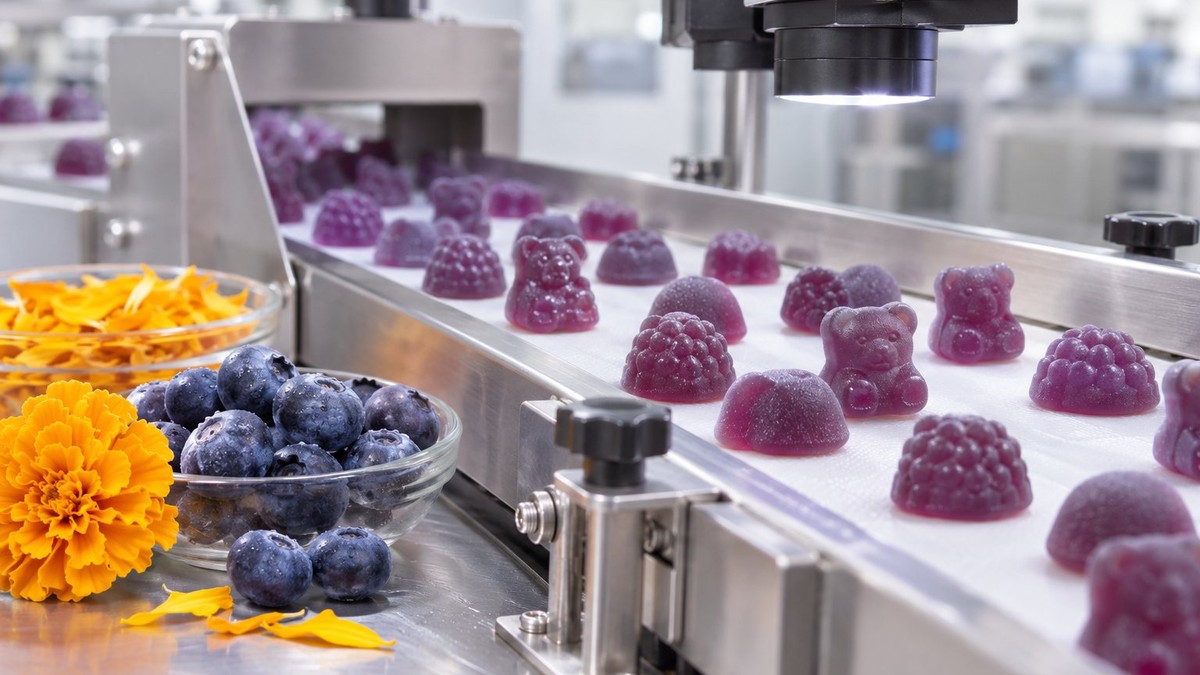
Whichever is chosen, the colour is also the first thing to fail. Carotenoid loss shows as fading long before an assay drifts out of specification, so a piece that looks pale at month twelve reads as expired to a buyer even when the HPLC number is still inside the tolerance.
What else the piece can hold
A brief rarely arrives with the two carotenoids alone. Bilberry extract at 50 to 100 mg is the usual partner, and it is not a neutral addition: it brings tannins that need sweetener to cover and anthocyanins that change the colour the carotenoid already set. Astaxanthin at 2 to 6 mg is a third carotenoid with the same sensitivity and a red rather than a yellow hue, so the colour balance moves again with every milligram.
DHA is the one that does not fit. The vision claim needs 250 mg a day, and 250 mg of oil in a three gram piece is over eight per cent of the mass carrying a marine note that mango does not cover. That is why omega-3 stays in a softgel and the gummy stops at the carotenoids. Zinc is the opposite case: at 1.5 mg it meets the condition for the vision claim, and as a gluconate it costs about 10 mg of powder in a piece that is already carrying 240 mg of beadlet.
The pack this site shows is the wrong pack for this formula
The jar in most of the photographs on this site is a clear PET container with a white cap and a paper label band. It is a good pack for a vitamin gummy and a poor one for a carotenoid: the shoulder, the base and the whole upper third of the body are unlabelled, and light passes through all of them.
That matters because the stability study has to be run in the pack being sold. Data from a foil pouch or an opaque HDPE bottle does not transfer to a clear jar on a shop shelf under fluorescent light, and a brand that moves pack after the study has restarted the clock. The overage that covers the loss is priced into the formula, and in this category the overage is the largest single lever on cost after the beadlet grade itself.
The options are ordinary ones: white or amber HDPE, an opaque shrink sleeve over the clear jar, or a carton. Each changes the artwork and the filling line, and none of them costs as much as a reformulation six months into a launch.
The trial formula is not the legal formula
The reason 10 and 2 are the numbers in circulation is AREDS2, published in 2013, which replaced the beta-carotene in the original AREDS formula with lutein and zeaxanthin in people at risk of advanced age-related macular degeneration. The trial's primary outcome across the whole group was not met; the signal appeared in a secondary analysis of participants with the lowest dietary intake of the two carotenoids.
The same trial family is where the eye-supplement aisle gets its other numbers, and there the arithmetic gets harder. The original AREDS formula carried 80 mg of zinc as zinc oxide with 2 mg of copper, over 3,640 participants and an average of 6.3 years. Eighty milligrams is more than three times the tolerable upper intake level of 25 mg a day that the Scientific Committee on Food set for adults, and the copper was in the formula because high zinc interferes with copper absorption.
So a gummy cannot reproduce the AREDS formula and stay inside the European upper limit. The ratio travels; the dose does not. A product can hold 10 and 2 and call itself AREDS2-based, and it cannot hold 80 mg of zinc without leaving the range a food supplement is built in.
Then there is the claim. In the European Union the only nutrients permitted to say anything about vision are vitamin A, riboflavin, zinc and DHA, each with one sentence in Regulation 432/2012 about maintaining normal vision. Applications for lutein and zeaxanthin were assessed and refused, so the two ingredients on the front of the bottle are the two that cannot carry the sentence. The zinc that can carry it meets the condition at 15 per cent of the reference intake, which is 1.5 mg — a line in the nutrition table, not a reason to buy.
What an eye gummy project specifies
A 500 kg batch of three gram pieces is roughly 166,000 gummies once deposit weight is set. At 10 mg of lutein each that batch needs 1.67 kg of lutein, which is 33 kg of 5 per cent beadlet, or 8 kg of the 20 per cent grade. The same calculation for zeaxanthin at 2 mg adds 6.7 kg at 5 per cent. It is the sort of number that decides a grade before anyone discusses flavour.
Three things then have to be agreed in writing. The beadlet specification, which names the grade, the wall material and the antioxidant system, because those three decide the vegan and halal position and half the stability. The stability study, run in the pack being sold, because that is the only basis for an overage that will hold to the expiry date. And the claim architecture, because whether the front panel leans on zinc or on nothing at all changes the formula and the artwork long before the first batch.
That division of labour is what separates a bulk order from a contract manufacturing or CDMO project. On a bulk order the gummies leave in lined cases and the buyer owns the pack and the study. On a CDMO project the plant signs the stability work that supports the date, holds the colour standard, and assays the finished piece rather than the incoming drum. The testing that supports those signatures is described under gummy quality control testing, and the cure side of the same problem under gummy shelf life and stability.
For a buyer scoping the project, the functional gummies range is where the format sits, and the questions that shorten a first quote are the four above: beadlet grade and wall, pack, overrun, and who signs the claim.
Ding Shaohua, Foreign Trade Manager at WANHUACAO, works with brands and distributors on functional gummy programmes from brief to first shipment, in bulk and in private label, including carotenoid and botanical formulas. The plant operates under SGS CN23/00007035 for gel confectionery and SC11434160205012 covering eight dosage forms, sports nutrition supplements among them. Reach him on WhatsApp, TikTok, LinkedIn and Facebook.
FAQ
How much lutein is actually in a lutein gummy?
The common dose is 10 mg of lutein with 2 mg of zeaxanthin, the AREDS2 combination. The piece holds far more powder than that: at a 5 per cent beadlet the two carotenoids account for 12 mg of a 240 mg addition, and the rest is the encapsulation wall, sucrose, starch and antioxidants.
Why would a pectin gummy fail a vegan check?
Because the base and the ingredient are two different questions. A pectin body contains no gelatin, but a gelatin-walled lutein beadlet does, and the wall is 35 per cent of a 5 per cent beadlet by mass. Gum acacia and modified starch beadlets are made for this case, and the wall material is a line item in the specification.
Can lutein gummies go in a clear jar?
They can be packed in one, and the pack then becomes part of the stability budget. Light passes through the unlabelled shoulder and base of a clear PET jar, carotenoid fading is visible before the assay drifts, and the overage needed to hold the label at the expiry date is set by the study run in that same jar.
Can the pack say the gummy supports eye health in Europe?
Not for lutein or zeaxanthin. In the EU the vision claim belongs to vitamin A, riboflavin, zinc and DHA under Regulation 432/2012, and the applications for the two carotenoids were refused. In the United States a structure or function statement is available with the DSHEA disclaimer, which is why the same formula ships with two artworks.