
The brief arrived as a screenshot. A #sleepmaxxing video paused on a nightstand: a bottle of melatonin, a tin of L-theanine capsules, a glass of something dark red. Under it one line: 1 mg and 200 mg in the same gummy, five markets, before spring.
Melatonin + L-Theanine Sleep Gummies look like the easiest product in the sleep category. Two familiar ingredients, one piece, a purple label. On a line they are two ingredients that disagree about almost everything: how much room they need, how they behave in water, and which countries will let them in at all. That is why the first reply from a supplement contract manufacturer tends to be a list of questions before it is a price.
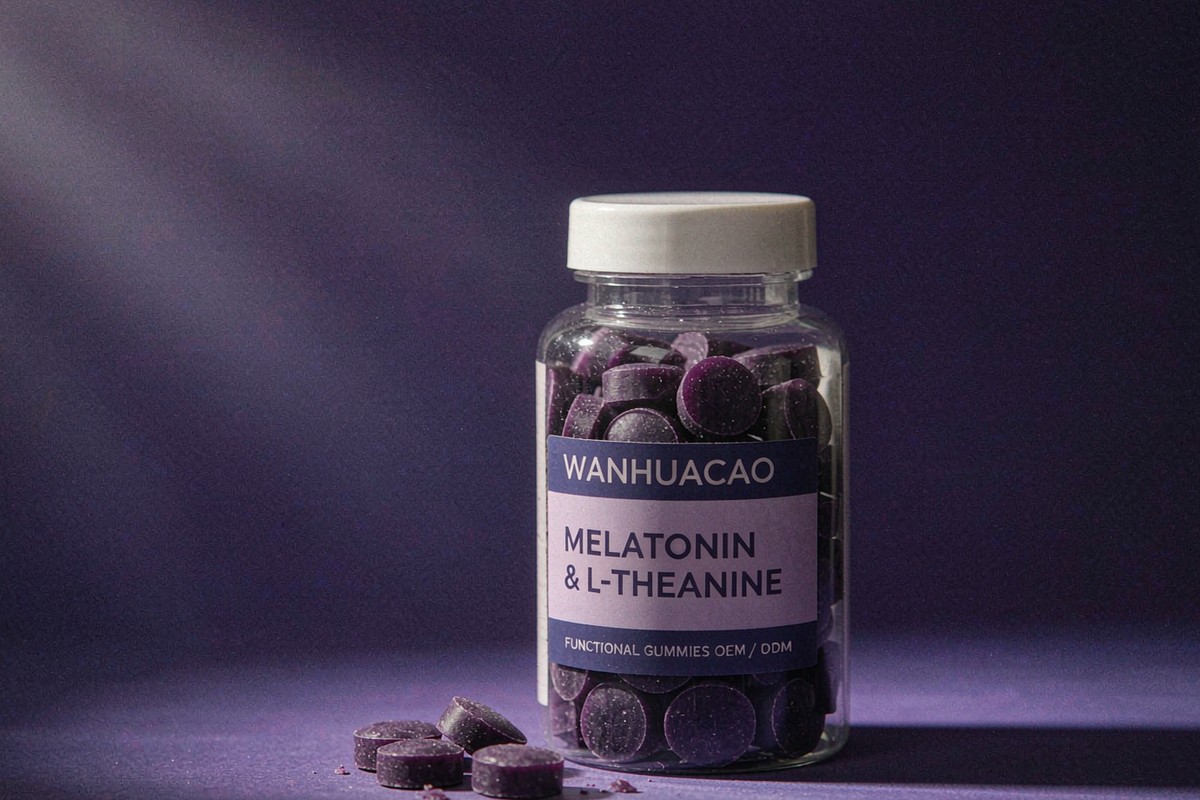
What a supplement contract manufacturer asks before quoting
Three answers reshape the quotation, and none of them is about price per piece.
The first is the destination. A melatonin + L-theanine sleep gummy built for the United States can carry 3 mg or 5 mg and a structure/function claim. The same brand selling into the European Union runs into 0.3 mg in the Benelux, 1 mg in Italy, Spain and Poland, 2 mg in France, and a prescription-only wall in Denmark, the Czech Republic, Slovenia and the UK. One formula cannot serve both. The market list comes before the formula.
The second is where the theanine comes from. Tea-extracted L-theanine and fermentation L-theanine read the same on a certificate of analysis and sit in two different regulatory categories in Europe. A quote that does not name the source is a quote for an ingredient that may not clear customs.
The third is pieces per night. A 0.3 mg dose needs two or three pieces before it feels like a dose. A 3 mg dose fits one. Pieces per night set the piece weight, the piece weight sets the solids budget, and the solids budget decides how much theanine can go in without the gel losing its bite.
Two numbers that differ by a factor of two hundred
A 2.5 g gummy at 16% moisture carries about 2.1 g of solids. At 200 mg, L-theanine is 9.5% of everything solid in the piece. Heavy, but a load a well-built gel can hold. At 1 mg, melatonin is 0.05%. The two actives sit 200 to 1 apart, and they cannot share a mixing plan.
Theanine at 200 mg can be weighed and added like any minor ingredient, with a check on dispersion and a check on taste. Melatonin at 1 mg cannot be weighed at all in a production room. One milligram on a 0.1 g balance is a reading inside the noise of the air conditioning. It arrives as a premix: one part melatonin on a carrier, diluted in stages until a scoop of powder carries a dose. The ladder is validated before the first batch, not after.
The sampling plan matters more than the mixer. A composite sample drawn from a finished batch will average a bad dispersion into a number that looks correct. What finds the problem is individual pieces: ten from the start of the run, ten from the middle, ten from the end, each one assayed on its own. At 0.3 mg the tolerance is tight in absolute terms, and the high-performance liquid chromatography method has to be validated to a limit of quantification low enough to see a piece holding half a dose.
This is the part of a melatonin gummy that already has a literature. The 2023 assay of 25 products sold in the United States found 22 outside their label claim, with one product carrying no detectable melatonin. The engineering that answers it, from the dilution ladder to per-piece validation, is covered in more detail in our melatonin gummies dose and stability notes. What changes here is that the same piece now has a second active at two hundred times the mass.
One dissolves, one does not
L-theanine dissolves freely in water, roughly a quarter of a kilo per litre at room temperature. Melatonin barely dissolves at all. Put both in the same gel and the water in that gel becomes a transport system for one of them and a barrier for the other.
Dissolved theanine moves with free water. Over a shelf life it migrates toward the surface, which shows up as a sticky piece, a white bloom, or a film of powder on the inside of the bottle. The fix lies in water activity: a sugar-alcohol base to pull free water down, a gellan or carrageenan network to hold what remains, and a two-stage drying curve so the surface sets before the core gives up its moisture.
Melatonin needs the opposite treatment. It is light-sensitive and oxidises readily, so it goes into an opaque bottle or an aluminium pouch, and the gel mass gets no long residence at temperature. Above roughly 80 °C the loss stops being negligible, which fixes the order of addition: theanine into the hot syrup phase, melatonin after the mass has dropped below 70 °C, then deposit quickly.
The two requirements meet in the dryer. A fast tunnel pulls water from the surface first and skins it over, trapping moisture in the centre and leaving a piece that is soft inside and hard outside after a month in the bottle. A slow first stage costs line time and buys a piece that still measures the same at month twelve.
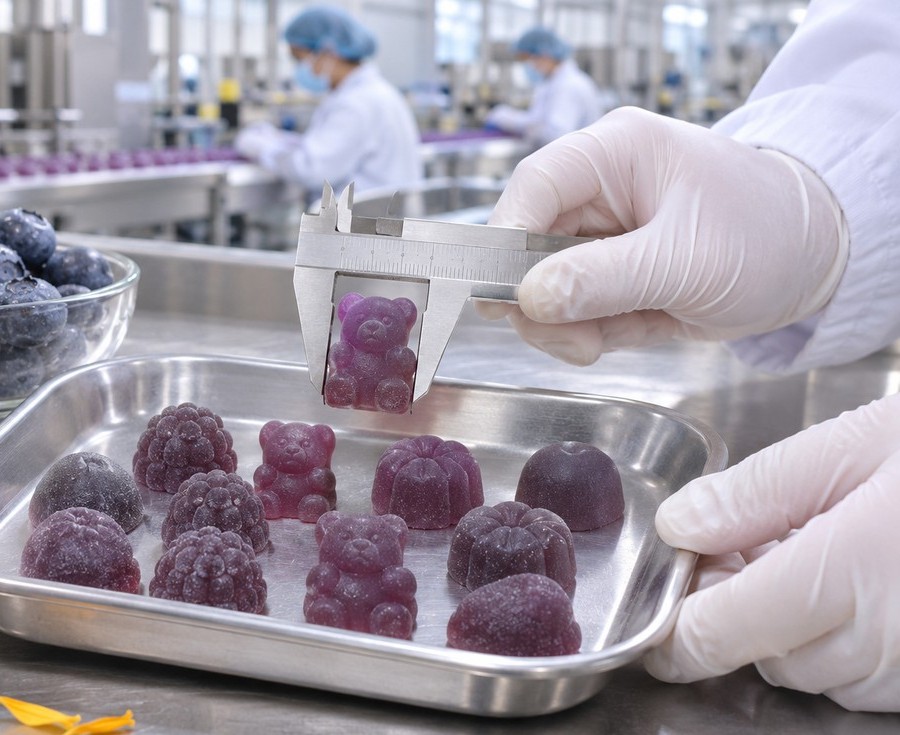
The savoury note in a berry gummy
L-theanine is the compound behind the umami of green tea. At 200 mg in a 2.5 g piece it is present at a level the mouth can find, and what it tastes of is not berry. It reads as broth, or seaweed, at the back of the throat, and it fights a blueberry flavour instead of blending into it.
Masking it is a balance of three levers. Acidity at 0.3% to 0.6% citric or malic lifts the fruit and cuts the savoury tail. The flavour direction matters: berry alone leaves the note exposed, while a little citrus terpene or mint closes over it. The sweetener system does the rest, and a sugar-alcohol blend with a touch of allulose carries less of the metallic edge that erythritol alone can leave.
Acidity then collides with the gel. High-methoxyl pectin needs a pH window around 3.0 to 3.4 to set at all, and gelatin loses strength when it is held hot at low pH. A vegan, high-acid, high-load sleep gummy therefore tends toward gellan and low-methoxyl pectin, which sets on calcium instead of acid, and which gives a shorter, firmer bite than the chewy piece most brands picture when they write the brief. The texture difference comes out of the formulation, and it is worth settling before the sample is approved.
Four dose ceilings and one prescription list
Melatonin is not harmonised across Europe. The ceiling is set member state by member state, and the spread is wide enough to split a product line.
- Netherlands, Belgium, Luxembourg: 0.3 mg per day in food supplements
- Italy, Spain, Poland: 1 mg per day
- France: 2 mg per day
- Germany: no settled ceiling; courts have gone both ways, and novel food authorisation is still required
- Denmark, Czech Republic, Slovenia: prescription only, immediate and prolonged release alike
- United Kingdom, Switzerland, Australia: prescription medicine, not a supplement ingredient
A supplement contract manufacturer quoting a single price for "Europe" is quoting a fiction. The 0.3 mg formula is the only one that crosses every border in the first group; 1 mg costs the Benelux; 2 mg is a France-first product. The practical answer is usually one 0.3 mg SKU for the open markets plus a separate, clearly labelled 1 mg or 3 mg SKU for the markets that allow it, with different artwork so the two cannot be confused in a warehouse.
Dose ceilings also decide the piece count. At 0.3 mg, two pieces a night is a normal instruction, and a 60-count bottle becomes a thirty-day supply. That single decision moves the piece weight, the bottle size, the carton and the freight.
The source of the theanine is a customs question
In March 2026 the European novel food catalogue drew a line through the middle of this ingredient. L-theanine extracted and isolated from green tea is listed as not novel in food supplements. L-theanine produced by fermentation with Escherichia coli is listed as an unauthorised novel food, which means it needs pre-market authorisation before it can be sold in the EU at all.
The same 200 mg on the same label is therefore either a routine supplement ingredient or a shipment that stops at the border. In the United States the FDA has raised no questions on GRAS notices for tea-extracted, synthetic and fermentation L-theanine, so the American brief does not care. In the UK the same catalogue logic applies.
Two documents settle it before production. A source declaration from the theanine supplier that names the route and the plant; most quotations carry only "L-Theanine 98%". And a chiral purity result, because the D-isomer is not the active form and a fermentation route that racemises will not show up on an ordinary assay.
Claims are the second half of the same problem. Neither the EU nor the UK has an authorised health claim for L-theanine or for melatonin, so a European label describes the contents, not the effect. The US allows a structure/function statement with the FDA disclaimer. A brand that writes one label for both markets ends up with text that is illegal in one of them.
What #sleepmaxxing changed in the brief
The trend has no peer-reviewed literature behind it as a package. A 2025 Harvard review searched PubMed, PsycNET and Google Scholar and found nothing under the term. It has still changed what arrives in the inbox.
Doses moved down. The 3 mg and 5 mg single-active bottles that dominated for years now sit beside 0.3 mg and 1 mg products built around two or three pieces a night, because the videos are about timing, not sedation. A lower dose is easier to sell into Europe and harder to disperse evenly, which is a trade the brand rarely sees and the line always does.
Stacks moved in. A brief for Melatonin + L-Theanine Sleep Gummies increasingly arrives with magnesium glycinate or ashwagandha attached, either as one piece or as a three-bottle set. Combining them goes past the label: magnesium glycinate raises the pH of the gel mass, and the alkalinity has its own consequences for gel strength and for the melatonin. Our notes on magnesium glycinate sleep gummies cover that side of the stack.
Order sizes moved down as well. Thirty and sixty count bottles, trial quantities, subscription-friendly formats. A trend word has a shelf life of about a season. The arithmetic inside the piece does not, which is why the work goes into the premix ladder and the drying curve, not the label.
The line, the laboratory, and the papers that travel
The WANHUACAO plant in Bozhou, Anhui runs 23 production lines across 20,000 m² of workshop space in a 160,000 m² site, with capacity around 1.6 billion pieces a year and close to a thousand staff. Depositing is fully servo-driven with in-line drying, and single-piece weight holds within ±2%, which on a 2.5 g piece is 50 mg either way. That tolerance is the difference between a 200 mg theanine claim that survives a label check and one that does not.
The laboratory covers 3,000 m² with more than fifty staff and a testing menu above two thousand items, including HPLC for the actives, ICP-MS for heavy metals, GC-MS for solvent residues and chiral columns for the theanine isomer ratio. The formulation library holds more than ten thousand recipes, the patent portfolio fifty-six filings, and two joint laboratories with universities keep the stability work moving between projects.
Four documents travel with a sleep gummy pallet:
- Certificate of analysis: including per-piece uniformity data from the start, middle and end of the run, not a single composite result
- Stability data: 25 °C/60% RH and 40 °C/75% RH, pulled at 0, 3, 6, 12 and 24 months, with melatonin and theanine assayed separately because they fail differently
- Source declaration: the theanine route, the melatonin supplier, and the chiral purity result
- Destination compliance statement: the dose ceiling and the claim wording for each market on the order
On certification, the site holds SGS CN23/00007035 covering gelatine confectionery among other categories, valid to 24 December 2026, and SC11434160205012 covering eight dosage forms including sports nutrition supplements, valid to 25 August 2030. One limit worth stating plainly: melatonin is not permitted in ordinary food in China, so a melatonin gummy is produced here against the rules of the destination market and cannot be filed as a domestic gelatine confectionery. That is a fact about the ingredient, not about the plant, and it belongs in the conversation before the sample stage.
What we need from you
- Market list: country by country, so the dose ceiling can be fixed first
- Dose and piece count: melatonin per night, theanine per night, pieces per serving
- Theanine source: tea-extracted or fermentation, and whether the EU is on the list
- Format: bottle, pouch or blister, and the count
- Label draft: the claim wording you intend to print, in each market
- Reference sample or existing formula: texture and flavour targets are easier to read than to describe
Send those six and the reply is a formulation route with the market limits marked on it, instead of a price for a piece that may not be sellable where you plan to sell it.
Ding Shaohua, Foreign Trade Manager at WANHUACAO, works with brands and distributors on sleep, beauty and functional gummy programmes from brief to first shipment. The plant operates under SGS CN23/00007035 for gelatine confectionery and SC11434160205012 covering eight dosage forms. Reach him on WhatsApp, TikTok, LinkedIn and Facebook.
Frequently asked questions
Can melatonin and L-theanine go into the same gummy?
Yes, and the order of addition decides whether the batch holds its label. Theanine goes into the hot syrup phase where it dissolves; melatonin goes in after the mass drops below 70 °C, as a validated premix, and the deposit follows quickly. Reversing the two costs melatonin to heat and leaves theanine undispersed.
What is the lowest melatonin dose you can run?
0.3 mg per piece is routine with a staged premix and per-piece assay. Below that, the limit stops being the mixer and becomes the analytical method: the quantification limit and the piece-to-piece variation have to be tight enough to prove the dose is there at all, and the cost of proving it rises faster than the cost of the ingredient.
Is the L-theanine in your sleep gummies from tea or from fermentation?
Both routes are available, and on this ingredient the choice is a market decision before it is a price decision. Tea-extracted L-theanine is not a novel food in EU food supplements; fermentation L-theanine is currently an unauthorised novel food in the EU. For a US-only launch the two are interchangeable on paper, and the source declaration is what proves which one shipped.
How does the EU dose ceiling affect a private label order?
It splits it. A 0.3 mg formula clears the Netherlands, Belgium, Luxembourg and every market above them, at the cost of a two-piece serving. A 1 mg formula loses the Benelux, and a 2 mg formula is effectively a France-first product. Most brands on their first European order take the 0.3 mg route and keep a higher-dose SKU for the markets that permit it.
Looking for a supplement contract manufacturer for Melatonin + L-Theanine Sleep Gummies? Our functional gummies line covers formulation, depositing, drying and packaging in one site, and the contact page reaches the export desk directly.
All News