
The brief is one page. Men's multivitamin gummy, two pieces a day, sixty count, zinc 30 mg, ashwagandha 600 mg, energy and stress on the front, first pallet in twelve weeks.
Two numbers on that page decide the project, and they are written in different units because they come from two different accounting systems. The zinc figure is a threshold. The ashwagandha figure is a dose. One is the price of admission to a set of sentences. The other is a quantity someone measured in a trial.
Between them sits five grams of gummy, of which about 1.26 g is available for anything that is not sugar, water or gel.
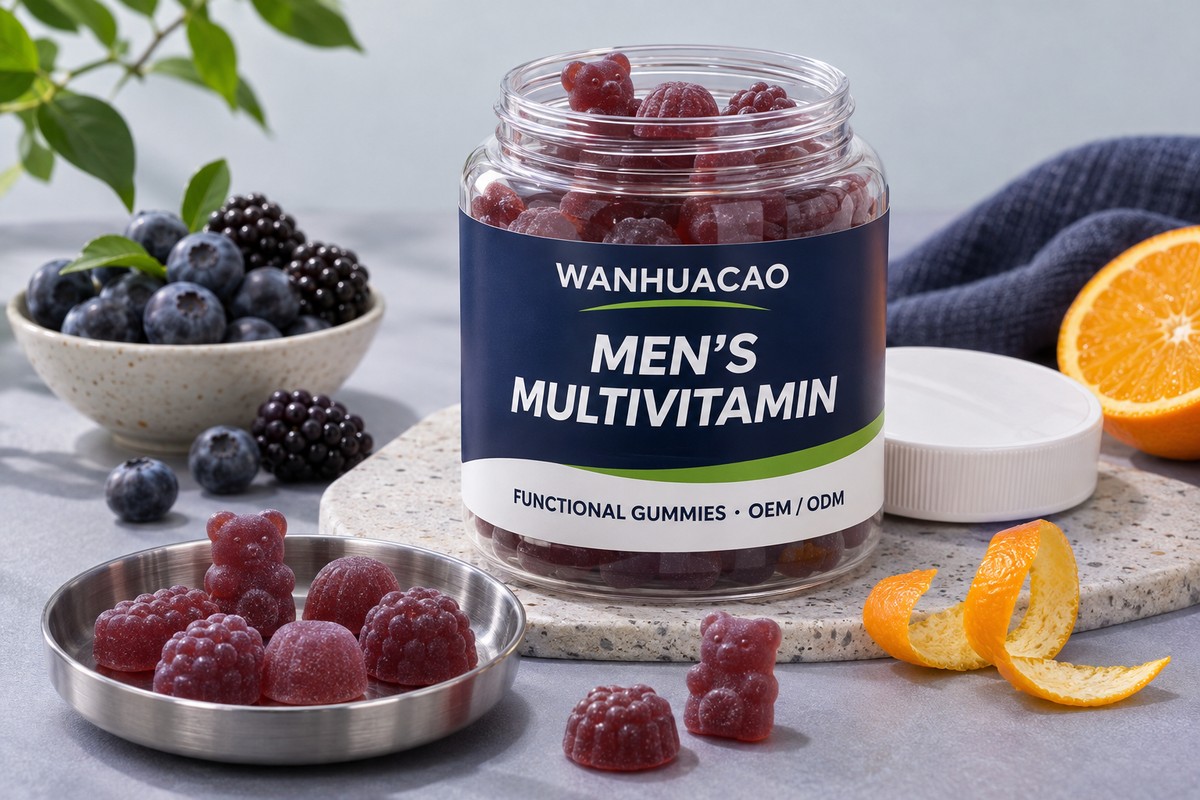
The threshold and the dose
European claim law does not regulate how much of a nutrient helps. It regulates how much a product must contain before it may use a sentence. The entry point is the word source, which Regulation 1924/2006 defines as 15% of the nutrient reference value, and for a supplement that percentage is read against the daily dose printed on the label.
Zinc's reference value is 10 mg, so the door opens at 1.5 mg a day. That 1.5 mg is the entire qualifying bar for the sentence Zinc contributes to the maintenance of normal testosterone levels in the blood, and for the seventeen other wordings in the same entry of Regulation 432/2012, among them normal fertility and reproduction, normal cognitive function, and the maintenance of normal hair, skin and nails. The same 1.5 mg qualifies the product for all eighteen, and the file contains no dose response anywhere.
A sixty count at two pieces a day is a thirty-day bottle, so the daily dose is two pieces and 1.5 mg spread across them is 0.75 mg each. Zinc gluconate is 12.9% zinc, which makes 0.75 mg of zinc about 5.8 mg of gluconate. In a 2.5 g piece that is a rounding error, and on a 600 kg batch it is a weighing that a junior operator can hit without a second check.
The 30 mg on the brief is a marketing number. The panel needs 1.5 mg, and 30 mg is twenty times that. The figure comes from a different document: a 1996 study by Prasad and colleagues, in which twenty weeks of dietary zinc restriction in four healthy young men was associated with serum testosterone falling from about 39.9 to 10.6 nmol/L, and repletion in nine marginally zinc-deficient older men with roughly 30 mg a day was associated with a rise from 8.3 to 16.0. Both groups were deficient before the intervention began, and the samples were four men and nine men.
Thirty milligrams came out of that study, and 30 mg is exactly where the European and American readings of the same evidence part company.
Two ceilings and one endpoint
The Scientific Committee on Food set the European upper level at 25 mg a day, taking a no-observed-adverse-effect level of 50 mg and applying a factor of two. The Institute of Medicine set the American level at 40 mg, taking a lowest-observed level of 60 mg and applying a factor of 1.5. The WHO and FAO went to 45 mg. The UK expert group set 25 mg for supplemental zinc alone, separately from food.
Two pieces at 15 mg is 30 mg a day. That is inside the American ceiling, 20% above the European one, and twenty times the amount the claim requires. The same bottle is compliant in Ohio and non-compliant in Ireland, and the formulation is identical.
Every one of those numbers was derived from the same endpoint: copper. Chronic zinc intake in the range of 50 to 75 mg interferes with copper absorption, and the consequences run from anaemia and low white cell counts to a sensory neuropathy that does not always resolve when the zinc stops. The IOM used suppression of copper-dependent superoxide dismutase at 50 mg of supplemental zinc as its critical effect. A men's gummy at 30 mg with no copper anywhere in the panel is a formula that has spent its safety margin on a study of nine men.
Where the fifteen milligrams go
Mass rarely decides which zinc salt a formula uses. Zinc oxide is 80.3% zinc, so 15 mg of elemental zinc is 18.7 mg of oxide. Zinc gluconate at 12.9% needs 116 mg of salt for the same 15 mg. Both fit inside a 2.5 g piece without touching the solids budget, and neither appears in a cost conversation that is dominated by the botanical.
What the salt does in the syrup decides more. Zinc oxide does not dissolve. It is dense, it settles in the holding tank between drops, and the last pieces off a run can carry more than the first. That turns content uniformity into the release test that matters, and uniformity is measured per piece, not per batch, because the consumer takes a piece. Zinc gluconate dissolves cleanly and tastes metallic and astringent at 116 mg in 2.5 g, which the sensory panel notices several weeks before the laboratory does.
A specification that says zinc 15 mg and stops there has not specified the product. The salt chooses the uniformity, the taste and the price, and the three do not move together.
The percentage column stops paying at 15%
Vitamins are sold the same way as zinc, in percentages of a reference value, and that column behaves like a set of switches rather than a dial. Vitamin B12's reference value is 2.5 µg, so its energy sentence unlocks at 0.375 µg. A men's formula carrying 500 µg is at 1,333 times the threshold, and the sentence it may print is identical to the one a 0.375 µg product may print.
Vitamin B6 shows the same shape with a ceiling attached. Its threshold is 0.21 mg. A 50 mg dose is 238 times that, and it is twice the European upper level of 25 mg a day, while sitting comfortably inside the American one of 100 mg. The asymmetry that punished zinc punishes B6 harder, because 50 mg of B6 is an ordinary amount to see on a men's energy SKU.
Magnesium is the one mineral where the switch is worth reaching. Its reference value is 375 mg, so the tiredness sentence unlocks at 56.25 mg, which is 93 mg of oxide or about 350 mg of citrate. That fits in a two-piece serving, and 56 mg buys the same sentence a 400 mg capsule buys.
Above 15% nothing else switches on. Every additional milligram is mass, taste, cost, and at the top of some ranges a ceiling, and none of it changes what the pack may say.
Five grams, and what is left of it
The piece is where the two currencies meet, so the arithmetic deserves to be done slowly. Two pieces at 2.5 g is 5 g. A gummy at a water activity of 0.6 sits near 16% moisture, which leaves 4.2 g of solids. A gel base at 70% of the piece takes 2.94 g of that, and what remains is about 1.26 g for everything the label is about.
Into that 1.26 g go the minerals, the vitamins, the acid that sets the gel, the colour, the flavour and the botanical. The minerals are almost free: 116 mg of zinc gluconate, a B-complex at 15 to 25 mg, vitamin D at 25 µg. The acid is 30 to 60 mg depending on the base. Flavour and colour together are usually under 20 mg.
Then the ashwagandha asks for 500 to 600 mg, which is 40 to 48% of the entire budget, before the sensory work, the overage and the water activity take their share. In a capsule, 600 mg is unremarkable. In a two-piece gummy serving it is half the product, and the other half has to remain a piece of candy that an adult will eat twice a day for a month.
The brief did not mention this collision. The zinc figure and the ashwagandha figure are both defensible on their own, and together they leave the formulator choosing which one gets the space.
Six hundred milligrams is a dose with a floor
Ashwagandha has no authorised health claim in Europe. The word adaptogen does not exist as a claim category in Regulation 1924/2006 and appears nowhere in the register, which is why a European pack sells stress and sleep through wording that never uses either term.
Canada is the one jurisdiction with a sentence and a number attached to it. The NNHPD monograph for Withania somnifera, dated 28 February 2025, covers adults eighteen and over and permits, for the adaptogen use, the statement used in Herbal Medicine as an adaptogen to help increase energy and resistance to stress over time. The dose range for that claim is 2.5 to 6.5 g of dried root or whole plant a day. The traditional Ayurvedic statements run 2 to 6 g.
The floor turns the extract ratio into a compliance calculation, which is why the ratio on the label matters more than the milligram figure beside it. A 500 mg dose of a 10:1 extract represents 5 g of crude root, which sits inside the Canadian range. The same 500 mg from a 5:1 extract represents 2.5 g, which sits on the floor. Three hundred milligrams of a 20:1 extract represents 6 g, close to the ceiling. Three labels can carry the same word on the front and stand for 2.5 g, 5 g or 6 g of root, so the ratio is the only thing that says which product you are holding.
Europe has no harmonised rule for herbal extracts in supplements, so the answer is per member state. Poland caps ashwagandha root powder at 3 g a day and withanolides at 10 mg in the daily portion. A 600 mg dose of a 5% extract carries 30 mg of withanolides, three times that cap. Denmark's food administration, on a risk assessment from the Technical University of Denmark, concluded that no safe level could be established and pulled the ingredient from the market, and Dutch, German, French, Swedish, Finnish and British bodies have since published positions of their own, several of them advising against use in pregnancy or by people with liver or thyroid conditions.
So the 600 mg is a quantity that works in Canada, works in the United States as a structure and function statement carrying the disclaimer, is a calculation in Poland, and is a wall in Denmark. The licence behind the extract is a separate question from the dose, and 300 mg of an unnamed extract is not a specification at all.
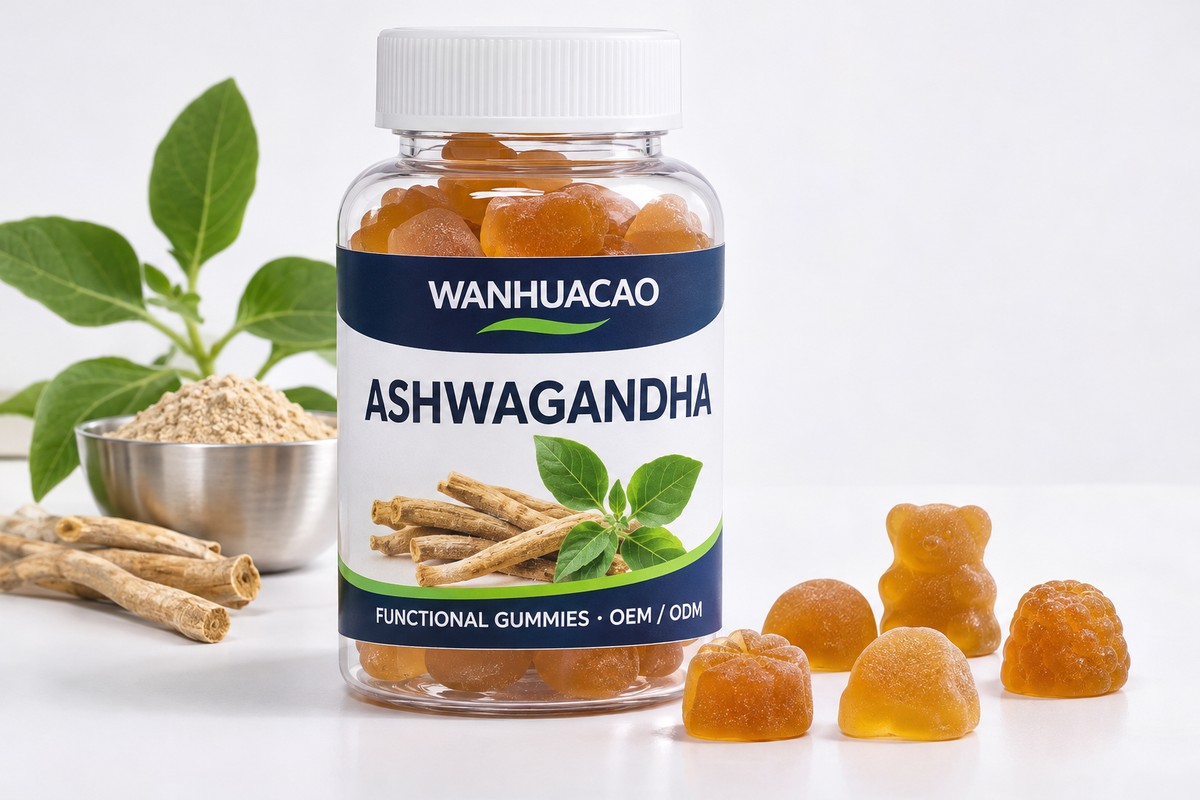
The men's panel is a subtraction
A men's multivitamin differs from the women's mainly by removing one ingredient, and that ingredient is iron. The American recommended intake is 8 mg a day for men and 18 mg for women of menstruating age, and the gap is the whole reason the two panels exist separately.
The reason a formulator raises first is chemical. Iron is a pro-oxidant. In a gel piece it catalyses the degradation of vitamins A, C and E, and it darkens the colour of anything it sits in. A formula with iron is a darker formula with a shorter vitamin shelf life, and both of those are decided by an ingredient that most men do not need.
Population arithmetic adds a third. Homozygosity for the HFE C282Y variant runs at roughly one in two hundred people of northern European descent, and that genotype is the common form of hereditary haemochromatosis, a condition in which absorbed iron is not regulated and accumulates. A men's formula sold across northern Europe without iron is sold to a population where one person in two hundred should actively avoid it.
Without iron, a men's gummy can be pale and translucent, and the colour of the candy can be the colour of the flavour. With iron, the piece goes dark and opaque, and the flavour has to follow the colour down. The category's two panels are therefore legible on the shelf without reading a word, which is the cheapest piece of differentiation in the whole product.
Colour, bitterness, and the camera at the end of the tunnel
Five hundred milligrams of root extract is 10 to 12% of a finished piece, and it arrives as a khaki powder with an earthy, faintly bitter taste. In a translucent gummy that reads olive. The two ways out are to make the piece opaque, which is a whitening agent and a different texture, or to move the flavour towards berry, where a dark red carries the shade instead of fighting it.
Masking the taste costs acid, and on a pectin base the acid is also the setting agent. Sweetener, acid, buffer and flavour move together, so the sensory work and the texture work are one job rather than two, and both of them sit downstream of a decision about which extract was bought.
The line measures the result whether or not anyone asks. A camera at the end of the cooling tunnel compares each piece to a reference and rejects what does not match, which means a shade shift from a new extract lot is counted piece by piece before a single consumer sees it. Colour is the one attribute a machine can check on every unit, so on a botanical product the visual specification is also the incoming-material specification.
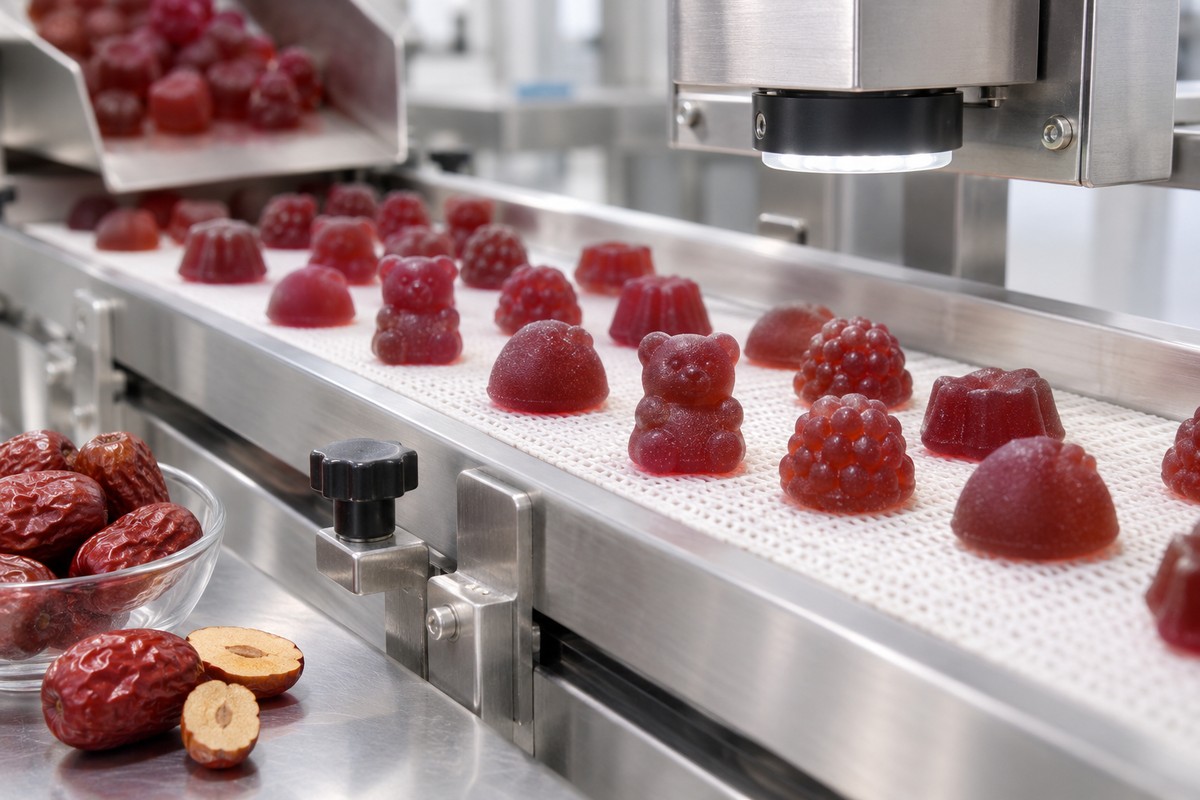
Toll means you rent the machine and keep the paper
Toll manufacturing is the narrowest of the outsourcing models. The brand supplies the actives, the packaging and the formula, and the processor supplies the building, the equipment, the labour and the quality system for a fee. Contract manufacturing moves sourcing to the processor. A CDMO moves the development. Toll moves nothing except the conversion.
The specification is what makes the product, and the factory is where it is executed. In a two-stream formula that distinction stops being philosophical. The vitamin premix comes from one supplier and the root extract from another, each with its own certificate of analysis, its own assay method and its own moisture. The cook sees only their sum.
Premix moisture is the one that catches people. A premix at 5% water instead of 3% adds solids that behave like water in the syrup, shifts the water activity of the finished piece and lengthens the cure. An extract at 8% moisture does the same in the other direction, and neither number appears on the label. A toll quote that does not name the incoming moisture, the particle size and the assay method is quoting a process, not a product.
Two more lines belong in the same document. The first is stability: toll arrangements document processing, and the twenty-four month date on the carton needs a protocol with real time points. If the brand owns the formula, the brand owns the protocol, and the factory supplies the batches. The second is the unit the toll is charged in. Per kilogram of syrup in and per kilogram of good pieces out are different contracts, and the difference is who pays for overfill and who pays for the tray that failed. A 2% piece-weight drift on one tonne is 8,000 pieces, which is either material shipped as air or a line item on someone's invoice.
There is a licence question on top of that when the extract is a branded one. KSM-66 is a trademark licensed to approved manufacturing sites, and in a toll arrangement the brand holds the licence while the site holds the equipment. A facility that is not on the approved list cannot make the claim, whatever the certificate of analysis says.
What the tags ask for
The two hashtags on the brief are not one audience. Ashwagandha traffic arrives from stress, sleep and cortisol. Adaptogen traffic arrives from people who already read labels and are looking for a stack. Neither of them is searching for a men's multivitamin, and the product that serves both has to answer a percentages shopper and a milligrams shopper in the same bottle.
The practical consequence sits in the pack size. Two pieces a day at sixty count is thirty days. The trials behind the ingredient ran six to twelve weeks, and a thirty-day bottle cannot reach the point where the outcome the marketing describes would be visible. That is a subscription product dressed as a trial, and the reviews that say nothing happened after two weeks are written before the formula had a chance to work.
The sample cost is easy to miss. A sixty count at 600 mg is 36 g of extract per bottle, which is more than a brand usually budgets when the piece was priced as candy. It is the single line where the two currencies on the brief turn into money.
Our own scope, in the same terms
The functional gummies line runs under a food production licence, and gel confectionery is covered by SGS certificate CN23/00007035, valid to 24 December 2026, alongside herbal tea, solid beverages and instant cereal powder. An export men's multivitamin built on that scope is the version we can sign for.
The health food licence, SC11434160205012, covers eight dosage forms and runs to 25 August 2030. Gel candy is not one of the eight, so a filed domestic blue hat gel candy is not a product we can manufacture, and that belongs in the first conversation rather than the week before artwork.
What we will not print is the part of the brief that usually causes the problem. Zinc may carry its authorised sentence and no more. Ashwagandha may carry a structure and function statement with a disclaimer in the United States, and in Europe nothing beyond the wording the destination permits. Boosts testosterone, clinically proven and supports hormonal health are not claims this format can carry in either market, and a formula built to support them is a formula that will be rewritten after the first import review.
If you have a panel, a destination and a count, send them over and the first reply will be about which of the two numbers has to move.
Ding Shaohua, Foreign Trade Manager at WANHUACAO, works with brands and distributors on men's multivitamin, adaptogen and functional gummy programmes from brief to first shipment, in bulk and in private label. The plant operates under SGS CN23/00007035 for gelatine confectionery and SC11434160205012 covering eight dosage forms. Reach him on WhatsApp, TikTok, LinkedIn and Facebook.
Frequently asked questions
How much zinc should a men's multivitamin gummy contain?
The legal minimum for the testosterone wording is 1.5 mg a day, which is 15% of zinc's 10 mg reference value. Most men's formulas declare 15 mg, and 30 mg a day is common. The European upper level is 25 mg a day from all sources and the American one is 40 mg, so a two-piece serving at 15 mg each sits inside the American ceiling and above the European one. The endpoint behind both is copper, which is why a high-zinc panel usually carries 1 mg of copper alongside it.
Can a gummy hold 600 mg of ashwagandha?
It can, and it will take about half of the space the piece has for anything that is not sugar, water or gel. Two 2.5 g pieces leave roughly 1.26 g for actives, so 600 mg of extract is 48% of the budget before flavour, acid and colour. The dose also has to be read as an extract equivalent: 600 mg of a 5:1 extract is 3 g of root, which sits inside Canada's 2.5 to 6.5 g adaptogen range, while 600 mg of a 5% extract carries 30 mg of withanolides, three times Poland's daily cap of 10 mg.
Why do men's gummies leave out iron?
Men need about 8 mg a day against 18 mg for women of menstruating age, so the nutrient is less often missing. Iron is also a pro-oxidant in a gel piece, accelerating the loss of vitamins A, C and E and darkening the colour, and roughly one in two hundred people of northern European descent carry two copies of the HFE C282Y variant, the common form of hereditary haemochromatosis. The absence of iron is also what keeps the piece pale and translucent, so the difference between the men's and women's panels is visible before the label is read.
What does toll manufacturing change about the specification?
The specification becomes the product, because the processor is only converting materials the brand supplied. That makes the incoming specification the document that decides what ships: moisture of the vitamin premix, moisture and particle size of the extract, and the assay method for both, since the cook sees only their sum. It also fixes who owns the stability protocol behind the shelf life, and whether the toll is charged per kilogram of syrup in or per kilogram of good pieces out, which decides who pays for overfill and rejects.