The first question about an NMN gummy is not whether the dose fits. It does. A 250 to 500 mg serving sits in two pieces of three grams at a load the format handles comfortably.
The first question is where the product is going to be sold. In the EU, at the time of writing, the answer is nowhere: NMN is a novel food without authorisation, and a finished NMN gummy cannot be placed on the market there at all.
The dose is the easy part
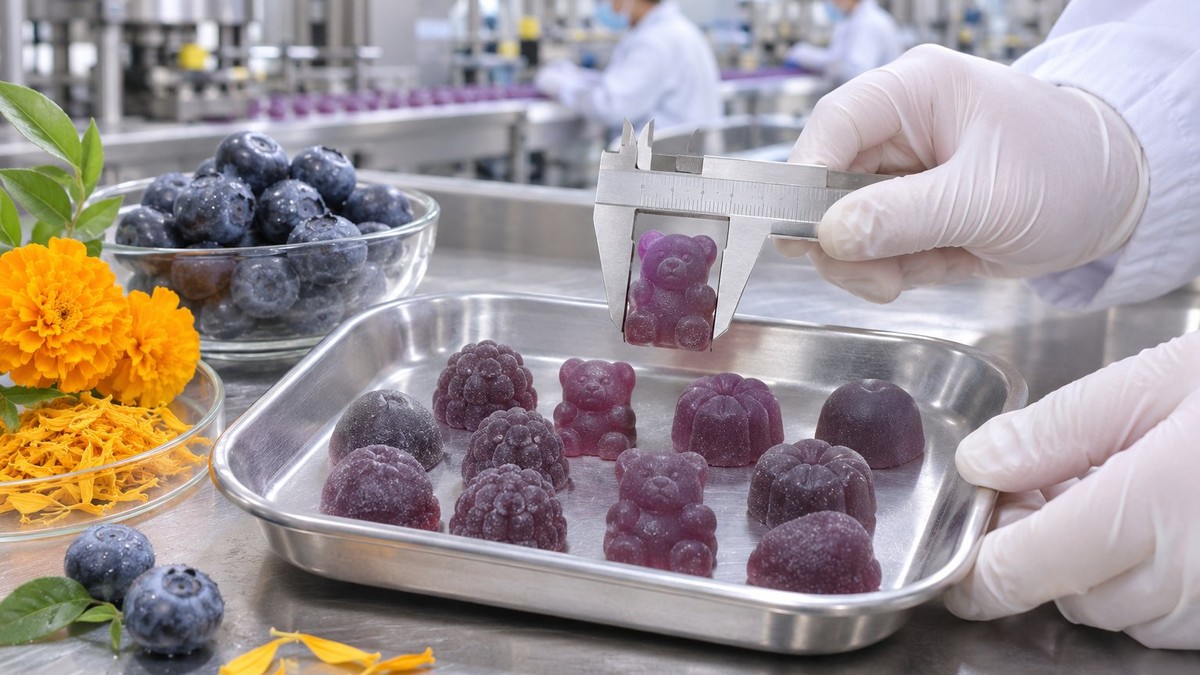
NMN is a small molecule and a well-behaved powder. A three gram gummy at 16 per cent loading carries 480 mg, which covers the 250 to 500 mg range used in the published human work in two pieces a day. Texture holds at that load, bitterness is manageable, and no unusual equipment is needed.
Compare that with the ingredients that fight the format — calcium crosslinking a pectin, curcumin staining a hopper — and NMN looks easy. Which is why so many NMN gummies exist and why almost none of them are formulated around the actual difficulty.
Water is the difficulty
β-Nicotinamide mononucleotide degrades in aqueous solution by apparent first-order kinetics, and the rate is dominated by temperature and pH. In the degradation work published in 2023, the room-temperature aqueous figures were a t90 of 95.6 hours and a half-life of 860 hours — about four days to lose ten per cent, about thirty-six days to lose half. Strong acid and strong alkali accelerate it. Low temperature, neutral to mildly acidic conditions and, above all, the absence of water slow it down.
A gummy is not an aqueous solution. It is a gel with a water activity somewhere between 0.5 and 0.7, and that is the whole argument for why an NMN gummy can work at all. But it is also why the piece has to be designed around moisture from the first line of the formula rather than from the stability study.
The practical levers are narrow and they interact:
- Water activity below 0.5 is the single biggest factor. That points to a polyol base rather than a sucrose-glucose syrup, and to a pectin or starch system that sets without needing high solids.
- Low deposition temperature. NMN is added as late and as cool as the gel allows. Every ten degrees at the nozzle moves the degradation curve.
- pH near neutral to mildly acidic. Not a fruit-acid-forward formula. A sour gummy and a stable NMN gummy are pulling in opposite directions.
- A moisture barrier. A foil pouch or a high-barrier bottle with a desiccant, specified at the packaging stage rather than discovered at the end.
Each of those is a cost. A polyol base is more expensive than sugar and brings the laxative labelling threshold with it. A low deposition temperature narrows the process window. A barrier pack costs more than a clear PET jar and hides the product.
NAD+ on the label and NMN in the piece
A pack that says NAD+ and a pack that says NMN are not the same product, and the difference is not marketing.
NAD+ itself is a dinucleotide. It is not absorbed intact from the gut in any meaningful quantity; the cells that need it make it, from precursors. The precursors that have been studied are NMN and nicotinamide riboside, and the doses in the human work sit at 250 to 500 mg for NMN and 150 to 300 mg for NR.
So an "NAD+ gummy" is, in practice, a precursor gummy. Whether the label says NAD+ or NMN, the piece contains a precursor, the assay is run on that precursor, and the number on the front panel is that precursor's milligram figure. A product that prints "NAD+" and loads NR is not lying exactly, but the buyer comparing two packs is comparing two different molecules unless the ingredient list is read.
Two jurisdictions, two answers
The regulatory file on NMN has moved more than any other ingredient in this category over the last four years, and the movements have not been in the same direction everywhere.
In the United States, the FDA accepted an NMN new dietary ingredient notification in 2022 and then reversed position in November of that year, on the basis that NMN had been investigated as a new drug, which triggers the drug exclusion clause. Industry litigation and a citizen petition followed, enforcement was stayed, and by late 2025 the agency had confirmed that NMN is not excluded and restored its status as a dietary ingredient. A US-bound NMN gummy is therefore workable, with the caveat that the file has been unstable and could move again.
In the EU, NMN remains an unauthorised novel food. It cannot legally be sold as a food or food ingredient. The Rapid Alert System has logged a series of notifications against NMN products on exactly that ground, and the safety evaluation that opened at EFSA in July 2025 — on an application from a Chinese manufacturer — is a step towards authorisation, not authorisation itself.
For a contract manufacturer, this is the first thing to establish with a client, before any formula work: which market the pack is for. An EU-bound brief is not a formulation problem, it is a legal one, and no amount of process engineering fixes it.
Japan took a different route, adding NMN to its list of ingredients not treated as drugs and later accepting it in the functional food notification system. Canada lists it in the natural health product framework. The same powder is a legal ingredient in one market and an unauthorised novel food in another, on the same day.
Assay at the end, not at the start
The number that matters on an NMN gummy is the assay at the end of shelf life, measured in the pack the product ships in.
That is not the same as the loading figure. A formula loaded at 500 mg to deliver 400 mg at month eighteen is a normal arrangement; a formula loaded at 500 mg with no end-of-life data is a guess. The degradation curve above is steep enough that the two cases are commercially different products.
The test methods matter too. NMN is quantified by HPLC at 266 nm with a C18 column and a formate buffer, and the method has to resolve NMN from nicotinamide and from the riboside, because those are what it turns into. A method that measures only "total nicotinamide-related compounds" will pass a piece that has largely converted.
Water activity belongs on the same certificate. It is the variable that predicts the assay drift, and it can be measured on the finished piece in minutes.
What a 500 kg batch settles
Five hundred kilograms at three grams is about 166,000 pieces. At 480 mg of NMN per piece — two pieces per 500 mg serving with a small margin — the batch needs about 80 kg of NMN.
That is a large single purchase of an ingredient whose price has moved with its regulatory status, and it is the reason NMN projects tend to be quoted with a shorter price validity than a vitamin project.
The batch also has to fix the base and the pack before the price means anything. A polyol base at water activity below 0.5 and a foil pouch is a different cost from a sucrose base in a clear jar, and only the first one is likely to hold the assay for the shelf life the buyer is asking for.
For buyers comparing formats, the functional gummies line is where piece weight, water activity and pack are set together. The moisture and cure side is described under gummy shelf life and stability, and the assay side under gummy quality control testing.
Ding Shaohua, Foreign Trade Manager at WANHUACAO, works with brands and distributors on functional gummy programmes from brief to first shipment, in bulk and in private label, including nucleotide and low-water-activity formulas. The plant operates under SGS CN23/00007035 for gel confectionery and SC11434160205012 covering eight dosage forms, sports nutrition supplements among them. Reach him on WhatsApp, TikTok, LinkedIn and Facebook.
FAQ
Can NMN survive in a gummy at all?
Yes, with the right base. The constraint is water activity and temperature, not the format. A polyol base below 0.5 aw, late addition at the coolest workable temperature and a moisture-barrier pack is the combination that holds an assay; a sucrose syrup in a clear jar is the combination that does not.
Does an NMN gummy need to be sold as NAD+?
They are different molecules. NAD+ is not absorbed intact, so a gummy sold on NAD+ contains a precursor — NMN or nicotinamide riboside — and the assay is run on that precursor. The ingredient list should name which one and at what milligram figure.
Why can't an NMN gummy be sold in the EU?
NMN is an unauthorised novel food. It cannot legally be placed on the market as a food or food ingredient, and products containing it have been notified through the EU rapid alert system on that basis. A safety evaluation opened at EFSA in 2025, but an evaluation is not an authorisation.
Is the US position stable now?
It has been restored, after a 2022 reversal that was reversed again by late 2025. The point for a buyer is that the file has moved twice in three years, so the market a pack is destined for should be confirmed before the formula is fixed.
How much overage does an NMN gummy need?
It is calculated from end-of-life data in the actual pack, not applied as a rule of thumb. The degradation curve is steep enough that an overage picked without data is either wasted ingredient or a failed specification.