
Search for best private label herbal tea and you get rankings. Minimum order, lead time, certificates, review scores, sometimes a rating out of five. Every one of those is a property of a supplier. None of them is a property of the tea.
The tea gets judged nine months after it ships, in a cup, by somebody who has already paid for it. Between the sample you approve and that cup sit three losses that no ranking measures: what leaves the bag, what enters it, and what separates inside it.
Each of the three can be measured before a carton is printed, with a scale, a glass and a cupboard.
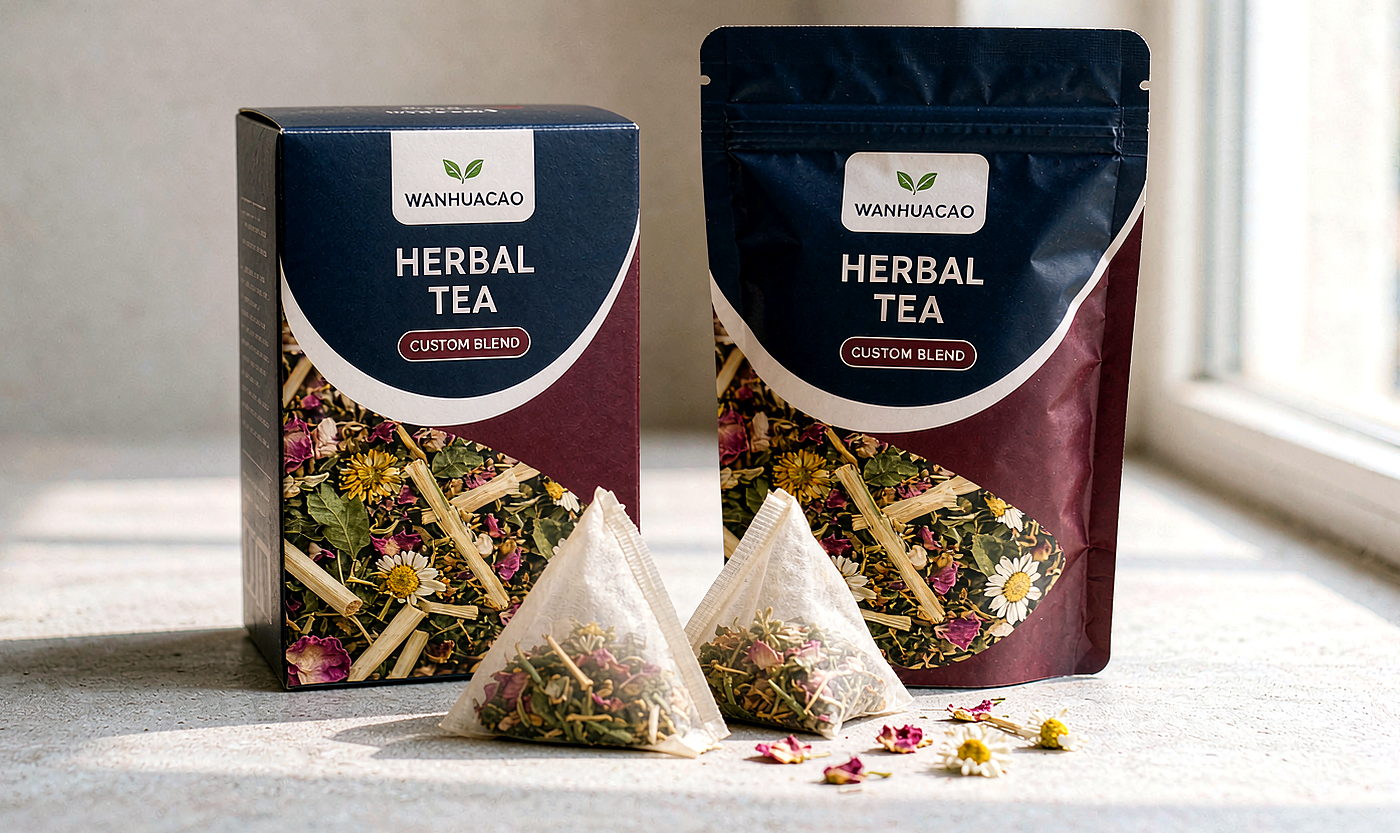
A ranking ranks the supplier, not the tea
Lists are built from catalogue attributes because those are the attributes a catalogue carries. Minimum order is real. Certificates are real. A plant that cannot show you a licence detail page is not a candidate, and the difference between a plant, a co-packer and a trader decides more about your first order than any score does.
But two suppliers with identical minimums, identical certificates and identical review scores will hand you two different cups. The variables that separate them are not hidden. They are just not on a comparison table.
They are the particle size distribution of the blend, the moisture of the material at the moment it goes into the filler, and the amount of air and water vapour the pack lets through over a year. One of those is a decision you make. Two are measurements you can ask for.
The sample room is a bad instrument
A sample arrives in a pouch, gets opened at a bench, and is brewed within the hour. That is the best that tea will ever be. It has not travelled, it has not sat in a warehouse through a summer, it has not been opened and closed four times in a customer's kitchen, and it is being brewed by someone who wants it to taste good.
None of this makes the sample dishonest. A sample is a fair test of the recipe and a poor test of the bag it will be sealed in.
Three of those gaps decide most of the difference. A sample pouch holds twenty or fifty grams and gets opened once; a retail carton holds twenty sachets and gets opened twenty times, each opening exchanging the headspace. A sample travels in a courier box for three days; the retail pack travels in a container for six weeks and then sits in a distribution centre. And a sample is brewed at whatever strength the person at the bench prefers, which is usually stronger than the ratio printed on the carton.
Approving a sample means approving a recipe. What reaches a shelf is that recipe after the pack and a year of time have worked on it.
What leaves the bag: the aromatics
Herbal aroma is volatile by definition. The molecules that read as chamomile, peppermint or lemongrass are small, and small molecules leave a leaf at room temperature. They leave faster when the leaf is warm, and faster still when the leaf has been cut, because cutting multiplies the exposed surface.
Two consequences follow, one about cutting and one about packing.
The first is that whole leaf holds its aroma longer than fannings, and not because it is better leaf. It is the same leaf with fewer cut faces. A blend quoted with fannings will smell correct on the day it is filled and flatter by the time the carton reaches a shelf.
The second is that every opening costs something. A stand-up pouch that is opened and resealed in a kitchen exchanges its headspace each time. This is why a one-hundred-gram pouch of loose leaf can taste tired at the bottom while the sachets in a carton, each one sealed until use, taste the same on the last day as on the first.
What the pack does about it is a set of choices with prices attached: an individual overwrap per sachet, a coated rather than uncoated carton, a foil layer rather than paper alone, or none of these. Light matters alongside air: chlorophyll and petal colour fade under retail lighting, and a blend that goes brown in the box reads as old before it is opened.
Ask which barrier the format uses, whether there is an overwrap, and whether anyone has brewed the same lot at the start and the end of a twelve-month retention test. A supplier who has run that test can describe what changed. A supplier who has not will describe the pack instead.
What enters the bag: water
Dried botanical is hygroscopic. It arrives at whatever moisture the drying process left, and from then on it equilibrates with whatever air surrounds it. A cool dry store keeps that number where it was. A humid store hands the problem to the filler, and the filler hands it to the carton.
Moisture does three things to a herbal blend, in this order.
It dulls the aroma, because the volatile fraction partitions into water and stays in the leaf instead of reaching the cup. It raises water activity, which is the number that decides whether a sachet grows mould at the seam during a container crossing the equator. And it makes sticky botanicals clump: licorice root, dried fruit pieces, anything with sugar on the surface. That is a filling problem before it is a quality problem.
The failure that shows up first is rarely mould; it is a bag that smells of cardboard. Paper pouches and uncoated cartons pass water vapour in both directions, and what comes through carries the pack's own smell with it. A blend can be perfectly in specification and still taste of the box it lived in.
Dust belongs here too, because dust and moisture meet at the same place. Herbal material sheds fines at the sieve and at the filler. If there is no extraction at the filling head, those fines settle across the seal face, and a seal made over dust is a weak seal: it holds at the start of the run and leaks at the end. The visible result is a sachet that floats in the cup.
So the numbers worth asking for are the moisture of the blend as it enters the filler (not the raw material certificate, which describes a delivery that may be months old) and the water vapour transmission of the pack. If nobody can name either, the pack was chosen for how it prints.
What separates inside the bag: the particles
A herbal blend is a mixture of materials with different densities and different particle sizes: leaf, petal, root, seed, dried fruit. Put them in a carton and shake it, which is what a lorry does for four hundred kilometres, and they sort themselves. Root and fruit sink. Leaf and petal rise.
The result is that the first sachets filled from a carton and the last ones are not the same product. The difference is small and it is not random: it runs in one direction, so it repeats in every carton of the run. A customer notices this on the second purchase, not the first, which is the most expensive moment to find out.
Three things reduce it. Cutting the blend to a narrower particle band so the components behave more alike. Granulating or coating sticky fruit so it does not segregate by weight. And filling in an order that keeps the hopper mixed rather than letting it draw down a settled bed.
Extraction runs on the same variable from the other end. Finer particles give up their flavour faster and cloud the cup; whole leaf gives it up slowly and brews clear. Neither is better in the abstract. A three-gram mesh sachet in a mug wants leaf with room to expand. A two-gram paper bag in a catering urn wants a faster, more forgiving fill.
The format sets the ceiling
The bag is a machine before it is a presentation choice, and the machine decides fill weight, tolerance, seal type and the price floor.
On this line, a pyramid sachet carries two and a half to three grams in mesh, sealed ultrasonically along folded seams. A paper filter bag carries about two grams, heat sealed, with or without string and tag. Those are different products before anything is blended, because cup strength is grams against water: the same blend at 1.8 grams in a 200 ml cup is a weaker drink than at 2.4 grams, and no amount of better leaf closes that gap.
Mesh shows the leaf, which sells a herbal blend in a way a paper bag cannot, and costs more per bag in material. Paper is faster on the machine, holds aroma differently, and drains more slowly because the fibres hold water. A supplier who quotes both formats at the same price per bag is either very large or has not checked which machine your order lands on.
The carton is part of the format, not packaging around it. Board weight, coating, and whether the box is glued or folded decide both the barrier and a real share of the unit cost. A carton chosen because it photographs well can be the thinnest barrier in the pack.
The ratio printed on the carton is part of the product
Every carton carries a brew instruction, and most buyers read it as advice. It fixes grams against millilitres, which is the only thing that decides strength, and the fill weight was chosen with that number in mind whether or not anyone said so.
The arithmetic is simple enough to do in a meeting. Two grams into two hundred millilitres is one gram per hundred. Two and a half grams into two hundred and fifty is the same drink. Three grams into three hundred is also one per hundred. The same three-gram sachet in a two-hundred-millilitre mug is one and a half, half again as strong, from one product carrying one instruction.
This is why a fill weight is never just a cost lever. A supplier who quotes 1.8 grams has decided, in effect, that the instruction says one hundred and eighty millilitres, and the customer who fills a normal mug will find the tea thin without being able to say why.
Catering is a different arithmetic and a different sachet. A five-litre urn and a retail mug pull the same leaf at very different ratios, so the catering pack and the retail pack are not interchangeable even when the blend is identical. A supplier who quotes one price for both has not thought about the urn.
Then there is the part the buyer does not control: people under-fill and over-steep. How a blend behaves when it is left four minutes too long is a function of particle size, and it is the difference between a tea that gets a second purchase and one that gets a review about bitterness. Finer material gives up its tannins and its aromatics fast and turns harsh early. Whole leaf is slower at both ends, which is a robustness argument as much as a flavour argument.
So ask what fill weight and what instruction the supplier is proposing together, and whether anyone at that plant has brewed the instruction as written before it went onto a carton.
Four tests that separate best from well described
None of these requires a lab, a relationship or a deposit.
- Weigh ten sachets from one carton. On a scale that reads to 0.1 g. The spread tells you the filler's tolerance, and the average tells you whether the machine is running at the bottom of it.
- Brew the first and the last. Two sachets from the top of a carton and two from the bottom, same water, same time, tasted blind. If they differ, the blend segregates and the fill order is not holding it.
- Look at the seal under a raking light. A seal line with fines trapped in it is a leak waiting for a hot cup. Hold the sachet up and look along the seam, not at it.
- Give one pouch a warm cupboard and a few weeks. Then brew it against a fresh one. This is not an accelerated shelf-life study, and it does not need to be: it tells you which direction the product moves, and how fast.
Where this leaves the brief
The best supplier for a two-hundred-thousand-bag programme of two-gram paper bags is not the best supplier for a ten-thousand-bag first run of three-gram pyramids. Both statements can be true at once, which is why a ranking that ignores your format is answering a different question than the one you asked.
What decides it is narrower and duller than "best": the format your order fits, the moisture at the filler, the particle band the blend is cut to, and the barrier between the tea and the year ahead.
If you are building a herbal tea range and want the format question answered against a specific market, send the brief with the destination, the blend and the pack. Formats, minimums, bag materials and certificate coverage are set out on the herbal tea OEM page. The supplier side (plant, co-packer or trader, and the six questions that separate them) is in which of the three you are buying from, and the regulatory side of the same project is in the three layers inside one tea bag.
FAQ
Is the most expensive private label herbal tea the best one?
Not reliably. Price tracks leaf grade, format and order size far more than it tracks the cup. Two sachets at the same price per unit can differ by fill weight and by particle size, and those two variables decide more of what the customer tastes than the leaf's origin does. The expensive blend made with fannings in a thin carton is a worse product than the mid-priced one made with leaf in a coated box.
What shelf life can I put on a private label herbal tea?
It follows from the pack, not from a table, and it is why the barrier question comes before the artwork. A sachet sealed individually inside a coated carton holds its aroma longer than loose material in a paper pouch, so the two cannot carry the same date. Ask what retention test the supplier has run on the format you are buying, and set the date from that rather than from a number that appears on a competitor's box.
Whole leaf or fannings for a first order?
It depends on the format and on where the product is drunk. Whole leaf in a mesh pyramid gives room to expand, a clear cup and a visible leaf through the mesh, at a higher material cost per bag. Fannings extract faster and cost less, which suits paper bags and catering use, and reads as flat and dusty in a retail cup. A first order is usually better served by one format done properly than by two formats quoted at the same price.
Can the carton say the tea is the best?
Comparative superlatives are a claims question in every market, and a private label buyer is the party who owns the exposure. What can be stated is what is measurable and true of the product: the format, the fill weight, the ingredients, the origin of the blend, the absence of added flavour where that is the case. Claims that rank the product against others need substantiation that a supplier's marketing copy does not provide.
Ding Shaohua, Foreign Trade Manager, takes the enquiries that arrive this way. The same person answers on WhatsApp, TikTok, LinkedIn and Facebook, and the sample questions usually arrive by WhatsApp first.
All News