
A hair growth gummy brief usually contains two ingredients and one promise. The promise is the problem, and so is the fact that the two ingredients are measured on scales a thousand times apart.
Biotin is specified in micrograms against a threshold that unlocks a sentence at 7.5 µg. Silica is specified in milligrams against no threshold at all, because silicon has no authorised claim in Europe and no reference value to compare against. A specification that treats the two numbers the same way will be wrong about one of them.
Growth is the word that cannot go on the pack
In the European Union the only authorised claim for biotin and hair is a maintenance sentence: biotin contributes to the maintenance of normal hair. It is available from 7.5 µg per daily dose, which is 15 per cent of the 50 µg nutrient reference value. There is no growth claim, and there is no biotin claim for nails either, because the data submitted were not sufficient.
Maintenance says the nutrient is needed for normal hair. It does not say that more of it produces denser, faster or stronger hair. A pack with 5,000 µg and a pack with 10 µg can carry the identical sentence, and the pharmacy shelf invites exactly the comparison the regulation refuses to make.
The United States allows structure/function claims, and draws the line at disease. Hair loss is treated as a condition with causes a doctor investigates, so a product that says it grows hair is making a drug claim, and the enforcement record follows the wording, not the intent. Testimonials do not help, because an endorsed claim is held to the same substantiation standard as a claim the company writes itself.
The practical answer is to name the nutrients and let the consumer draw the conclusion. It reads weaker on a marketplace listing. It also survives a review, a retailer audit and a competitor's complaint.
Where the biotin number lands
The nutrient reference value for biotin is 50 µg, and the percentage on the panel is calculated against it, which is why a 5,000 µg piece shows 10,000 per cent.
No tolerable upper intake level has been set for biotin, because the data for a quantitative risk assessment do not exist. That absence is often read as permission to put in ten thousand micrograms, and legally it is. It buys nothing on the claim and it costs money per kilogram of finished goods.
There is one place where the number has a real consequence. High-dose biotin interferes with immunoassays that use the biotin streptavidin system, and the interference starts well below the doses sold as beauty supplements. A consumer taking 5,000 µg daily who has a thyroid or cardiac troponin test can get a result that describes the supplement and not the patient. The lab side of that is covered in biotin and collagen gummies, where the serving arithmetic is set out.
For a hair gummy the working range is a few hundred micrograms, which clears the claim threshold by two orders of magnitude and stays away from the assay problem.
Silica carries no claim at all
Silicon has been assessed repeatedly and never authorised. EFSA reviewed claims for silicon on collagen and connective tissue formation, normal bone, normal joints, skin elasticity, and the formation of hair and nails, and found no cause and effect relationship for any of them. The EU register holds nine silicon entries and all nine are non-authorised.
Silicon also has no nutrient reference value, in the EU or in the UK, which means there is no percentage to print and no reference amount that makes a dose comparable. EFSA's 2004 review put usual dietary intake at 20 to 50 mg of silicon a day, which is the closest thing to a benchmark the category has, and it describes a diet and does not set a recommendation.
So on a hair gummy the claim is carried entirely by the vitamins and minerals: biotin for hair and skin, zinc at 1.5 mg for skin, hair and nails, selenium at 8.25 µg for hair and nails. Silica sits on the panel as a declared ingredient with a number beside it and no sentence attached. That is a legitimate reason to include it and an illegitimate reason to build the front panel around it.
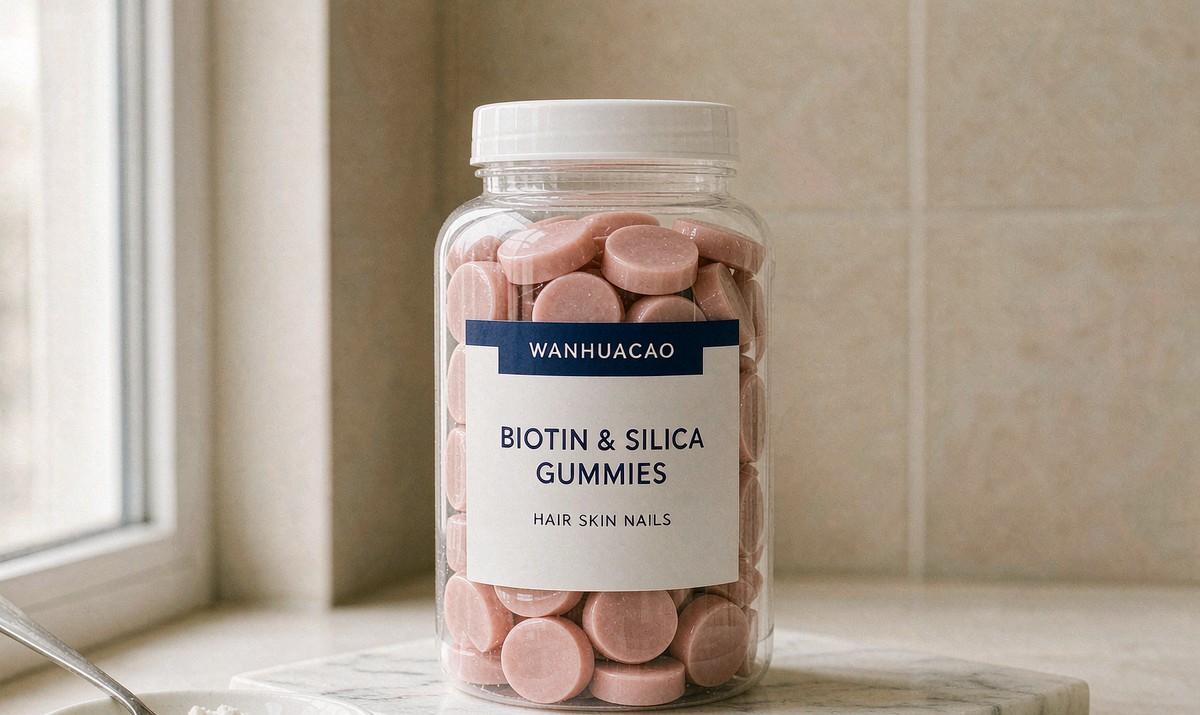
Silicon or silicon dioxide, a factor of 2.14
This is the arithmetic that decides whether a specification means anything.
Silicon has an atomic mass of 28.09 and silicon dioxide has a formula mass of 60.08. One milligram of silicon is 2.14 mg of silicon dioxide, and one milligram of silicon dioxide is 0.47 mg of silicon. A label that says "silica 10 mg" may mean 10 mg of the dioxide, which is 4.7 mg of silicon, or 10 mg of elemental silicon, which is 21.4 mg of the dioxide. Both readings appear on real products and they differ by a factor of more than four.
The trials that people cite used elemental silicon, 10 mg a day. In a nine month study in 48 women with fine hair, hair cross-sectional area rose significantly against placebo, and the loss in tensile strength over the period was smaller. In a twenty week study in 50 women the primary endpoints were skin measures, with hair and nail brittleness self-rated as secondary outcomes.
A ten milligram silicon dose is also a small fraction of what a normal diet supplies, which is worth knowing before a front panel implies that the piece corrects a deficiency. It is a supplement to a diet that already contains twenty to fifty times that amount.
Four silica sources, one of which absorbs
The word silica on a specification can describe four different materials.
Choline stabilised orthosilicic acid is the absorbed form, and it is the one used in the hair, skin and nail trials. Stabilisation is what keeps it from polymerising in the bottle, and it is why this form arrives as a liquid and not as a powder.
Colloidal silicon dioxide, E551, is an anti-caking and glidant used at 0.5 to 1 per cent in powders and capsules. Its absorption is low, and its role is processing, not nutrition. Many gummy formulas already contain it and it has nothing to do with the number on the front panel.
Bamboo extract is high in silicon, mostly as the dioxide, and no human hair study of bamboo extract exists. Horsetail extract carries silica plus thiaminase, an enzyme that degrades thiamine, which is a reason to leave it out of a product taken daily for months.
The question to put to a supplier is which of the four, and whether the number on the certificate is elemental silicon. Extract specifications in general are covered under botanical extract specifications.
If nails are on the label, biotin cannot carry them
Hair, skin and nails is one phrase on a pack and three different claim positions in the regulation, and that is why almost every product in the category is a combination and not a single nutrient.
Biotin carries hair and skin. It does not carry nails, because the data submitted were judged insufficient. Zinc carries skin, hair and nails at 1.5 mg. Selenium carries hair and nails at 8.25 µg. So a pack that promises nails has to deliver zinc or selenium, and the biotin number on the front panel does nothing for that promise however large it is printed.
Selenium is also the one mineral in this group where more is genuinely worse. The tolerable upper intake level is 400 µg a day, and the U shape is not theoretical: a mislabelled supplement in the United States in 2008 delivered roughly 41,750 µg a day to 201 people, and about 70 per cent reported hair loss and about 61 per cent nail changes. A hair product with a selenium error produces the exact symptom it is sold to fix.
That is the argument for treating the mineral side of a hair gummy as a specification with limits on both ends, and for printing the percentage of the reference value instead of a round number.
What a liquid active does to a gel
Here the formula meets the process, and the process usually wins.
Orthosilicic acid is supplied as a stabilised aqueous solution, so the dose arrives with water attached. Ten milligrams of silicon as ch-OSA arrives dissolved, and the mass of solution that carries it is many times the mass of the silicon itself. In a four gram piece that water has to come out of the sugar or polyol budget or be cooked off in the tunnel. Either way it changes the water activity, the cure time and the texture, and the change lands on a formula that was probably specified for a dry vitamin.
A powdered silica source avoids the water and loses the trial evidence. That trade is the honest one to put in front of a brand: the form with data is a liquid, and a gummy has to be reformulated around it and not simply dosed at the end of the cook.
Biotin itself is easy. It is potent at micrograms, it has no taste at any sensible dose, and it does not colour the piece. The colour and flavour in a hair gummy are free choices, which is why the category runs berry, peach and rose.
What a private label supplement manufacturers list will not tell you
A private label supplement manufacturers list is ranked on capacity, certifications and price. For this formula the three questions that matter are not on any of them.
The first is what the silica certificate reports. A number in milligrams with no statement of whether it is silicon or the dioxide cannot be turned into a dose, and a specification written from it cannot be checked at goods inwards.
The second is whether the biotin claim is being carried by one piece or by three. At 7.5 µg the threshold is trivially met; the arithmetic that matters is whether the label instructs one piece or three, because that number sets the bottle's days and the consumer's actual intake. The serving question is covered in more detail under collagen and biotin beauty gummies.
The third is who signs the stability study. A liquid active in a gel, at a water activity chosen for texture, is a combination that needs its own study and cannot borrow a dry vitamin's. The signature that supports the expiry date should belong to the party that ran the study, and on a private label order that party is the plant.
None of this is a reason to distrust a list. It is a reason to use one for what it measures, which is whether a plant can run your volume, and to bring the three questions above to the conversation that follows. The tags #B2BManufacturing and #ManufacturingPartner describe two different relationships, and this formula sits more easily in the second: a partner who reads the silica certificate before quoting.
The specification that survives a review
Put the constraints together and the product is small and specific. A biotin dose in the low hundreds of micrograms, which clears the claim and stays clear of the assays. A zinc and selenium contribution if nails are on the pack, because biotin carries no nail claim. Silica declared as elemental silicon with the source named, at or near the ten milligrams the trials used, and a front panel that describes the nutrients and stops short of the outcome.
Everything else, the colour, the flavour, the shape, the bottle, is a design decision with no regulatory consequence. That is where a hair gummy has room to be a good product, and it is a larger space than the front panel suggests.
Our functional gummies line runs pectin and gelatin bases on separate depositors, which matters for a formula carrying a liquid active, because the water budget differs between the two.
Ding Shaohua, Foreign Trade Manager at WANHUACAO, works with brands and distributors on functional gummy programmes from brief to first shipment, in bulk and in private label, including mineral and vitamin combinations. The plant operates under SGS CN23/00007035 for gel confectionery and SC11434160205012 covering eight dosage forms, sports nutrition supplements among them. Reach him on WhatsApp, TikTok, LinkedIn and Facebook.
FAQ
Can a gummy say hair growth?
Not lawfully in the EU, where the only available wording is maintenance of normal hair, and not safely in the United States, where hair loss is treated as a condition and a growth claim becomes a drug claim. Name the nutrients and the amount, and let the pack describe what it contains.
How much biotin belongs in a hair gummy?
Enough to clear 7.5 µg, which is 15 per cent of the reference value, and not so much that a routine blood test is affected. A few hundred micrograms does both. Five thousand micrograms changes the percentage on the panel and nothing else.
Is bamboo silica the same as the silica in the trials?
No. The trials used choline stabilised orthosilicic acid at 10 mg of elemental silicon a day. Bamboo extract is largely silicon dioxide, which absorbs poorly, and no human hair study of bamboo extract was located for this article.
Does silica have a health claim in the EU?
None. Every silicon claim assessed has been refused, nine of them are on the register as non-authorised, and there is no reference value for silicon to compare a dose against. A silica number on a pack is a declaration, not a claim.