
A cup of chamomile was left on the sampling table for four minutes, long enough to go the colour of weak honey. The tag stood against the rim, its paper already translucent where the tea had climbed into it. The string was still attached to the bag. The staple had opened a small tear in the corner of the tag, and by the end of the second steep the tag was hanging by one leg.
Nobody in the room was tasting the tea any more. Six people were looking at a piece of paper the size of a postage stamp.
A drinker touches the tag twice, once dry and once wet, and it is usually the last line on a quotation. It is also the part with the most moving pieces: a paper, a print, a string, a knot, and a joint that has to hold in hot water without putting metal into a compost stream or a cup.
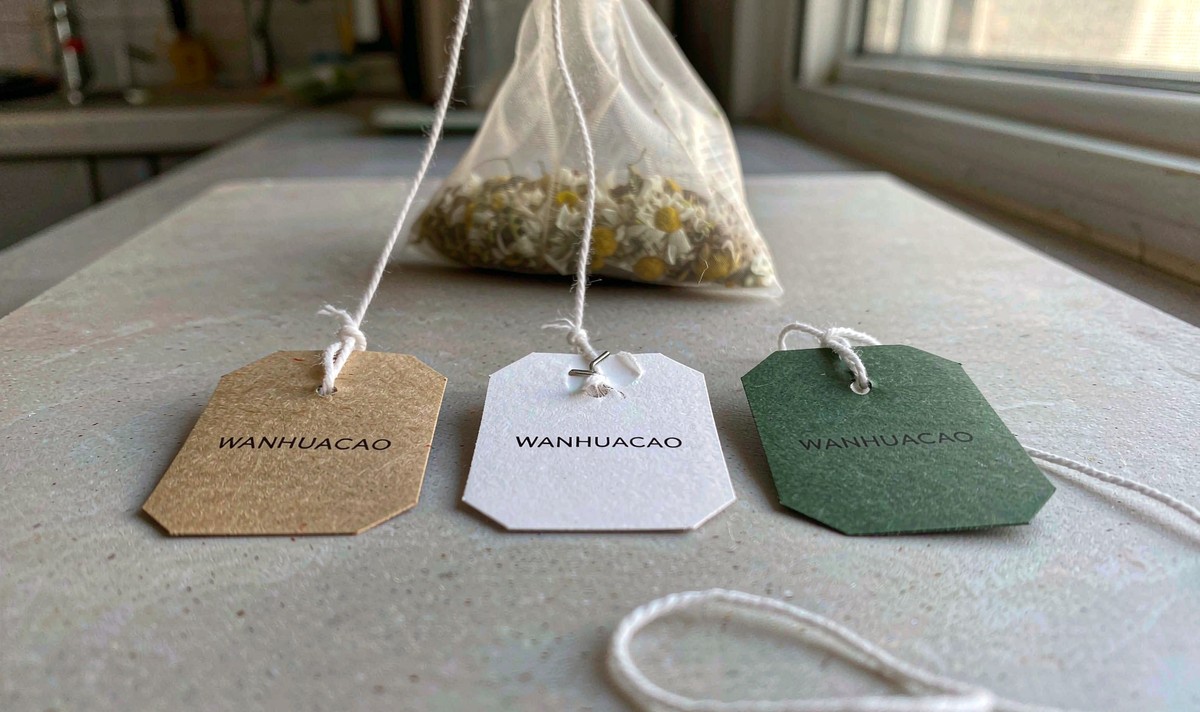
A tag is four stations, not one item
On the line, a tag is made before it is printed on. A roll of tag paper is cut into single tags, a string is threaded through the punched hole, a knot is tied, and the free end is joined to the bag.
Two strings are involved, and buyers often quote for one. The bag string runs from the bag mouth up to the tag. The tag string passes through the hole and is knotted back on itself. On most machines those are the same continuous thread with the knot as the only break, which is why a specification that names one string length is usually naming half the job.
The cost structure surprises most buyers. Paper is the cheapest element on the tag and the printing plate is the most expensive, so a tag that grows from 25 to 30 millimetres square adds almost nothing per unit while a fifth colour adds a full pass through the press. Two moves reduce a tag quotation faster than any negotiation: one colour fewer, and one standard size instead of a bespoke die.
Staple, weld, or knot: three ways to fail
The joint between string and bag is where nearly all tag complaints begin, and each method fails differently.
- Metal staple. Set from the tag side, through the tag and through the filter web, with the legs bent over on the far side. If the legs are not fully turned the point stays proud and catches on the carton; if the staple is long enough for the tag but short for the web, the tag is held by friction alone, which survives a sampling room and not a shipping carton.
- Ultrasonic weld. A horn presses the string into the web and melts the fibre around it. No metal enters the product, which is why compostable projects use it. The weld is also a hole in the sheet: the fibre that melted is no longer fibre, and that small brittle disc becomes the point where a wet bag tears when a drinker pulls the tag away.
- Knot through a punched hole. No metal, no weld, and the option most compatible with a compostable claim, provided the string is not over-waxed. Cotton is waxed so it runs through guides without fraying, and wax that is too heavy lets the knot slip under the pull of a full bag.
The question worth asking a supplier is whether the joint is pull-tested after setting, and at what interval. A line that cannot answer has a method rather than a control.
What fits on twenty-five millimetres
Artwork for a tag arrives shaped like artwork for a carton, and the difference in scale is usually discovered at proof.
- The six things a tag carries. Brand and mark, the blend name, the net weight of the bag, brewing guidance, a lot or best-before pointer, and any certification mark the brand is licensed to print. A seventh item, a QR code, is now common and is the one that fails silently.
- The arithmetic. On a 25 mm tag with a 2 mm margin, 21 mm of width is usable. At 6 pt, a line of type is about 2.1 mm tall, so the space holds roughly nine lines in theory. A brand name set at 4 mm takes two of them, and a certification mark takes four. What is left is three lines, which is why most tags end up smaller in type than the design.
- Print method sets the floor. Flexo holds roughly 6 pt and starts to fill in below it, and reverses out of a solid ground close up first. A design that depends on a hairline rule around the edge will not survive the plate.
- Water resistance is about appearance. Nothing in food law requires a tag to stay white in a cup. Aqueous and soy-based inks bleed sooner than solvent inks, and a coated stock holds a line longer than an uncoated one, which is why the tag that looks premium dry can be the one that looks worst wet.
- The back is free space. A lot number, a QR code and a second language cost nothing in material. What they cost is registration: below about 0.3 mm per module, a QR code printed flexo on a moving web stops being readable by the time it is on the shelf.

Line length is a cup measurement
String length is specified in millimetres and decided by a cup. It is measured from the bag mouth to the tag hole, and the useful test is a real cup from the target channel rather than a number on a form.
- Too short. The tag slides into the water on a tall glass or a travel tumbler, which is the complaint that arrives with a photograph of a floating tag.
- Too long. The tag clears the rim and lies on the table, and the string wicks tea onto the surface beside the cup.
- The range in practice. Most retail bags sit between 7 and 10 cm from mouth to hole, which covers a standard teacup and a mug. A foodservice single-serve pack, opened into a paper cup, usually needs the shorter end of that range.
- Material matters more for colour than for strength. Cotton absorbs, so a white string in a hibiscus or rosehip blend turns pink by the second steep, and a dark string can leave a mark on a saucer. Polyester stays white and does not compost. PLA string exists and belongs in the same test batch as the bag, not in a separate one.

The tag sits inside the compostable claim
When a bag is sold as compostable, the claim is about the item a drinker throws away, and that item is the bag, the string and the tag together.
- What the documents cover. Certification for a tea bag is issued on a construction, and the tag and string are named parts of it. A bag certified without its tag is a bag half claimed.
- The staple is a contaminant. Industrial composting screens metal out of the feedstock, and a screened item is a loss rather than a failure. A compostable programme that keeps a metal staple has to accept that every tag arrives at the facility as residue.
- The paper and the ink follow the same logic. Uncoated paper with water-based ink is the version that belongs in the same claim as the bag. A coated, foil-stamped tag with a solvent ink is a separate material stream dressed as part of the product.
- The claim has to be printed on something. A carton that says the bag is compostable and a tag that carries a plastic laminate are two statements a buyer can photograph side by side.
What our documents cover, and what they do not
Two documents travel with this line, and neither of them covers a tag.
- SGS CN23/00007035 —— issued to Anhui Wanhuacao Biological Technology Co., Ltd. against the Codex code of practice CXC 1-1969 as revised in 2020. The scope names substitute tea, solid drinks, instant cereal powder and gel candy. Substitute tea is the line a bagged herbal blend sits in.
- Production licence SC11434160205012 —— covers eight dosage forms including tea in bag. Bagged tea is a manufacturing category under this licence.
- What neither one certifies —— tag paper, ink, string, staple wire or a compostability claim. Those belong to the converter and to the market the product is sold into, and a factory certificate is not a substitute for either.
A tag project therefore starts with three documents that are not ours: the paper's food-contact declaration, the ink's migration statement, and the string's material specification. They are short, they are free, and the project that asks for them before the artwork is the project that does not reprint.
What to put in the brief
Five lines shorten a tag project more than any sample:
- The tag size and stock, with coated or uncoated and one or two print sides.
- The joint method, staple, weld or knot, and whether a compostable claim is involved, because that decides it.
- The string material and length, measured from bag mouth to tag hole against a real cup from the channel.
- The colour count and the smallest element in the artwork, so the printer can say before the plate whether it will hold.
- The marks to be printed, with the licence that allows each one, since a certification mark on a tag is an authorisation question before it is a design question.
Send the artwork and the cup and the tag can be quoted with the bag rather than after it. The companion piece on pyramid tea bags explains why the string leaves the bag at a single point on that format, and the guide to eco-friendly tea bag materials covers the claims a tag and a string have to fit into.
Ding Shaohua, Foreign Trade Manager, takes enquiries for this line. The same person answers on WhatsApp, TikTok, LinkedIn and Facebook.
FAQ
Can we print our logo on both sides of the tag?
Yes, and it changes the print route rather than the paper. Narrow-web flexo prints one side per pass, so a two-sided tag runs the web twice, or runs a press with a turning bar. The cost lands in make-ready rather than in ink, which is why a two-sided tag at 20,000 units costs nearly the same per unit as at 100,000, while a one-sided tag falls with volume. If the second side only needs a lot number or a QR code, a single pass with a divided plate is the cheaper answer.
Will the staple rust inside the cup?
A food-grade staple is plated or stainless and does not rust into visible oxide in a normal steep. The failure that does happen is mechanical rather than chemical: legs that are not fully turned, or wire that is too short to pass through both the tag and the web, so the tag is held by friction and lets go in the carton rather than in the cup. For a compostable product the question is not rust but metal, since a staple is screened out at the composting facility and every tag arrives as residue.
Does a pyramid bag take a different tag?
The tag is the same object; the exit point is not. On a flat bag the string leaves the top seam at a corner, so the tag hangs beside the bag. On a pyramid the four seams converge at one point at the apex, so the string leaves from a single narrow tip and the tag rides higher in the cup for the same string length. That is worth measuring on the actual format rather than assuming the flat bag figure carries over.
Can the string be compostable as well?
Cotton is, and it is the usual choice for a compostable tag because it knots without a weld. PLA string also exists, and it has to be tested with the bag rather than on its own, since the joint is the part that has to hold. The mistake is treating the string as an accessory: a compostable bag certified with a polyester string is a bag whose claim stops at the knot.