
Search for famous private label herbal tea and the results are lists. Twenty manufacturers, ranked by nothing in particular, each one introduced as a full-service tea partner with low minimums and custom blends.
The word famous is doing a different job in that query. It means the tea in the box the searcher already buys, and the company that made it. That company is almost never named on the carton.
There is a moment in a supermarket aisle that shows what the word measures. A woman reaches for a box without looking at it. Her hand goes to a shelf position, her fingers close on the carton, and only then does she turn it over to check the date. The reading comes after the choosing, and everything that produced the choice happened in the half second before.
What she perceived in that half second, roughly in order: a block of colour at three feet, the shape of the box in her hand, the weight of it, the small paper sound when it landed in the shopping bag. Words arrived last. Fame in this category is a pattern of reorders that has not broken yet, and it is built out of small physical constants.
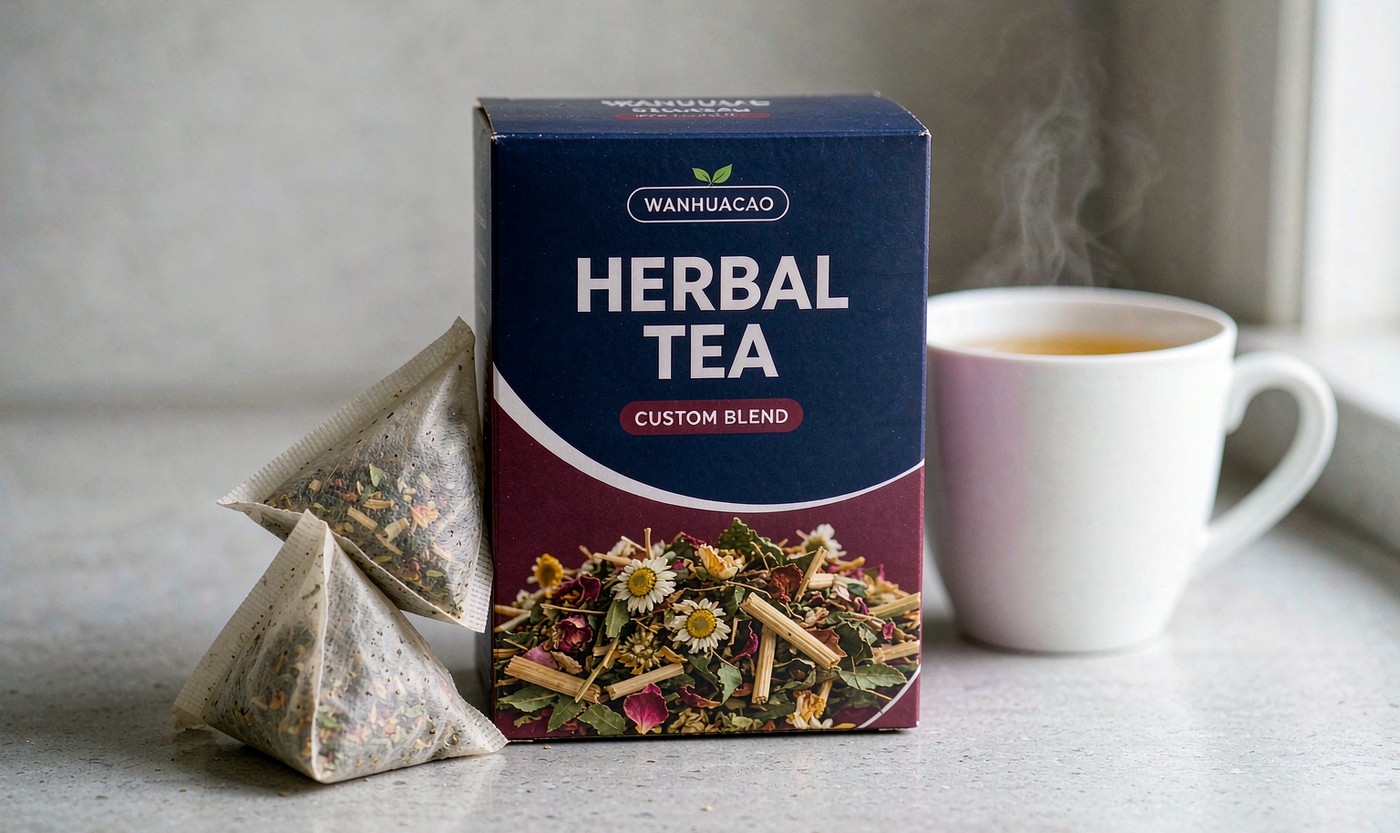
The factories behind famous cartons are not named on them
Ask who blends the tea inside a well-known carton and the answer is usually a company with no consumer brand, in a town most customers will never visit. That is how the trade is arranged.
Labelling rules in most markets let the firm named on the pack be the distributor rather than the plant. In the United States a carton can carry the name and address of the company that sold it, with no reference to the factory that filled it. The plant's name often appears nowhere on the product it made.
The split runs through the whole arrangement. The brand owns the recipe approval, the artwork and the shelf position. The plant owns the machinery, the changeover routine and the batch records. Fame sits with the first. The ability to repeat a cup sits with the second.
Which is why the query is awkward. A buyer searching for a famous private label herbal tea is looking for a company whose fame belongs to its customer, and which has a commercial reason to stay out of the search results. Names will not lead there. A licence detail page, a shelf of retention samples and a cut specification will.
The most widely drunk private label tea has no brand at all
There is one place where private label herbal tea is genuinely famous, and it does not appear on any list of manufacturers: the store's own line.
Every large grocer in Europe and North America runs a herbal tea range under its own name. In some of those stores it outsells every branded box on the shelf, because it sits at eye level, costs a third less than the box beside it, and is bought by people who already trust the shop. The chamomile inside it was blended by a company that appears on no marketing page.
These are the most widely drunk private label herbal teas in the world, and almost nobody could name the company that makes them. The contract between the two parties is what the customer buys into when they trust a box they have bought before.
A smaller brand runs the same mechanism at a smaller scale. The target is not fame across a country. It is one box that a specific person reaches for without reading, in one store, for three years.
The recipe is rarely the part that was hard to get right
Take apart the teas people call famous and the formulas are ordinary. Chamomile is chamomile. Peppermint is peppermint.
What has been tuned, usually over years and usually without anyone writing it down, is the tolerance band around each material and each process step. Two suppliers can quote the same formula and produce a different cup, because a formula describes what goes in and says nothing about how narrowly it has to land.
That band is the product, and it is the part a quotation cannot show.
The five things a specification names
- The colour of the dry leaf. A bright green peppermint photographs better under shop light. A duller, greyer green smells stronger, because more of the leaf surface has been cut open. A famous carton tends to hold the second one, and the photography sells the first.
- The cut. Fine leaf gives up its flavour in ninety seconds and leaves sediment in the cup. Coarse leaf takes four minutes and tastes thinner but cleaner. Neither is better. What matters is that the cut stays inside a narrow band, measured on a screen rather than described as medium.
- The ratio inside a blend. Two percent of licorice root changes the finish of a nine-herb infusion more than any other two percent in the formula.
- The bag material. Heat-sealed filter paper is mostly abacá fibre and wood pulp, and its pore size decides how fast water gets in. A mesh pyramid is polylactic acid, nylon or PET, and it drains faster. Two bags that look alike in a photograph brew differently.
- Fill weight against bag size. A two-gram paper bag and a pyramid carrying two and a half to three grams are different machines, not different settings. A tightly packed sachet also leaves the leaf no room to move, which slows the steep.
None of this is glamorous. It is the kind of thing that gets argued about for forty minutes in a meeting and never mentioned again.
Four places a blend drifts
Drift is what happens to any agricultural material that gets cut, dried, blended and packed by machines that wear.
Aroma. The oils that make a herb smell like itself are volatile, and they leave the leaf continuously. Cutting multiplies the surface they leave from. A blend that smells right on the day of packing can be flat by the fourth month, and a panel run in the first week will not see it coming.
Moisture. Dried herbs pull water out of the air. The standard for this category sets 8.5 percent for leaf classes and 13.0 percent for flower classes, so a blended product has to satisfy both figures at once. A blend received at eight percent in a dry month can be at eleven after a summer in a warehouse with a failing dehumidifier, and wet leaf tastes dull long before it becomes a mould question.
Cut. Mills are set to a screen size and screens wear. The change is a few percent of fines per year, invisible in a sample, visible in the cup as cloudiness and a gritty last mouthful.
Origin. Crops move. A chamomile from the Nile Delta one season and from Argentina the next will not smell the same, and both are correctly described chamomile. Peppermint swings between the Pacific Northwest and Egypt on price and on oil content. A blend built around one origin has to be rebalanced when the origin changes, and that rebalancing is a decision somebody has to make.
The fifth is the paper, and almost nobody records it. Filter paper varies by lot in thickness and pore structure, and a new lot can change the steep time of an unchanged blend. Plants that track paper lots separately are rare, and they are the ones whose tea tastes the same in year three.
The sample room answers a different question
Three things are better in a sample room than in a kitchen: the water, the light, and the fact that everything comes from one batch.
The water is usually filtered and the kettle is not scaled. The light is bright enough to show the colour in the cup, which makes the liquor look deeper than it will in a north-facing kitchen in February. And the sample comes from a single batch, often the first one off the line, when the mill has just been set and the leaf has just been opened.
A sample room therefore answers the question of what this tea is like at its best. The question that decides a reorder is narrower: what is it like on an average Tuesday in month seven, in a mug that had coffee in it an hour ago.
Reading a plant instead of a ranking
A ranking says who is big. A plant says who is repeatable, and repeatability is the only thing that travels into a carton.
Some of the evidence is physical and takes an afternoon to look at.
- The licence detail page. The page that carries the category, the sub-categories and the validity dates, not the certificate on a homepage. For this category the number is 1404, and the sub-categories are named individually, bagged tea among them.
- Retention samples. A plant that keeps a sealed sample of every lot, dated and shelved, can pull the exact lot behind the cup in your hand. Either that shelf exists or it does not.
- A cut specification in numbers. "Medium cut" is an adjective. A screen size with a tolerance is a specification, and the difference shows up in the fourth container rather than the first.
- The changeover routine. A filling line that has just run peppermint carries peppermint in the auger, in the dust duct and in the seal area. A plant that names the purge sequence and the bags it runs to waste has answered. A plant that says it cleans between runs has not.
- Who signs a blend change. A name and a date means a record exists. "We would tell you" means it does not.
Where the licence stops at the bagged line
The SGS report we hold, CN23/00007035, names four product categories, and herbal infusion is the first of them. The production licence behind it lists eight dosage forms, and tea is one of the eight.
Inside that category the licence itemises sub-categories, and bagged tea is listed separately from loose leaf. A licence that covers flower types does not automatically cover a bagged blend, which is one of the details a buyer discovers after the artwork is signed if nobody reads the scope page first. A pyramid sachet of chamomile and lemon balm sits inside both documents, and the copies are yours whenever you want them.
What the documents do not cover is a sachet carrying a number on the front, a stated milligram of an active per cup. That is a supplement rather than an infusion, it runs on a different line under a different filing, and the distinction is cheaper to settle before a purchase order than after one. The destination market splits the two the same way, with an infusion sold as food and a fixed-dose sachet regulated as a supplement.
What a first conversation settles
A tea project gets decided in the first exchange. The rest of the project is execution.
- The destination market, because the alkaloid limits, the claim rules and the labelling requirements all change at the border.
- The blend, with a legal basis for each ingredient, rather than a name and a percentage. A plant that is on neither the food list nor the medicine list cannot go in, whatever it does in a cup.
- The bag format and the fill weight, because two grams of leaf in paper and three grams in mesh are different machines and different claims.
- The carton wording, since a claim the market does not allow sends the blend back for reformulation after the artwork is signed.
On this line, tea bag orders start at ten thousand bags, and the figure has to be pinned down before it is compared. Ten thousand individual bags, ten thousand retail cartons and ten thousand mixed-format units are three different orders, and the setup cost falls in a different place for each.
Timing is agreed per project rather than quoted from a table. A blend that needs developing, a bag material that is not already on the machine, or a new carton each adds a step that a repack of an existing blend into an existing box does not have.
If you are building a herbal tea range and want the constancy question answered against a specific market, send the brief with the destination, the blend and the pack format. The herbal tea programme sets out formats, minimums and the certificate scope. The regulatory detail behind a tea bag is written up separately for buyers who need it in their own paperwork, and what happens inside the bag over nine months takes the sachet itself apart at more length.
FAQ
Who makes the tea inside a famous brand's box?
Usually a contract manufacturer whose name is printed nowhere on the pack. Labelling rules in most markets allow the firm on the carton to be the distributor, so the plant that filled the sachet stays invisible. The brand owns the recipe and the shelf position. The plant owns the machinery and the consistency.
Is a famous private label tea better in the cup than a cheaper one?
Often it is steadier rather than better. The leaf may come from the same gardens and the blend may be close to identical. What the famous box has paid for is a specification narrow enough that carton forty thousand tastes like carton one, plus a supplier willing to be held to it.
How long does a herbal infusion stay at its best?
Most carry a best-before of eighteen to twenty-four months from the packing date. The aromatic top note fades first, well before the tea becomes undrinkable, so a box opened at month eighteen is usually flat rather than spoiled. Sealed, dark and cool slows all of it.
Can our own blend go into the sachet format we already use?
In most cases yes, and the format will change the blend more than the blend changes the format. A finer cut in the same paper steeps faster and clouds the cup. A coarser one needs longer and tastes lighter. The paper lot matters too, since two lots of the same specification can draw at different speeds.
Ding Shaohua, Foreign Trade Manager, takes the enquiries that arrive this way. The same person answers on WhatsApp, TikTok, LinkedIn and Facebook, and the sample questions usually arrive by WhatsApp first.
All News