
A buyer in Lagos orders the same ginger tea twice, six months apart. The second lot comes back from the tasting panel described as flat. The raw material is the first thing checked: same species, same origin, same fill weight, same certificate of analysis. The difference sits in a drying room, in a parameter that was never written into the purchase order.
Ginger is unusual among tea botanicals in that its main sensory property is made rather than preserved between harvest and the sachet. The compounds that make the cup hot are largely created by heat, and the reaction keeps running as long as the material stays warm. Every drying decision is therefore also a heat decision, and it is taken months before anyone tastes the finished product.
Two gingerols, one curve
Fresh ginger rhizome is dominated by 6-gingerol, which carries a bright heat with a little sweetness behind it. Under heat it loses water and converts to 6-shogaol, a dehydrated form that binds the TRPV1 receptor more strongly and tastes sharper, with less of the sweetness. The conversion is part of what drying does to ginger, and it is why a dried product can be hotter than the rhizome it came from.
The speed of that conversion tracks temperature. Dried slowly below roughly 60 °C, most of the gingerol survives and the material keeps its fresh character. Dried fast in a hot air tunnel, a larger share becomes shogaol and the heat reads as aggressive rather than warm. Two lots from the same farm, dried on two different curves, arrive as two products with one name on the invoice.
A specification written as 6-gingerol alone can therefore pass inspection and still deliver the wrong cup. The number that holds sensory consistency is total pungency, gingerol plus shogaol, and it belongs next to the drying record rather than next to the incoming material.
Aroma and heat move in opposite directions
The volatile oil in ginger is a different chemistry from the pungency, and it behaves the other way round. Zingiberene, ar-curcumene and the citral notes that make ginger smell like ginger are volatile, so they leave with heat and time. A hot, fast dry buys shogaol and spends aroma.
Steam sterilisation sits on the same trade. Saturated steam is the usual route for tea because it leaves no residue, and it strips volatile oil from the surface of the cut material. Gingerols and shogaols are not volatile and come through it intact. A sterilised lot therefore arrives with the same pungency and less aroma than the sample that was approved, which is one of the quieter reasons a reorder tastes different from the first shipment.
The way out is a drying temperature low enough to keep the aroma, a lower shogaol figure accepted, and the target pungency reached by proportion in the blend rather than by heat. A blend can be tuned with a small share of material from a hotter curve. A single-origin lot cannot.
Why a sachet tastes weak at three minutes
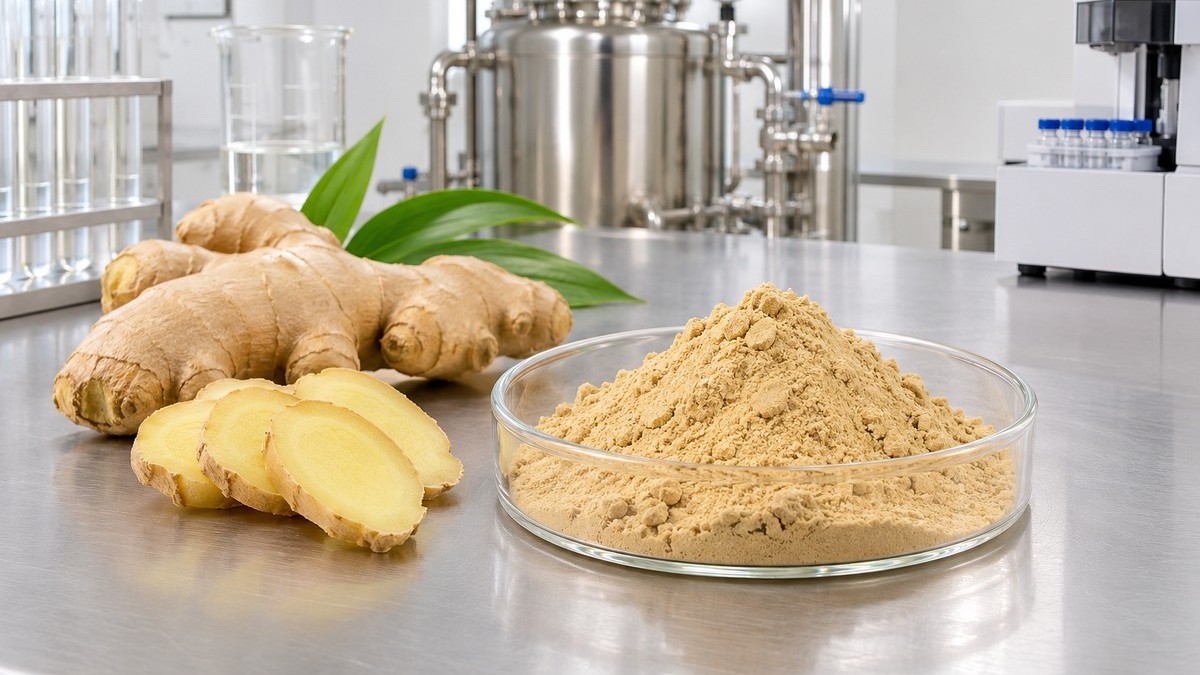
Gingerols are poorly soluble in water. A cup of ginger tea is not a solution; it is what the surface of the particles gives up in the time the bag stands in the mug. That makes cut size the second decision after the drying curve, and it pulls in two directions at once.
Fine powder releases fast and clouds the cup. Below a certain particle size it also passes through the filter paper of a flat sachet and leaves grit in the bottom of the mug, which a consumer reads as a defect even when the flavour is stronger. Coarse granules stay in the bag and keep releasing into a second cup, but three minutes in a mug extracts only the front of the flavour.
Most ginger tea bags therefore run a mix of powder and granule rather than one cut. The powder carries the first impression, the granule carries the finish. The ratio is the first number locked in the formulation, and it is set by the steep time printed on the pack rather than by cost. A product labelled three minutes needs a different ratio from one labelled five.
Short video has pushed part of this category toward a concentrated shot rather than a mug, filed under #WellnessShot as often as under #herbaltea and #teatok. A shot is brewed strong and short, which is the profile a coarse granule cannot deliver in ninety seconds and the profile a powder-heavy blend delivers easily.
A lemon ginger tea adds one variable on top. In most commercial versions the lemon is a flavour rather than juice or peel, so it does not change the pungency arithmetic at all. It sits over whatever aroma survived the dryer, which is why the lemon dose is set last, after the ginger lot is approved.
Powder, granule, and the instant product
Three materials trade under the same word. Dried ginger powder is milled from the dried rhizome. Ginger granule is cut and dried and holds its shape in the bag. Crystallised ginger is candied with sugar, which makes it sticky and hygroscopic and rules it out of a sachet. They are not interchangeable by weight, because in the third one the sugar is most of the mass.
An instant ginger tea is a separate product built on a separate line:
- The rhizome or a ginger extract is brewed into a liquid concentrate.
- The concentrate is dried with a carrier, usually maltodextrin or glucose syrup, in a spray tower.
- The powder is agglomerated so that it dissolves in cold water without lumps.
Nothing in that sequence happens on a sachet line, and nothing on a sachet line produces a soluble powder. A brand that wants both a tea bag and an instant stick is buying from two suppliers, with two lead times and two sets of documents. Planning them as one order is the most common scheduling mistake in this category.
The sourcing side splits along the same lines. A private label tea bags programme and a custom tea blending project ask different questions of the supplier. A tea bag manufacturer that has only run cut leaf will quote a flat sachet and find the volume problem at sampling. A herbal tea contract manufacturer used to roots asks for bulk density and cut size before quoting at all. A tea bag co-packer can fill material you supply, and a pyramid tea bag OEM brings the format with it.
Origin is a specification
Dried ginger trades as a commodity with a country name attached, and the country carries most of the relevant difference. West African rhizomes from Nigeria and Sierra Leone run high in pungency and low in aroma, with a fibrous texture that survives coarse cutting. Chinese and Indian material goes the other way, more aromatic and moderate in heat.
Peruvian ginger is where organic programmes tend to source, because the certification chain is shorter and volumes trace back to a grower group. None of this appears on a certificate of analysis that reports only moisture and ash.
A purchase order that says dried ginger and a weight has specified almost nothing. An herbal ginger tea brief that opens with origin is off to a better start than one that opens with price. Origin, organic status, total pungency, volatile oil, cut size, moisture and microbiological limits are the seven lines that make the material repeatable, and they belong in the brief rather than in the email after the first lot is rejected.
What the label can say
Ginger has no authorised health claim in the European Union. Regulation 1924/2006 lists the claims that may be used on food and none of them belongs to ginger, so a tea cannot say it aids digestion, settles the stomach or supports immunity.
The European Medicines Agency does hold a traditional use monograph for ginger rhizome, with indications around motion sickness and dyspepsia. That monograph is a route to registering a herbal medicinal product. A tea that borrows its wording moves toward the definition of a medicinal product by function under Directive 2001/83/EC, and the obligations shift from food law to pharmaceutical law.
In the United States the same bag is a conventional food or a dietary supplement depending on how it is presented, and a structure or function statement is allowed with the standard disclaimer. A disease claim is not. A name like ginger tea, and words like warming or spicy, describe the sensory experience and stay on the food side.
Five lines for the brief
These five items remove most of the variables that make two ginger teas taste like two different products:
- The drying curve, meaning inlet temperature, time and final moisture.
- Total pungency as gingerol plus shogaol, not gingerol alone.
- Cut size in millimetres or mesh, with the powder to granule ratio when both are used.
- The sterilisation route, since ethylene oxide has been banned for food use in the EU since 1991 and irradiation carries a labelling duty.
- Bag format and the steep time printed on the pack.
Two related decisions sit outside this brief. How a root behaves on a line that also runs pale blends, and what turmeric leaves on the same equipment, is in tulsi turmeric ginger tea. What to check on site before any of this is quoted is in private label herbal tea manufacturers. The bagged range sits on the herbal tea page.
Ding Shaohua, Foreign Trade Manager at WANHUACAO, works with brands and distributors on private label and OEM herbal tea programmes from brief to first shipment. The plant runs blending, bagging and overwrapping under SGS CN23/00007035 for herbal tea among other categories, and SC11434160205012 covering eight dosage forms. Reach him on WhatsApp, TikTok, LinkedIn and Facebook.
FAQ
Is ginger tea supposed to be spicy?
To some degree, and the degree is set at the dryer rather than at the farm. A mild cup usually means a lot dried cool with most of the gingerol intact. A sharp one means more shogaol from a hotter curve. When a specification does not name the curve, the heat level is whatever that batch happened to produce.
Do ginger tea bags use powder or whole pieces?
Usually both. Powder gives the first thirty seconds of flavour and the colour. Granule keeps releasing into the second cup. A bag built only on powder goes flat quickly and can leave sediment. A bag built only on coarse pieces tastes thin at three minutes.
Can instant ginger tea be made on a tea bag line?
No. Instant needs extraction, concentration and spray drying with a carrier, which is a different plant. The two products can share a brand and a specification, not a line.
Can a ginger tea be sold without a health claim?
Yes, and in the EU it has to be. Ginger has no authorised claim under 1924/2006, and the EMA monograph for ginger rhizome belongs to the herbal medicinal product route. The commercial case is flavour, warmth and ritual, which is what this category has always sold on anyway.