
Walk the filling room after a turmeric run and the evidence is everywhere. The gasket under the hopper is yellow. The mesh on the forming tube is yellow. The cloth on the bench is yellow, and so is the edge of the operator's glove. Turmeric is a dye that happens to taste of something, and a factory that treats it as a flavour will spend the next week cleaning it out of places it was never meant to reach.
That is the practical side of a blend that sells on colour. The golden cup is the product's best asset on a phone screen and its worst behaviour on a line.
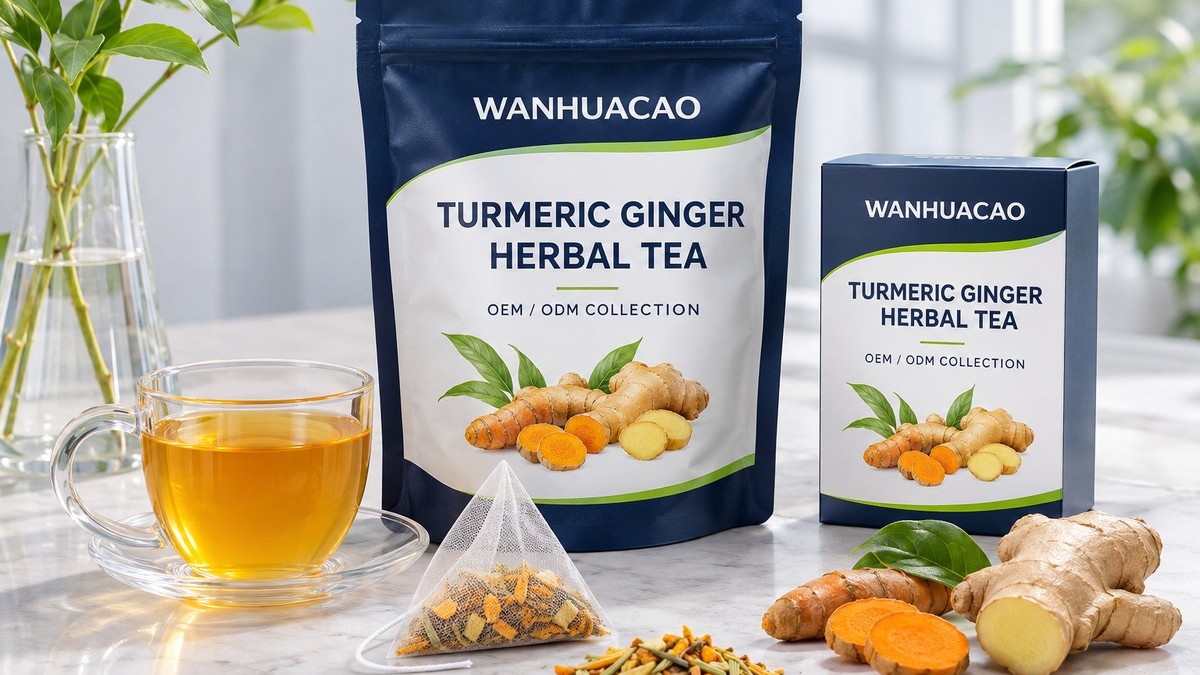
Turmeric is a dye before it is a flavour
The yellow in turmeric is curcumin, and curcumin is the same molecule sold as food colour E100. It is fat-soluble and it binds to stainless steel welds, to elastomer gaskets, to polypropylene and to filter mesh. Hot water does not remove it; it spreads it.
For a bagged tea this produces three consequences that belong in the quotation rather than in the complaint file. Changeover time goes up, because a turmeric run followed by a pale blend leaves colour in the first few hundred bags. Cleaning validation has to name an agent that actually dissolves curcumin, which is not the same agent used for a mint or chamomile changeover. And the dust travels: fine turmeric passes through the mesh of a pyramid bag and clouds the cup, which a consumer reads as strength and a buyer reads as a specification.
The cut specification is where that trade is settled. A coarser cut keeps the cup clearer and gives up some of the colour. A finer cut gives a deeper gold and a muddier cup, and it also puts more colour into the room.
Ginger is not one pungency
Gingerols are the pungent compounds in fresh ginger, and drying converts a share of them into shogaols, which are sharper. That is why dried ginger tastes hotter than the fresh root it came from, and why the same recipe can come out mild in one lot and fierce in the next.
Origin and harvest age move the number as much as the process does. A buyer comparing two ginger quotations is usually comparing two pungency levels without knowing it, and the blend that is balanced against a mild lot will taste wrong against a hot one.
For a tea, ginger also brings fibre and structure. It fills well, it gives the bag a visible body, and it holds heat in the cup longer than a leaf does. A blend that is short of body can be fixed with ginger, which is one reason this combination works commercially.
Tulsi is the aroma that leaves first
Holy basil carries eugenol, the same compound that dominates clove, and the number of chemotypes in commercial supply is a detail most briefs miss. Rama, Krishna and Vana types differ in leaf size, colour and aroma, and a blend balanced on one tastes different on another.
Eugenol is volatile, so drying and sterilisation take it, the same way they take the oil from chamomile. What survives is often the woody, peppery base rather than the clove-like top note that the brand approved in the sample.
Tulsi is also the component that follows you. Its aroma stays in the room, in the ducting and in the next blend, in a way that turmeric's colour does not. A line that runs tulsi before a delicate floral blend will put basil into a product that never listed it.
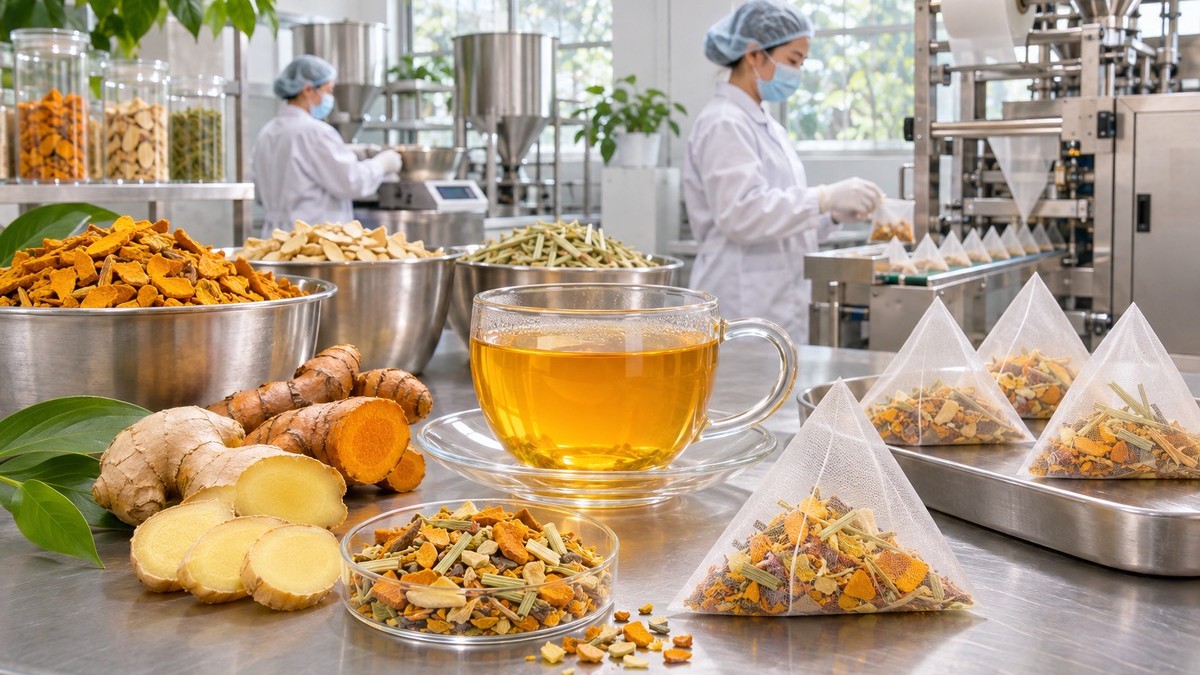
Organic is decided by the weakest certificate
An organic claim on a blend is a claim about every ingredient, and the certificate has to cover the operator as well as the farm. Three organic ingredients mean three supply chains, three certificates and three sets of residue results, and the claim fails if any one of them lapses.
Turmeric is the usual weak link. Organic turmeric is in demand from the supplement side as well, supply is concentrated, and a lot that was organic last year may only be available conventional this year. A brand that has printed organic on a carton has printed a promise that depends on the least reliable of its three inputs.
The practical arrangement is to hold a conventional version of the same blend ready, so the organic claim can be dropped for one production run without stopping the product.
The cup is the marketing asset
This is one of the few tea blends that looks like something on a phone. The colour is deep enough to read as deliberate, the sachet is visibly full, and the steam carries. On short video that matters more than a paragraph of copy, and the hashtags this category runs on, #teatok and #herbaltea, are built around exactly that image.
The trap is designing the blend for the photograph and then discovering that the photograph comes from a fine cut that clouds the cup in a glass and clogs a mesh on the line. The version that looks best on camera is usually the version that is hardest to run.
Light is the second half of the colour problem
Curcumin is light-sensitive. A clear jar on a bright shelf fades over months, and the fade is uneven, because the side facing the window goes first. The same blend in an aluminium pouch holds its colour for the whole shelf life.
That puts the pack in direct conflict with the product. The format that shows the gold, a clear jar or a windowed carton, is the format that removes it. Brands that sell this blend on colour usually choose an opaque pouch with a printed photograph, which is honest about the trade rather than fighting it.
What to lock in the brief
Four things belong in writing before a first production run: the cut specification for the turmeric and the resulting cup clarity, the pungency reference for the ginger, the tulsi chemotype, and the cleaning routine between this blend and the next.
An organic herbal tea manufacturer will ask for the three certificates before quoting. A loose leaf tea wholesale supplier will quote the components separately, which is useful, because the cheapest total is often the one with the least reliable turmeric.
For the bag format, see pyramid tea bag manufacturer. The residue side of the turmeric question is covered in tea extract pesticide residues, and the range sits on the herbal tea page.
Ding Shaohua, Foreign Trade Manager at WANHUACAO, works with brands on spice and botanical blends from brief to first shipment. Blending and bagging run in the same plant, under SGS CN23/00007035 covering herbal tea among other categories and SC11434160205012 covering eight dosage forms. Reach him on WhatsApp, TikTok, LinkedIn and Facebook.
FAQ
Why does turmeric cause so much cleaning work?
Its colour is curcumin, the same molecule as food colour E100. It is fat-soluble and binds to gaskets, mesh and steel welds, and hot water spreads it rather than removing it. Changeover needs a cleaning agent that dissolves curcumin, and the first bags of the next run usually carry colour.
Is dried ginger hotter than fresh?
Often yes. Drying converts gingerols into shogaols, which are sharper. Origin and harvest age move pungency as well, so two ginger lots at the same price can taste very different in the cup.
Does the tulsi type matter?
It does. Rama, Krishna and Vana types differ in leaf size and aroma, and eugenol, the clove-like note, is what the blend is balanced on. A blend approved on one chemotype will not taste the same on another.
Can a blend be organic if only some ingredients are?
No. An organic claim covers every ingredient and the operator. Three organic components need three valid certificates, and the claim fails if any one lapses, which is why turmeric is usually the constraint.