
A brief for glutathione gummies usually carries three numbers: 500 mg per serving, sugar free, and a flavour. The dose is the easy part.
Glutathione is a reducing agent. Put it in a gel that holds water, dissolved oxygen, residual trace metals and, in a sugar free piece, a polyol load that keeps moisture tighter than sucrose does, and the thiol has something to react with for the whole shelf life. The reactions run slowly at room temperature and in the dark, which is why a batch can look perfect on the day it is made and fail an assay at month nine.
The molecule arrives reduced and leaves oxidised
Glutathione is a tripeptide of glutamate, cysteine and glycine. The cysteine residue carries a free thiol, and that thiol is the reason the ingredient works and the reason it is difficult to put in a chew.
In a hard capsule the powder sits at low water activity with little molecular mobility, and oxidation is slow. A gummy is the opposite environment. The gel network holds water, the water holds oxygen, and the whole mass moves enough for the thiol to find an electron acceptor. The first product is glutathione disulfide, two molecules joined through the cysteine residues. Mixed disulfides with other thiols in the matrix follow, and the free amino groups on the peptide can enter browning reactions with reducing sugars once the piece has been through a hot cook.
The loss that matters is the reduced fraction, not the peptide mass. A piece can still contain the same mass of glutathione and hold a fraction of what the label promises.
A total-glutathione assay hides that failure
Several commercial methods reduce the sample before reading it. That step converts oxidised glutathione back to the reduced form, so the number on the certificate is a sum. A product that has lost most of its reduced content can pass a total-glutathione specification.
The specification has to be written against GSH, with oxidised glutathione carried as a separate limit. Sample preparation matters as much as the instrument: extracting a gummy into warm water at neutral pH oxidises the analyte before it reaches the column, and the result understates what was in the piece. Ask for the extraction solvent, the temperature and the run time on the method sheet, not only the result. The same discipline applies to any botanical or peptide where the labelled form is one of two states, which is what identity testing on incoming material is for.
Overage is not a free fix
The first instinct on a 500 mg claim is to add 15 per cent and let the assay drift down to the label. Glutathione punishes that.
The thiol carries a sulphurous, slightly yeasty note that intensifies with heat history and with age. Sweetness makes it worse, and a sugar free syrup is built almost entirely from sweetness. Extra loading also feeds the browning route, because more peptide means more free amino groups in the same hot mass. A batch with a large overage can pass its release assay and fail on taste and colour at month six, which is a harder failure to argue with a buyer than a short assay.
Overage has to come out of the stability data for that base, in that pack, at that water activity. It does not transfer from a vitamin gummy, and it does not transfer from a capsule.
Water activity is the lever that is missing from the brief
Most finished gummies sit between 0.55 and 0.70 water activity. A glutathione SKU is run drier than that, often below 0.50. One gummy producer publishes a working rule for its own base: every 0.05 aw above 0.55 roughly doubles the oxidation rate.
Drier means more solids, a longer cure, and a firmer bite. That collides with the brief, because the same page that asks for 500 mg usually asks for a soft chew. The two requests pull in opposite directions, and the piece that satisfies the assay is not the piece that satisfies the texture note. Somewhere in the first meeting that has to be settled, because it changes the cook, the cure tunnel time and the throughput the line can hold. Cure behaviour is covered in more detail under gummy shelf life and stability.
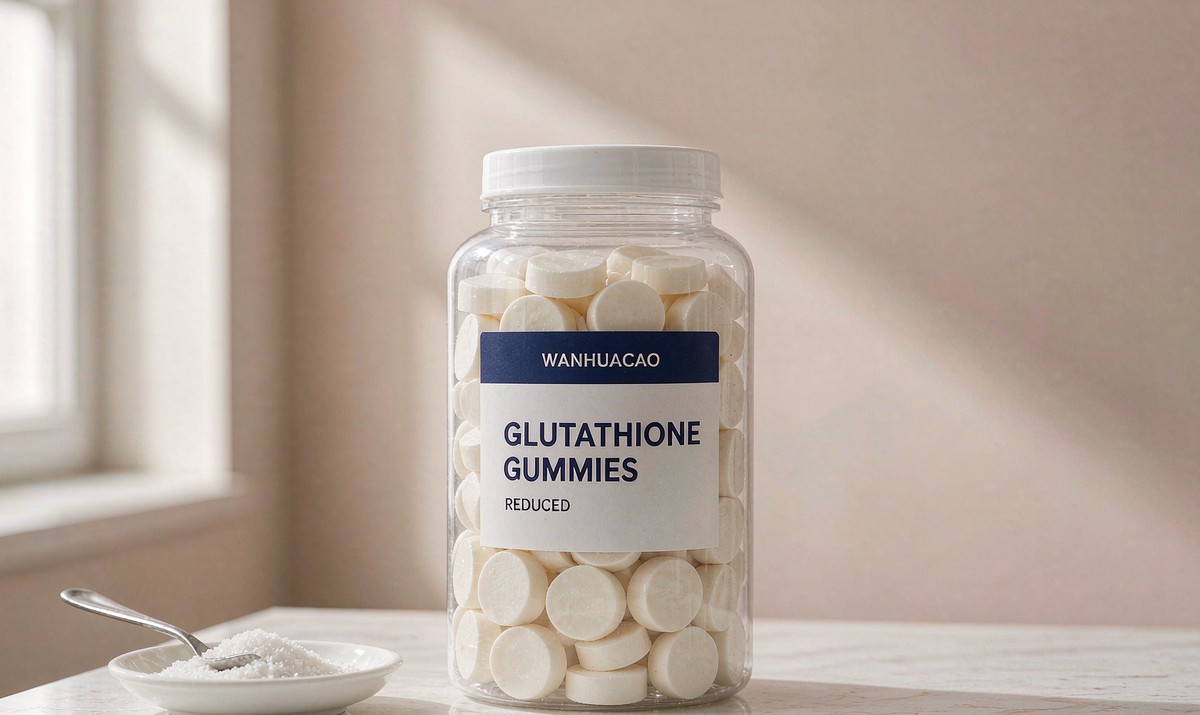
What the sugar free base adds
Sugar free is not a claim sitting on top of the formula. It changes the water in it.
Sucrose at 75 per cent solids is a preservative in its own right, because it binds water and lowers water activity. A maltitol or sorbitol syrup does something similar at a similar solids load, which is why sugar free gummies are achievable at all. The difference appears in the piece: polyols hold water more tenaciously, so the same cure time leaves a wetter centre, and the water activity that protects the thiol is also the water that keeps the chew soft. Push the piece dry enough for glutathione and the texture turns from soft to leathery, because there is no sucrose left to plasticise it.
The second effect is thermal. Polyol syrups reach depositing viscosity at a higher temperature than sucrose glucose syrups, so the mass arrives at the depositor hotter and stays hot longer. That is the opposite of what a thiol wants, and it is the main reason a glutathione formula cannot simply be dropped into an existing sugar free line and run at the same settings.
What the line has to change is the cook temperature, the cooling curve before addition, and the cure time. Those three are process parameters, and they belong in the trial protocol, not in the correspondence after the first batch. The wider subject of polyol bases is covered under sugar free gummy manufacturing.
The addition point decides the batch
Depositing runs at 90 to 95 °C. Glutathione added into that mass loses a measurable part of its reduced content before the piece is even formed.
Added too late, the slurry is already viscous, the powder does not disperse evenly, and the potency varies from the first tray to the last. The usable window sits between a mass hot enough to deposit and a mass cool enough that the thiol is not being cooked. In practice the powder goes in below 55 °C, after the gel has been cooked and partly cooled, with quick homogenisation and a hold time written into the batch record.
That window is narrow, and it is narrower on a pectin base than on gelatin because pectin gels on cooling and not on temperature alone. A line that runs vitamins at 12 trays a minute will run this SKU slower, and the quotation should say so.
Iron and copper, including the ones from last week
Thiol oxidation is catalysed by trace metals, iron and copper first among them. A few parts per million in the mass will do more damage than months of ambient storage.
The risk is rarely in the glutathione. It is in the plant. A line that ran a mineral premix on Monday, a seaweed blend on Wednesday and glutathione on Friday carries residues on scraper blades, in the hopper corners and in the transfer pipe. Cleaning validation written for allergen changeover does not automatically cover trace metal carryover, because the target is measured in a different unit and at a different limit.
The practical controls are dull and effective: dedicated utensils for thiol batches, a chelating agent permitted in the target market such as citrate in the formula, and a rinse water check for iron on the day. A factory that cannot describe its changeover for this product has not run it before.
Colour is a chemistry question here
The brief usually says mixed berry, no artificial colours. That combination puts anthocyanins in the same gel as a reducing agent.
Anthocyanins are redox sensitive in both directions. A thiol can protect a pigment from oxidation and can also drive it toward a different coloured form, depending on pH, on the ratio and on how much oxygen is left in the pack. Glutathione itself is a white crystalline powder and contributes nothing to the colour.
The only reliable answer is a three month colour reading in the actual pack, measured on the same instrument at the same angle, at 0, 1 and 3 months. A formulator who offers a colour match from a five day trial is offering a photograph, not a result. If the brand wants a stable berry tone and a sugar free base, the honest option is often a colour that is declared as added, because that is the one that can be held to a number.
The drum on the floor
Glutathione ships in 25 kg fibre drums with a foil laminate liner, nitrogen flushed, and it is stored cold. The certificate describes the drum, not the scoop.
A batch at 12 per cent loading on a 500 kg slurry takes 60 kg, which is two and a half drums. That is where the handling question starts. An opened drum in a pre-weigh room at 55 to 60 per cent relative humidity takes up water, and the next batch weighs the same kilograms and receives fewer dry solids. The assay drops and the piece count costs rise by the same fraction.
Factories running this material keep opened drums under nitrogen or in a dry store, re-check moisture before the drum returns to the pre-weigh room, and record the assay at receipt and again at use. Two numbers, one spread. If the spread is wider than the specification allows, the problem was storage, not the supplier.
What can be printed on the pack
The European register of nutrition and health claims contains no authorised claim for glutathione. The pack can describe the ingredient and its amount, and that is the end of it. A brand that wants a benefit sentence on the front panel needs to find it in another ingredient, which is why so many glutathione products are sold with vitamin C on the same label.
The acetylated form is a separate case. S-acetyl glutathione went through the novel food process with a draft opinion recommending authorisation at a ceiling of 300 mg per day for food supplements, and that ceiling applies to the finished daily dose. A gummy carrying 500 mg of the acetylated form sits outside it, and a seller would need to know that before printing the front panel.
Liposomal is a third case. A liposome is a phospholipid vesicle, and a gel at 0.45 water activity does not hold one. A formula can contain phospholipids and glutathione in the same piece; that is not the same structure, and the word describes the structure.
What the trials support
Oral glutathione is hydrolysed on the way in. Gamma-glutamyl transferase on the intestinal brush border cleaves the peptide, and the fraction that reaches circulation intact is small. The published figure used most often is under ten per cent, which puts the whole category in an awkward place: the ingredient is real, and the delivery is inefficient.
The best known human work used a branded reduced form at 250 mg and 1,000 mg a day for six months. The higher dose raised glutathione in red blood cells, plasma and lymphocytes by roughly 30 to 35 per cent; 250 mg raised whole blood by about 17 per cent and red cells by about 29 per cent; levels returned toward baseline within a month of stopping. A twelve week skin trial at 250 mg found wrinkle readings lower than placebo at some measured sites and melanin index not statistically different from placebo.
That body of work supports a 250 to 500 mg band and nothing above it. At 500 mg a single piece carries the dose and a 60 count bottle is 60 days. At 250 mg the same bottle is 30 days at two pieces, which changes the retail price per day and the whole commercial case. The arithmetic belongs in the brief, before the mould is cut.
Where bulk ends and private label begins
A bulk supplement manufacturer and a private label manufacturer can be the same plant running the same formula, and the two orders carry different risks. The two tags behind most of this traffic, #privatelabel and #PrivateLabelSupplements, come from buyers who have already decided to own the label; what they are still choosing is the base and the dose, and for this molecule those two are the whole conversation.
Bulk means loose gummies in lined cases, and the buyer fills, labels and ships. The stability study that supports the expiry date then belongs to the buyer, and so does the pack. Private label means finished bottles leaving the plant with the brand's artwork, and the stability study is ours. The difference decides who pays when month nine comes back short, which for this molecule is a live commercial question.
Batch size is set by the slurry, not by the order. A 500 kg mass at 12 per cent loading consumes 60 kg of glutathione, and that is the smallest sensible run regardless of how many cases the brand wants. Our functional gummies line runs pectin and gelatin bases on separate depositors, which matters here because a thiol batch should not follow a mineral batch on the same equipment.
Ding Shaohua, Foreign Trade Manager at WANHUACAO, works with brands and distributors on functional gummy programmes from brief to first shipment, in bulk and in private label, including peptide and botanical actives. The plant operates under SGS CN23/00007035 for gel confectionery and SC11434160205012 covering eight dosage forms, sports nutrition supplements among them. Reach him on WhatsApp, TikTok, LinkedIn and Facebook.
FAQ
Does glutathione survive a gummy at all?
It survives in proportion to how dry and how cool the piece is kept. A base under 0.50 water activity, powder added below 55 °C, no iron or copper in the equipment and a nitrogen flush on the pack will hold most of the reduced form through a normal shelf life. A standard 0.65 aw berry gummy with the powder added into the cook will not, and the assay will show it by month six.
What dose should the label carry?
Between 250 and 500 mg of reduced glutathione per daily serving is the range the published human work covers. Above 500 mg the sulphur note starts to dominate the flavour system and the overage needed to hold the claim gets large enough to drive browning. Below 250 mg the piece is small enough that the commercial case weakens more than the formula improves.
Can a glutathione gummy be called liposomal?
A gel cannot hold a liposome, so the word describes a structure the piece does not have. A formula can contain phospholipids alongside glutathione and the label can say so. The word liposomal belongs to liquids and softgels, where a vesicle can exist.
Why does the specification ask for GSH and GSSG separately?
Because a total-glutathione figure cannot distinguish a fresh batch from one that has oxidised, and the two behave identically on a certificate that reports only the sum. Writing the specification against the reduced fraction, with the oxidised form as a separate limit, is the only way the number on the certificate describes what the consumer receives.