
A tray of freshly deposited gummies went into the curing room at four in the afternoon and came out the next morning with a surface that no longer stuck to a glove. Nothing had been added to them. They had simply spent eighteen hours in air that was drier than they were.
That room is where the piece becomes the product, and it is the one step in gummy manufacturing that cannot be shortened by turning a dial. A depositor can be sped up and a packing line can be run faster. A gummy that has not finished losing water is a gummy that will finish losing it inside the bag.
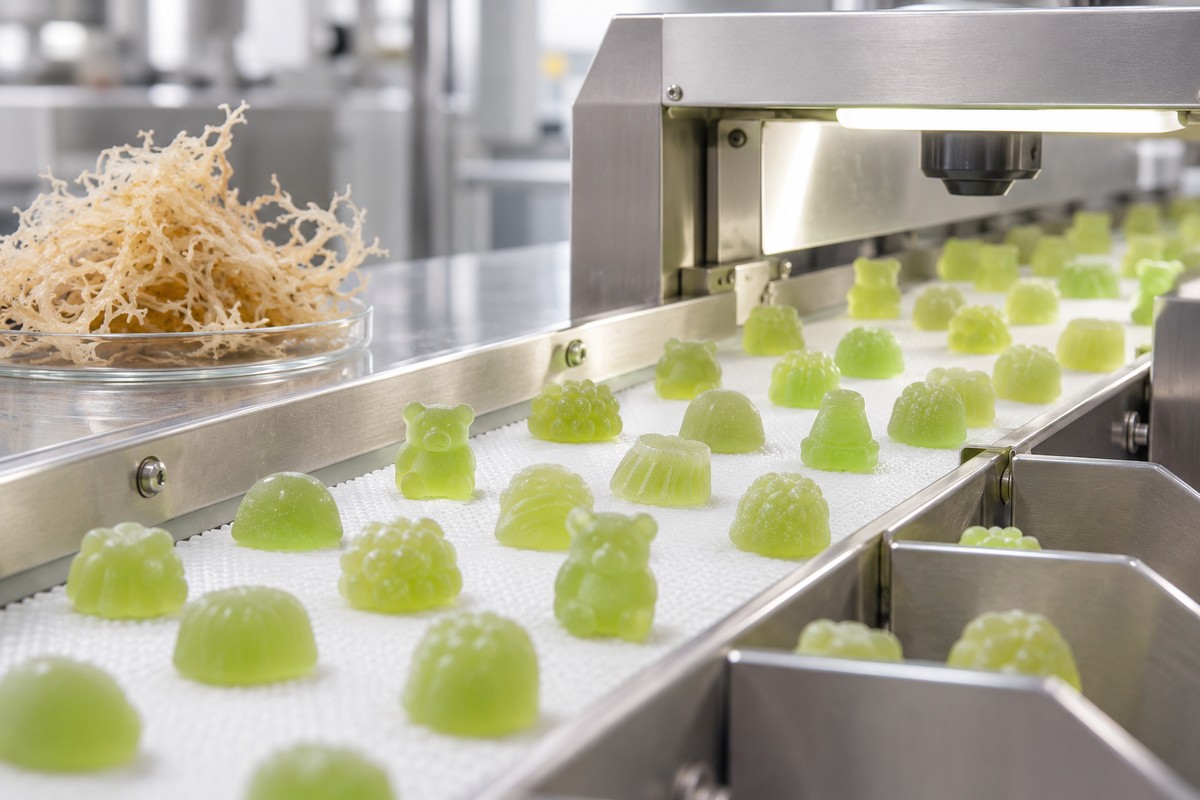
Three things happen in the room at once
Curing is usually described as drying. Water leaving is only the visible part.
- Water leaves from the surface. The skin dries first, and the moisture inside has to travel outward to replace it. How fast that happens depends on the gradient between the piece and the air, not on the clock.
- The gel network keeps forming. Gelatin continues to build structure for hours after the piece is set, and a pectin or starch system continues to rearrange. A piece pulled early is not just wetter, it is structurally younger.
- Sugar redistributes. As water leaves, the concentration at the surface rises, and with it the risk of crystallisation. A cure that is too fast pushes sugar to the surface faster than the syrup can hold it, which is where a white bloom comes from.
Which is why two pieces with the same moisture can feel different: one was dried slowly at a moderate humidity and one was dried hard at a low one. The number matches. The skin does not.
The endpoint is water activity, not hours
A cure time is a planning number. The release criterion is a water activity reading, taken on the piece, at a stated temperature.
- Water activity, not moisture. Two formulas at the same moisture percentage can have different water activity, because the sugars and the gelling system bind water differently. The shelf-life behaviour follows the activity.
- A target range, per formula. A gelatin piece and a pectin piece do not share one number, and a piece with a high polyol load does not share one with a sugar-based piece either. The range is set in development, then held in production.
- Measurement has to be repeatable. A sample taken from the tray surface and a sample taken from the middle of the load can differ, so the sampling plan is part of the specification.
- Time is the fallback, not the rule. When a line releases on hours alone, the release is really a bet that the room behaved the same way as last time.
Starch moulds and metal moulds cure differently
The two main routes into a mould produce the same shape and two different curing problems.
- Starch moulding. The piece sets inside a starch cavity, and the starch absorbs moisture from the surface as it sets. The starch then has to be dried and cooled before reuse, and its condition affects the next piece. This is a closed loop that has to be managed, not a consumable.
- Metal or silicone moulds. The piece sets against a solid wall and is demoulded while still soft, then dried in the room as a free piece. There is no starch to condition, but there is no starch to wick moisture either, so the first hours in the room matter more.
- Mixed routes are common. A line may deposit into starch for one shape and into metal for another, and the cure schedules are not interchangeable even when the formula is.
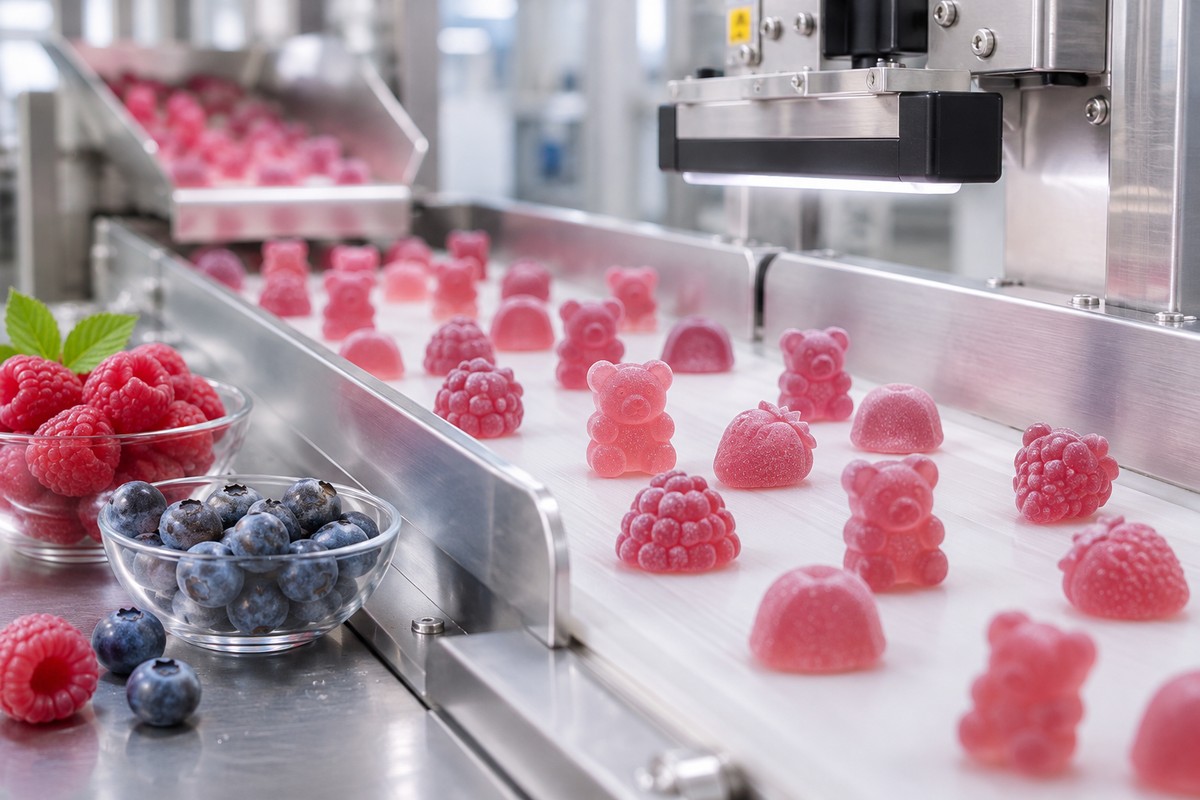
Four variables decide whether the load cures evenly
A room is a volume of air, and the air at the door is not the air in the corner.
- Temperature. Warm air holds more moisture, so a warmer room dries faster at the same relative humidity, and a room that drifts warm overnight dries the outer trays harder than the inner ones.
- Relative humidity. This is the variable with the most direct effect on the rate, and the one most often controlled by a single sensor in a bad position.
- Air movement. Still air builds a saturated boundary layer around the tray and slows drying to almost nothing. Too much air dries the edges of the load and leaves the centre behind.
- Loading density. Trays stacked close together cure as a block. The same room holds fewer trays well than it holds badly, which is why nameplate capacity and usable capacity are different numbers.
The practical answer is zoning, rotation and a logging sensor or two in places where nobody wants to stand.
What the defects are telling you
Almost every gummy complaint that appears on day two has a curing cause, and most of them can be read off the piece.
- Case hardening. The surface dries into a skin while the centre stays wet. The piece feels firm at first touch and collapses on the bite. Cause: air too dry, or too fast, in the first hours.
- Sticking in the bag. Residual moisture at the surface, or a cure that ended before the surface and centre were in balance. Cause: release on time rather than on water activity.
- Tailing and deformation. Pieces pulled from the mould too early, or dried unevenly on one face. Cause: demoulding timing and tray orientation.
- White bloom. Sugar crystallising at the surface as water leaves too quickly for the syrup to hold it. Cause: a fast, dry cure, sometimes compounded by a formula with too little crystallisation inhibitor.
- Mould on a sealed bag. Water activity in a range that supports growth, usually from a load that was packed warm or from condensation inside the film.
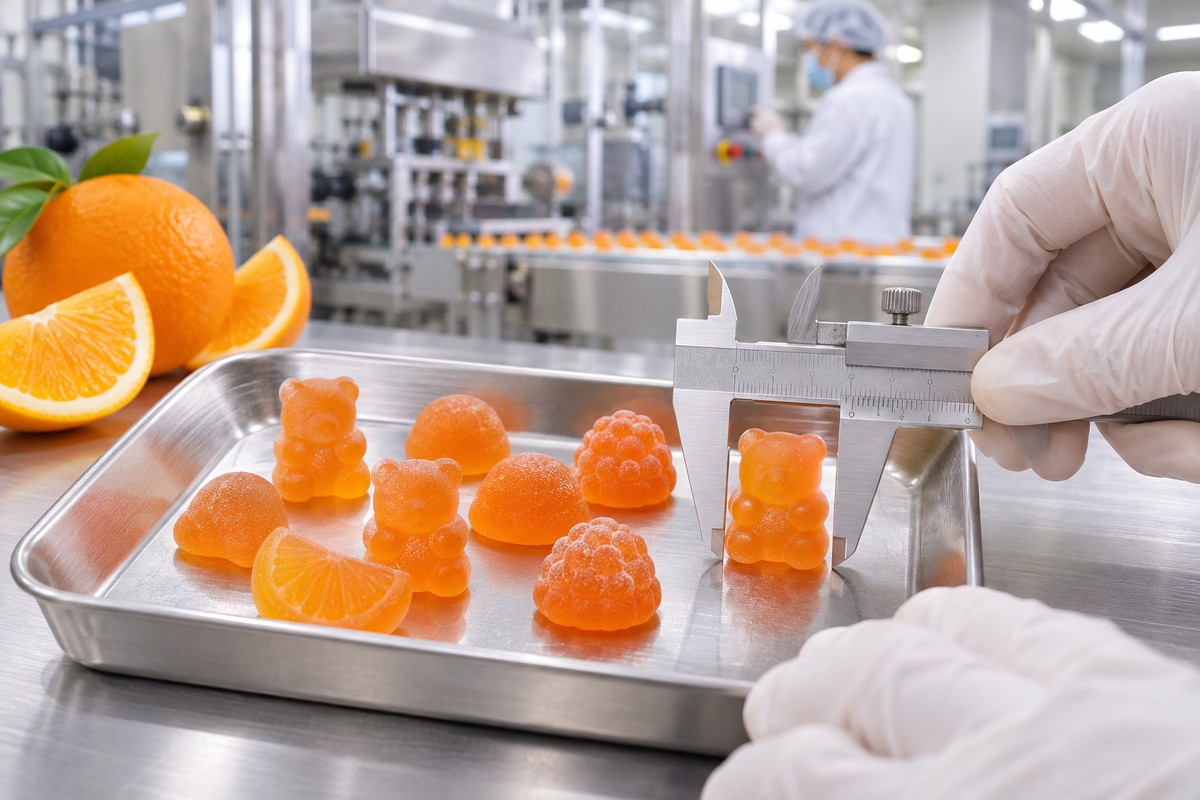
Finishing happens after the cure, not before
Polishing, sanding and glazing are the last touches and they are all downstream of a piece that has to be dry enough to take them.
- Oil or wax polish. A thin film that stops pieces sticking to each other and gives the surface its sheen. Applied too early, it traps moisture under a sealed skin.
- Sugar or acid sanding. A coating that has to adhere to a surface with the right tack. A piece that is too dry will not hold it; a piece that is too wet will dissolve it.
- Weight and dimension check. Piece weight and size settle once the piece stops losing water, which is why the caliper reading taken at packing is the one that belongs in the specification.
What our documents cover, and what they do not
- SGS CN23/00007035 —— issued to Anhui Wanhuacao Biological Technology Co., Ltd. against Codex CXC 1-1969 as revised in 2020, with gel candy named in scope.
- Production licence SC11434160205012 —— eight dosage forms, which is the framework a gummy sold as a supplement is produced under.
- What neither covers —— the cure schedule for your formula, the water activity at which your piece should be released, or the shelf life that follows from it. Those are set on your product, in development, and recorded per batch.
What to send before the first cure
- The formula and the piece weight, because the cure target is derived from the solids, the polyols and the geometry together.
- The mould route, starch or metal, since the two schedules are not interchangeable.
- The pack format and the storage condition, because a bag in a humid market needs a different release point from a bottle in a dry one.
- The defect you are trying to avoid, in your own words, since "too soft on day two" and "sticky in the bag" point at different parts of the room.
- The finishing step, polished, sanded or bare, because it decides how dry the piece has to be before it moves on.
Send the formula and the pack format and the cure target can be set before the first production run. The piece on scaling from pilot to mass production covers where the room fits in the line, and gummy shelf life picks up from the moment the bag is sealed.
Ding Shaohua, Foreign Trade Manager, takes enquiries for this line. The same person answers on WhatsApp, TikTok, LinkedIn and Facebook.
FAQ
How long does a gummy need in the curing room?
It depends on the formula, the piece weight and the room, which is why the honest answer is a range rather than a number: a small piece in a well-controlled room finishes sooner than a heavy one in a room that is loaded to the door. The release decision should be taken on water activity, with the time used only to plan tray capacity.
Can curing be sped up by making the room drier?
It can be made faster, and the piece that comes out is different. A hard, dry cure builds a firm skin over a wetter centre, which reads as a hard piece on day one and a collapsing one on day thirty. Faster drying also pushes sugar to the surface, which is the usual origin of a white bloom.
Why do the pieces near the door come out different?
Because a room is not uniform. Trays near the door see more air movement and a different temperature, so they dry faster than trays in the centre of the load. The fixes are zoning the room, rotating trays through positions, and loading at a density the air can actually reach.
Does polishing hide a curing problem?
It hides the look of it for a while. A polish applied to a piece that is still losing water seals moisture under the film, and the piece then softens from the inside rather than the outside. Polishing belongs after the release check, not instead of it.