
The first production run came off the line looking right and failed on the second day. Same formula as the sample batch, same colour, same flavour. The pieces had gone soft at the shoulder and started to stick in the bag.
Nothing in the formula had changed. What changed was the size of the pot it was cooked in, and everything downstream of that.
A pilot batch is a few kilos in a jacketed pan, stirred by hand, deposited into a small tray and cured on a bench. A production batch is hundreds of kilos through a vacuum cooker, held in a buffer tank, dosed by a depositor into moulds, cured in a room and packed on a line. Between those two things sit heat history, residence time and machine geometry, and none of them appear on a formula sheet.
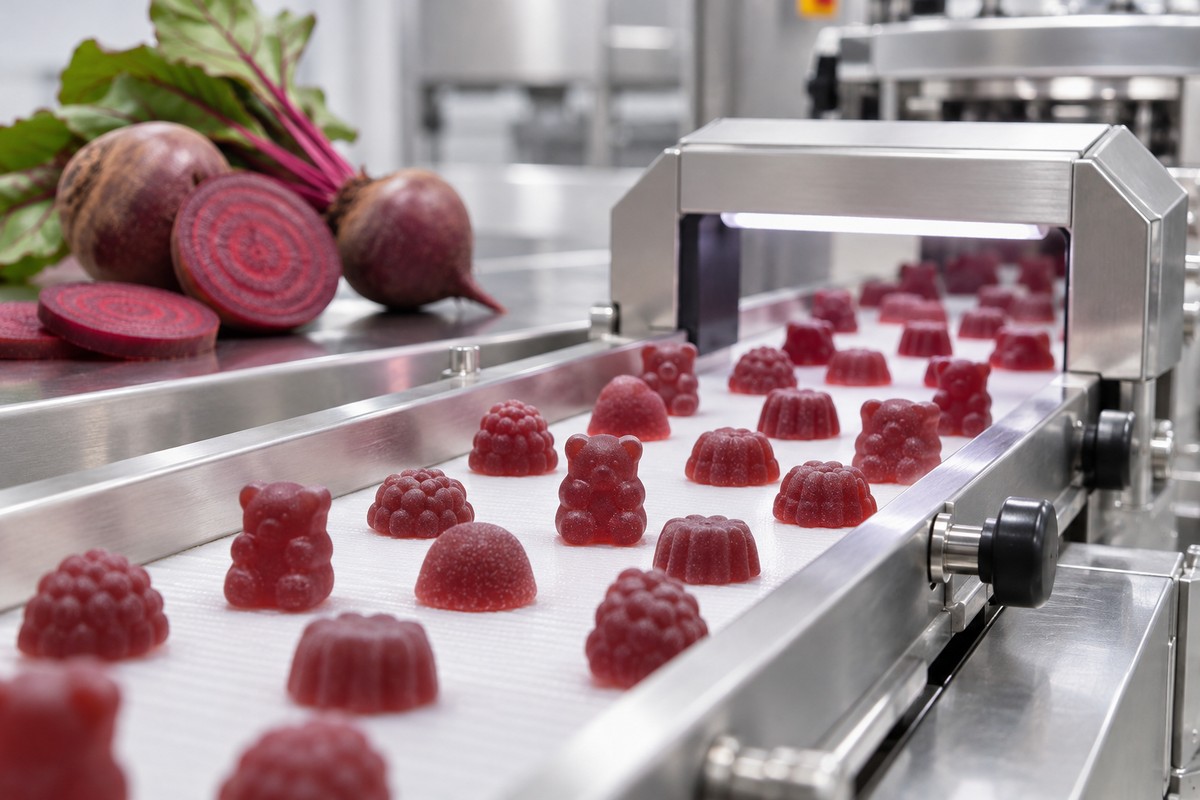
The same recipe is not the same cook
A jacketed pan and a production cooker do not deliver the same heat to the same syrup, and the difference is structural rather than a matter of settings.
- Surface to volume. Heat moves through the wall of a vessel, so the area available per kilo of syrup falls as the batch grows. A large batch takes longer to reach temperature and then sits at temperature longer, which is more time for colour to develop and for volatile flavour to leave.
- Stirring is part of the heat transfer. A small batch is mixed by the moving wall and a paddle. A large one needs an agitator that keeps the whole mass moving, and a zone that moves slowly scorches first.
- Vacuum changes the endpoint. Production cookers boil under vacuum, so water leaves at a lower temperature and the final solids are set by the vacuum and the jacket temperature together. The same "cook to 78 Brix" instruction means different things in the two vessels.
- The hold matters. Syrup that waits in a buffer tank between cooking and depositing keeps cooking. Ten minutes of hold at temperature is a formula change nobody wrote down.
The practical consequence is that the pilot formula has to be re-established on the production cooker, not simply transferred to it. That first production run is a trial, whatever the paperwork says.
Syrup is a state, not an ingredient
Recipes are written in kilos. A depositor responds to viscosity, and viscosity responds to solids, temperature and the sugar spectrum, in that order.
- Solids by refractometer, at a fixed temperature. A Brix reading taken on a hot sample is not the same number as one taken after cooling, so the measurement needs a stated temperature to mean anything.
- Temperature at the depositor, not in the tank. The syrup cools in the pipework between the cooker and the head. The temperature that matters is the one at the nozzle, and it drifts as the run goes on unless the line is jacketed and controlled.
- Dextrose equivalent sets the body. Two syrups at the same solids can differ in how thick they are and how fast they set, which shows up as a weight difference rather than a taste difference.
- Batch-to-batch variation in raw materials is real. Gelatin strength and pectin grade are specified in ranges, and a batch at the bottom of the range needs a different acid or calcium dose to set the same way.
Which is why a production record worth reading has a syrup batch number, a Brix curve and a depositor temperature log on it, rather than a signature at the bottom.
Weight comes from the machine, not the scale
Piece weight is the first thing a customer measures and the last thing a formula controls. It is set at the depositor, by the interaction of four things.
- Cavity volume and its wear. A mould cavity is a fixed volume until it is not. Silicone and starch moulds both change over a run, and a worn cavity fills differently from a new one.
- Syrup viscosity at the nozzle. Warmer syrup flows further into the cavity in the same dwell time. Cooler syrup gives short pieces and, at the edges, a tail that sets before it separates.
- Deposit time and pressure. Both are set on the machine and both drift with maintenance. A nozzle that is partially blocked fills slowly and produces a light piece in a heavy batch.
- The demoulding moment. Pieces pulled too early deform; pulled too late they tear at the base. Either way the weight is right and the piece is wrong.
A line that weighs the first piece and then trusts the machine will produce a batch that averages correctly and varies too much. The control is a check at fixed intervals, on a fixed number of pieces, recorded against the run.
The curing room is the bottleneck
After depositing, a gummy spends a day to two days in conditioned air, losing water until the surface and the centre are in balance. That time is a process step with a capacity, and the capacity is the number of moulds the room can hold.
- Moulds set throughput. Daily output is limited by how many trays fit in the room and how long each stays there, not by how fast the depositor runs. A faster depositor with no room for its trays simply builds a queue.
- Temperature and humidity drift across a room. A tray near the door and a tray in the corner do not dry at the same rate, which is why rooms are zoned and trays are rotated.
- Starch moulds need their own conditioning. The starch that holds the shape absorbs moisture and has to be dried and cooled before reuse, and its condition affects how the next piece sets.
- Pulling early is the most common shortcut. A piece that leaves the room at the wrong moisture looks acceptable and fails later, in the bag, at the shoulder, exactly where the first production run failed.
Consistency is locked in the process, not tested at the end
A finished-goods test tells you what you have. It does not tell you what to do about it. The controls that hold a gummy constant sit inside the run.
- A first-piece check on weight, dimension, colour and texture, signed before the run is released.
- Interval checks on weight and appearance, at a frequency the batch length justifies rather than a frequency that fits the paperwork.
- A syrup log that ties every kettle to a Brix curve and a depositor temperature.
- Retained samples from the beginning, middle and end of each run, kept long enough to answer a complaint months later.
- A rework rule. Trimmings and rejects can go back into a batch, and the proportion matters: too much rework carries colour, carries fines and changes how the next batch sets.
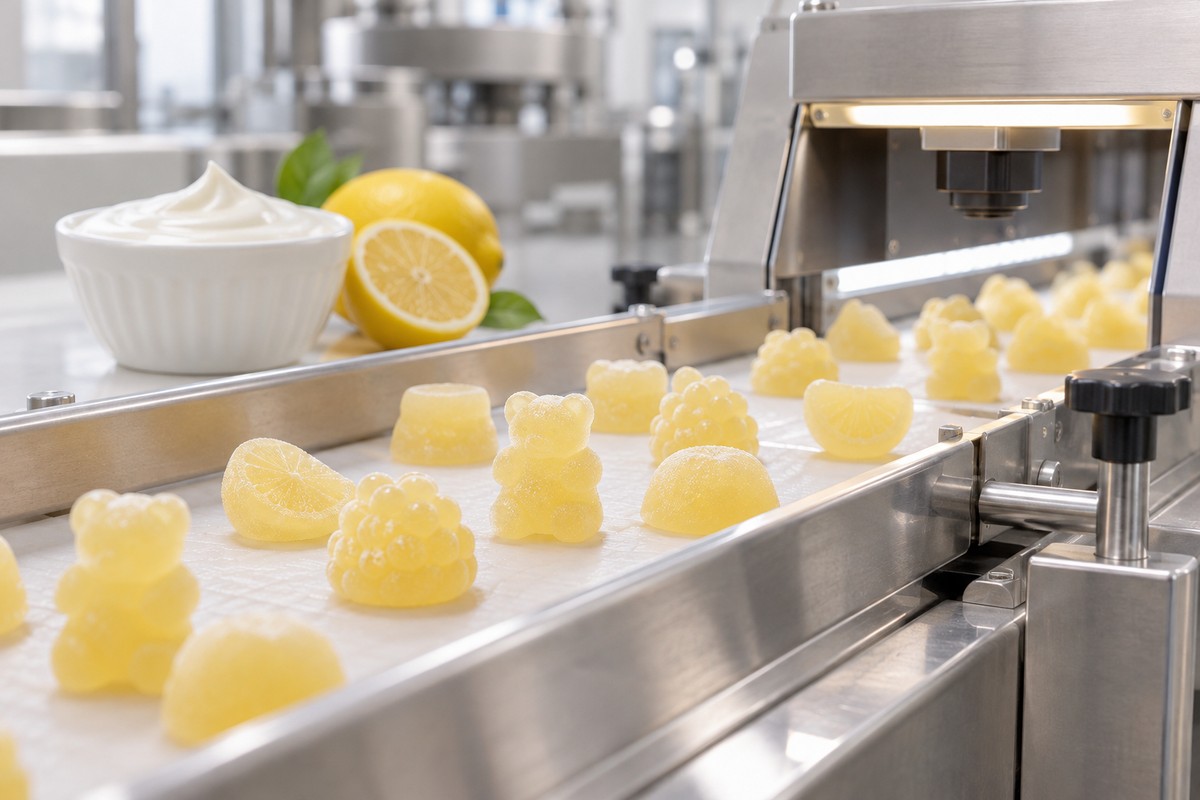
What changes when the volume goes up
Four things surprise brands in the first months of production, and none of them are about the recipe.
- Changeover costs time. A new flavour or colour means cleaning the cooker, the pipework and the depositor, and the first pieces of the next run are transitional. Small runs spend proportionally more of their time on changeover.
- Packaging becomes the constraint. A bagging machine set for a softer piece needs a different speed from one set for a firmer piece. The line runs at the speed of its slowest station.
- Cold chain and climate show up in the data. The same batch behaves differently in a humid month than in a dry one, and the cure room is where that difference is absorbed or not.
- Yield is a spec item. First-pass yield and rework rate belong in the quotation conversation, because a formula that produces more trimmings costs more per good piece than its ingredient cost suggests.
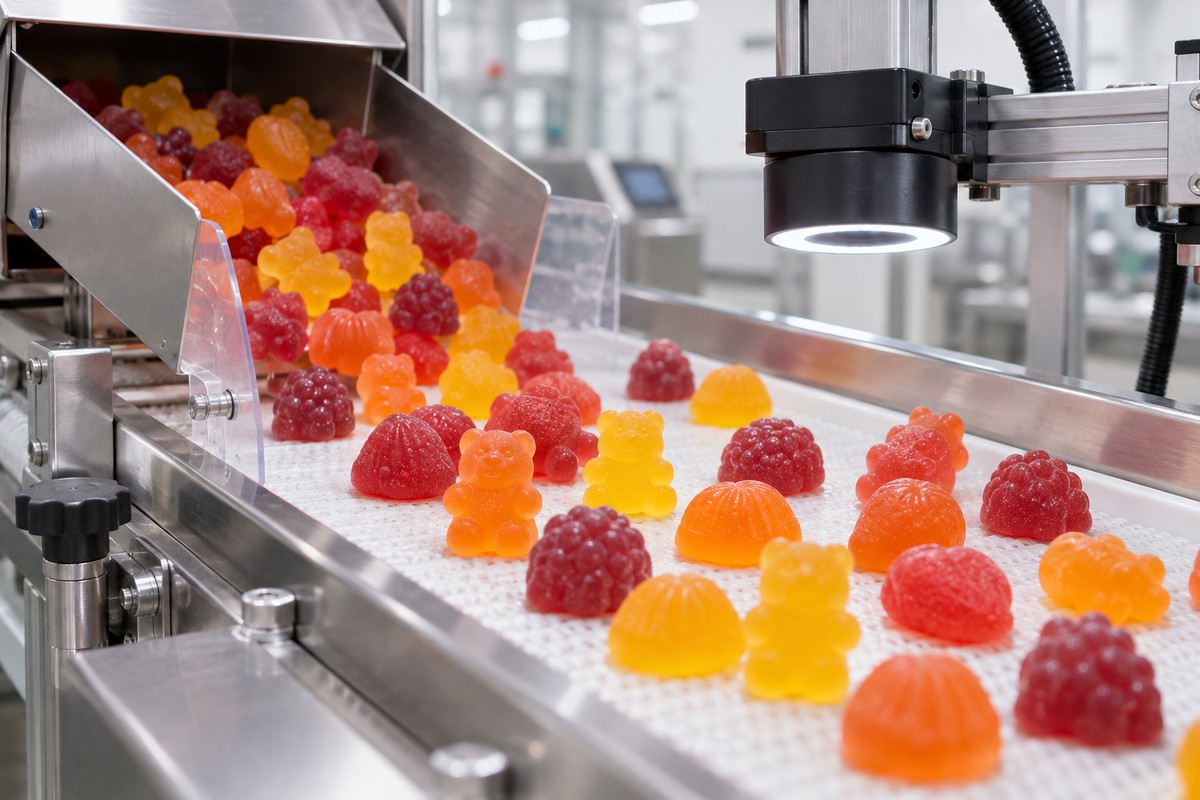
What our documents cover, and what they do not
- SGS CN23/00007035 —— issued to Anhui Wanhuacao Biological Technology Co., Ltd. against Codex CXC 1-1969 as revised in 2020, with gel candy named in its scope.
- Production licence SC11434160205012 —— eight dosage forms, which is what a gummy sold as a supplement is made under rather than as confectionery.
- What neither covers —— the capacity of a specific line on a specific date, the yield of your formula, or a delivery schedule. A licence says what a site may make. It does not schedule it.
What to send before the first production run
- The approved sample with its date, so the production target is a piece at a known age rather than a piece in a photograph.
- The pack format and the piece weight, because both constrain the depositor and the cure room before anything is cooked.
- The expected order pattern, one large run or several small ones, since changeover is charged to the run either way.
- The market and the claims, because a supplement-form gummy and a confectionery gummy are produced under different rules even on the same line.
- The acceptance criteria, written before the run, so the first production batch is judged against a document rather than against a memory of the sample.
Send the approved sample and the pack format and the first production run can be planned against the line rather than against the pilot pan. The piece on how a gummy specification is rebuilt from a sample covers the measurements that make the target objective, and the guide to gummy shelf life explains what happens to the piece after it leaves the cure room.
Ding Shaohua, Foreign Trade Manager, takes enquiries for this line. The same person answers on WhatsApp, TikTok, LinkedIn and Facebook.
FAQ
Why did the production batch come out softer than the sample?
Usually because the piece left the cure room earlier than the bench sample did, or because the syrup reached the depositor at a different temperature and filled the cavity differently. Both are process differences rather than formula differences, and both are visible in the run records: a moisture reading at packing, and a temperature log at the head. Soft shoulders that appear on day two are almost always a curing or moisture issue rather than a gelling issue.
Can you run a small first order on the same line as a large one?
Yes, and the cost per piece is the part that changes. A short run pays the same changeover, the same cleaning and the same first-piece checks as a long one, so the overhead per kilo is higher. The useful question is not whether a small run is possible but which part of the range should share a colour and a flavour, since that is where the changeover cost is decided.
Does a bigger batch need a different formula?
Not necessarily a different formula, but usually a different process window. A larger mass holds heat longer and loses volatiles for longer, so the same ingredients may need a shorter cook, a different vacuum, or a flavour dose adjusted at the depositor. Those are adjustments to the process record, and they should be documented as such rather than quietly folded into the formula sheet.
How is weight controlled through a long run?
By checking rather than by setting. A depositor is set once and then drifts with temperature, nozzle condition and cavity wear. The control that works is a defined interval, a defined number of pieces, a recorded average and range, and a reaction plan when the range widens. A run that only weighs its first piece is a run that finds out from the customer.