
A bag of gummies arrived at the sampling room with a note attached: make ours taste like this. The bag was a competitor's, bought retail, six months into its shelf life. Inside, the pieces had already lost the snap they had on the day they were packed.
That detail decides the whole project. What a brand wants to match is the experience of a fresh piece. What arrives in the post is a piece that has been losing water, and hardness, since the day it was sealed.
Reverse engineering a gummy is not copying a recipe. It is measuring what a piece does in the mouth, then rebuilding a formula that will still do it after your own packing line, your own curing room and your own twelve months on a shelf.
What can be measured before anything is cooked
A piece of gummy is a small set of numbers, and most of them can be taken from a competitor's sample without knowing a single ingredient.
- Composition proxies. Solids by refractometer, water activity, pH, and moisture by loss on drying. Together these describe how much water is left in the piece and how much sugar is holding it there.
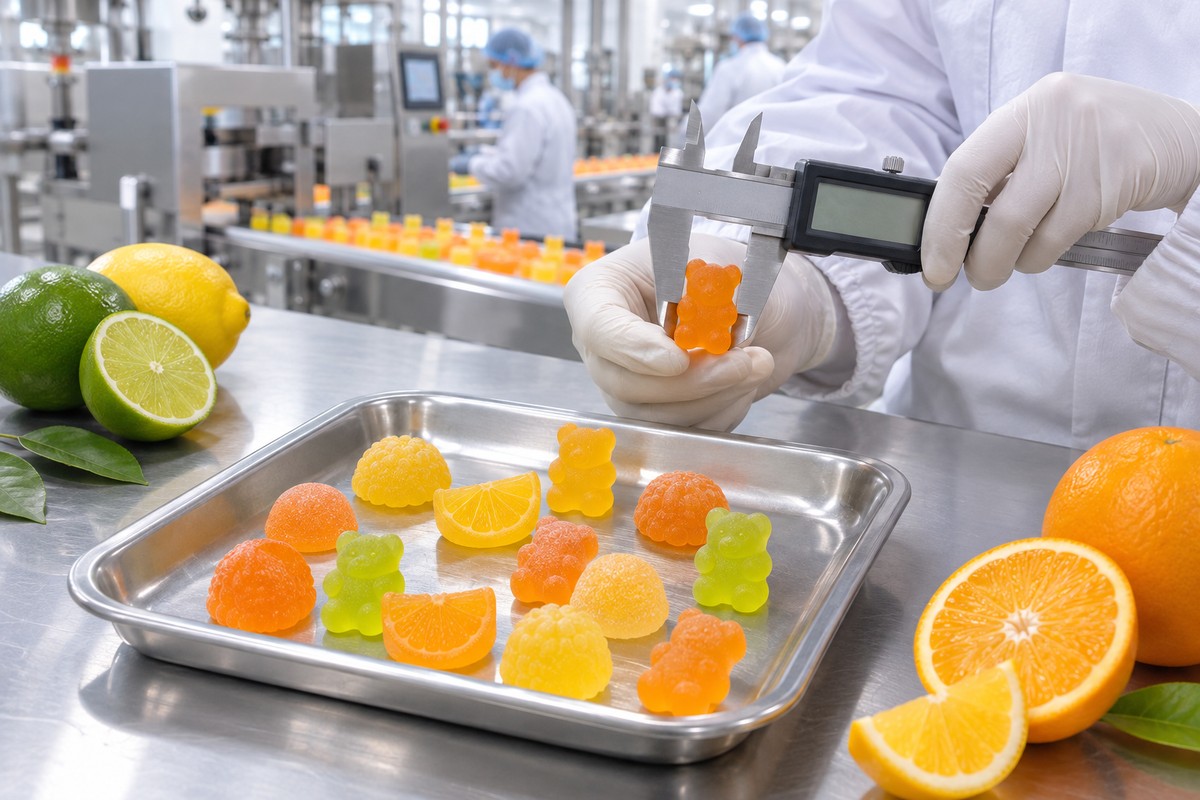
- Geometry. Piece weight to 0.01 g, length, width, height, and the radius at the edges. A caliper on ten pieces from one bag gives a spread, and the spread is as informative as the average.
- Texture. A texture analyser compresses the piece twice and reports hardness, springiness, cohesiveness and chewiness. Cut a piece in half and the cut face shows whether the centre is uniform or has skinned over.
- Colour. A spectrophotometer gives L, a and b values, which is the only way to say "the same orange" in a document.
- Aroma and taste. A trained panel scores intensity, sweetness, acidity, bitterness and the length of the finish, against a written reference rather than a memory.
None of that tells you the formula. It tells you the target, which is the part most briefs leave out.
The same numbers can chew differently
Two pieces can match on every measurement above and still feel like different products, because the numbers describe the state of the piece rather than the chemistry that produced it.
- The gelling system sets the character. Gelatin gives a springy, elastic bite that recovers; pectin gives a shorter, cleaner break; starch gives a soft, slightly mealy chew. A blend of two systems can imitate a third on paper and diverge in the mouth after ten seconds.
- The sugar spectrum sets the body. Glucose syrup with a different dextrose equivalent changes how much crystallisation is suppressed and how the piece dries. The same Brix reading can come from syrups that behave differently in curing.
- pH and calcium decide a pectin set. A high-methoxyl pectin needs acid and sugar to set; a low-methoxyl one sets on calcium. Move the pH by two tenths and the same formula produces a piece that is firmer or that never sets properly.
- Curing time decides the skin. A piece that dries quickly forms a firmer outer layer, and a firmer outer layer reads as a harder chew even when the centre is identical.
- The coating is part of the texture. An oil or wax polish changes the first bite, and a sugar or acid sanding changes it again before the piece is even chewed.
A project that starts from "match these four numbers" ends with a formula that has to be built, not copied. That is the work.
The sample in the post is not the product
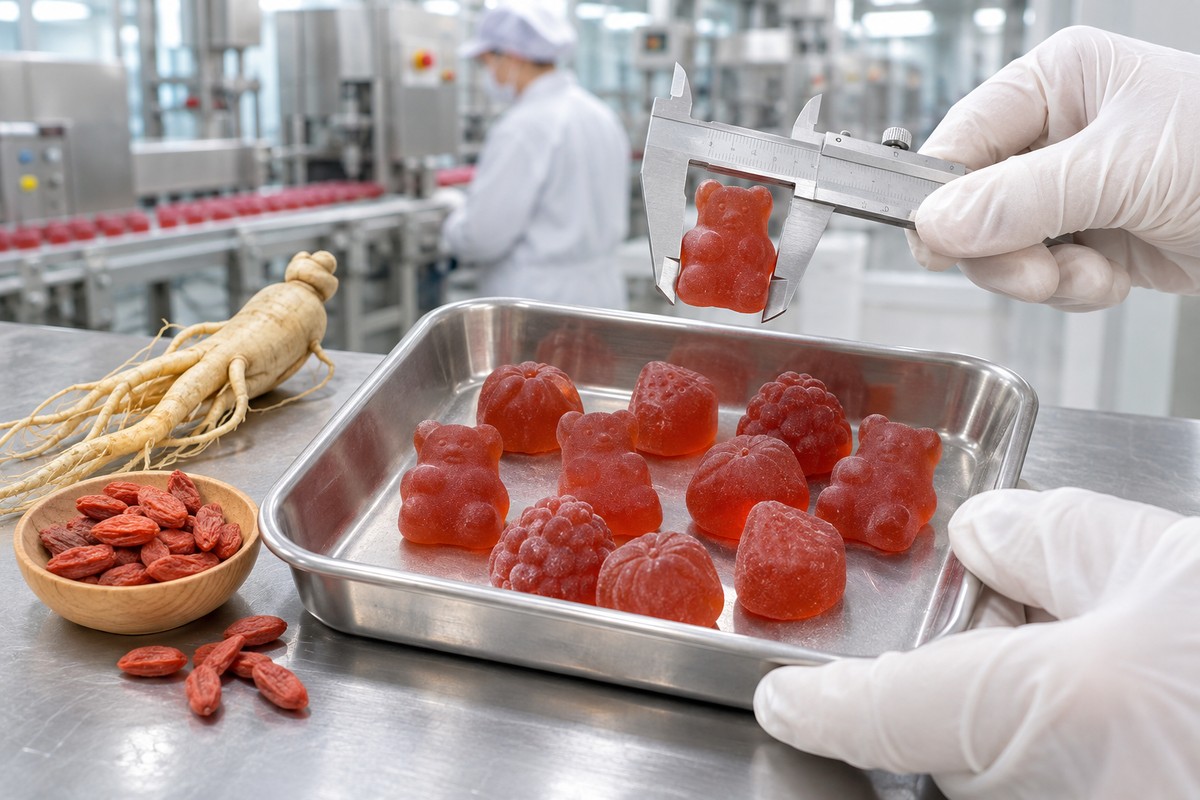
A competitor's gummy bought at retail is a piece at an unknown point in its life. Gelatin continues to cross-link slowly, sugar can begin to crystallise at the surface, moisture migrates toward the wrapper, and volatile flavour compounds leave through the film.
- Ask for the production date. If the pack carries a lot code rather than a date, the code usually decodes to one, and the supplier's own website will often explain the format.
- Aim for the thirtieth day, not the day of purchase. The honest target is the piece as it was a month after packing, which is what a consumer meets in the first weeks of a launch.
- Send more than one bag. Two purchases a few months apart show how the piece is drifting, and the drift is a free stability study.
- Keep the storage conditions. A bag that spent August in a warehouse is a different sample from one that never left an air-conditioned shop, and the difference is not small.
A brief that says "match this bag" without a date is asking for a formula tuned to a piece that no longer exists in that state.
Trade dress is a different question from formulation
Matching a mouthfeel is a technical exercise. Matching a shape, a colour combination and a pack is a legal one, and the two are usually mixed up in the first meeting.
- Shape and silhouette. A distinctive piece shape can be protected as a design or as trade dress in the market where it sells. A gummy bear is generic; a specific bear with a specific profile may not be.
- Colour as a system. A single colour is rarely protectable, but a fixed palette used across a range, with a house shape and a house pack, can be.
- The formula itself. Recipes are protected by patent or kept as trade secrets, not by copying. A rebuilt formula that reaches the same sensory target by a different route is a different formula, and it should be documented as one.
- What a factory should refuse. Reproducing a competitor's logo, a registered shape, or a pack that a shopper would mistake for the original. That is a different request from "make a chew like this", and it should be answered differently.
The useful split in a brief is: match the experience, not the identity.
How a target becomes a specification
The deliverable of a reverse engineering project is not a sample. It is a specification a production line can hit on a Tuesday in November, with tolerances on every number.
- A sensory target in words and references. Not "chewy" but a named commercial product as the upper bound and another as the lower, with the panel trained on both.
- A trial sequence. Each trial changes one variable, usually the gelling system first, then the sugar spectrum, then the acid and buffer, then the cure. Changing two at once produces a result nobody can attribute.
- A blind panel against the reference. Scored on the same attributes as the original measurement, at the same age, so the comparison is fair.
- A specification with ranges. Solids, water activity, pH, piece weight, dimension, texture values and colour, each with a tolerance that the line can hold, not a tolerance that flatters the sample.
- A shelf-life check. The rebuilt piece has to hold its texture for the same period as the original, which is a separate test from matching it on day one.
What our documents cover, and what they do not
- SGS CN23/00007035 —— issued to Anhui Wanhuacao Biological Technology Co., Ltd. against Codex CXC 1-1969 as revised in 2020. Its scope names gel candy among other categories, which is the line an ordinary gummy sits in.
- Production licence SC11434160205012 —— eight dosage forms, including the supplement forms used when a gummy carries a health claim rather than being sold as confectionery.
- What neither covers —— the exclusivity of your formula, the freedom to operate around a competitor's design, or a claim printed on your pack. A factory certificate says what a factory is licensed to make. It says nothing about whether the product is yours to sell.
What to send for a rebuild
- Three retail packs of the reference, with the production date or a lot code, and where and when they were bought.
- The sensory target in your words, including what you would change if you could, since most briefs want an improvement rather than a copy.
- The market and the channel, because a piece sold as confectionery and a piece sold as a supplement are formulated and labelled under different rules.
- The pack format, bag, bottle or blister, and whether the piece will be panned or sanded, since both change the first bite.
- The target piece weight, because everything downstream, from cavity size to cure time, is set from it.
Send the reference packs and the target and the first trial can be built against a measured target rather than an impression. The piece on why sugar-free gummies behave differently covers the one substitution that changes texture most, and the guide to gummy shelf life explains what the reference bag has already been through before it reached you.
Ding Shaohua, Foreign Trade Manager, takes enquiries for this line. The same person answers on WhatsApp, TikTok, LinkedIn and Facebook.
FAQ
Can you match a competitor's gummy exactly?
The texture, the sweetness and the colour can be matched closely enough that a panel cannot separate them in a blind test, and that is the usual target. An exact copy of the formula is not available to anyone, because the formula is not printed on the bag, and the piece in the bag has changed since it was made. What a rebuild delivers is a specification that reproduces the experience at a defined age.
How many samples do you need?
Three retail packs from different purchases, ideally with the production dates visible. One pack gives a target; three give a target plus a sense of how the piece ages, which is more useful than a single perfect sample. If the reference is a product that is no longer sold, two packs from the same batch are enough, with the caveat that the drift cannot be measured.
Do we need to tell you the ingredients we suspect?
No, and it is better not to. A guess about the gelling system in the first meeting tends to become an assumption in the trial plan. The measurements point at the system faster than a list does, and the trial sequence tests it directly. What is useful is what you already know about your own market, such as the claims the pack has to support.
Can the rebuilt piece carry the same claims as the reference?
Only if the claim belongs to your product rather than to the reference. A structure and function claim, a nutrient content claim or a proprietary blend statement each has its own rules, and the rules apply to what is in your piece, not to what is in theirs. A rebuild that starts from the claim is easier to finish, because the claim fixes the dose, and the dose fixes how much of the active has to fit in a piece of a given weight.