
A cold brew hibiscus tea made at home usually fails the same way. The bottle goes into the fridge overnight, and in the morning the top third is pale pink, the bottom third is almost black, and the sachet is floating on the surface with dry calyces inside. Nobody blames the herb. The herb was fine. The bag was the wrong object for cold water.
This matters commercially because cold brew is now a format rather than a style. Once a hibiscus SKU is sold as a bottle-ready sachet, the bag stops being packaging and becomes part of the process specification.
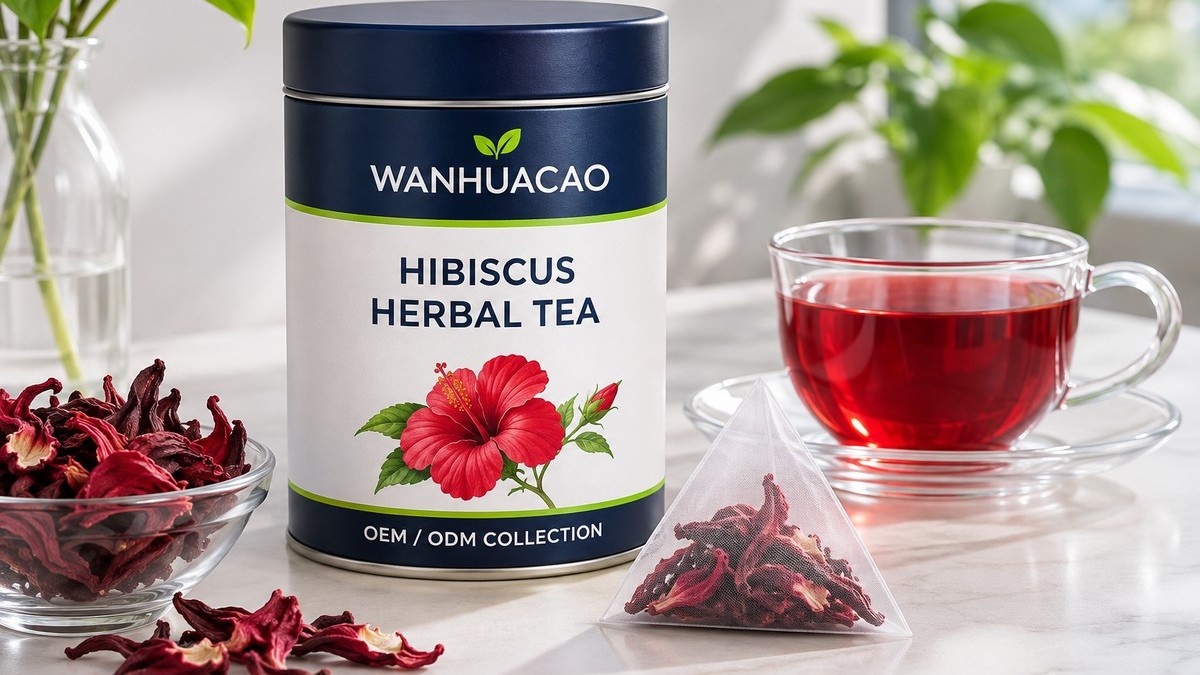
Cold water asks the bag a different question
Most hibiscus tea bags on a shelf were built for a mug of hot water, and the difference shows up on the first cold test. Hot water wets a sachet from the outside in within seconds. The paper or mesh goes transparent, the fill absorbs, and the bag sinks on its own. Cold water does none of that. A dry sachet dropped into cold water keeps a layer of air in the fibre and in the spaces between the calyces, and that air is buoyant enough to hold the whole bag at the surface.
The visible result is stratification. The part of the fill above the waterline never extracts, the part below over-extracts, and the drink has two colours instead of one.
Three design answers exist. A pyramid gives a larger open area and a fill with gaps in it, so water enters from more directions and the bag wets through. A sachet with enough fill mass and a porous mesh sinks once the air escapes. A cold brew pouch, which is a larger bag with a much more open structure, is designed for a bottle rather than a cup and behaves differently again.
The calyx is leathery, and that is the second problem
Dried hibiscus calyx is not a leaf. It is a thick, leathery structure with a waxy outer surface, and it holds its shape in water for a long time. Whole calyces can sit in cold water for hours and still be firm in the middle, which is why cold brew recipes ask for eight hours or more and why the ones that work use cut material.
Cutting solves the wetting and creates the sediment. Hibiscus dust is heavy and dark, it passes most meshes, and it settles into a layer at the bottom of the bottle that looks like a fault even when the drink is correct.
The compromise most programmes land on is a coarse cut that opens the calyx without generating dust, in a pyramid, with the fill weight set so the bag sinks within the first minute. That last number is worth testing rather than assuming.
The colour is a pH reading
Hibiscus red comes from anthocyanins, mainly delphinidin-3-sambubioside and cyanidin-3-sambubioside. They are water-soluble, which is why cold water extracts the colour quite well, and they are pH indicators, which is why the same lot can look like two different products.
Hibiscus is also the rare botanical whose colour is the advertisement, which is why it travels so well under #herbaltea and #teatok where the glass is the whole frame. Below about pH 3 the pigments sit in their red form. As the pH rises towards 4 and 5 the colour moves to purple and mauve, and above that it dulls towards brown. A hibiscus infusion on its own sits around pH 2.5, comfortably in the red, because the calyx carries citric and malic acid.
Any formulation that raises the pH moves the colour. That includes hard water with high alkalinity, an added mineral blend for a hydration positioning, and any buffer added to make the drink less sour. A brand that fixes the colour by adding anthocyanin-rich fruit powder is adding more of the same pH-sensitive pigment, not a stabiliser.
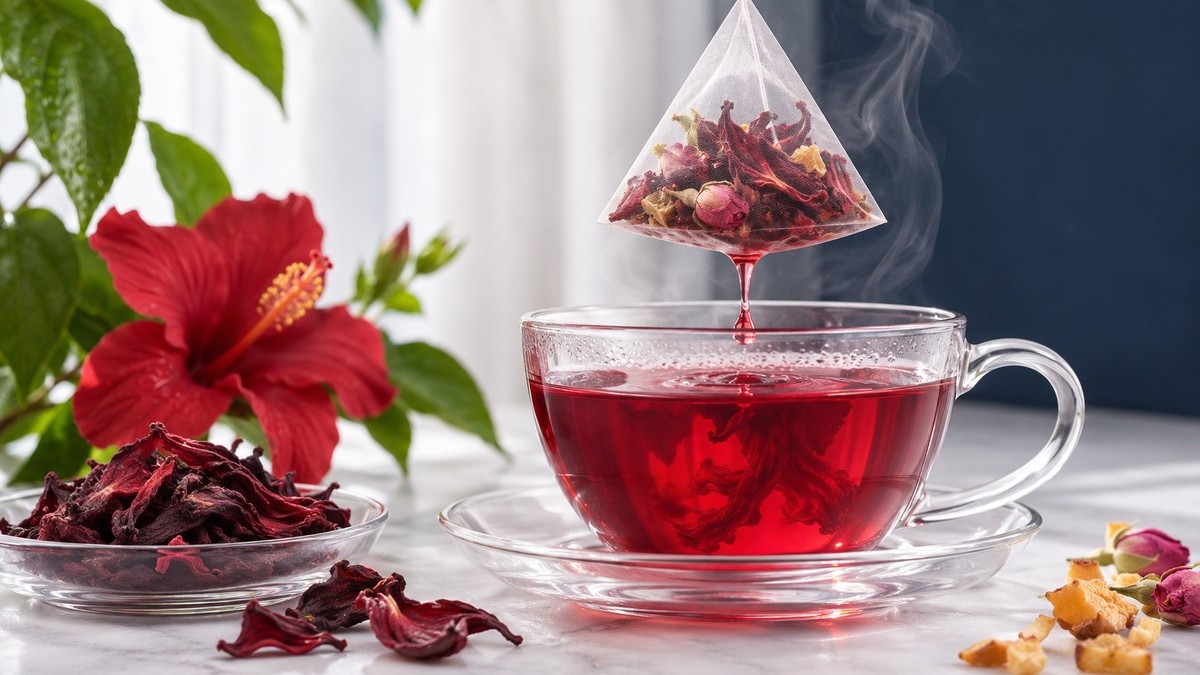
Whole against cut, for colour
Whole calyces hold colour better in storage. Less surface area means less exposure to oxygen and light, and a whole calyx in a sealed liner keeps its red for longer than a cut one in the same liner.
In the cup the order reverses. Cut material gives colour in two minutes, whole material gives it in ten, and a cold brew made with whole calyces needs the full eight hours to reach the same intensity.
The commercial decision is therefore about which failure the brand can live with. Whole calyces in a sachet look generous through a mesh and disappoint anyone who brews for three minutes. Cut calyces deliver the colour quickly and put a dark sediment in the bottle.
A colour specification two labs can agree on
Most hibiscus briefs ask for a deep red. Two laboratories will disagree about that sentence, and the disagreement is not about the herb.
A colour specification needs five numbers attached to it before it means anything.
- Grams of material per litre of water.
- Water specification, since alkalinity moves the pH and the pH moves the colour.
- Temperature and time, because a cold infusion and a hot infusion of the same material do not match.
- The measurement itself, either absorbance at around 520 nm or a set of colour space values.
- The tolerance, in the same units.
With those five fixed, the same material reads the same in two labs. Without them, a buyer and a supplier can both be honest and still disagree, and the argument ends in a replacement lot that fixes nothing.
The blood pressure claim
Hibiscus is one of the botanicals with a real research literature behind a cardiovascular effect, and that is precisely why the claim is dangerous rather than useful.
In the European Union, no health claim for hibiscus is authorised. Blood pressure, circulation and heart health are all absent from the list, and the published studies do not create an authorisation. On a food label the only route is a claim about a nutrient the product actually contains at a meaningful level, which for a hibiscus sachet is usually nothing.
In the United States, a statement that a product lowers blood pressure is a claim to affect a disease, and it makes the product a drug. A structure or function statement about antioxidant content is a different sentence, allowed with the standard disclaimer, and it is the one most brands end up using.
The name is not the problem. Hibiscus tea can be called hibiscus tea. The problem is the sentence underneath it, and that sentence is written by whoever writes the pack copy, usually months after the specification was agreed.
What a cold brew SKU needs locked
A private label tea bags programme that has run cold brew before will ask for different things than a hot tea programme, and the differences are all mechanical.
- The bag structure, chosen for cold water rather than for appearance.
- The fill weight, set so the sachet sinks rather than floats.
- The cut, coarse enough to wet through and fine enough to colour in the stated time.
- The mesh or the filter paper, tested with the actual cut rather than with a similar one.
- The infusion protocol that the colour and the taste were signed off against, written down, because it is the only way a second production run can be compared with the first.
A biodegradable tea bag manufacturer will also want to know how long the bag stands in water, since a material that holds up for a three-minute steep is not the same specification as one that sits in a bottle overnight. A pyramid tea bag manufacturer will quote the format. Whether the format works in cold water is a separate test, and it takes an afternoon with a bottle and a timer.
For the ownership side of a private label project, including who holds the blend sheet, see herbal tea private label. The format itself is covered in pyramid tea bag manufacturer, and the range sits on the herbal tea page.
Ding Shaohua, Foreign Trade Manager at WANHUACAO, works with brands on herbal tea programmes from blend brief to first shipment, including cold brew and single-serve formats. Blending, bagging and overwrapping run in the same plant, under SGS CN23/00007035 covering herbal tea among other categories and SC11434160205012 covering eight dosage forms. Reach him on WhatsApp, TikTok, LinkedIn and Facebook.
FAQ
Why does my cold brew hibiscus tea come out pale at the top?
Because the sachet floats. Dry fibre and the air held between the calyces keep the bag at the surface, so the fill above the waterline never extracts. A pyramid with more open area, a heavier fill, or a short hot bloom before the cold water goes in all fix it.
Does cold water extract hibiscus as well as hot water?
It extracts the colour well, because the anthocyanins are water-soluble, but it needs far longer, often eight hours. Whole calyces also stay firm in cold water for hours, which is why cold brew recipes usually specify cut material.
Why does the same hibiscus lot look different in two drinks?
Because the colour is a pH reading. The pigments are red below about pH 3, shift to purple and mauve as the pH rises, and dull above that. Hard water, added minerals or a buffer in the formula all move the colour without changing the herb.
Can hibiscus tea be sold on a blood pressure claim?
Not as a food in the EU, where no health claim for hibiscus is authorised regardless of the published studies. In the US a blood pressure statement makes the product a drug, while a structure or function statement about antioxidant content is allowed with the standard disclaimer.