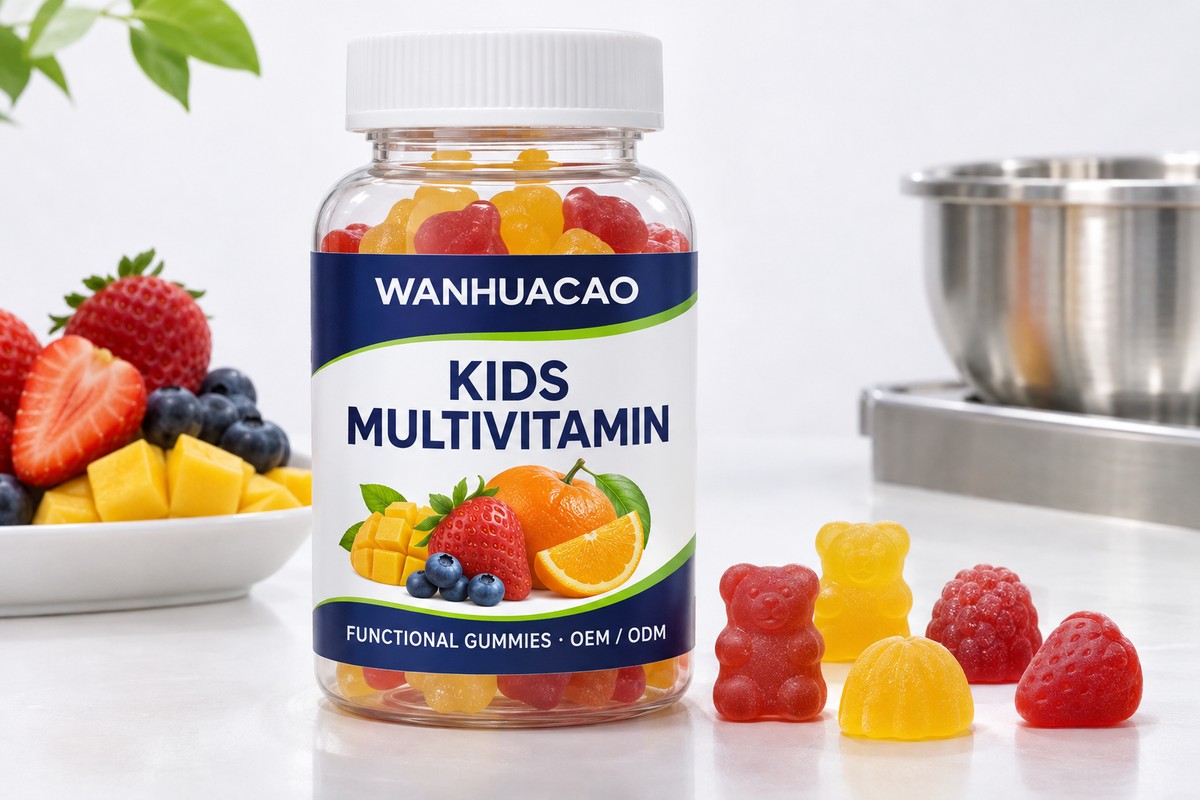
The bottle comes down from the cupboard at seven in the morning. On the front, KIDS in a soft rounded typeface, an orange with a leaf, red and yellow bears scattered underneath. On the back, in six-point type below the supplement facts: Children 4 years and older, chew one gummy daily.
The line that decided the formula is the one nobody photographs.
A children's gummy vitamin is, in practice, a product for four-year-olds and up, and the floor is a chewing age: the point at which a child can manage a piece of gel without choking on it. Everything after that follows from the floor: which nutrients can be carried, how many pieces make a serving, what the panel has to warn about, which colours are still lawful where the bottle is going, and whether the closure has to be one a four-year-old cannot open.
The front says kids, the back says four
The wording barely varies between brands. Not recommended for children under 4 years of age due to choking hazard. Same sentence, same reason, on products from three different manufacturers in three different countries.
In March 2024 the Council for Responsible Nutrition, the US trade association, published voluntary labelling guidelines for gummy supplements. Products intended for children should state the intended age group, and any product intended for children under four should carry a choking-hazard statement. The guidelines are voluntary and the sentence is on the bottle anyway, because a gummy is the one supplement format a small child cannot be trusted with.
The floor changes the shape of the catalogue behind it. For a child under four, the forms that work are drops, powders and liquids, dosed by a parent with a dropper or a scoop. A brief that asks for a gummy from twelve months is asking for a different dosage form, and the answer is a conversation about which form, before anyone talks about moulds.
Shape sits inside the same question, ahead of the design brief. Walk the shelf and the children's pieces are fruit slices, discs and rounded rectangles, all of them an even thickness from edge to edge. A bear with ears and limbs asks a four-year-old to manage several thicknesses in one mouthful, and the child most likely to be given the product is the one least able to do it.
One piece, five windows
A gummy sold as ordinary confectionery can carry a nutrient if the destination permits it in that food category. A gummy sold as a filed nutrient supplement has to land inside a published daily window, and China's catalogue does not contain one children's band. It contains five.
From the 2023 edition of the nutrient supplement catalogue, the daily amounts run like this:
- Vitamin A — 50 to 300 µg RE at ages 1 to 3; 60 to 400 at 4 to 6; 80 to 500 at 7 to 10; 100 to 700 at 11 to 13; 130 to 800 at 14 to 17; 160 to 800 for adults
- Vitamin D — 2.0 to 10.0 µg at 1 to 3; 2.0 to 15.0 from 4 to 17 and for adults
- Thiamin — 0.1 to 0.6 mg at 1 to 3; 0.2 to 1.5 at 4 to 10; 0.3 to 2.0 at 11 to 17; 0.5 to 20.0 for adults
- Copper — no line at all for ages 1 to 3; 0.1 to 0.3 mg at 4 to 6, rising to 1.5 mg for adults
Run a piece through those lines and the arithmetic stops being abstract. A piece carrying 200 µg of vitamin A, eaten four times a day, delivers 800 µg. That is exactly the ceiling at 14 to 17 and the adult ceiling, and it is 2.7 times the ceiling for a two-year-old. The same bottle is lawful for a fifteen-year-old and unlawful for a five-year-old, and no wording on the front changes it.
The reverse happens on other lines. The adult floor for thiamin is 0.5 mg. The ceiling for a one-to-three-year-old is 0.6 mg. The floor for adults therefore sits at 83% of the ceiling for toddlers, which means a line built to clear the adult minimum is already near the top of what a small child may take, while a line built for a small child falls below the adult minimum and cannot be sold to an adult at all.
That is why the bracket on the front fixes the serving before it fixes anything else. The bracket fixes the piece count, the count fixes the bottle, the bottle fixes the carton and the pallet, and the stability programme is written against the serving that survives. The adult panel runs into a version of the same wall between the US and China; a children's line runs into it five times.
The United States does not set per-age ceilings for supplement nutrients, so an American kids panel is built on percentage of daily value and the label's answer to the age problem is the four-year floor. The European Union never adopted harmonised maximum levels for vitamins and minerals in food supplements, so the ceilings are national. A children's SKU aimed at three markets is three panels, three overage tables and three sets of stability work, and the piece in the mould is the least of it.
What a filed notification looks like
There is a public document that shows the shape of a filed Chinese children's gummy better than any description. In July 2025 a gel candy multivitamin from a Tianjin manufacturer was filed under number 食健备G202512002055, and the filing record is published.
The product is 修正牌多种维生素矿物质凝胶糖果, a mixed fruit flavour gel candy at 3 g per piece. It is suitable for ages 4 to 17, adults, pregnant women and nursing mothers, and it is not suitable for children under 3. The serving for 4 to 17 is two pieces twice a day, so four pieces and twelve grams. Adults take six pieces, eighteen grams. Shelf life is 24 months.
Per piece it declares calcium 70 mg, iron 1.2 mg, zinc 0.66 mg, vitamin D3 1.5 µg, vitamin B6 0.2 mg and vitamin E 1.2 mg. At four pieces the daily totals are calcium 280 mg, iron 4.8 mg, zinc 2.64 mg, vitamin D 6 µg, B6 0.8 mg and vitamin E 4.8 mg.
The name says multiple vitamins and minerals, and the panel declares six. Vitamin A is not there. Vitamin C is not there. Those are the two lines a parent's eye reaches first, and they are the two that were left out of a product whose name promises a full panel.
Read the rest of the record and the compromises become visible in the same way. The sweetener is maltitol syrup with maltitol, sorbitol and mannitol, so the piece carries no sucrose. The colour is tartrazine, which is lawful on the Chinese market and one of the six colours that carry a warning in Europe. The notes on the label instruct the consumer not to swallow the piece whole, to chew it fully, to supervise anyone under 13, and to keep it away from infants.
That record is also what a formula looks like after the window, the taste panel and the overage table have each had a turn, with a name written before any of the three had a say. Twelve grams of candy a day is the quantity the filing chose, and on the shelf that quantity is invisible.
Iron decides the bottle closure
Iron is the nutrient a paediatrician is most likely to ask about, and the one this format is least able to carry. A gummy that declares it inherits three separate rules, and each of them costs money in a different part of the project.
The first is the label statement. Iron in a solid supplement form has to carry, in the United States, this warning: Accidental overdose of iron-containing products is a leading cause of fatal poisoning in children under 6. Keep this product out of reach of children. In case of accidental overdose, call a doctor or poison control center immediately. A gummy is a solid form, so the sentence goes on the panel of a product whose whole design intent is to look like a sweet.
The second is the closure. Since 1978 a Consumer Product Safety Commission rule has required child-resistant packaging for dietary supplements holding 250 mg or more of elemental iron per container. Multiply that out and the count decides the packaging: a 60-count bottle at 5 mg of iron per gummy holds 300 mg, which crosses the line, and a 50-count at the same dose holds 250 mg, which sits exactly on it. A closure that a four-year-old cannot open is taller than the one that was quoted, so the bottle changes, so the carton changes, so the pallet changes. None of that appears in a price per piece.
The third is the one that started all of this. A candy-shaped supplement gets eaten like candy, and the numbers on that are not small. Between 2012 and 2021 US poison control centres recorded 260,435 paediatric ingestions of melatonin, 94.3% of them unintentional, 83.8% in children aged five and under, 99% of them at home. Of 27,795 children seen at a health care facility, 4,097 were hospitalised and 287 went to intensive care. Two died, both under two years old. In the published analyses of product content, the chewable format had the widest variation between label and bottle, which converts an accidental ingestion from a known dose into an unknown one.
The record is about the format more than the molecule. What sets a gummy's safety profile is how the piece looks in a small hand, and the industry's answer has been a closure, a warning statement and a shell a child cannot open. For a children's multivitamin those three are part of the formula discussion, because they change the count, the bottle and the carton before anyone has agreed on a flavour.
Colour is a regulatory decision again
Tartrazine on a Chinese label is unremarkable. The same colour on a European label brings a sentence with it. Article 24 of Regulation 1333/2008 requires any food containing one of six colours, tartrazine, sunset yellow, quinoline yellow, carmoisine, allura red and ponceau 4R, to print the name or E number followed by: may have an adverse effect on activity and attention in children. The requirement has applied to products placed on the market since 20 July 2010.
The American side moved in a different direction. On 15 January 2025 the FDA revoked the authorisation for FD&C Red No. 3 in food, including dietary supplements, under the Delaney Clause, after data showed tumours in male rats at high dose. Manufacturers have until 15 January 2027 to reformulate, and until 18 January 2028 for ingested drugs. In April 2025 the Department of Health and Human Services asked companies to remove petroleum-based certified colours from the food supply ahead of that deadline. California passed its own additive statute in 2023, taking Red No. 3 and three other additives out of food sold in the state from 1 January 2027.
A kids line sits in the middle of all three. The cherry red that reads as strawberry to a six-year-old is the exact colour under pressure in the United States, and the shade that survives the switch is a natural one, which behaves nothing like the dye it replaces. Beetroot betanin loses intensity with heat and over shelf life. Spirulina phycocyanin is sensitive to pH and does not survive a depositing temperature. Carotenoid colours are oil-soluble and migrate into adjacent phases. A gummy whose red comes from beet is a different stability file from one whose red came from a lake.
The colour also carries the flavour. Red means strawberry or cherry, orange means orange, purple means grape, and a child reads the piece before tasting it. Change the colour system and the flavour has to be re-matched, and since the acid that delivers a fruit note is also the acid that sets a pectin gel, the texture reopens with it. A colour change on a children's SKU reopens the stability file and the sensory panel; the artwork moves last. The moulded colour question is longer than it looks from the marketing side.
The sentence nobody wants to print
A 3 g piece has almost no room to be sweet. In the European Union a sugar-free claim requires no more than 0.5 g of sugars per 100 g, which for a 3 g piece means under 0.015 g, and no confectionery base made of sucrose can reach that. So a sugar-free kids gummy is a polyol gummy, and polyols come with their own mandatory line: where more than 10% of the product is added polyols, the label must state that excessive consumption may produce laxative effects.
The quantity is what makes that line awkward. At four pieces a day the serving is 12 g of candy. A gel candy base that is 55 to 70% polyol delivers 6.6 to 8.4 g of polyol in that serving, to a child who weighs about 16 kg, and the warning sits on the same panel as the age bracket and the fruit on the front.
The sugar route has a different sentence and a different set of numbers. A sucrose and glucose base at the same 12 g a day is 12 g of candy, which the panel declares in the sugars line, and the US dietary guidance that keeps added sugars away from children under two is already answered by the four-year floor. Sugar in a children's gummy is a market position, as long as the brand knows it chose the sugars line over the polyol warning.
Both routes are lawful and both print something. The choice belongs in the brief, because the base decides the cook temperature, the water activity, the texture and the claim, and a base swapped after the stability work has started costs the stability work. The sugar-free line is built around that decision rather than around the sweetener.
What one desk does not take over
The trade uses four words for the same factory, and they are not interchangeable.
Private label means a stock formula with your artwork. Contract manufacturing means your formula on someone else's equipment. ODM means the manufacturer's formula under your brand. A CDMO adds the development half: it writes the panel with you, runs the trial, runs the stability, and hands over the document set that supports the claim. In supplements the D is borrowed from pharma, and it is the part that produces a file a regulator can read.
Full service is a description of how much of that sits on one desk. On a children's line the list is longer than it sounds: the panel built against the destination window, the overage table with a measured loss behind every line, a stability protocol with real time points, a sensory panel run with children rather than adults, the artwork including every mandatory statement, the closure, the carton, the certificate pack, and the export documents. When those come from four suppliers, the interfaces are where the schedule goes.
What does not move is the label. Under Regulation 1169/2011 the food business operator named on the pack owns the information on it, and under 21 CFR 111 the brand remains responsible for the finished product even when a contractor makes it. A full-service arrangement concentrates the work. It does not transfer the liability, and a supplier who says otherwise is describing a contract that will not survive the first enforcement letter.
The commercial case for putting it on one desk is strongest exactly where a children's range is hardest. A kids launch is rarely one product. Three age brackets, two flavours and two counts is twelve SKUs, and the twelfth is where a per-SKU development fee becomes the whole budget. Formula families share the development, the stability and the trial; what changes per SKU is artwork, a validation and a changeover. That is the difference between #contractmanufacturing and #CDMO in one sentence: one presses what you bring, the other writes the panel with you. The second is worth paying for when the panel is the part you cannot write alone, which on a children's multivitamin it usually is.
Our own scope, in the same terms
This is where the answer has to be specific rather than encouraging.
The functional gummies line runs under a food production licence, and the gummy category is covered by SGS certificate CN23/00007035 for herbal tea, solid beverages, instant cereal powder and gel confectionery, valid to 24 December 2026. An export children's multivitamin gummy is built on that scope, and the certificate is the instrument a foreign buyer or a port authority will ask for.
Our health food licence, SC11434160205012, covers eight dosage forms and runs to 25 August 2030. Gel candy is not one of the eight. A filed domestic blue-hat gel candy, the kind described above, is therefore not a product we can sign, and that sentence belongs in the first conversation rather than the fifth. Reaching that market means a licence amendment or a different plant, and a brand that discovers it after the artwork is approved has bought a delay it did not budget for.
What we can do is the export version done properly: a piece built for one destination's window, an overage table with measured losses, a stability programme that ends at the shelf life printed on the carton, and a colour and sweetener system chosen for the label it will carry. If you have a panel and a destination, send them over and the first reply will be about which lines do not fit.
Ding Shaohua, Foreign Trade Manager at WANHUACAO, works with brands and distributors on children's multivitamin, probiotic and functional gummy programmes from brief to first shipment, in bulk and in private label. The plant operates under SGS CN23/00007035 for gelatine confectionery and SC11434160205012 covering eight dosage forms. Reach him on WhatsApp, TikTok, LinkedIn and Facebook.
Frequently asked questions
Can a two-year-old take a gummy multivitamin?
The labels say no, and the reason printed on them is choking rather than nutrition. Under four, the forms that work are drops, powders and liquids, dosed by an adult. The Chinese nutrient window also narrows at that age: vitamin A has a ceiling of 300 µg at 1 to 3 against 800 for a teenager, and copper has no permitted line at all below four, so a piece designed for a two-year-old is a different formula and not a smaller version of the same one.
How much sugar is in a children's gummy vitamin?
It depends on the base, and the number worth checking is the serving rather than the piece. A filed Chinese gel candy at 3 g per piece with a four-piece serving is 12 g of candy a day. In the sugar-free version that serving carries 6.6 to 8.4 g of polyol at a 55 to 70% polyol base, which triggers the European requirement to state that excessive consumption may produce laxative effects. In the sugar version the same 12 g appears in the sugars line.
Do children's multivitamin gummies contain iron?
Often not, and the reason is the arithmetic around the bottle. Iron in a solid supplement carries a mandatory US warning about fatal poisoning in children under six, and a container holding 250 mg or more of elemental iron needs a child-resistant closure, which a 60-count at 5 mg per piece crosses at 300 mg. A brand that wants the nutrient, the count and an easy-open bottle is asking for three things that do not coexist.
What does a full-service manufacturer do that a contract manufacturer does not?
It writes the panel and the documents behind it: the nutrient window for the destination, the overage table, the stability protocol, the sensory trial, the mandatory statements, the closure and the carton. What it does not do is take the label off your hands. Under EU 1169/2011 the operator named on the pack owns the information on the pack, and under 21 CFR 111 the brand stays responsible for the finished product, whoever pressed the piece.