
Open a carton of lemon balm and lavender tea in a meeting room and the room knows before anyone reads the label. That is the whole commercial case for the product, and it is also the part of the specification that nobody writes down. A buyer can test fill weight, moisture and microbial load. The thing the customer actually buys has no number attached to it.
Both herbs are sold on scent. Lemon balm carries a lemon note that comes from citral, and lavender carries the floral, slightly sweet note that comes from linalool and linalyl acetate. Neither survives a careless process, and neither shows up in a certificate of analysis in the form the nose detects.
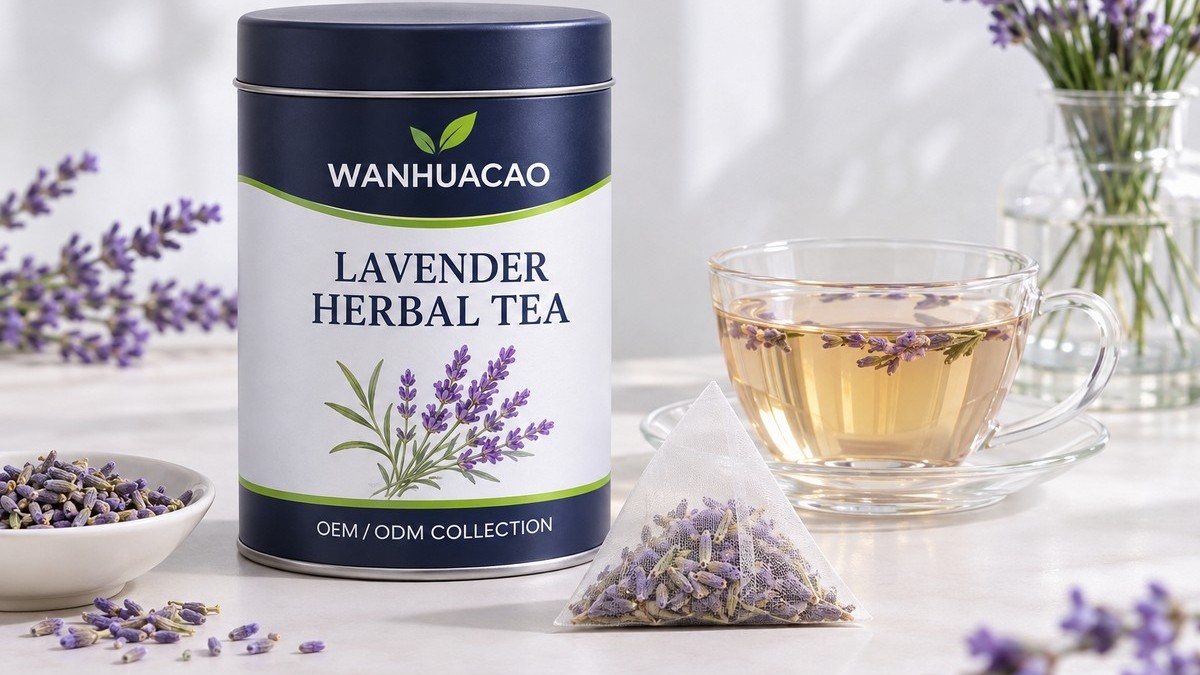
Two herbs sold on a sense
Lemon balm is a leaf, thin and quick to dry, and it gives up its oil easily. Lavender is a flower bud with a waxy surface that holds oil well until heat and moisture get to it. Put them together and the blend has one aroma profile at the mixer, another after sterilisation, and a third after six months in a carton.
The two also share a regulatory position that matters more than the scent. Under Regulation 1924/2006, calming is a health claim and it is not authorised for either herb, so a calming tea cannot carry it. Both herbs do have traditional-use monographs from the European Medicines Agency, for mild stress and aid to sleep, which means the calming position is reachable as a registered traditional herbal medicinal product and not as a tea.
Citral leaves first
Citral is two isomers, geranial and neral, and it is the reason lemon balm smells like lemon rather than like hay. It is also volatile and it oxidises. Leaf dried at a high temperature loses a large share of it, and leaf stored warm loses more, and the loss does not show up in any specification that a tea factory normally runs.
The marker that does show up is rosmarinic acid. It is water-soluble, it survives drying and it survives brewing, so it appears on certificates and in extract specifications. It is also not what the customer smells. A lot can hold its rosmarinic acid and have lost the lemon, which is why a sensory reference sample belongs in the purchase order next to the certificate.
Drying temperature is the single decision that sets this up. Lemon balm dried slowly at a low temperature keeps its colour and its citral, and it arrives with a higher microbial load that has to be handled later. There is no way to have both a gentle dry and a low count without a sterilisation step, and that step takes aroma out.
The ester in lavender, and which lavender
Linalyl acetate is the fresh, floral part of lavender. Under heat and moisture it hydrolyses into linalool and acetic acid, so the ester share falls and the smell turns heavier and sweeter. Steam sterilisation accelerates it. So does a warm warehouse, slowly, over a year.
The second decision is which lavender. True lavender, Lavandula angustifolia, is low in camphor and is what the aroma brief usually means. Lavandin, a hybrid grown for oil yield, carries more camphor and reads as medicinal or camphoraceous in the cup. Both can be sold as lavender. The difference is visible in a GC trace and in the first sip, and it is worth asking about before comparing two quotes.
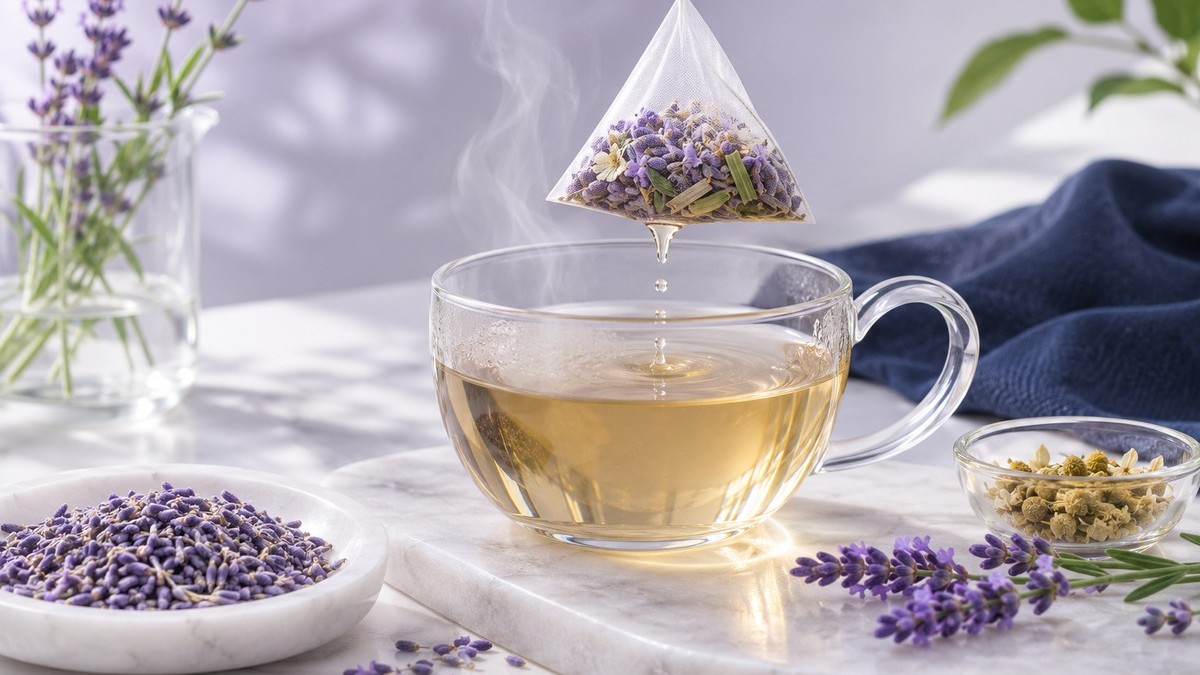
The only sentence that survives a label review
Calming cannot go on a food label in the European Union. Aroma can. "Floral and citrus aroma" is a description of the product, not a claim about the person drinking it, and that distinction is where the copy for this category has to live.
That is thinner than most brand decks expect. It also explains why the packaging copy in this segment leans on occasion and image rather than on benefit: an evening cup, a quiet ten minutes, the smell of the thing. A brand that wants a benefit statement needs the monograph route, a pharmaceutical licence and a registered indication.
On Instagram this category runs on the same logic. #tearitual and #herbaltea content is a cup, a hand and a window, and the product that photographs well is the one that gets shared. The aroma has done the selling before anyone reads a word.
In the United States the same product is a supplement or a conventional food depending on how it is presented. A structure or function statement with the standard disclaimer is available; a disease claim is not.
Packaging is part of the formula
Aroma leaves through packaging in two ways. It adsorbs onto paperboard, so a carton that has been on a shelf for a year smells of carton when it is opened. And it permeates the film, slowly, at a rate that depends on the laminate.
For a product whose value is its smell, that makes the pack a process decision. An aluminium foil laminate holds volatiles; a paper or PLA structure lets them go, which is the trade a brand makes when it chooses plastic-free. An individually enveloped sachet protects the sachet until it is opened and then exposes one serving at a time. Loose sachets in a carton expose everything on day one.
The tin in the photograph does something different again. Metal blocks permeation, the double seam holds, and the format suits a gift or a shelf presence that a carton cannot carry. It also costs more per unit, and it needs a filling line that can dose into a rigid container rather than a web.
What to write into the purchase order
A purchase order for a lemon balm tea, or for a blend like this one, should name the species behind the word lavender, the drying method, the sensory reference, and the pack. Without those four, two suppliers can both deliver "lemon balm and lavender tea" and neither is wrong.
A functional tea OEM quoting on this brief will ask what the shelf life has to be, because that answer sets the laminate. An enveloped tea bag OEM will ask for the aroma reference, because the envelope is the unit that has to hold it. A custom tea blend manufacturer will ask for the ratio, and the ratio is usually settled by taste rather than by cost.
For the bag itself, see pyramid tea bag manufacturer. The material trade-offs are set out in eco-friendly tea bag materials, and the range sits on the herbal tea page.
Ding Shaohua, Foreign Trade Manager at WANHUACAO, works with brands on calming blends and aroma-led herbal teas from brief to first shipment. Blending and bagging run in the same plant, under SGS CN23/00007035 covering herbal tea among other categories and SC11434160205012 covering eight dosage forms. Reach him on WhatsApp, TikTok, LinkedIn and Facebook.
FAQ
Why does lemon balm lose its lemon note?
The note comes from citral, which is volatile and oxidises. High drying temperatures and warm storage remove it, and none of the routine tests on a tea lot detect the loss. Rosmarinic acid, the marker that does appear on a certificate, is water-soluble and survives, so it cannot stand in for the aroma.
Is all lavender the same in a blend?
No. True lavender, Lavandula angustifolia, is low in camphor and carries the floral note most briefs mean. Lavandin has more camphor, yields more oil per hectare and reads as medicinal in the cup. Both can be labelled lavender.
Can the pack say calming?
Not on a food label in the EU. Calming is a health claim under Regulation 1924/2006 and is not authorised for lemon balm or lavender. Aroma descriptors such as floral and citrus are product descriptions and are allowed. A benefit statement needs the traditional herbal medicinal product route.
How much does packaging change the smell?
A great deal. Paperboard adsorbs volatiles, films permeate them at rates that differ by laminate, and loose sachets in a carton expose the whole batch from the first day. A foil laminate, an envelope or a tin each hold aroma differently, and the choice is part of the specification rather than a design preference.