
A brief for a mullein leaf tea usually arrives with a fill weight borrowed from a chamomile project: 1.5 g, sometimes 2 g. The quote that comes back specifies a pyramid sachet and costs more per unit than the line it was copied from. The gap comes from volume. At the same weight mullein leaf takes up three or four times the space of cut chamomile flower, so the bag has to be built around the material rather than around the habit.
That decision is usually taken in the wrong order. A brand picks the format, then the weight, then asks for a price, and discovers at sampling that the two do not fit.
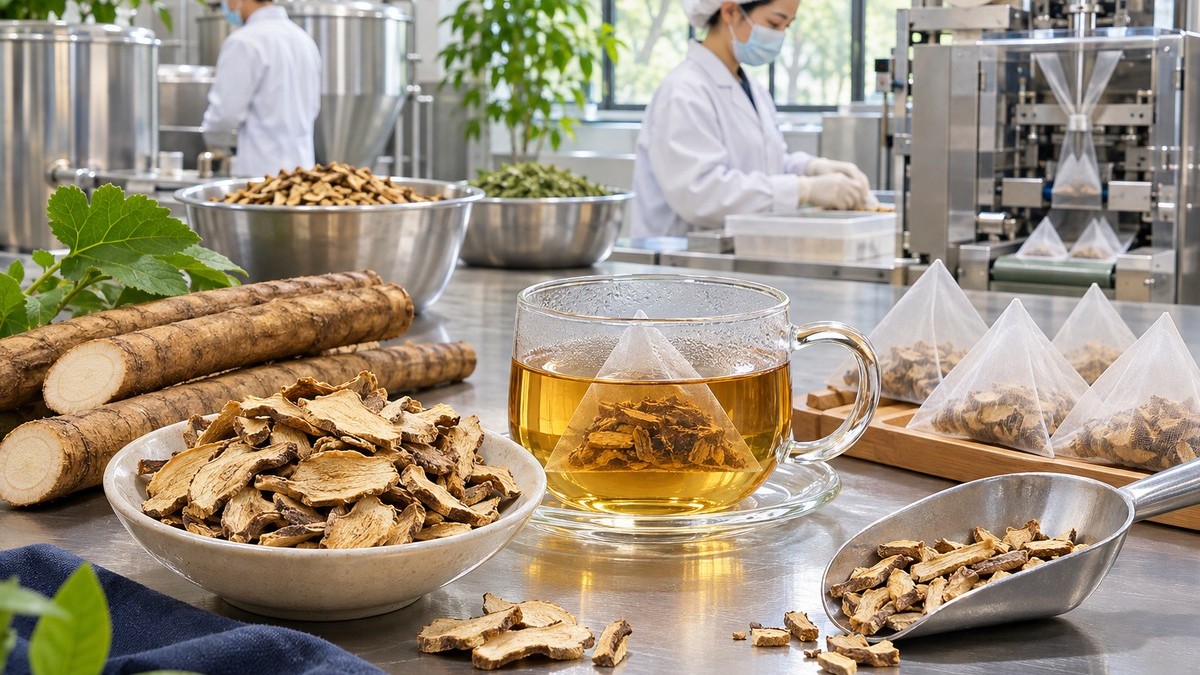
Weight and volume are two separate specifications
Loose dried mullein leaf commonly measures between 0.08 and 0.15 g per millilitre. Take the middle of that range and a 1.5 g fill is roughly 12 mL of material. A flat sachet of 45 by 55 mm, filled to the seam, holds about 6 to 8 mL. The arithmetic says the weight and the bag are incompatible before anyone has discussed price.
There are three ways out. Drop the fill to about 0.7 g and keep the flat bag. Keep 1.5 g and move to a pyramid, which holds the volume because the web is drawn into a three-dimensional shape rather than folded flat. Or cut the leaf finer so that the same weight takes less space, which is a decision about the cup rather than about packing.
A loose leaf tea wholesale supplier quotes per kilo and a sachet programme quotes per unit, and volume is where the two prices stop agreeing with each other.
The second option is the common one in this category, and it is why mullein programmes quote higher per sachet than a chamomile programme at the same weight. The bag is larger, the film or mesh per unit is larger, and the carton is larger for the same count.
The cut decides the cup before it decides the packing
A fine cut raises bulk density to around 0.2 to 0.25 g per millilitre, which brings 1.5 g back inside a flat sachet. It also puts dust into the cup. Mullein dust passes a mesh that holds leaf pieces, so the liquor goes cloudy within a minute and the sediment settles by the time the cup reaches the table.
A coarse cut or a whole leaf gives the clear amber cup that the category shows in its photographs, which is the image that carries herbal tea on short video under #herbaltea and #teatok. A cloudy cup does not survive the comparison. The coarse route is also slow. Coarse material wets through more slowly, releases less in a three-minute steep, and needs the volume discussed above.
The specification that resolves this is written in millimetres. Coarse and fine are opinions; a sieve range is a specification. A leaf cut to 2 to 4 mm behaves differently from one cut to 1 mm, and a supplier who is told "coarse" will deliver whichever of the two their mill is set to that week.
Mullein is a hairy leaf, and the hairs change how it wets
The leaf is covered in dense trichomes. They are the reason the dried herb feels like felt, and they are the reason it floats. Air trapped in the hair layer keeps water off the surface, so a sachet dropped into a cup tends to sit on top of the water with the fill still dry inside.
In a teapot that is a small annoyance that a stir fixes. In a cold brew bottle, or in any application where the consumer does not stir, it is a defect: the first third of the drink is water and the last third is over-strength. The fixes are mechanical. A pyramid gives more open area for water to enter. A short hot bloom before the cold water goes in wets the leaf. A larger cut leaves more gaps between pieces for water to move through.
The hairs also hold water on the way out. A sachet lifted from the cup keeps dripping for longer than a leaf blend without them, which matters on a wrapping line where a wet sachet meets an envelope.
Licorice is the one herb in the blend with a number
Most blends in this category are mullein with licorice and thyme, or mullein with licorice and marshmallow. Licorice is there to soften the mouthfeel and to cover the leaf's flat, slightly bitter taste. It also brings glycyrrhizic acid, at roughly 2 to 6 percent of the root.
That number has a labelling consequence. Under Directive 2004/77/EC, a beverage containing licorice needs the mention "contains liquorice" above 10 mg of glycyrrhizic acid per litre, and a warning for people with hypertension above 300 mg per litre.
Run the arithmetic on a typical sachet. At 0.3 g of licorice root in a 1.5 g blend, and 4 percent glycyrrhizic acid, one sachet carries about 12 mg. Brewed into 200 mL that is 60 mg per litre, six times the mention threshold and a fifth of the warning threshold. To reach 300 mg per litre you would need 60 mg in the cup, which is 1.5 g of licorice root at that strength, more than the entire sachet.
So the mention applies and the warning does not, as long as licorice stays a supporting herb. If a brand raises it to the main ingredient to make the tea taste sweeter, both thresholds move into play and the carton copy has to change with them. That belongs in the brief. Changed at the printer it costs a new plate, and changed after the first shipment it costs a recall.
Cleanse is a word without a definition
The products in this category are usually named for what they are for. Lung, respiratory, breathe easy, cleanse. None of those words has a regulatory definition, and that is exactly where the risk sits.
In the European Union, detoxification and cleansing claims were reviewed by EFSA in 2011 and the evidence was found insufficient, so no claim of that kind is authorised for a food. A respiratory claim is further away still: nothing in the authorised list covers the lungs, and a product presented as relieving a bronchial condition moves towards the definition of a medicinal product by function.
In the United States the same sentence is judged differently but arrives at a similar place. A structure or function statement is allowed with the standard disclaimer. A claim to treat or prevent a disease, and asthma and bronchitis are diseases, makes the product a drug.
A name can describe a tradition or an occasion. A sentence that attributes an effect to the product is a different object, and it is the sentence that gets a shipment held.
What belongs in the brief
A tea bag manufacturer that has only run cut chamomile will quote the flat format out of habit. A herbal tea contract manufacturer that has run mullein will ask for the bulk density before quoting at all, and that question is the cheapest filter available at the enquiry stage.
Five items settle most of the questions above before sampling starts.
- The fill weight, and the bulk density range that weight assumes.
- The cut, in millimetres, with a sieve range rather than a word.
- The bag format and the mesh, chosen together, because a mesh that holds a coarse cut will not hold dust.
- The licorice percentage, and a named person on the supplier side who runs the glycyrrhizic acid calculation.
- The foreign matter limit, since leaf harvested close to the ground carries sand, and sand is denser than leaf, so it ends at the bottom of the cup where the consumer sees it.
What the certificate should carry
Identity comes first: species, plant part and origin. Mullein is Verbascum thapsus and the leaf is the part used, and a certificate that says only "mullein" leaves the question open.
Foreign matter and microbial counts come next, because a leaf that grew in a rosette at ground level is a soil-contact material. The sterilisation route then has to be chosen against the volatile fraction, since steam removes some of what the cup is for, irradiation has to be declared on the pack, and ethylene oxide has been prohibited for food use in the EU since 1991.
A certificate that lists all four tells you the supplier has run this material before. One that lists only a specification percentage tells you they have run something.
For the claim side of a herbal tea, the same reasoning is set out in chamomile sleep tea. The site audit questions, including the fill tolerance on a bulky material, are in herbal tea private label manufacturers. The product range sits on the herbal tea page.
Ding Shaohua, Foreign Trade Manager at WANHUACAO, works with brands on herbal tea programmes from blend brief to first shipment, including loose leaf, flat sachet and pyramid formats. Blending, bagging and overwrapping run in the same plant, under SGS CN23/00007035 covering herbal tea among other categories and SC11434160205012 covering eight dosage forms. Reach him on WhatsApp, TikTok, LinkedIn and Facebook.
FAQ
How much mullein leaf fits in a standard tea bag?
A flat sachet of 45 by 55 mm holds about 6 to 8 mL of loose material, which at the bulk density of dried mullein leaf is roughly 0.7 g. A 1.5 g fill needs a pyramid or a finer cut. The weight a brand wants and the bag it has chosen are usually incompatible until one of them changes.
Why does a mullein sachet cost more than a chamomile sachet at the same weight?
Because the volume is different. Mullein leaf is three to four times bulkier than cut chamomile flower at the same weight, so the sachet, the mesh and often the carton are larger for the same count. The herb's own price is a smaller part of the difference than the format.
Does a mullein and licorice tea need a licorice warning?
It needs the mention "contains liquorice" once the brewed drink passes 10 mg of glycyrrhizic acid per litre, which a 0.3 g share of licorice root in a 1.5 g sachet does. The hypertension warning threshold is 300 mg per litre, which that sachet does not reach. If licorice becomes the main herb, both thresholds apply.
Can a mullein tea be sold as a lung cleanse?
The name can describe a tradition. A statement that the product cleanses the lungs or relieves a bronchial condition cannot, in the EU because no such claim is authorised for a food and in the US because it turns the product into a drug. Detoxification claims were reviewed by EFSA in 2011 and found insufficient.