
A brief lands with a name already chosen: Probiotic / Debloat Gummies. Behind it, five lines of actives: a spore-forming culture, an enzyme blend, simethicone, peppermint oil, and a "flat belly" claim in the caption. The brand has seen the format work on social and wants the same thing, in a 60-count bottle, sugar free, in twelve weeks.
Those five lines do not belong to one product. Two of them are drugs in most jurisdictions, one of them digests the gummy it sits in, and the culture has no mechanism that produces a visible change in the time the marketing implies. The name on the artwork is one word. The formula inside it is an argument between four different ways of being less bloated, and the argument has to be settled before the mould is cut.
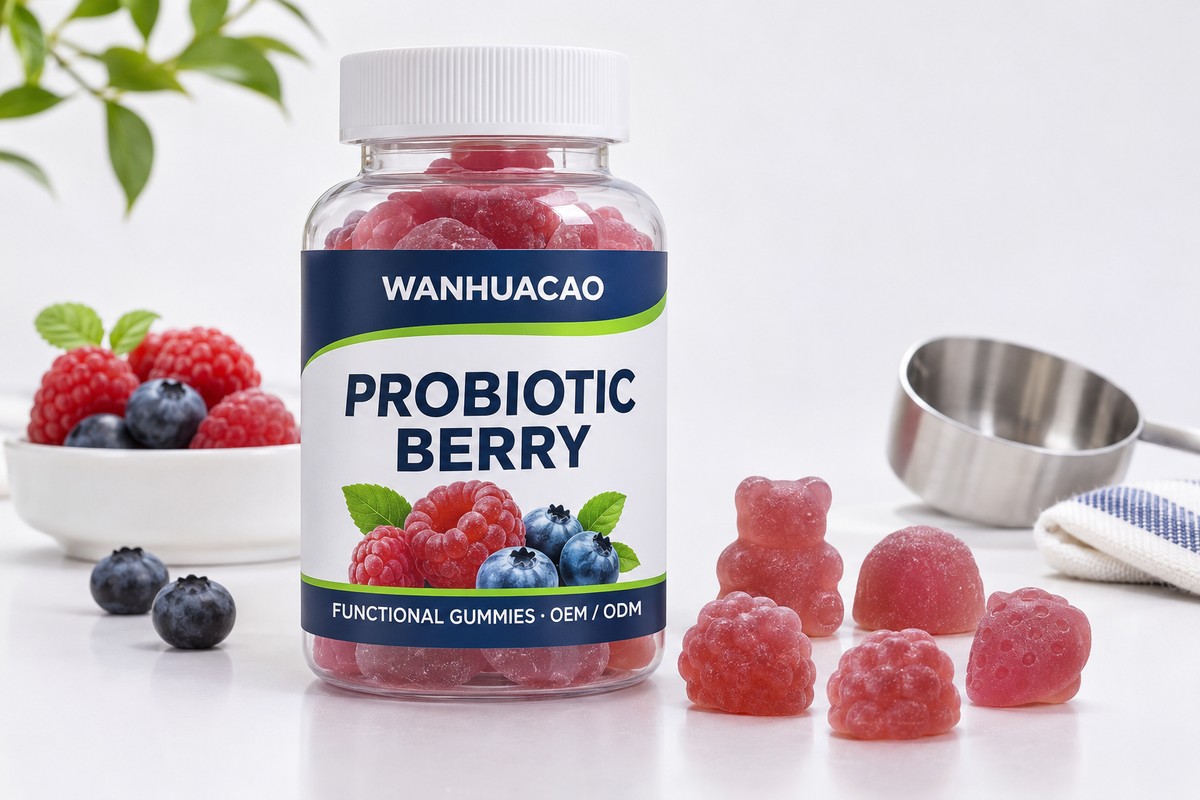
Debloat names a symptom, so the brief has to pick a mechanism
There is no debloat ingredient. There are four mechanisms that reduce abdominal distension, and they are not interchangeable.
Gas volume falls if you break the bubbles, which is what a silicone antifoam does. Gas production falls if you stop the fermentation, which is what an alpha-galactosidase does to the oligosaccharides in beans and brassicas. Water comes off if you promote diuresis, which is what dandelion leaf does, and the distension that goes is not gas at all. Motility and visceral sensitivity change if you relax smooth muscle, which is what peppermint oil does. A live culture does something slower and less visible: it shifts the composition of a community over weeks.
Each mechanism has its own active, its own dose, its own stability problem and its own legal status. A gummy can carry one of them well, two of them adequately, and five of them not at all, because five actives at effective doses do not fit inside 2.5 grams, and because the process that suits one destroys another.
The first useful question for a Probiotic / Debloat Gummies brief is which mechanism the customer is paying for. The answer decides everything downstream of it.
The antifoam cannot legally be a gummy
Simethicone is the mechanism most people mean when they say debloat. It is a polydimethylsiloxane with dispersed silica, it lowers the surface tension of foam in the gut, and it is not absorbed. It works in hours.
It is also a drug. In the United States it sits in the OTC antiflatulent monograph, 21 CFR 332, with a maximum daily dose of 500 mg, and the indications the monograph writes for it include, word for word, "relieves bloating, pressure, fullness, or stuffed feeling commonly referred to as gas". That sentence is the product a debloat gummy is trying to be, and it is an approved drug indication.
Two consequences follow. The dosage forms the monograph is built around are chewable tablets, capsules, liquids and orally disintegrating strips; a moulded gummy is not one of them, so a simethicone gummy sold as a supplement is an unapproved new drug rather than a supplement with an ambitious label. And a supplement that prints "relieves bloating" is using the drug's own indication, which is the pattern behind most of the warning letters in this category.
There is a food-grade version of the same chemistry, polydimethylsiloxane used as a processing antifoam, and it is permitted in food at a few parts per million to stop a kettle foaming over. That is not a dose. It is a line additive, and at the level that would matter in a stomach it would no longer be a processing aid.
So the honest answer to "make it like the gas tablet but a gummy" is either a drug registration in a permitted form, or a different mechanism.
The enzyme has to be dosed after the cook, and sold as activity
Alpha-galactosidase is the one mechanism that is both real and commercially feasible in a gummy.
The dose is small. A leading consumer product carries 5.2 mg of enzyme per tablet, quoted as 300 FCC GalU of activity, taken with the first bite of a meal. Five milligrams is 0.2% of a 2.5 g piece. Mass is not the constraint.
Heat is. The enzyme is a protein from Aspergillus niger with an activity optimum near 50 to 55 °C, and a gummy syrup is deposited at 75 to 88 °C. Enzyme activity falls away steeply through that range and does not come back. Nothing survives being cooked into the base, so the enzyme goes in downstream: injected into the cooled syrup after the cook, or carried as a coated bead that takes the temperature and releases in the stomach.
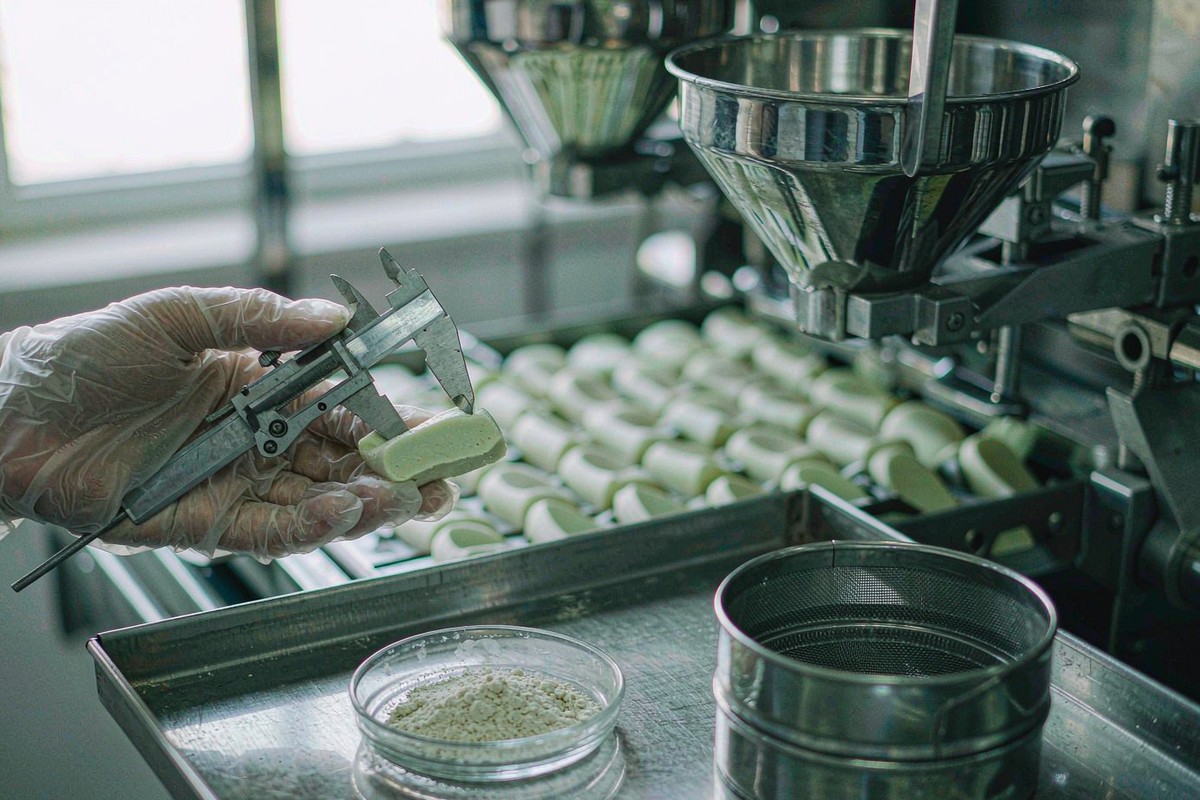
Then there is the labelling question, which is where most of the money sits. The quantity that has to be on the label is activity, not weight, and it has to be true at the end of shelf life. Health Canada's monograph for the ingredient sets the range at 260 to 3,000 FCC GalU per day and requires the quantity per dosage unit to be expressed in FCC units, with the milligram figure as supplementary information. A specification written in milligrams is a specification that cannot be checked.
Overage follows from the same place. Enzyme activity in a low-water matrix declines slowly rather than catastrophically, so a 20 to 40% activity overage usually holds a two-year claim, an order of magnitude cheaper than what a live vegetative culture would need, and one of the reasons enzyme gummies are the workable version of this category.
Papain eats the gelatin it is packed in
A digestive enzyme blend usually contains proteases, and a standard gummy base is gelatin, which is a protein.
Put bromelain or papain into a gelatin syrup and the enzyme starts hydrolysing the base while the base is still warm. Bloom strength falls, the piece loses its bite, and by the end of the cure it slumps or welds to its neighbour in the bottle. The effect is slow enough to pass a pilot and obvious by the third production batch, which is how it usually gets discovered.
There are three ways out. Remove the proteases and keep only the carbohydrase, which is what most commercial enzyme gummies do, because alpha-galactosidase is the active that has the evidence anyway. Coat the enzyme so it cannot reach the gelatin until it is swallowed, which works and costs. Or change the base to pectin, which is not a protein and cannot be digested by a protease. That last route is the cheapest and the most common, and it changes the whole process. A pectin base cooks hotter, sets on a different calcium-and-acid mechanism, and needs a different cure. The trade-offs between the two bases are set out in pectin versus gelatin; the relevant one here is that a protease blend is only compatible with one of them.
Peppermint needs a coat, and a gummy has no coat
Peppermint oil has the deepest evidence base of any of these mechanisms for abdominal bloating, and it is delivered as an enteric-coated capsule for a reason.
The oil has to reach the small intestine. Released in the stomach, it relaxes the lower oesophageal sphincter and the customer gets heartburn instead of relief, a side effect common enough that it is the main reason people stop taking it. The enteric coat is not packaging. It is the product, and it is the thing a gummy cannot provide, because the whole point of a gummy is that it dissolves in the mouth.
The dose is also awkward. A therapeutic dose runs 90 to 180 mg, which is 4 to 7% of a 2.5 g piece by weight, and peppermint oil at that level flavours the entire batch. Two pieces a day is then a confectionery-scale amount of menthol, and the chew experience is a breath mint rather than a supplement.
What a gummy can do is carry peppermint as a flavour and a mild carminative, at a fraction of the studied dose, and say nothing about it on the front of the pack. That is a legitimate product. It is not the one the clinical literature describes.
The sweetener can produce the symptom
The brief contradicts itself in the same line: sugar free.
A sugar-free gummy is built on polyols, usually maltitol syrup or a maltitol-sorbitol blend, at 55 to 70% of the piece. At 2.5 g per piece that is roughly 1.5 g of polyol, and a three-piece day is about 4.5 g. That is below the 10 to 20 g at which maltitol reliably produces osmotic diarrhoea in adults, so the arithmetic is not damning on its own.
The label is. European rules require any food with more than 10% added polyols to carry the statement "excessive consumption may produce laxative effects". A product at 60% polyol carries it, permanently, on the same panel as the promise. In the United States the equivalent note applies where a food may reasonably be eaten in amounts supplying 50 g of sorbitol a day, a threshold a gummy will not reach, which is why most US labels omit it and why the EU artwork cannot.
Then there is the customer. The person buying a debloat gummy is, in most cases, the person with irritable bowel syndrome, and polyols are fermentable. Sorbitol and maltitol sit in the FODMAP list precisely because they draw water into the colon and ferment there. The population most likely to buy the product is the population most likely to react to the excipient that makes it sugar free.
The same arithmetic kills the prebiotic story. A useful inulin or FOS dose is 3 to 5 g. A 2.5 g gummy cannot contain 3 g of anything, so a prebiotic-plus-probiotic debloat gummy carries at most about 0.5 g of fibre, which is a sixth of the dose the studies used. The stack that converts on camera does not fit in the piece being sold. The manufacturing constraints behind sugar-free bases are covered in sugar-free gummy manufacturing.
What survives a 2.5 g mould
Put the four mechanisms against the three questions that decide a gummy and the field narrows quickly.
- Silicone antifoam —— dose fits, survives the process, but cannot be sold in this form as a supplement in the US
- Alpha-galactosidase —— dose fits at about 5 mg, needs post-cook dosing or a coating, needs a pectin base if a protease is present, and the label has to be written in activity units
- Peppermint oil —— dose fits by weight but not by function, because the enteric coat is what makes it work and a gummy has none
- Dandelion leaf —— dose fits as a powder, but the effect is water rather than gas, and it interacts with diuretics and antihypertensives in a way that belongs on a pharmacist's label
- Spore-forming probiotic —— dose fits at a few billion CFU, survives depositing, but works on a timescale of weeks and produces nothing a camera can catch in a day
One clear winner on feasibility, one on evidence, none on both. That is the real content of the Probiotic / Debloat Gummies decision, and it is usually settled by which claim the brand can substantiate rather than by which ingredient is cheapest.
Where the word debloat becomes a regulatory problem
The word carries a different risk in each market, and the three markets rarely agree.
In the United States, "relieves bloating" is a drug indication in the antiflatulent monograph. A supplement can make a structure-function statement about digestive comfort, but it needs the DSHEA disclaimer, and the moment the copy moves to relief, timing or a body outcome, it has left that safe harbour. The Federal Trade Commission's 2022 Health Products Compliance Guidance treats before-and-after imagery as an implied claim, so a flat-stomach photo in an ad is a claim about the product regardless of what the caption says.
In the European Union there is no authorised claim for reducing bloating at all. The register carries bowel-function claims for lactitol on stool frequency and for wheat bran fibre on faecal bulk, and both are conditioned on around 10 g a day, which is four gummies at 3 g each and therefore not a gummy product. The word probiotic is itself treated as implying a health benefit and has no authorised claim behind it.
In Canada, alpha-galactosidase has a monograph and a permitted claim, which makes it the one mechanism in this article with a clean regulatory path in a major market. The claim is narrow and meal-specific, and it is the reason enzyme-based debloat products have a defensible label while silicone and peppermint ones usually do not.
Bulk is a different business from private label
A Probiotic / Debloat Gummies programme often starts as a private label enquiry and turns into a bulk one at the second order, and the two are not the same purchase.
Private label means the factory supplies a finished, labelled, bottled product under the buyer's brand. Bulk means the factory supplies gummies in 20 kg polyethylene-lined cartons, or in 10 to 25 kg moisture-barrier bags with a desiccant, and the buyer owns everything after that: the bottle, the cap, the label, the carton, the repack line and the regulatory identity of the seller.
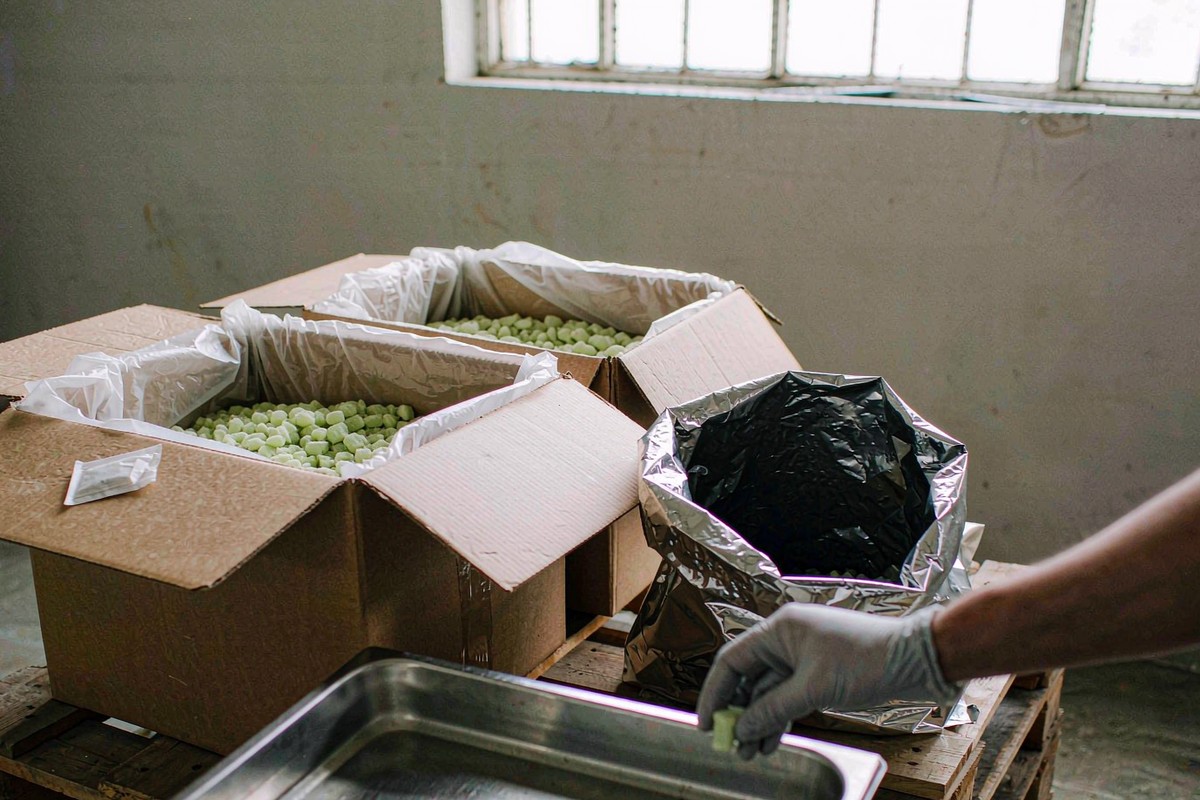
Three things change at that handover.
The first is the curing clock. A gelatin gummy needs 24 to 72 hours at controlled temperature and humidity before it is packed, or it sweats in the bag and fuses into a block. Bulk buyers who ask for a faster ship date are usually asking for uncured stock, and the failure appears at their repack line three weeks later, not at the factory gate.
The second is transport. A dry container crossing the equator in July passes 50 °C inside, and a gummy at 0.6 water activity softens well before that. A pallet of cartons without a barrier bag arrives as a single mass with a moisture ring on the outside. The moisture-barrier bag and the desiccant are not packaging cost; they are what makes bulk possible for a product with a 24-month claim.
The third is responsibility. In the EU, the operator that places the food on the market owns the label, and a bulk buyer who repacks and labels is that operator. The factory's specification and assay are evidence; they are not a defence. What the buyer should be holding at delivery is an activity assay on the lot in the units that will appear on the label, a water activity figure on the finished piece, and a count per kilogram, because the buyer is paying by weight and selling by count.
What bulk changes in the numbers
The arithmetic is simple and it is where bulk programmes leak money.
A tonne of 2.5 g gummies is 400,000 pieces. At 60 per bottle that is 6,667 bottles. If the depositor runs 2% heavy, the same tonne yields 392,000 pieces and 6,535 bottles. That is 132 bottles gone, with no visible defect and no complaint anyone can make. The piece weight tolerance belongs in the specification for exactly that reason, and a per-kilogram price is not a per-bottle cost.
Bulk pricing looks 20 to 40% better than private label per kilogram for the same reason it is riskier: the bottle, the cap, the label, the carton, the stability programme and the label compliance have all moved to the buyer's side of the invoice. A brand with a filling line and a QA function is buying a discount. A brand without either is buying a project.
#guthealth and #debloat sell different clocks
The two hashtags are usually planned as one campaign, and they reward different products.
#guthealth content sells a rebuild. The narrative is thirty days, ninety days, a before-and-after of a diet, and the product that fits it is a culture with a strain name and a CFU number that survives eighteen months. #debloat content sells a result inside a weekend. The narrative is a dinner, a photograph the next morning, and the product that fits it is something that acts in hours, which in a gummy means an enzyme, not a probiotic.
That difference has a commercial consequence that shows up in the repeat rate. A debloat buyer reorders on a felt effect within days, so the second purchase is cheap to earn and the retention curve is steep. A probiotic buyer reorders on trust, because nothing they can feel confirms the purchase. One bottle claiming both has to serve a customer who wants proof by Friday and a label that promises something at month eighteen.
The seeding economics are the other half. Creator programmes ship 60-count bottles, which is 150 g of product plus a bottle and a mailer per creator. At bulk cost that is a manageable number; at private label cost with a printed carton it is often the largest line in a launch budget, and it is the reason brands ask for bulk first and packaging second.
There is one more thing the content does to the formula. A flat-stomach photograph in daylight, held in front of the body, is the format, and it makes colour and opacity a formulation decision rather than an aesthetic one. Pale, opaque and matte photographs better than translucent, and a piece that has to be pale rules out several actives and most natural colourants.
What ships
What ships is one mechanism, not five. Usually the enzyme, because it is the only one with a dose that fits, a process that can be engineered around heat, and a permitted claim in at least one major market. It goes into a pectin base if a protease is in the blend, is dosed downstream of the cook or carried as a coated bead, and is specified in activity units at end of shelf life rather than in milligrams at manufacture.
What ships carries a polyol sweetener with a laxative warning on the same panel as the promise, or sugar, which contradicts the brief. It carries no simethicone, because that is a drug, and no therapeutic peppermint, because a gummy has no enteric coat. Its probiotic line, if it has one, is a spore-former at a few billion CFU doing slow work that the campaign will not wait for.
None of that is a reason not to make the product. It is the difference between a product that holds its claim for two years and one that is defended once, on a call, in month fourteen. The wider format range sits on the functional gummies page.
Ding Shaohua, Foreign Trade Manager at WANHUACAO, works with brands and distributors on probiotic, digestive and debloat gummy programmes from brief to first shipment, in bulk and in private label. The plant operates under SGS CN23/00007035 for gelatine confectionery and SC11434160205012 covering eight dosage forms. Reach him on WhatsApp, TikTok, LinkedIn and Facebook.
Frequently asked questions
Can a probiotic and a debloat ingredient go into the same gummy?
They can share a mould but not a mechanism. A spore-forming culture survives depositing at 75 to 88 °C and works over weeks; the actives that produce a felt change in a day are an enzyme or an antifoam, and the antifoam is a drug in the US. A product carrying both is really two products in one bottle, with the probiotic doing the slow work the label claims and the enzyme doing the fast work the content implies.
Why is simethicone a problem in a supplement?
Because it is an OTC drug active, not a supplement ingredient. 21 CFR 332 covers it as an antiflatulent with a 500 mg daily maximum, and its permitted indications include relieving "bloating, pressure, fullness, or stuffed feeling commonly referred to as gas", so a supplement using that language is making a drug claim. The monograph is also written around tablets, capsules, liquids and strips, not moulded gummies, which makes a simethicone gummy an unapproved new drug.
How much alpha-galactosidase fits in a gummy?
About 5 mg, which is 300 FCC GalU of activity and 0.2% of a 2.5 g piece, so mass is not the issue. Heat is: the enzyme is destroyed at depositing temperature, so it is injected after the cook or carried in a coated bead. The label then has to state activity in GalU at end of shelf life, not milligrams at manufacture, with an overage of 20 to 40% to cover the decline.
What does bulk mean for a gummy order?
Bulk means the factory ships unlabelled gummies in 10 to 25 kg cartons or moisture-barrier bags, and the buyer bottles, labels and sells. The buyer takes on label compliance, the repack, and the curing clock, and pays by weight while selling by count, so a 2% piece-weight drift costs about 132 bottles per tonne. Bulk also removes the bottle, carton and stability programme from the price, which is why it looks cheaper and is not, unless the buyer already has a filling line.