
A co-packer quote for a sea moss and bladderwrack gummy usually arrives with two lines near the top: material supplied by customer, formula supplied by customer. Those two lines move almost every risk in this product onto the brand, and most brands read them as a note about cost rather than a note about liability.
The ingredient that makes it matter is iodine. Bladderwrack is one of the strongest iodine accumulators in the seaweed family, and its iodine content is not a fixed property of the species. Published measurements on Fucus vesiculosus alone run from 139 to 730 µg per gram of dry weight depending on which study and which harvest is measured.
Those figures are per gram of powder, and the market dose is not small. The leading sea moss gummies on Amazon list 1,000 to 1,600 mg of Irish moss with 450 to 1,000 mg of bladderwrack in a two-gummy serving. At 1,000 mg, that batch-to-batch spread becomes 139 to 730 µg of iodine in one serving. Nothing on the label has to tell the customer which batch they are holding.
Two seaweeds, two different kinds of number
The two names in the product title are not two versions of the same thing. Chondrus crispus, sold as Irish moss or sea moss, is a red alga. Fucus vesiculosus, bladderwrack, is a brown alga, and the brown algae are the group that concentrates iodine hardest.
- Chondrus crispus —— published iodine values scatter widely and are generally low, from a few micrograms per gram upward, with the species historically consumed as food in Ireland and the Atlantic provinces. Its iodine is not the reason it is in a supplement.
- Fucus vesiculosus —— the same review literature puts the genus at 130 to 730 µg per gram, with the highest concentrations in this species. Along with Laminaria it was the original commercial source of iodine, isolated from kelp ash in 1811.
- The blend problem —— a label that says sea moss and bladderwrack at 300 mg each does not tell you whether the second one was the iodine-bearing part or a low-iodine batch of the same species.
That last point is the whole difficulty. Iodine in Fucus is not a specification you inherit by naming the species. It moves with the part of the plant harvested, the season, the water it grew in, and how the material was dried. The stipe, where the growing tissue sits, carries more than the blade, and iodine is water-soluble enough that processing and storage change the number after harvest.
The same species, five different numbers
Four independent measurements of Fucus vesiculosus are easy to find, and they do not agree:
- A Portuguese ICP-AES study of seaweeds collected from the Atlantic shore reports 352 ± 21 µg/g for Fucus vesiculosus, on a validated method with 100 ± 15% recovery against a kelp reference material.
- A US supplier's commercial samples from Maine report 276 µg/g with a variance of ± 82 across three samples.
- A UK supplier's laboratory data for a single seasonal harvest reports 139 mg/kg, which is 139 µg/g, with the caveat printed on the page that composition varies by season, harvest location and growing conditions.
- A review of Fucus phytochemistry gives the genus a range of 13 to 73 mg per 100 g dry weight, which is 130 to 730 µg/g, with the maximum in this species.
Read together, these are not contradictory. They describe a distribution: median somewhere in the low hundreds of micrograms per gram, with an upper tail five times higher than the lowest commercial figure. A formulator working from one supplier's certificate of analysis will design to that supplier's number and be right about that supplier, which is a true statement with no predictive value for the next purchase order.
This is the first place a co-packer arrangement diverges from a contract manufacturing one. If the factory buys the seaweed, it owns the supplier relationship and can hold a specification across batches. If the brand buys it and ships it in, the factory receives whatever arrived, tests it, and either runs it or rejects the lot.
What a thousand milligrams delivers
Take a two-gummy serving in the shape the category actually sells: 1,000 mg of Irish moss with 1,000 mg of bladderwrack. The Irish moss contributes little iodine in most analyses. The bladderwrack contributes whatever that batch happens to hold.
At 139 µg/g, which is the UK commercial figure, 1,000 mg delivers 139 µg of iodine. At 276 µg/g, the Maine figure, it delivers 276 µg. At 352 µg/g, the Portuguese measured value, it is 352 µg. At the top of the published genus range, 730 µg/g, it is 730 µg in a single serving.
Against an adult reference intake of 150 µg a day and a European tolerable upper intake level of 600 µg, that one label spans 93% of the reference intake at the low end and 122% of the tolerable upper level at the top. The customer reads the same panel either way. The difference is which drum the powder came out of.
A more conservative formula at 300 mg of bladderwrack does not escape the problem, it shrinks it: 42 to 219 µg, still a fivefold spread on one printed number. Smaller doses move the range down without narrowing it, because the variation is in the raw material rather than in the dose.
Daily iodine intake in most European countries already sits near or above the reference value because of iodised salt and dairy. Adding a supplement that silently varies by a factor of five means the same product is a modest top-up in one batch and a substantial overshoot in the next.
The gap between the claim threshold and the ceiling
European labelling makes this harder to see, not easier.
Iodine has six authorised health claims under Regulation 432/2012: normal cognitive function, normal energy-yielding metabolism, normal functioning of the nervous system, maintenance of normal skin, normal production of thyroid hormones and normal thyroid function, and normal growth of children. All six are conditional on the food being at least a source of iodine, which Regulation 1924/2006 sets at 15% of the nutrient reference value per 100 g. The reference value for iodine is 150 µg, so the threshold is 22.5 µg per 100 g, or 45 µg per 100 g to call the product high in iodine.
A gummy is heavy. At 2.5 g a piece, 100 g is forty pieces, and a two-piece serving is 5 g. To reach 22.5 µg per 100 g, a serving needs to carry 1.1 µg of iodine. Any product containing a meaningful amount of bladderwrack clears that by two orders of magnitude.
So the claim is effectively free, and it is also the only iodine statement the label is obliged to make. Nothing in the regulation requires the pack to declare what the actual figure is, and nothing requires a warning when a serving approaches the upper level. The distance between 1.1 µg, where all six thyroid claims unlock, and 600 µg, where the tolerable upper intake level sits, is roughly five hundredfold, and it is a space with no labelling obligation inside it.
The iodine conversation on this product has to happen at the specification stage, not at the artwork stage. By the time the claims are printed, the number has already been decided by a purchase order.
What the powder does to the batch
Bladderwrack arrives as a dark olive-brown powder, and it is not inert in a gummy base.
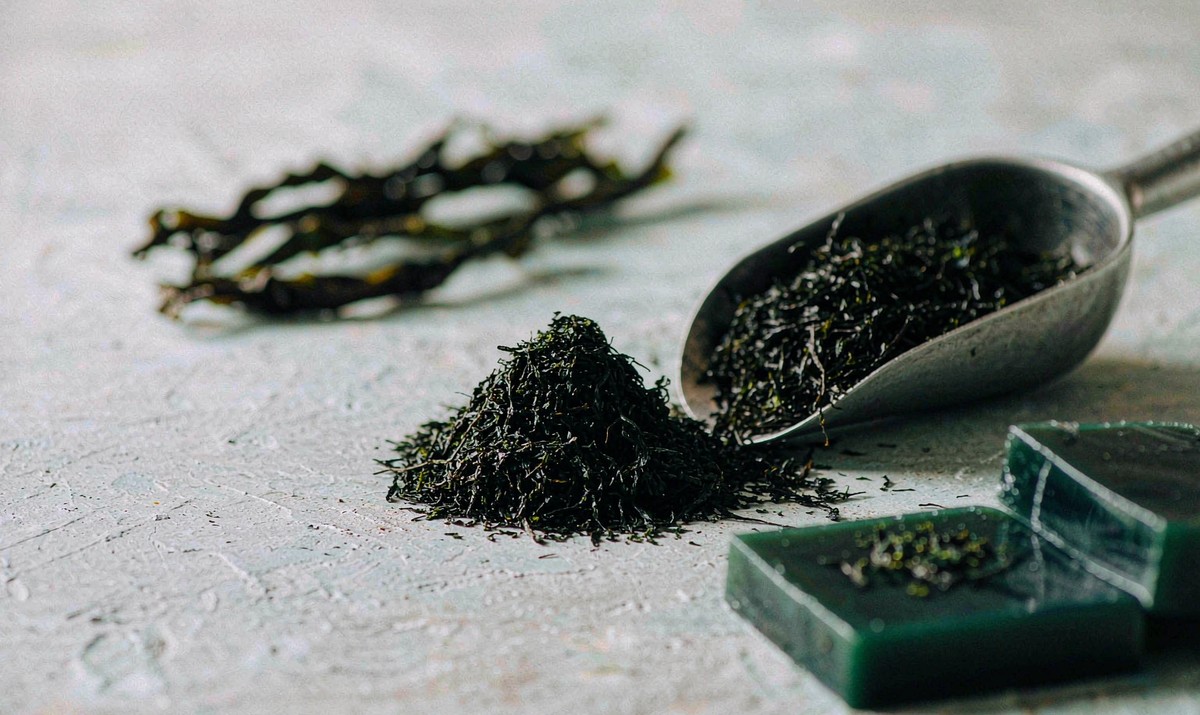
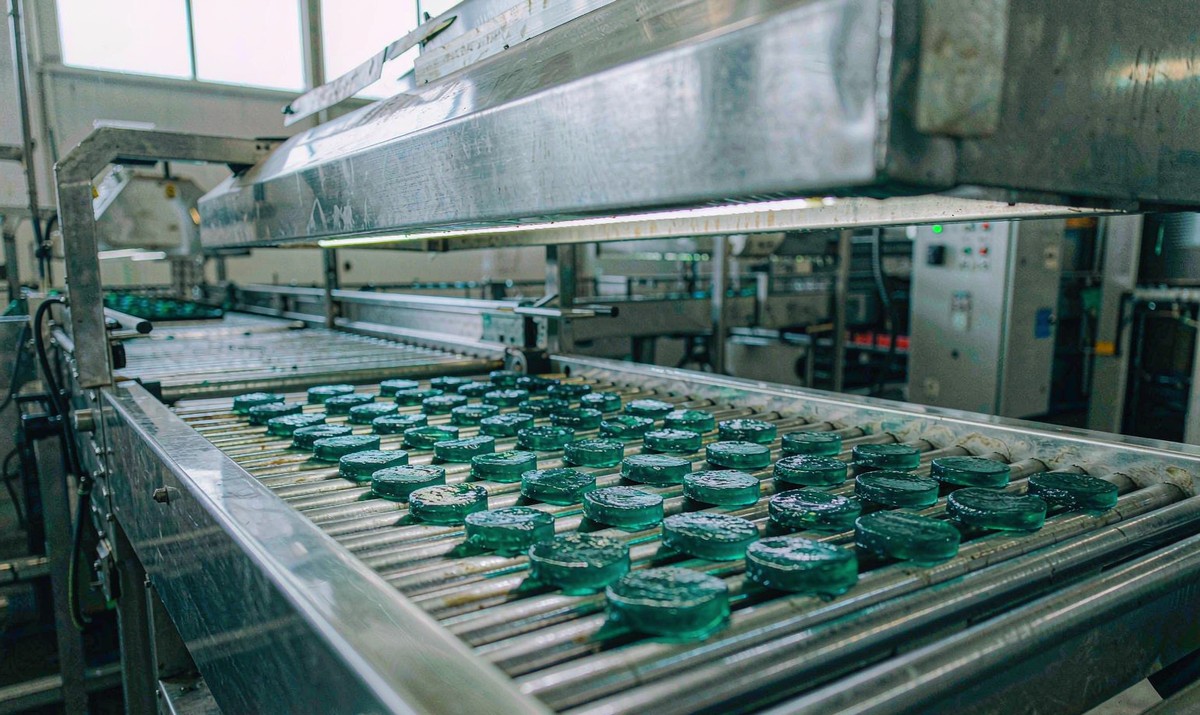
The fibre in it absorbs water and swells, which thickens the slurry at the depositor. A thicker slurry fills moulds less evenly, so piece weight moves, and piece weight is the denominator for every milligram on the label. A formula that ran at 2.5 g a piece in trial can drift upward as the seaweed load increases, and the dose per piece drifts with it.
The colour is the second issue. Seaweed powder at any meaningful dose takes a gummy to olive, and the usual response is to mask it. Titanium dioxide is gone from EU food use since 2022, so a white opacifier has to come from calcium carbonate or rice starch, and calcium brings its own interaction with pectin systems. The alternative is to lean into a dark colour, which is what most of the market does with a berry or tropical flavour direction that does not match the ingredient at all.
There is also the settling question. Seaweed powder and any mineral salts in the same slurry have different particle densities, and the depositor draws from a moving tank. Composite sampling hides that; single pieces from the first and last cavities do not.
The same sampling logic that applies to any suspended active applies here, and it is set out in gummy quality control testing.
Why the social shelf put this product in the wrong aisle
Search and social data file sea moss alongside ashwagandha under a shared vocabulary: adaptogens, cortisol, stress, daily ritual. The hashtags travel together because the audience is the same, not because the ingredients do the same thing.
Adaptogen is not a regulatory category anywhere in the EU. Regulation 1924/2006 has no such class, and 432/2012 contains no adaptogen claims. In claim terms what sea moss has is iodine, and iodine's authorised statements are all about the thyroid and about normal cognitive function. Nothing about stress, resilience or adaptation.
That mismatch creates a specific failure mode in product development. A brand that has built its positioning on adaptogen language will ask for a formula that supports that story, and the cheapest way to make the story true is to add ashwagandha to the blend. Products combining sea moss and ashwagandha are on the market for exactly that reason.
If ashwagandha goes in, two regulatory clocks start
Ashwagandha is where the two ingredients stop being interchangeable.
In Europe its status is unsettled and moving. Under Regulation 2015/2283 an ingredient needs a significant history of consumption in the EU before 15 May 1997, or an authorisation, to be sold as food. Ashwagandha has neither in a settled form, and member states have responded unevenly rather than uniformly. Denmark suspended the sale of food supplements containing it in 2023, citing the inability to establish a safe dose and reports of liver injury. The Netherlands has consulted on adding it to a list of substances prohibited in supplements. The EMA's herbal committee concluded in 2013 that it could not establish an EU herbal monograph for the root because the available data could not characterise a herbal preparation to pharmaceutical quality. EFSA has been asked for a formal safety assessment, and the industry is waiting on it.
The safety signal is hepatic, not thyroid. The US LiverTox database rates ashwagandha as a likely cause of liver injury, with a latency of two to twelve weeks and a cholestatic or mixed pattern. That is a different organ and a different mechanism from the iodine question, which means a blend carrying both has two independent safety conversations attached to one label.
The dose language changed. The ashwagandha programmes on this site were written around standardised withanolide content and clinical gram doses, which is a formulation problem covered in ashwagandha KSM-66 gummies. The regulatory question is separate from the chemistry, and on the EU side the chemistry does not help. For the stress-positioning side of that ingredient the formulation notes sit in ashwagandha gummies.
For a US launch the picture is different again, because ashwagandha has a GRAS-based route and a structure-function pathway. That is a market decision rather than a formulation one, and it needs to be made before the SKU is designed, not after.
What can go on the pack
The honest claim set for a sea moss and bladderwrack gummy is short and it is entirely about iodine.
- Source of iodine —— available at 22.5 µg per 100 g, which almost any seaweed-containing gummy exceeds, and it unlocks the thyroid claims.
- Iodine contributes to the normal production of thyroid hormones and normal thyroid function —— the one claim that matches what the ingredient does.
- Iodine contributes to normal cognitive function —— also authorised, also conditional on the source threshold, and the claim most often stretched into memory and focus language it does not support.
- Nothing about adaptogens, stress, cortisol or immunity —— the first three have no legal basis in the EU at all, and the fourth requires a vitamin or mineral at 15% of the reference value with an authorised claim attached.
There is also a warning question that most packs currently answer badly. A product carrying up to 219 µg of iodine per serving is not appropriate for everyone, and people with thyroid conditions are usually told by their clinician to manage iodine intake. Whether that goes on the label is a market-by-market decision, but the calculation behind it belongs in the specification file.
Four lines that belong on the co-packer brief
The brief that goes out with a sea moss enquiry decides more than the price. Four items carry most of the risk.
- Who buys the seaweed —— material supplied by customer means the factory tests what arrives and runs or rejects it. Factory-supplied material means the factory owns a specification across batches, which is the only version where a per-batch iodine ceiling can be enforced as a purchasing condition.
- An iodine ceiling per batch, not a target —— a number in µg/g with a method attached, agreed before the first purchase order, so a lot outside it is rejected at goods-in rather than discovered in a finished-goods test.
- Which iodine method —— ICP-MS after microwave digestion is the current standard and the one used in the published survey work. Colorimetric methods exist and are cheaper, and the two do not always agree at the top of the range.
- Who signs the release —— on a co-packer arrangement the certificate of analysis for the finished goods often states the result without stating who accepted the risk. Naming that in the contract is cheaper than arguing about it after a recall.
The same logic applies to heavy metals, which brown algae accumulate because they cannot regulate uptake, and which are covered for botanical ingredients in heavy metals in botanical extracts. The iodine number is simply the one with a published ceiling and no labelling obligation, which makes it the one most likely to be missed.
What the specification should hold
Beyond the usual release panel, four items are specific to this product.
- Iodine per batch, in µg/g of raw material and in µg per serving of finished goods —— both figures, because the raw material number is what purchasing can enforce and the per-serving number is what the label implies.
- Species and part on the certificate —— Fucus vesiculosus whole plant and Fucus vesiculosus extract are different materials with different iodine loads, and a certificate that says only bladderwrack does not distinguish them.
- Piece weight drift across a run —— the seaweed load changes slurry viscosity, and a 5% drift in piece weight moves every milligram on the panel including the iodine.
- Water activity and surface condition at 3 and 6 months —— seaweed powder is hygroscopic, and a dark powder at the surface shows moisture damage as blotching rather than as visible mould.
The rest is the ordinary programme: a stability run at the market's required conditions, a claim set checked against the current register, and artwork that does not use adaptogen language in a jurisdiction where the word carries no legal meaning. The gummy formats this line runs are listed on functional gummies, and a brief can start there or from the contact form.
Ding Shaohua, Foreign Trade Manager at WANHUACAO, works with brands and distributors on seaweed, botanical and functional gummy programmes from brief to first shipment, in bulk and in private label. The plant operates under SGS CN23/00007035 for gel confectionery and SC11434160205012 covering eight dosage forms, sports nutrition supplements among them. Reach him on WhatsApp, TikTok, LinkedIn and Facebook.
Frequently asked questions
How much iodine is in a sea moss and bladderwrack gummy?
It depends on the bladderwrack batch, and the range is wide. Published measurements of Fucus vesiculosus run from 139 to 730 µg per gram of dry weight across four independent sources, and the mainstream dose is 1,000 mg per two-gummy serving. That puts one serving between 139 and 730 µg of iodine. Irish moss contributes comparatively little in most analyses. The only way to know which end of that range a given lot sits at is a per-batch iodine test, and the pack is not required to tell the customer the result.
Is 730 µg of iodine per serving too much?
At 219 µg it is under the 600 µg European tolerable upper level and well under the 1,100 µg US level. At 730 µg, which is inside the published range for the species at a 1,000 mg dose, one serving is already above the European ceiling. Iodised salt and dairy bring most European adults close to the 150 µg reference intake before any supplement, so a batch at the top of the range has no room left for a second serving that day. The arithmetic is the reason a per-batch ceiling belongs in the purchase specification rather than in a marketing decision.
Why does it matter whether the co-packer or the brand buys the seaweed?
Because only one of those arrangements can enforce a specification. If the factory buys the material, the iodine ceiling becomes a purchasing condition and an out-of-spec lot is rejected at goods-in. If the brand supplies it, the factory tests what arrives and either runs it or refuses the lot, and the brand has already paid for material it may not be able to use. The test happens either way; what changes is who can prevent the problem rather than detect it.
Can the pack say adaptogen or support stress response?
Not in the EU. Adaptogen is not a recognised category under Regulation 1924/2006 and there is no adaptogen claim in 432/2012. The authorised iodine claims cover thyroid function, cognitive function, energy-yielding metabolism, the nervous system, skin and children's growth. In the US a structure-function statement with the required disclaimer is a different pathway, which is why the same formula is often sold with different copy on each side of the Atlantic.