
Open a sachet of a five-herb night blend onto a white plate and it separates into layers. The root sits at the bottom, the leaf and flower stay on top, and the fine dust has sifted down through both. Nothing has gone wrong at the filler. The bag was filled with materials of different density and then shaken on its way into the carton.
That layering is what a brand meets when it moves from a single-herb sleep tea to a compound. The recipe is the easy part. Getting five materials into one 1.5 g bag in the same proportion in bag one and bag fifty thousand is the work, and most of it happens before the machine starts.
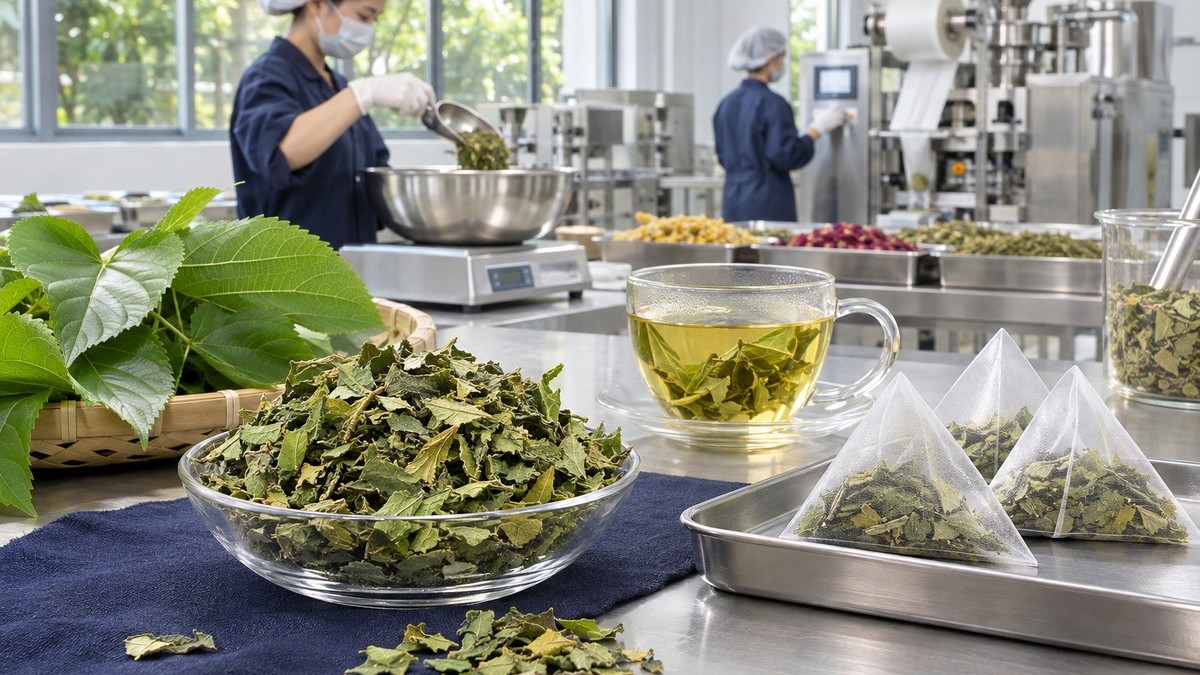
The blend separates before it is ever brewed
Powders separate by three mechanisms, and a sachet blend uses all of them. Fine particles percolate downwards through the gaps between coarse ones. Large flat pieces slide over each other and end up at the edges of a container. Light material fluidises when it is dropped and drifts as dust.
Cut valerian root runs four to eight millimetres and settles fast. Passionflower herb is light enough to hang in the air of a filling room. Hop strobile is brittle and breaks into powder under an auger. Skullcap leaf is thin and packs flat. Pour them together and the bag that comes off the machine first is not the same bag that comes off an hour later.
The usual fix is not a better mixer but a different order of operations. The minor components are premixed onto a portion of the bulkiest one, then that premix is diluted with the rest. A 60 mg component in a 1.5 g bag cannot be weighed into every bag; it can be weighed once into a 30 kg premix and then carried by the blend. Whether the factory does this is a question with a checkable answer, because the premix step appears on the batch record as its own line.
What each herb does to the machine
Valerian root is the densest material in the bag and the one that decides fill weight. Because it settles, the weight of a sachet is stable but the ratio inside it is not: the first bags off a hopper carry more root, the last more leaf.
Passionflower brings the opposite problem. Its bulk is high for its mass, so it occupies volume that the root would otherwise take, and the same 1.5 g bag holds visibly less material when the passionflower share goes up. A brief that fixes grams without fixing volume produces a bag that looks underfilled.
Hop strobile is the one that changes during the run. It is brittle, it dusts, and the dust is the part that carries the aroma. Sieving it out to protect the mesh removes the reason it was added.
Skullcap is bitter from baicalin, and bitterness is not proportional to weight. A small share of skullcap can dominate the cup, which pushes the formulator to licorice or a sweetener, and both of those take fill weight away from the herbs that were the point.
Valerian is the dose, and the dose is heavy
The European traditional-use monograph for valerian root puts a single dose at two to three grams of root for an infusion. A 1.5 g sachet of a five-herb blend cannot reach that with valerian alone unless valerian is most of the fill, and if valerian is most of the fill the bag smells of aged root and tastes of it.
That is the arithmetic behind most compound night blends. The label lists five herbs; the cup delivers a fraction of a clinical dose of each, and the blend is designed around the taste and the ritual rather than around the numbers. Brands that want the numbers have to move to a larger sachet, a two-bag dose, or a different format.
Valerenic acid is the marker most certificates report, and it is also the part that heat removes. Root that has been steam sterilised at the temperature needed for a microbial specification has lost a measurable share of the volatile fraction, and root that has been in a warehouse for a year has lost more. Two lots can both pass a valerenic acid specification and still smell different, which is why the sensory reference sample matters as much as the certificate.
Hop sets the shelf life
Of the five, hop is the one that fails first. Alpha acids oxidise, and the compounds they turn into carry a cheesy, stale note that sits on top of everything else in the cup. The failure happens in the bag, slowly, at ambient temperature, and it is not visible.
The practical consequence is that the shelf life of a compound night blend is usually the shelf life of its hop. A brand that specifies 24 months and a hop share of any size is specifying an oxygen barrier, a nitrogen flush or an individually wrapped sachet. Loose sachets in a paperboard carton will not hold that line for two years.
Hop also determines how the product ages in a way the other four do not. Valerian gets earthier, passionflower fades, skullcap stays bitter, but hop turns. If a stability programme tests only the marker compounds, it will pass a product that a customer would return.
The route that allows the word deep
On a food label in the European Union, a sleep tea cannot carry a sleep claim. Regulation 1924/2006 authorises melatonin at 1 mg for the reduction of time to fall asleep, and no herb is on that list. The word deep, printed next to sleep, describes a physiological effect and moves the product towards the medicinal definition just as surely as a sentence would.
There is a lawful route, and it is a different product. Three of these five herbs have traditional-use monographs from the European Medicines Agency: valerian root for aid to sleep, passionflower herb and hop strobile for mild stress and sleep. A product built on those monographs can be registered as a traditional herbal medicinal product under Directive 2001/83/EC as amended by 2004/24/EC, and a registered indication can say what a food label cannot.
The catch is that registration applies to the finished product, not to the herbs. Every ingredient has to be justified, the pack has to carry the registered wording, the manufacturer needs a pharmaceutical licence, and the shelf life and stability data have to support the claim. A brand that wants "deep sleep" on a carton in Europe is choosing a pharmaceutical supply chain, not a tea factory.
In the United States the same blend is a dietary supplement. A structure or function statement is allowed with the standard disclaimer, a disease claim is not, and insomnia cannot appear on the label. The United Kingdom added a third case: melatonin moved to prescription-only status, and brands that had built night products on it moved to herb blends and to magnesium.
None of this stops a brand calling a product a deep sleep tea, or posting under #sleepmaxxing and #bedtimetea. A name sets the occasion and a hashtag finds the audience. What carries the legal weight is the sentence that attributes the effect.
What belongs in the brief
A brief that says five herbs, 1.5 g and a sleep position leaves the factory to make three decisions that belong to the brand: the cut specification for each component, whether the minor components are premixed, and what the sachet material has to keep out.
A sleep tea manufacturer quoting on the bag price alone is quoting a fill. A custom tea blend manufacturer quoting properly will ask for the bulk density of each component, the ratio, and the sensory reference, because those three decide whether bag one and bag fifty thousand are the same product.
The same questions arrive whether the project starts from a private label catalogue or from an ODM development file. What changes is who owns the answer, and who pays when the answer turns out to be wrong at the end of a 24-month stability study.
For the bag format itself, see pyramid tea bag manufacturer. The claim framework for the single-herb version is set out in chamomile sleep tea, and the range sits on the herbal tea page.
Ding Shaohua, Foreign Trade Manager at WANHUACAO, works with brands on sleep blends and compound herbal teas from brief to first shipment. Blending and bagging run in the same plant, under SGS CN23/00007035 covering herbal tea among other categories and SC11434160205012 covering eight dosage forms. Reach him on WhatsApp, TikTok, LinkedIn and Facebook.
FAQ
Why do five-herb blends separate in the sachet?
The components differ in bulk density, particle size and shape. Fine particles sift down through coarse ones, flat pieces migrate to the edges, and light material drifts as dust during filling. The fix is a premix of the minor components onto a portion of the bulkiest one, plus a fill weight that is verified per bag.
Can valerian reach its traditional dose in a 1.5 g sachet?
Only if valerian is most of the fill. The European monograph puts a single dose at two to three grams of root. Most compound blends therefore deliver a fraction of that, and they are designed around taste and ritual rather than around the dose.
Which herb limits the shelf life?
Hop. Its alpha acids oxidise and produce a stale, cheesy note that dominates the cup, and the reaction runs at ambient temperature inside the bag. A two-year shelf life on a hopped blend needs an oxygen barrier, a nitrogen flush or individually wrapped sachets.
Can a sleep tea say deep sleep in Europe?
Not as a food. Regulation 1924/2006 authorises melatonin for reduction of time to fall asleep and no herb. A blend built on EMA traditional-use monographs can be registered as a traditional herbal medicinal product, which allows a registered indication, but that route needs a pharmaceutical licence and finished-product stability data.