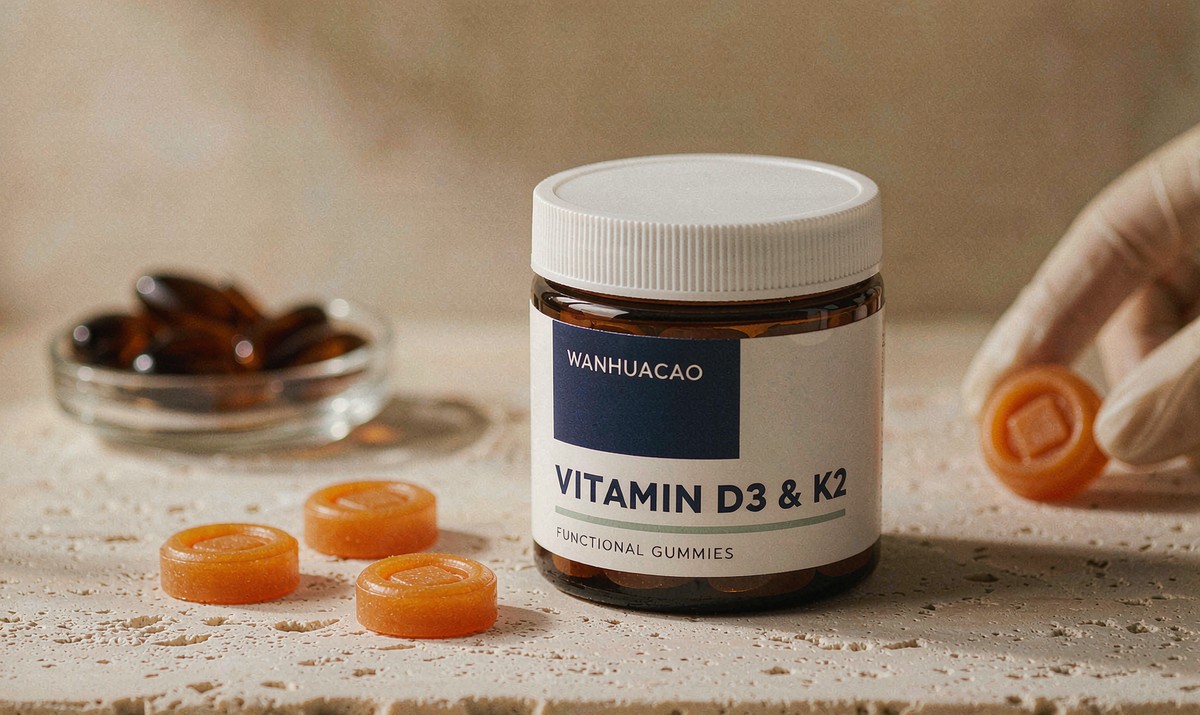
A bottle on a retail shelf holds sixty gummies and carries a two-piece serving: 5,000 IU of vitamin D3 and 100 micrograms of MK-7. The label is lawful in the market it was printed for. Twelve months later, the pieces inside it are not the pieces that were deposited.
Vitamin D3 and vitamin K2 are both fat-soluble. A gummy is water, sugar or polyol, a gelling hydrocolloid and about 8 to 16 percent moisture, cooked at 85 °C or above and set in a starch mould. The two vitamins are being asked to hold their potency inside a medium that is chemically hostile to them, at a dose measured in micrograms, in a piece weighed in grams.
That mismatch explains the shape of the category. Search for a D3 and K2 combination product and the format that dominates is the softgel: an oil fill inside a gelatin shell, no water in the matrix, opaque amber bottle, five to ten percent overage. The gummy version exists, sells well, and is the harder product to keep on claim. This is what changes when the format changes.
The oil in the water
A softgel does not dissolve its actives. Vitamin D3 arrives as an oil, MK-7 arrives as an oil or a spray-dried powder, and both are dispersed in a lipid fill that contains no free water. There is nothing for the vitamin to partition into and nothing to hydrolyse against. The shell is a barrier, the fill is the carrier, and the two vitamins sit in the medium they are soluble in.
A gummy has no such medium. Its continuous phase is an aqueous gel, and both vitamins are hydrophobic. They cannot be dissolved into it, only suspended in it, which means every gummy project starts by choosing a delivery form for the active, not a dose.
The trade answer is a beadlet or a spray-dried powder: cholecalciferol adsorbed onto a carrier, typically supplied at 100,000 IU per gram or 500,000 IU per gram, coated in gelatin, modified starch or sugar, with an antioxidant. A thousand IU of D3 is 25 micrograms of the vitamin and 10 milligrams of a 100,000 IU/g beadlet. Five thousand IU is 50 milligrams. In a 3-gram piece, the entire vitamin D payload is under 2 percent of the weight, and the K2 payload at 100 micrograms of a 1 percent MK-7 powder is 10 milligrams, another third of a percent.
Two consequences follow, and they are separate problems. The first is whether those few milligrams are evenly distributed across several hundred thousand pieces. The second is whether they are still the same molecules after the cook, the cure and eighteen months in a bottle. A softgel answers both with geometry. A gummy has to answer them with process.
One speck in three grams
Content uniformity is the failure that a certificate of analysis will not show you.
A finished-product assay is normally run on a composite: ten pieces ground together, extracted, injected. That number answers a question about the batch. It does not answer a question about the piece, and for a microgram-dose active in a deposited matrix those are different questions.
A laboratory that publishes its supplement testing notes described one case in its own client work: a 2,000 IU strawberry pectin gummy, thirty individual pieces assayed. The mean came back at 1,840 IU, 92 percent of label. The range ran from 980 IU to 2,650 IU, with a relative standard deviation of 22.3 percent, and nine of the thirty pieces fell below 75 percent of the declared amount. The same batch passed as a ten-piece composite, because the mean sat inside the acceptance window. Two-thirds of a bottle would have delivered something close to what the front said. One piece in three would not.
The mechanism is in the depositing machine rather than the formula. A gummy slurry is held hot and stirred so it stays pourable, then metered through a row of nozzles into starch moulds. Viscosity rises as the batch cools and as water leaves the surface. A suspended particle that is denser than the slurry settles; one that is lighter floats. The first pieces from a run and the last pieces from the same run can be fed from slurry at different points on that curve, and the difference does not appear until somebody weighs the vitamin in single pieces.
D3 beadlets are dense. MK-7 on a starch carrier is not. A formula carrying both has two particles with different settling behaviour in the same tank, so the two vitamins can drift apart from each other across a run, not merely away from the label.
What closes the gap is pre-dispersion of the actives in a small quantity of oil before they meet the batch, a mixer that keeps the slurry homogeneous at the nozzle, and in-process checks at the start, middle and end of deposition. A larger overage does not close it. Release testing on individual pieces, pulled from different mould rows, is the only test that sees the problem at all.
What the cook does to a beadlet
The coating that protects a beadlet in a drum is not designed for a kettle at 85 °C.
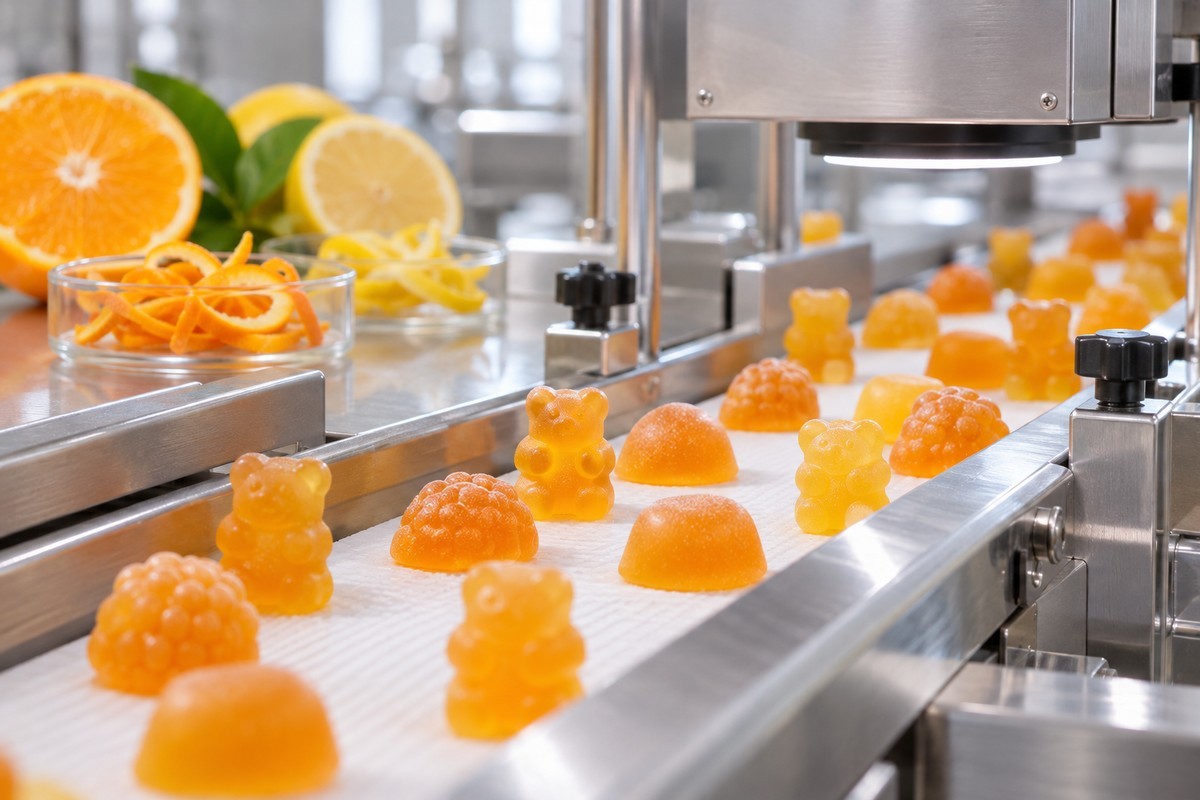
A gummy batch is cooked as a syrup, held at temperature, dosed with acid, colour, flavour and actives, then deposited while still hot. A gelatin base deposits somewhere around 75 to 85 °C; a pectin base is cooked hotter and deposited at a similar point. The beadlet's starch or gelatin shell starts to take up water and soften at that temperature, which is precisely when the vitamin inside it becomes mobile.
Three things happen at once. The antioxidant that was packed with the active is diluted into the batch and its local concentration at the particle falls. The vitamin begins to migrate through a semi-liquid phase, which is how it ends up at the surface of a piece rather than evenly through it. And as the batch cools, any vitamin that has left its carrier can crystallise, because cholecalciferol is poorly soluble in a water-based gel and a crystal is not a dispersed dose.
Published work on D3 gummies has taken the emulsification route rather than the beadlet route and reported the difference. A 2022 study built an oil-in-water nanoemulsion of vitamin D in corn oil with Tween 20 and lecithin, at a mean droplet size of 118.6 nm, then set it into a gelatin gummy containing 10 percent corn oil. Stability analysis showed the nanoemulsion retained more than 97 percent of the active across 15 days against 94.5 percent for the same vitamin in plain oil solution, and the gummies held their hardness from day one to day 45. The emulsion does the same job a beadlet does, in a form that survives being stirred into a gel.
The temperature is not the only variable, and it is not the largest. Free water is. A piece at 12 percent moisture with a water activity of 0.65 protects a fat-soluble vitamin better than a piece at 11 percent moisture and a water activity of 0.75, because water activity measures the water that is available to react rather than the water that is present. The humectant system, glycerin against sorbitol, changes vitamin retention for the same reason, even when the moisture number on the specification does not move.
Pectin buys the label and pays in potency
The single largest formulation decision on a D3 and K2 gummy is often made for reasons that have nothing to do with either vitamin.
Gelatin is the base that suits cholecalciferol. A gelatin gummy sets near pH 4.5 to 6.0, its gel network is thermoreversible, and its texture is the one consumers recognise. It is also an animal protein, which rules out a vegan claim, and a gelatin base contains collagen, which rules out a collagen-free claim on the same piece.
Pectin is the base that carries the vegan and clean-label story. High-methoxyl pectin only gels in an acid environment, conventionally pH 3.0 to 3.5, set with a calcium source. That range is on the wrong side of cholecalciferol's stability curve. Vitamin D3 holds up above pH 5 and degrades increasingly quickly as the pH falls through 4 to 5, which is exactly where a pectin gummy has to live in order to set at all.
A contract manufacturer that works in both bases describes the outcome in its own stability work: pectin-based vitamin D gummies lose noticeably more potency in the first six months at room temperature than gelatin versions held at pH 4.5 to 6.0, consistently across batches. There is no third option that delivers both the vegan claim and the gelatin matrix's pH, so the base is chosen as a priority rather than optimised.
The acid is not the only cost. Pectin sets with calcium, and calcium is one of the minerals that accelerates MK-7 degradation, which is a problem in the next section but starts here. A vegan D3 and K2 gummy is carrying three separate stability penalties that a gelatin softgel never pays: an acidic matrix, a calcium set, and a gel with free water in it.
The base decision is usually written as a texture and dietary question. On a fat-soluble vitamin it decides the overage before the stability work begins, and an overage set against the wrong base is a claim failure with a two-year lag on it.
K2 has a second failure mode
Vitamin D3 and MK-7 do not degrade the same way, and treating them as one stability line is how a product ends up passing on D3 and failing on K2.
Cholecalciferol is damaged by light, oxygen and low pH, and its photodegradation products include suprasterols and tachysterol. MK-7 is damaged by light in a different and more specific way: ultraviolet and visible light below roughly 480 nanometres drives photo-isomerisation, converting the biologically active all-trans isomer into cis forms. The cis isomer has a bent side chain and does not carboxylate vitamin K-dependent proteins the way the all-trans form does. Published work on vitamin K isomers puts the residual activity of cis forms at a small fraction of the trans form.
The loss can be fast. One technical reference reports an 80 percent loss of vitamin K2 in food oils within two days of daylight exposure, and the same literature identifies packaging as the control: amber glass, opaque containers, subdued lighting during handling, nitrogen flushing for bulk material.
The part that matters for a gummy is what a survey of finished products found. A 2018 study that separated and identified cis and trans isomers of MK-7 in dietary supplements, using a C30 column because a standard C18 will not resolve the pair, reported that in several products the combined cis and trans content was substantially larger than the content of pure all-trans MK-7. In other words, a meaningful share of what those labels called vitamin K2 was isomerised material, and routine finished-product testing would not have distinguished it, because most release assays quantify total menaquinone-7 rather than the all-trans fraction.
For a softgel the answer is a shell and a bottle. For a gummy it is harder, because a gummy is the one supplement format that is designed to be looked at. Translucent pieces in a clear PET jar on a lit shelf are the least favourable combination for a molecule that isomerises below 480 nanometres, and no amount of overage recovers a dose that has changed shape rather than disappeared.
The whitener that left, and the one that came back
Until 2022 the easy answer was titanium dioxide. E171 gave a gummy opacity, which is what a light-sensitive active needs, at a few tenths of a percent and almost no cost.
EFSA published its opinion on 6 May 2021 concluding that titanium dioxide could no longer be considered safe as a food additive, on the basis that a genotoxicity concern could not be ruled out and an acceptable daily intake could not be established. Commission Regulation (EU) 2022/63 withdrew the authorisation, entered into force on 7 February 2022, and allowed a six-month transition that ended on 7 August 2022. Food placed on the EU market after that date cannot contain it. The United Kingdom, outside Northern Ireland, still permits it, so a SKU sold on both sides of the Irish Sea is two formulas.
Removing the whitener put every translucent gummy back in front of the light, and the reformulation that followed has a trap in it. The common replacements for E171 in confectionery are calcium carbonate, rice starch and other opaque flours. Calcium carbonate is cheap, food-grade, delivers whiteness, and puts calcium into the matrix at a loading high enough to matter, in an alkaline form. That is the same mineral the literature names as accelerating MK-7 degradation, alongside magnesium, through the alkaline environment it creates.
So a formulator who replaces titanium dioxide with calcium carbonate to protect a light-sensitive vitamin from light has added a destabiliser for one of the two vitamins in the same move. The alternatives are less elegant and more expensive: opaque packaging that does the light blocking outside the piece, an opaque piece built on starch rather than calcium, or a microencapsulated MK-7 whose coating is the barrier instead of the matrix.
Packaging is where most of the retention is bought, and it is measurable. A laboratory's published stability figures for D3 across formats, at 25 °C and 60 percent relative humidity over 24 months, put softgels in an amber bottle at 92 to 97 percent retention, tablets with calcium carbonate in an opaque bottle at 88 to 94 percent, pectin gummies in a clear bottle at 70 to 82 percent, and pectin gummies in an opaque bottle with a desiccant at 82 to 90 percent. The format accounts for more of the spread than the overage does. A clear jar is the worst case, and one published figure puts D3 loss in a clear bottle at 25 to 30 percent by twelve months under ordinary retail lighting.
The packaging decisions that are usually made on shelf appeal are, on this product, the difference between one overage table and another.
Two overages, not one
An overage is the amount added above label to cover loss before expiry. On a single-active gummy it is one number. On a D3 and K2 gummy it is two, and they do not move together.
D3 loss is driven mainly by matrix pH, water activity and light. MK-7 loss is driven mainly by light and by contact with alkaline minerals, and its failure mode includes isomerisation, which is a change of shape rather than a reduction in mass. A lab method that quantifies total menaquinone-7 will report a number for material that no longer works, which means an overage calculated from that assay can be correct on paper and wrong in the piece.
The overage is also capped from above, and the cap is different in each market. In the European Union, EFSA set the adult upper level for vitamin D at 100 micrograms a day in its 2023 assessment, including pregnant and lactating women and adolescents aged 11 to 17, with 50 micrograms a day for children aged 1 to 10. There is no single EU maximum for vitamin D in food supplements, so each member state sets its own, which a brand discovers when it tries to sell one formula across several of them.
Put those two facts next to a shelf. A one-piece serving at 5,000 IU carries 125 micrograms of vitamin D3, which is 125 percent of the EU adult upper level before any overage is added. A two-piece serving at 2,500 IU per piece carries the same 125 micrograms. The pieces are smaller and the arithmetic is identical. A product designed to sit under 100 micrograms a day is a 4,000 IU or 3,200 IU serving, and the overage has to fit inside what is left rather than being added on top.
That constraint is why a D3 and K2 gummy brief that arrives with 5,000 IU on it usually leaves the building as a two-piece serving, or as a 4,000 IU one. The number on the front is a legal figure before it is a marketing one.
Overage practice differs by format for the same reason. Published laboratory guidance puts a workable softgel overage at 5 to 10 percent and a gummy overage at 20 to 35 percent, with a clear-bottle pectin version needing the top of that range or failing claim. A brand that moves a formula from softgel to gummy and keeps the softgel overage has moved the format and left the loss behind.
The dose is a legal number before it is a marketing one
The claim thresholds in the European Union are low enough that almost any D3 and K2 product clears them, which means the presence of a claim on the pack says nothing about the dose.
The reference values are 5 micrograms for vitamin D and 75 micrograms for vitamin K under Regulation (EU) 1169/2011 Annex XIII, and a nutrient claim requires 15 percent of the reference value per daily portion. That is 0.75 micrograms of vitamin D and 11.25 micrograms of vitamin K a day. A single gummy at 200 IU clears the vitamin D threshold. A single gummy at 20 micrograms of MK-7 clears the vitamin K threshold nearly twice over.
The dose that sells is several times larger than the dose that unlocks the sentence, and that gap is where the regulatory work sits. 25 micrograms is 500 percent of the vitamin D reference value. 100 micrograms of MK-7 is 133 percent of the vitamin K reference value. Both numbers appear on packs next to a claim that was available at a fraction of the amount.
What the two vitamins are allowed to say
The claim list is closed, and for this pair the overlap is one line.
Under Regulation (EU) 432/2012, vitamin D carries seven authorised statements: contribution to normal absorption and utilisation of calcium and phosphorus, to normal blood calcium levels, to the maintenance of normal bones, to the maintenance of normal muscle function, to the maintenance of normal teeth, to the normal function of the immune system, and a role in the process of cell division. Vitamin K carries two: contribution to normal blood clotting, and contribution to the maintenance of normal bones.
Exactly one of those nine sentences is shared: both vitamins contribute to the maintenance of normal bones. That is the whole authorised basis for putting the two in one piece. Two nutrients, one sentence between them, and the sentence is about bone.
The story that sells the combination is a different story, and it has been assessed. In 2012 EFSA evaluated an application, logged as ID 125, for a claim linking vitamin K2 to the normal function of the heart and blood vessels. The Panel on Dietetic Products, Nutrition and Allergies found that a cause-and-effect relationship was not established, citing the absence of human intervention studies, contradictory cross-sectional data on arterial calcification, prospective cohort studies reaching opposing conclusions on coronary heart disease risk, and weak evidence for the proposed mechanism. The claim was not added to the list. Eleven years later the German Federal Institute for Risk Assessment reviewed the same question and concluded, in opinion 065/2023, that the claim that vitamin K2 prevents the risk of vascular calcification caused by high vitamin D intakes has not been scientifically established, and that the data are not sufficient for a reliable assessment of the interaction between the two vitamins.
That leaves a manufacturer in a specific position. The mechanism is real: vitamin K is a cofactor for gamma-glutamyl carboxylase, which carboxylates osteocalcin in bone and matrix Gla protein in vascular tissue, and those proteins are the reason the hypothesis exists. A mechanism is not an authorised statement, and a label that presents the mechanism as an outcome is a label a member state authority can act on.
There is a second, sharper constraint that rarely appears in the marketing. Vitamin K antagonises vitamin K antagonists. A consumer on warfarin or acenocoumarol who adds a 100 microgram MK-7 gummy to a stable dose has changed an anticoagulation regimen, and the interaction is a clinical one rather than a nutritional one. The EU label framework does not require a warning about it in every member state, which is not the same as it being absent from the product's risk profile. The quality control programme around this product is partly about that: the dose in the piece has to be the dose on the label, every piece, because the person taking it may be managing a narrow therapeutic window.
Where turnkey stops
Turnkey supplement manufacturing means the project arrives as a specification and leaves as a shippable case, with the development, the trial, the stability, the artwork and the document set on one desk. On a D3 and K2 gummy the list is longer than the phrase suggests, and it is worth writing down which items are actually inside it.
- Active form selection — beadlet versus spray-dried versus emulsified, at which carrier loading, from which supplier, with an isomer specification on the MK-7
- Base and pH — gelatin against pectin, the acid system, the calcium source, and the texture that follows from each
- Overage table — one line for D3 and one for MK-7, each backed by measured loss in this matrix rather than by a rule of thumb
- Stability protocol — real-time points at 0, 3, 6, 9, 12, 18 and 24 months on market packaging, plus accelerated work to catch a failure early
- Analytical method validation — extraction recovery from a sugar-heavy matrix, and a method that separates all-trans MK-7 from cis forms rather than reporting a total
- Uniformity testing — individual pieces from different mould rows, not a composite
- Packaging — the light barrier, the desiccant decision, the closure, and the carton that carries the mandatory statements
- Destination documents — the composition table, the certificate of analysis per batch, the allergen and additive declarations, and the claim wording checked against the market the pack is sold in
What turnkey does not absorb is the label. Under Regulation (EU) 1169/2011 the food business operator named on the pack owns the information printed on it, and under 21 CFR 111 the brand remains responsible for the finished product even when a contractor makes it. A turnkey arrangement moves the work. It does not move the liability, and the sentence in a supplier's proposal that suggests otherwise will not survive the first enforcement letter.
Nor does it absorb market entry. A food supplement notification, a health food registration, a novel food determination for an ingredient form: those run against the brand's entity in the destination, on the brand's timeline, and a manufacturer's certificate pack supports the file rather than replacing it.
The commercial argument for one desk is strongest where the development is genuinely shared. A D3 and K2 range is rarely one SKU. Two potencies, two flavours, a sugar-free and a sugar version, a 60-count and a 120-count: those share one formula family, one stability programme and one deposition trial. What changes per SKU is artwork, a fill-weight validation and a changeover. That is the difference the #privatelabel and #PrivateLabelSupplements tags are circling. A private label catalogue sells the formula that already exists. A project that has to be written against a pH, an isomer specification and a market's upper level is development work wearing a private label name.
Our own scope, in the same terms
The specific answer matters more than the encouraging one.
The functional gummies line runs under a food production licence, and gel confectionery is inside SGS certificate CN23/00007035, which covers herbal tea, solid beverages, instant cereal powder and gel confectionery and runs to 24 December 2026. An export D3 and K2 gummy is built on that scope, and the certificate is the document a buyer or a port authority asks for.
Our health food licence, SC11434160205012, covers eight dosage forms and runs to 25 August 2030. Gel candy is not one of the eight. A domestic filed gel candy with a nutrient claim attached is therefore not a product we can sign, and that belongs in the first conversation. The export route, built on the SGS scope with the destination's own rules applied to the panel, is the one we can execute end to end.
What that route includes is the part this article has been describing: an active form chosen for a matrix rather than for a catalogue, a base decided with the pH consequence stated up front, two overage lines backed by measured loss, a stability programme that ends at the date printed on the carton, uniformity testing on individual pieces, and a method that resolves all-trans MK-7 before anyone signs a label. The gummy line starts at one tonne, samples are free, and production runs 15 to 30 days from deposit confirmation, with the specification confirmed per project.
If a D3 and K2 brief is on your desk, send the panel and the destination. The first reply will be about which of the two overages the destination's upper level actually allows, because that number decides the serving before the flavour does.
Ding Shaohua, Foreign Trade Manager at WANHUACAO, works with brands and distributors on vitamin, mineral and functional gummy programmes from brief to first shipment, in bulk and in private label. The plant operates under SGS CN23/00007035 for gel confectionery and SC11434160205012 covering eight dosage forms. Reach him on WhatsApp, TikTok, LinkedIn and Facebook.
Frequently asked questions
Can vitamin D3 and K2 be combined in one gummy?
Yes, and the manufacturing constraint is the reason the combination is more common in softgels. Both vitamins are fat-soluble and a gummy is an aqueous gel, so each has to be carried on a solid or emulsified delivery system rather than dissolved. The D3 dose is typically 25 micrograms per 1,000 IU, which is 10 milligrams of a 100,000 IU/g beadlet, and the MK-7 dose at 100 micrograms of a 1 percent powder is another 10 milligrams. Those two small masses have to be evenly distributed through a 3-gram piece and survive a cook at 75 to 85 °C.
What is the shelf life of a D3 and K2 gummy?
It is set by measured retention in the actual matrix and packaging, not by a general figure. Published laboratory stability data at 25 °C and 60 percent relative humidity put 24-month D3 retention at 92 to 97 percent for a softgel in an amber bottle, 88 to 94 percent for a tablet in an opaque bottle, 82 to 90 percent for a pectin gummy in an opaque bottle with a desiccant, and 70 to 82 percent for a pectin gummy in a clear bottle. MK-7 adds a second failure mode, because light below about 480 nanometres converts the active all-trans isomer to cis forms without reducing the total menaquinone-7 that a routine assay measures.
Why is 5,000 IU a problem in Europe?
Because 5,000 IU is 125 micrograms of cholecalciferol, and EFSA set the adult upper level for vitamin D at 100 micrograms a day in 2023, including pregnant and lactating women and adolescents from 11 to 17, with 50 micrograms a day for children aged 1 to 10. A one-piece serving at 5,000 IU sits at 125 percent of that level before any overage for shelf loss is added. The European Union has no single harmonised maximum for vitamin D in food supplements, so each member state sets its own, and a 4,000 IU or 3,200 IU serving is the version that fits under the lowest of them.
What can a D3 and K2 label claim in the EU?
Only what Regulation (EU) 432/2012 authorises. Vitamin D has seven statements, covering calcium absorption and utilisation, blood calcium, bones, muscle function, teeth, the immune system and cell division. Vitamin K has two, covering blood clotting and bones. The only sentence the two share is the one about normal bones. The claim that K2 directs calcium into bone rather than into arteries was assessed by EFSA in 2012 under application ID 125 and was not authorised, and the German Federal Institute for Risk Assessment restated in opinion 065/2023 that a benefit from combining high-dose vitamin D with vitamin K has not been established.