
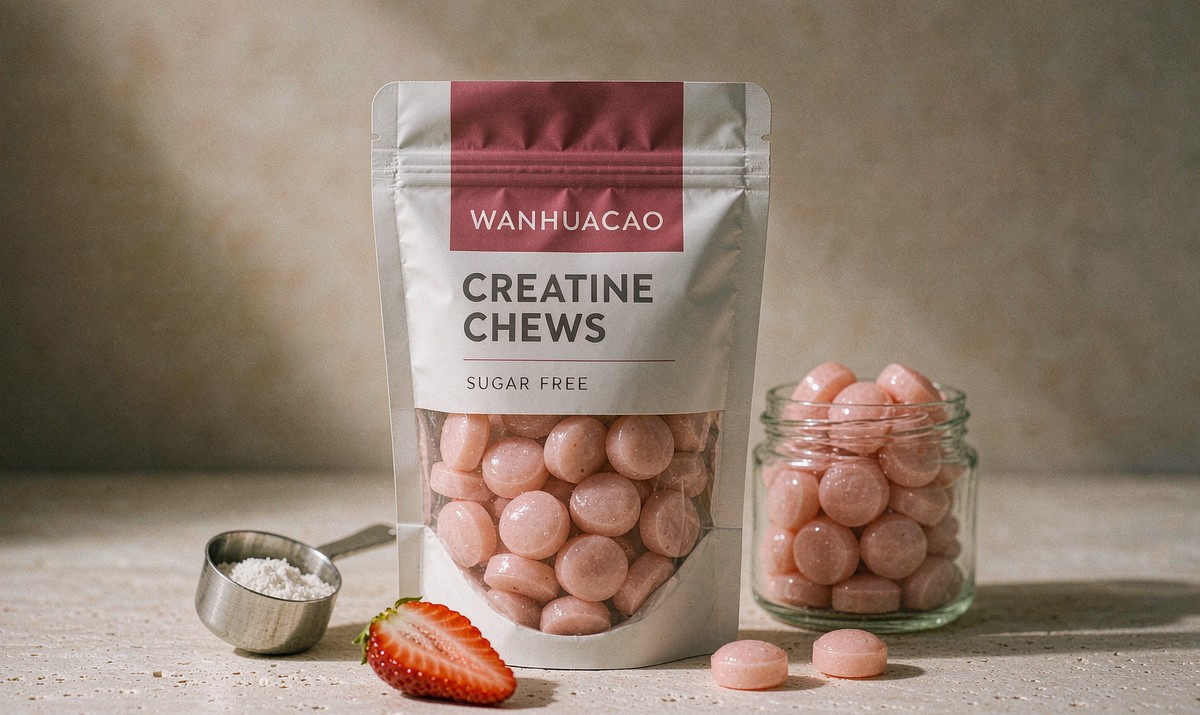
The brief that arrives is short: three grams a day, sugar-free, strawberry, for women, two pieces a serving. Every word of it is a constraint on the piece, and two of them pull against each other.
Three grams across two pieces is 1.5 grams of creatine per piece. Creatine monohydrate at a 25 percent load in a gummy base means a 6-gram piece, which is not a gummy any more. Lift the load to 50 percent and the piece is 3 grams, which is the weight of a normal gummy but not the texture of one. Stay at 1.5 grams per piece and 20 percent load and the serving is four pieces of 7.5 grams, which nobody chews.
The format follows the dose, not the other way round. And on creatine the dose is where the market rules and the chemistry meet, because creatine is the one supplement active that turns into something else while it sits in water.
Where three grams comes from
The daily maintenance figure in the sports nutrition literature is 3 to 5 grams of creatine monohydrate, with an optional loading phase of about 20 grams a day split into four doses for five to seven days. The International Society of Sports Nutrition position stand is the document most often cited for it, and it does not separate men from women: the same range is given for both.
Two other numbers sit underneath that range. The first is body weight. Maintenance is described as roughly 0.03 grams per kilogram per day, so a 60-kilogram woman is at 1.8 grams, and 3 grams is already 167 percent of that. A 5-gram serve is 0.083 grams per kilogram, close to three times the maintenance rate, and the loading phase is ten times it for a week.
The second number is legal and it is national. Australia's Food Standards Code, Schedule 29, caps a formulated supplementary sports food at 3 grams of creatine in a one-day quantity. A product made and labelled for that market cannot print a 5-gram serve. That is why the same brand sold in Australia and in the United States can carry 3 grams on one label and 5 on another, with the same powder inside.
Put those three together and a women's SKU written for the European or Australian market lands at 3 grams, not because the research says women need less, but because the requirement scales with muscle mass, the legal ceiling is 3 in one major market, and nothing above 3 has been shown to be necessary for maintenance.
What the female evidence actually supports
A 2025 systematic review in Nutrients screened 10,563 records and found 27 eligible studies in physically active women, with interventions running from five days to twelve weeks. Most of those studies reported no improvement in performance outcomes against placebo, and the authors judged that methodological issues specific to female participants were poorly addressed in most of them.
That is a more honest summary than the category usually offers, and it changes what a product can responsibly claim. The same review and the surrounding literature do support effects on strength and performance in women when creatine is combined with resistance training, particularly in trained populations. What they do not support is a women's dose that differs from a men's dose, a cycle-synchronised protocol, or a benefit at perimenopause that has been demonstrated rather than hypothesised.
Three findings are specific enough to design around.
- Endogenous synthesis — women synthesise creatine at roughly 70 to 80 percent of the rate reported in men, and eat less of it from food, which is the argument for supplementing rather than an argument for a higher dose
- Menstrual phase — one study reported reduced post-sprint fatigue from supplementation in the luteal phase and no change in the follicular phase; no consistent protocol has followed, and no guidance recommends moving the dose across the cycle
- Menopause — the bone data do not separate creatine from exercise. Improvements in bone measures are reported where creatine sits alongside a training programme, and not with creatine alone
For a manufacturer the practical consequence is narrow and useful. A women's product is a 3-gram product, a one- or two-piece serving, and a label that says nothing about hormones. The marketing around the category says much more than that.
One piece, and how much it can carry
The arithmetic that decides the format is the load: how much creatine goes into a piece as a percentage of the piece weight.
A gelatin or pectin gummy at 20 to 25 percent creatine monohydrate is already dense. Above that the gel network stops holding the powder, the texture turns from chewy to chalky, and the piece starts to taste like what it is. At 2.5 grams per piece an experienced line will quote a chew rather than a gummy, and we have written about that ceiling elsewhere.
Run the women's brief through it. Three grams a day as two pieces is 1.5 grams each. At 25 percent load that is a 6-gram piece, twice the weight of a normal gummy and outside what the format does well. At 50 percent load, which is where a chew becomes possible, 1.5 grams fits in a 3-gram piece. Four pieces of 0.75 grams each would sit at 5.6 grams per piece at 25 percent load, a serving of 22 grams of confectionery a day.
The women's version of this product is therefore so often a chew, and the number of pieces on the front is decided by the load rather than by the flavour brief.
Chews and gummies are not the same format
The two words are used interchangeably in listings and in the keyword phrases people search with, and they describe different manufacturing systems with different water in them.
A gummy is a deposited gel. The base is cooked, acid, colour and flavour are added, the active goes in, and the slurry is metered into starch moulds or a moulding belt where it sets. Gelatin bases cook around 75 to 85 °C and deposit hot; pectin bases cook hotter, often at 100 to 110 °C, because the pectin has to hydrate fully. Finished pieces sit at roughly 8 to 20 percent moisture depending on the base and the target texture, and water activity is reported anywhere from 0.46 to 0.75 across published confectionery work.
A chew is a low-moisture chewable. It is built from a sugar or polyol syrup with a fat phase and a structuring agent, formed by extrusion or pressing rather than depositing into a wet mould, and it reaches the consumer at a lower water activity than a gel. It can carry a higher active load because there is less water to dilute the load and less gel network to disrupt, and it can be pressed to a weight a gummy cannot reach without becoming unpleasant.
The distinction matters because of what water does to creatine, which is the next problem.
The molecule that cyclizes
Creatine monohydrate in dry powder form is one of the most stable supplement raw materials there is. A review in Amino Acids reports no detectable degradation after more than three years at room temperature or at 40 °C, with creatinine staying under the 67 ppm quantification limit; at 60 °C, creatinine was first detected after 44 months.
In water it is a different material. Creatine undergoes an intramolecular cyclization and loses a water molecule to become creatinine, which has no biological activity in this context. Concentration does not drive the reaction. pH and temperature do, and the published numbers are specific.
After three days at 25 °C in aqueous solution, the share of creatine converted to creatinine runs:
- pH 7.5 — under 1 percent
- pH 6.5 — about 1.5 percent
- pH 5.5 — about 4 percent
- pH 4.5 — about 12 percent
- pH 3.5 — about 21 percent
The curve is not monotonic at the bottom end. Below about pH 2.5 the amide group is protonated and the cyclization stops, which is why creatine survives the stomach. Between pH 3 and 5 it is at its least stable, and that is exactly where a pectin gummy has to sit to gel at all.
Water activity carries the second half of the effect. A 2009 storage study held creatine in glycerol and pH 4.0 buffer systems across water activities from 0.31 to 0.983, at 4, 23 and 35 °C. Half-life ran from 43 days at the highest water activity to 182 days at the lowest, and at room temperature the half-life fell under three months at a water activity of 0.68 or above.
Read those two findings against a gummy and the format's problem is visible. A gel at water activity 0.6 or above, held at pH 3.2 to 3.5 for a pectin base, is a matrix that combines both accelerating conditions at once. A gelatin base at pH 4.5 to 6.0 is less bad and still nowhere near the neutral range where the loss is under 2 percent. A chew at water activity below 0.5 gets out of the worst of the water activity curve, which is the technical reason the higher-dose products in this category are chews.
One boundary belongs here. The figures above come from buffer solutions and glycerol model systems. A published review of the field notes that no peer-reviewed stability study of creatine in a gummy matrix was available, and none of the solution data should be read as a shelf-life prediction for a finished piece. A gummy has high solids, hydrocolloids and limited mobile water, and the local environment around a creatine crystal is not a buffer. The honest position is that pH and water activity are the variables to control and measure, and that the actual retention has to come from testing the finished product, not from the solution table.
Sugar-free helps and vegan hurts
The two most common requests on a women's brief push the matrix in opposite directions, which is why the formula conversation gets long.
Sugar-free helps. Replacing sucrose and glucose syrup with polyols raises the solids and lowers water activity for the same piece weight, and by the water activity curve above that is a measurable gain in creatine retention. A sugar-free base is also what removes the calorie objection that sends a lot of this category to powder, so the request is not only a marketing one.
Vegan hurts. A gelatin-free piece means pectin, and high-methoxyl pectin needs an acid set at pH 3.0 to 3.5 with a calcium source. That puts the creatine at the bottom of the stability curve, at the pH where 21 percent converts in three days in solution. The alternatives are a different hydrocolloid system at a higher pH with a modified setting mechanism, or acceptance of a larger overage and a shorter shelf life.
Both requests in the same brief is where a project either gets a formula family or gets a compromise. The sugar-free base decision is usually written as a calorie question; on creatine it is a moisture question first.
What the assay has to separate
A creatine assay that reports 98 percent can be a report on a product that no longer works, if it reports creatine and creatinine together as "creatine-related compounds", or if it does not report creatinine at all.
The two molecules differ by one water molecule and are read on the same HPLC run, which is the good news. The quantification limit for creatinine is low enough, at 67 ppm, to see the problem early. What a release test cannot tell you is what the piece will read at month twelve, and a finished-product result at release is a snapshot of the day the batch was deposited.
The stability protocol is therefore the document that decides the shelf life on this product rather than the release specification. Time points on the commercial pack, at the storage temperature the market actually has, assaying creatine and creatinine separately. A retention curve that ends at 85 percent creatine at month eighteen with the balance in creatinine is a working product; the same total with the balance unaccounted for is a label that will fail.
The quality control programme around a creatine chew follows the same logic as any other piece with a claim on it: the number on the label has to be the number in the piece, and on creatine the number in the piece is the one that has not cyclized.
The three worries behind the search
Anyone searching creatine for women is usually carrying one of three worries, and none of them is a formulation problem. They are worth stating accurately because they decide what the label has to say and which markets will accept it.
Water weight. Creatine raises water stored inside muscle as creatine and phosphocreatine are retained, and the early gain on a loading phase is largely that. A systematic review and meta-analysis of trials in women found no statistically significant difference in weight gain between creatine and comparison groups, while noting that the evidence base was limited. Intramuscular water is not fat, and a label cannot say either thing as a health claim in the European Union.
Hair loss. The concern traces to a single small study in rugby players reporting a rise in dihydrotestosterone, and it has not been reproduced in the form the internet repeats it. No authorised claim exists in either direction, and a brand that answers the worry on pack is making a statement it cannot support.
Kidneys. Creatine raises serum creatinine because creatinine is its breakdown product, not because it damages the kidney, and a routine kidney panel can read that as reduced function. Reviews of the safety literature recommend assessing kidney function in creatine users with a marker independent of creatinine metabolism, such as cystatin C. For a product aimed at women this matters twice, because baseline serum creatinine is lower in women and in people with low muscle mass, so an ordinary lab report has less room to absorb the shift.
Pregnancy and breastfeeding sit outside the evidence. A 2025 safety review grades the human evidence in pregnancy as unknown and advises caution, which for a manufacturer means the label says what the market requires it to say and the product makes no prenatal positioning.
What a manufacturers list does not tell you
Search terms like private label supplement manufacturers list return directories, and a directory is organised by format and by certification rather than by what a line can actually hold.
Three questions decide whether a name on that list can make this product, and none of them is usually in the listing.
- Which format the line is built for — a depositing line for gummies is not a chew line, and a factory listed under gummies may quote a chew it does not run
- What water activity the finished piece reaches — the number that decides creatine retention, and it is a property of the formula and the drying step, not of the equipment list
- Whether the assay separates creatinine — a laboratory that reports total creatine-related content cannot see the failure this product is prone to
A quotation that arrives without those three answers, from a company that appeared on a list, is a price rather than a capability. The contract manufacturing comparison is the same conversation in a different order: dose arithmetic first, format second, price last.
That is also where the #creatineforwomen tag and the trend reports behind it land. The social interest is in a 3-gram daily habit that does not require a shaker, and the manufacturing answer to that interest is a low-moisture chew or a multi-piece gummy with an honest shelf life. A private label catalogue can supply the first. Only a development project supplies the second, and the two are priced differently for a reason.
Our own scope, in the same terms
Creatine is the one active where the domestic route and the export route separate early.
Under GB 24154, the Chinese food safety standard for sports nutrition foods, creatine is a required component of the speed-and-strength category and the daily intake is capped between 1 and 3 grams. A product built for that standard is a 1-to-3-gram product with a fixed claim set attached to the category, and the piece count follows from it.
Our health food licence, SC11434160205012, covers eight dosage forms and runs to 25 August 2030; gel candy is not one of the eight. The functional gummies line runs under a food production licence, and gel confectionery sits inside SGS certificate CN23/00007035, which covers herbal tea, solid beverages, instant cereal powder and gel confectionery and runs to 24 December 2026. An export creatine chew or gummy for a European or North American brand is built on that scope, with the destination's rules applied to the panel.
The gummy line starts at one tonne, samples are free, and production runs 15 to 30 days from deposit confirmation, with the specification confirmed per project. What we will say about a 3-gram women's brief before anything is quoted is the load and the water activity, because those two numbers decide whether it is a chew, a two-piece gummy or a serving nobody finishes.
If a brief is on your desk, send the dose and the destination. The first reply will be about the format the dose allows, and the shelf life the matrix allows after that.
Ding Shaohua, Foreign Trade Manager at WANHUACAO, works with brands and distributors on creatine, vitamin and functional gummy programmes from brief to first shipment, in bulk and in private label. The plant operates under SGS CN23/00007035 for gel confectionery and SC11434160205012 covering eight dosage forms. Reach him on WhatsApp, TikTok, LinkedIn and Facebook.
Frequently asked questions
How much creatine should a woman take a day?
The figure in the sports nutrition literature is 3 to 5 grams of creatine monohydrate a day for maintenance, with no separate female dose. Body weight scales it: maintenance is described as about 0.03 grams per kilogram a day, which is 1.8 grams for a 60-kilogram woman. Australia's Food Standards Code caps a formulated supplementary sports food at 3 grams in a one-day quantity, which is why a product made for that market prints 3 grams rather than 5.
Is 3 grams of creatine enough to see a difference?
A 2025 systematic review in Nutrients found 27 eligible studies in physically active women and reported that most showed no performance improvement against placebo, with methodological issues specific to female participants poorly addressed. The evidence that does hold up is for strength and performance alongside resistance training. A larger dose has not been shown to close that gap, and 3 grams sits inside the range that maintains muscle stores.
Why are high-dose creatine products chews rather than gummies?
Because of load and water. A gummy holds roughly 20 to 25 percent creatine monohydrate before the gel network fails and the texture turns chalky, so 1.5 grams of creatine needs a 6-gram piece. A low-moisture chew can carry a higher load and reaches a lower water activity, and water activity is what drives the conversion of creatine to creatinine, which has no biological activity. Above about 2.5 grams per piece the format quoted is generally a chew.
Does creatine degrade in a gummy?
In solution it does, and the rate depends on pH and temperature rather than concentration. After three days at 25 °C, about 4 percent converts to creatinine at pH 5.5, 12 percent at pH 4.5 and 21 percent at pH 3.5. A pectin gummy has to sit at pH 3.0 to 3.5 to gel, which is the least favourable range, and a gelatin base at pH 4.5 to 6.0 is better but not neutral. A review of the field notes that no peer-reviewed stability study of creatine in a gummy matrix has been published, so the real number has to come from testing the finished piece on the commercial pack.