Ten kilometres into a run in July, a packet comes out of a pocket and four gummies go in. The label says 360 mg of electrolytes, which sounds like a bottle of sports drink condensed into something chewable. The sodium in those four pieces is 94 mg.
Sweat runs between 20 and 80 mmol of sodium per litre across the normal population, which is 460 to 1,840 mg. At the middle of that range, 94 mg replaces about 120 mL of sweat. The same four pieces carry 6.6 g of sugar.
That ratio is the whole story of this product, and it runs opposite to the ratio that makes oral rehydration work.
Three ingredients, three different orders of magnitude
Search data from the UK in September put protein powder, electrolytes and vitamin D in the same top-32 of 72 tracked terms. They read as one shopping list: the everyday nutrition trio. In a gummy, they are three completely different engineering problems, and only one of them fits.
- Protein —— a scoop delivers 20 to 25 g. At 2.5 g a piece that is ten gummies for one serving, before the gel is even discussed. Gelatin base makes it worse, because the hydroxyproline assay used for collagen counts the base as protein, so the number on the label stops matching the number the customer thinks they are buying.
- Electrolytes —— sodium, potassium, magnesium and chloride arrive in milligrams, tens to hundreds per serving. This is inside what a 2.5 g piece can physically hold.
- Vitamin D —— cholecalciferol is dosed in micrograms, 5 to 125 µg. Mass is not the constraint at all; retention through cooking and shelf life is, which is a separate problem covered in why vitamin D3 K2 gummies lose potency.
So electrolytes are the one member of that trio a gummy can genuinely carry. The question worth asking is how much of the dose survives the trip from the specification to the sweat, and that answer is smaller than the category admits.
What "hydration" is asking for
Rehydration is a volume problem before it is a mineral problem. The body needs water to move, and electrolytes move with it because of an osmotic gradient, not because they are sprinkled on top.
The WHO and UNICEF reduced-osmolarity oral rehydration solution, recommended since 2004, is the reference point because every number in it is there for a reason: 2.6 g sodium chloride, 13.5 g anhydrous glucose, 1.5 g potassium chloride and 2.9 g trisodium citrate per litre, giving 75 mmol sodium, 75 mmol glucose, 20 mmol potassium, 10 mmol citrate and a total osmolarity of 245 mOsm/L. The reduction from the older 311 mOsm/L formula cut unscheduled intravenous therapy by a third in children with acute non-cholera diarrhoea, and lowered stool output by about 20%.
The part that matters here is the 1:1 molar ratio between sodium and glucose. Glucose and sodium are absorbed together across the intestinal brush border by the sodium-glucose linked transporter, and the transporter needs both present at roughly the same concentration to work at rate. ORS is not salty water with sugar added. The two are a matched pair, and the ratio is the mechanism.
In mass terms, 75 mmol of sodium is 1,725 mg and 75 mmol of glucose is 13,500 mg, so the reference solution runs about 1 part sodium to 7.8 parts glucose.
Four gummies from a UK brand on the shelf deliver 94 mg sodium with 6.6 g sugar. That is 1 to 70. The sodium-to-glucose ratio is roughly nine times more dilute in sodium than the solution designed to drive absorption, and the sugar is there in a quantity that makes the piece taste like candy rather than reconstituted therapy.
None of this makes the product useless. It makes it a salted confection rather than a rehydration tool, and the label on most of these packs says hydration in a way that implies the second.
Four pieces, 94 milligrams: what the shelf sells
Reading the panels of what is currently sold in the UK and the US is more informative than reading the marketing. Four examples, all real products, all sold as electrolyte gummies:
- Brand A, UK, 4 gummies —— sodium 94 mg, chloride 149 mg, potassium 40 mg, calcium 20 mg, magnesium 56 mg, sugar 6.6 g, 42 kcal. Gelling agent: pectin.
- Brand B, US, 2 gummies —— sodium 135 mg, chloride 130 mg, potassium 40 mg, magnesium 20 mg, total sugars 6 g including 5 g added, 40 kcal. Gelling agents: pectin and agar.
- Brand C, US, 2 gummies —— sodium 60 mg, chloride 40 mg, potassium 36 mg, calcium 10 mg, magnesium 6 mg, sugars 4 g. Marketing total: 150 mg of electrolytes. Gelling agent: pectin.
- Brand D, US, 3 gummies —— sodium 450 mg, potassium 300 mg, chloride 150 mg. Gelling agents: agar with erythritol.
The spread in sodium is almost eightfold, from 60 mg to 450 mg, and the spread in sugar is under twofold. The category has not converged on a dose, because there is no dose that satisfies both the physiology and the candy.
The other thing the panels agree on is the gelling agent. Four out of four use pectin, agar, or both. Not one uses gelatin. That is not a dietary preference across four unrelated companies; it is what salt does to a gelatin gel.
Salt is a solvent for the gel, not an ingredient in it
Sodium chloride does not sit passively inside a gelatin matrix. It breaks hydrophobic and hydrogen bonds, which is exactly the bonding that holds the triple helix of a gelatin gel together, and it interferes with the water structure around the junction sites.
The measured effect is not subtle. In a study of seven gelatins, gel strength fell sharply up to 2% NaCl and continued falling after that, and at 14% NaCl pork gelatins had lost 37% to 54% of their original gel strength. Melting points dropped 9% to 11%. Fish gelatin, which is more sensitive, lost 64% to 65% of its strength at the same salt level.
Run the numbers on a real product. Sodium 94 mg is 239 mg of sodium chloride. Across four pieces at 2.5 g each, that is 10 g of gummy carrying 2.4% salt, which already sits past the point where gel strength drops steeply. A brand pushing to 450 mg of sodium in three pieces is carrying about 1,145 mg of sodium chloride in 7.5 g, or 15%, which is the region where the published data shows a third to a half of the gel strength gone.
A gelatin gummy at that salt load does not fail gracefully. It goes soft at warm room temperature, it deforms in the jar, and it collapses on the pallet in a way that a 20 °C stability chamber will not catch if the profile only runs at controlled temperature.
Pectin and agar tolerate the salt load better, which is why the shelf looks the way it does. The switch is a consequence of the formula, not a marketing position on vegan.
Pectin solves the salt problem and brings a pH problem
High-methoxyl pectin gels through an acid-and-sugar mechanism, and it needs a pH around 3.0 to 3.5 to set. That is a narrow window, and it is the opposite of what a salt blend wants.
Sodium citrate and potassium citrate are the standard way to deliver sodium and potassium without a hard salty taste, because the citrate anion buffers the palate. They are also buffers in the literal sense: they resist the pH drop that citric acid is trying to produce. A formula that carries meaningful citrate has to push more acid to reach the same set point, and the extra acid shows up as sourness in a product that is supposed to taste like orange.
Low-methoxyl pectin, which gels through a calcium bridge instead of acid, avoids that conflict and is the usual answer in higher-mineral formulas. It brings its own constraint: calcium competes with sodium and potassium for the same carboxyl groups, so the calcium level becomes a gelling variable rather than a nutritional one. Raise calcium for the label and the texture moves.
There is also the melting behaviour. Agar sets around 32 to 45 °C and melts near 85 °C, which gives a piece that holds at warehouse temperature but does not melt in the mouth the way a gelatin gummy does. That difference is measurable in sensory panels as chewdown and flavour release, and it is the reason some electrolyte gummies read as firm and slightly waxy next to a fruit gummy.
Potassium is where the bitterness arrives, and it arrives early
The four brands above deliver 36 to 300 mg of potassium. The EU reference intake is 2,000 mg, and a claim of being a source of potassium needs 15% of that, or 300 mg. Only the outlier reaches it.
That number is worth sitting with, because it explains a pattern in the category. Magnesium is 56 mg in the UK product, against a reference intake of 375 mg, which is 14.9%. That is not a coincidence; it is a formula written backwards from the 15% threshold, so the front of the pack can carry the magnesium claims about muscle function and electrolyte balance. The potassium sits at 2% because pushing it to 15% would mean 300 mg of potassium salt in four pieces, and potassium chloride at that level tastes bitter and metallic in a way no flavour system fully masks.
Potassium citrate and potassium gluconate are the usual workarounds. Both trade bitterness for mass: potassium citrate is 36% potassium by weight, so 300 mg of potassium needs 833 mg of salt, which is 8% of a 10 g serving before anything else goes in. Potassium chloride is 52% potassium, cheaper and more bitter.
The form matters for a second reason. Chloride is the anion the label usually reports alongside sodium, and the four products above report 40 to 150 mg of it. Sweat chloride roughly tracks sodium, so a product that is heavy on sodium citrate and light on chloride will show a sodium number on the panel that does not correspond to the salt the customer is losing.
Water activity, surface moisture and the pack
Salt lowers water activity, which is good for microbiological stability and bad for everything the customer can see.
A gummy sitting at 0.55 to 0.65 water activity with a high mineral load pulls moisture from the headspace and from neighbouring pieces. The salt at the surface is hygroscopic, so it takes on that moisture first and the surface turns tacky before the piece itself changes. In a jar, that shows up as gummies welded together at the base; in a pouch, as a film of syrup on the inside of the laminate.
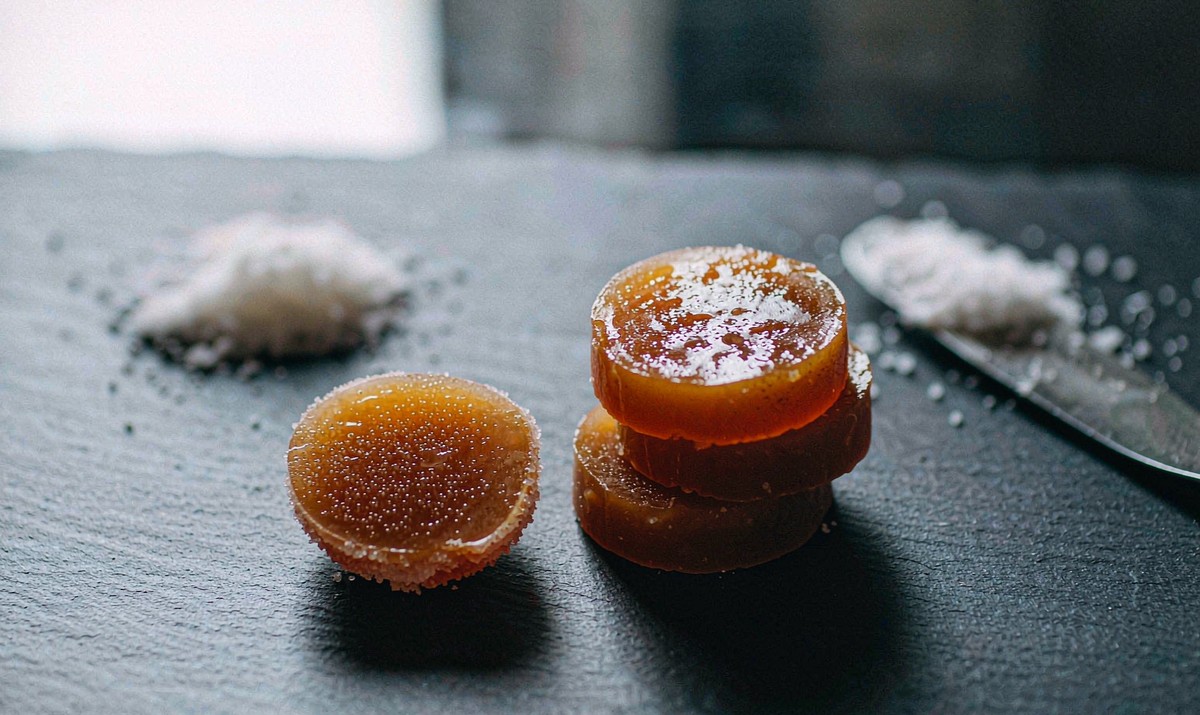
Two fixes are common and both cost something. A starch or oil coating on the piece interrupts the surface, at the price of a duller finish and a slightly powdery mouthfeel. A drier base lowers the driving force for moisture migration, at the price of a firmer chew that reads as stale to anyone comparing it to a fruit gummy.
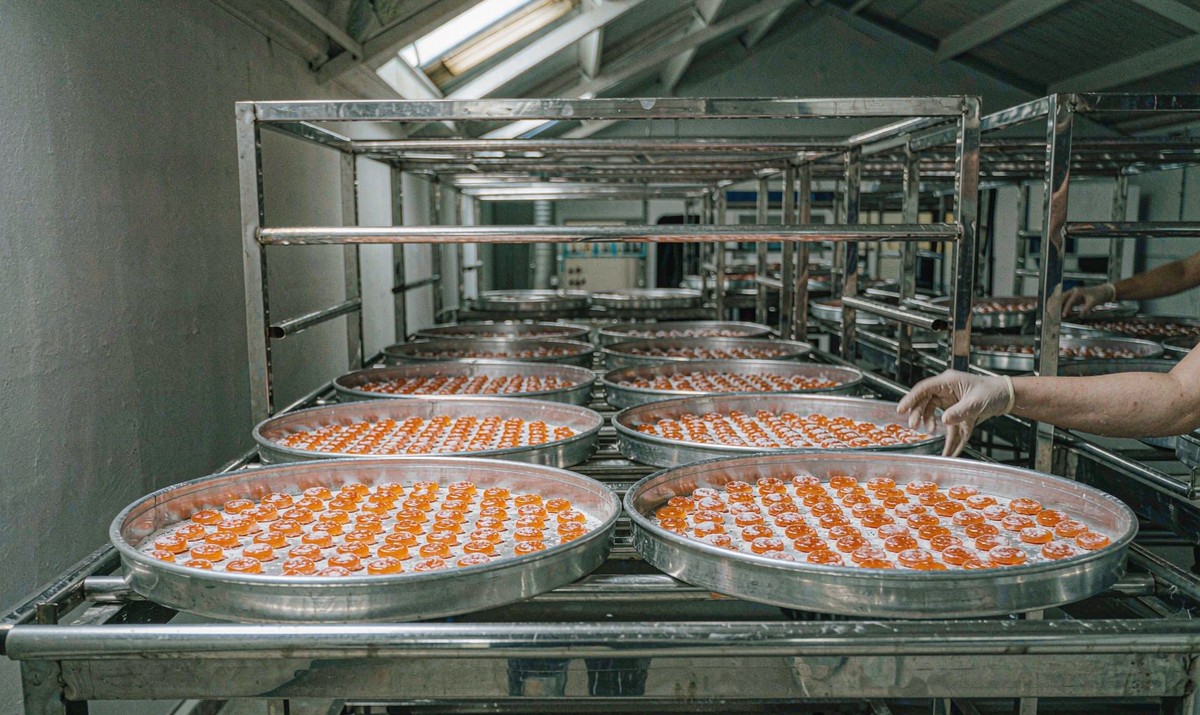
The pack decision follows from the same numbers. A high-barrier laminate with a desiccant sachet buys shelf life and adds a step the customer sees. A simple jar is cheaper and shows the problem sooner. The failure modes and which formats cause them are set out in gummy packaging issues, and the underlying moisture behaviour in gummy shelf life and stability.
One detail specific to minerals: salt is dense. In a depositor, a slurry carrying dissolved salts and suspended mineral particles is not homogeneous at the nozzle, and the last cavities filled in a run can carry more mineral than the first. That shows up as a sodium result that passes on a composite sample and drifts on single pieces, which is the same sampling argument that applies to any active in a gummy and is covered in gummy quality control testing.
What Europe will and will not let you say
This is the part of the category that gets decided in Brussels rather than in the kitchen, and the answer is more restrictive than most brands realise.
Water claims belong to water. Regulation 432/2012 authorises two: water contributes to the maintenance of normal physical and cognitive functions, and water contributes to the normal regulation of body temperature. Both carry a condition that the consumer be told the effect needs at least 2.0 L of water a day from all sources, and both are restricted to water complying with Directive 2009/54/EC on natural mineral waters or 98/83/EC on water intended for human consumption. A flavoured electrolyte product, drink or gummy, cannot carry them. Hydration as a claim does not exist for this category in the EU.
The sodium claim was assessed and then refused. EFSA's NDA panel confirmed in 2011 that a cause-and-effect relationship exists between sodium intake and the maintenance of normal muscle function, entry ID 359. The Commission then declined to authorise it, and the recital of 432/2012 says why: authorising it would send a contradictory message by encouraging consumption of a substance that European, national and international authorities recommend reducing, contrary to Article 3(2)(a) of Regulation 1924/2006. It is one of the few cases where the science passed and the claim still did not, on grounds of public health messaging rather than evidence.
The one sodium claim that exists runs the other way. The authorised claim is that a lower sodium intake contributes to the maintenance of normal blood pressure, and it requires the food to meet the low sodium threshold of 0.12 g of sodium per 100 g. A gummy carrying 94 mg of sodium in 10 g sits at 940 mg per 100 g, roughly eight times the threshold. The only sodium claim available in Europe is for products that have less sodium than this one.
The sports claims are written per litre. Two claims exist for carbohydrate-electrolyte solutions, one on endurance performance and one on recovery after exercise, with conditions of 80 to 350 kcal per litre, sodium at 20 to 50 mmol/L and osmolarity between 200 and 330 mOsm/kg. Every one of those conditions is a concentration in a liquid. A gummy has no litre to be measured against, and if it were dissolved to make one, 42 kcal in 10 g becomes 4,200 kcal/L, which is nowhere near the range.
What remains is the ordinary nutrient content claims, and those are honest but narrow: a source of magnesium at 15% of the reference intake, a source of calcium, and nothing at all about hydration, sweat, cramps or performance.
Custom formulation here means four variables that lock each other
The industry term for this work is custom formula supplement manufacturing, and on an electrolyte brief the phrase has a specific meaning that is worth being precise about, because it is not the same as changing a flavour.
Change the sodium-to-potassium ratio and the bitter balance moves, which changes the acid level, which changes the pectin set point.
Change the salt form from chloride to citrate and the pH buffer capacity moves, which changes how much citric acid the batch needs, which changes both the taste and the gel.
Change the sugar system to a polyol to cut calories and the water activity drops further, which helps the microbes and hurts the texture, and erythritol above a certain load brings its own digestive statement to the label.
Change the gelling agent to fix any of the above and the melting profile moves, which changes how the piece behaves in a warm warehouse and in the mouth.
A custom formula on this product is not a flavour selection exercise. Settling four coupled variables against a target market's claim rules, then proving the result on singles, is most of the engineering. The coupling is why a formula developed for one market rarely transfers to another without a new stability run.
What belongs on the specification
Four numbers carry most of the risk on this product, and all four are cheap to test.
- Sodium and potassium by assay, per piece —— label value against measured, on single pieces pulled from different mould rows, not on a composite. Salt density makes the drift invisible in a pooled sample.
- Water activity —— the number that predicts both the microbiological status and the surface tack, and the one most often missing from a specification written around assay alone.
- Moisture migration over accelerated storage —— pieces stored at 30 °C and 40 °C, weighed and photographed at 0, 1, 3 and 6 months, because the visible failure is stickiness rather than potency.
- Weight and dimension spread across a run —— a mineral load changes the slurry viscosity, which changes fill weight, which changes the dose on the label.
The rest of the programme is the ordinary work: a stability protocol that matches the market's required conditions, a claim set checked against the current register instead of against a competitor's pack, and artwork that does not promise hydration in a jurisdiction where the word is reserved for water. The gummy formats this line runs are listed on functional gummies, and a brief can start there or from the contact form.
Ding Shaohua, Foreign Trade Manager at WANHUACAO, works with brands and distributors on electrolyte, sports nutrition and functional gummy programmes from brief to first shipment, in bulk and in private label. The plant operates under SGS CN23/00007035 for gel confectionery and SC11434160205012 covering eight dosage forms, sports nutrition supplements among them. Reach him on WhatsApp, TikTok, LinkedIn and Facebook.
Frequently asked questions
How much sodium can one gummy physically hold?
Around 100 to 150 mg is a practical ceiling at 2.5 g a piece, and it is set by taste and gel strength rather than by solubility. Sodium chloride is 39% sodium, so 150 mg of sodium is 380 mg of salt, about 15% of the piece. At that load the salty taste needs a sour or citrus direction to mask, and a gelatin base has already lost a large share of its gel strength. Products claiming 450 mg of sodium in three pieces exist, and they use agar with a polyol system rather than gelatin, which is the formulation route that makes the number possible.
Do electrolyte gummies replace a sports drink?
They replace the salt, not the water. Sweat sodium runs 460 to 1,840 mg per litre, and a four-gummy serving at 94 mg covers roughly 120 mL of that loss. During a long session the fluid volume is the larger requirement, and a gummy has none of it. The useful framing is a salt top-up that travels well and is taken with water. A drink in solid form is a different product.
Why do electrolyte gummies use pectin instead of gelatin?
Because salt breaks gelatin gels. Sodium chloride disrupts the hydrogen and hydrophobic bonding that stabilises the gelatin triple helix, and the published data shows gel strength falling sharply up to 2% salt and pork gelatin losing 37% to 54% of its strength at 14%. A formula carrying a meaningful mineral load sits in that range. Pectin and agar hold their structure at the same salt concentration, so the switch is a technical consequence, and the vegan positioning follows from it as a side effect.
Can a hydration claim go on the pack in Europe?
Not as hydration. The two water claims in Regulation 432/2012 are restricted to water complying with the mineral water and drinking water directives, so a flavoured electrolyte product cannot use them. The sodium and normal muscle function claim was assessed as scientifically supported by EFSA in 2011 and then refused authorisation by the Commission on the grounds that it would contradict public health advice to reduce sodium. What is left is nutrient content wording such as a source of magnesium, and in the US a structure-function statement with the required disclaimer.