
A brief arrives with three numbers in it: 200 mg caffeine, 3.2 g beta-alanine, two gummies. Two of those numbers come from exercise studies. The third comes from the size of the bottle and the cost of the label, and it is the one that rewrites the other two.
What ships is smaller on both sides, usually around 50 mg of caffeine per piece and 300 to 500 mg of beta-alanine. The gap is arithmetic, not secrecy, and it is cheaper to run the sum before the artwork than after the first stability batch.
Two ingredients, two different clocks
Beta-alanine does not act during a workout. It raises muscle carnosine, and carnosine buffers the acid that accumulates in a working muscle. That store takes weeks to fill. The International Society of Sports Nutrition position stand of 2015 puts the protocol at 4 to 6 g a day for two to four weeks, split into single doses of about 1.6 g or less to keep the tingling tolerable, with the performance benefit concentrated in efforts lasting roughly one to ten minutes.
Caffeine works on a different schedule entirely. It is absorbed within about 45 minutes, peaks in plasma around the hour, and clears with a half-life of three to five hours in most adults. EFSA's 2011 opinion on endurance performance describes the studied conditions precisely: at least 3 mg per kilogram of body weight, taken about an hour before exercise, after at least a day without caffeine.
So the word pre-workout covers two schedules, a month and a morning, and a single piece of gel can only be designed around one of them. Everything that follows comes from that mismatch.
Where the load arithmetic breaks
A deposited gummy lands between about 2 and 3 g. Above that the piece stops reading as a gummy and starts reading as a chew, which changes the texture brief, the drying time and the pack count. Take 2.5 g as the working weight and the numbers fall out quickly.
- At 500 mg of beta-alanine per piece —— 4 g a day needs eight pieces. At 50 mg of caffeine each, that is 400 mg of caffeine, which is EFSA's entire daily intake of no concern for a healthy adult, consumed in one sitting.
- At 1 g of beta-alanine per piece —— 4 g needs four pieces, and four pieces at 50 mg is 200 mg of caffeine, which is exactly the single dose EFSA treats as the ceiling for the general adult population.
- At 2 g of beta-alanine per piece —— the piece is no longer a gummy, and the caffeine that comes with two of them is 100 mg, which is half the studied dose.
The amino acid sets the piece count, and the stimulant is carried along at whatever rate that piece count implies. It is the same argument that runs through creatine chews for women, where a 3 g dose decided the format before anyone chose a flavour. Nothing in this chain is a formulation preference. It is the mass balance of two powders in a fixed volume of gel, and the only free variable is how many pieces the front panel asks the customer to take.
Sugar travels with the piece count too. Four pieces at 2.5 g, in a base running around 60% syrup solids, is roughly 6 g of sugar and 24 kcal in a serving that a customer takes thirty minutes before training.
That leaves three designs that survive contact with the mass balance, and only three:
- Two pieces, 100 mg caffeine, 600 mg beta-alanine —— the serving fits the pack and the price, the caffeine is half the studied dose, and the beta-alanine is a gesture toward a loading protocol that needs seven times as much.
- Four pieces, 200 mg caffeine, 2 to 4 g beta-alanine —— a real loading dose per serving, at the highest single caffeine dose EFSA considers safe, with six grams of sugar attached and a front panel the customer has to read carefully.
- Caffeine and B vitamins, no amino acid at all —— what most of the market sells, and the version that can be honest about being an energy gummy rather than a pre-workout one.
The tingling is the reason the middle design keeps coming back. Beta-alanine paresthesia arrives fifteen to forty-five minutes after a dose, peaks for about an hour and fades, which lines up with a warm-up almost exactly. It is a harmless sensory effect with no relationship to carnosine loading, and it functions as proof of purchase: a customer who feels nothing believes nothing. A formulator who has to choose between an ineffective dose that tingles and an effective dose that does not fit will usually ship the tingle, and the label then has to be written carefully enough not to promise the rest.
Caffeine does not dissolve in a gummy
This is the part that surprises people who have only run caffeine in beverages. Caffeine is soluble at 21.7 mg per mL of water at 25 °C, and at 180 mg per mL at 80 °C. A 2.5 g gummy at 8 to 12% moisture contains 0.20 to 0.30 g of water. Multiply that out and the water inside one piece can hold about 4 to 6.5 mg of caffeine at room temperature.
A 50 mg dose is therefore roughly nine tenths crystalline solid. What that leaves is a suspension of caffeine crystals in gel rather than a solution, and everything that follows from the word suspension applies: settling, particle size, surface deposition, and the way the crystals feel against a tooth.
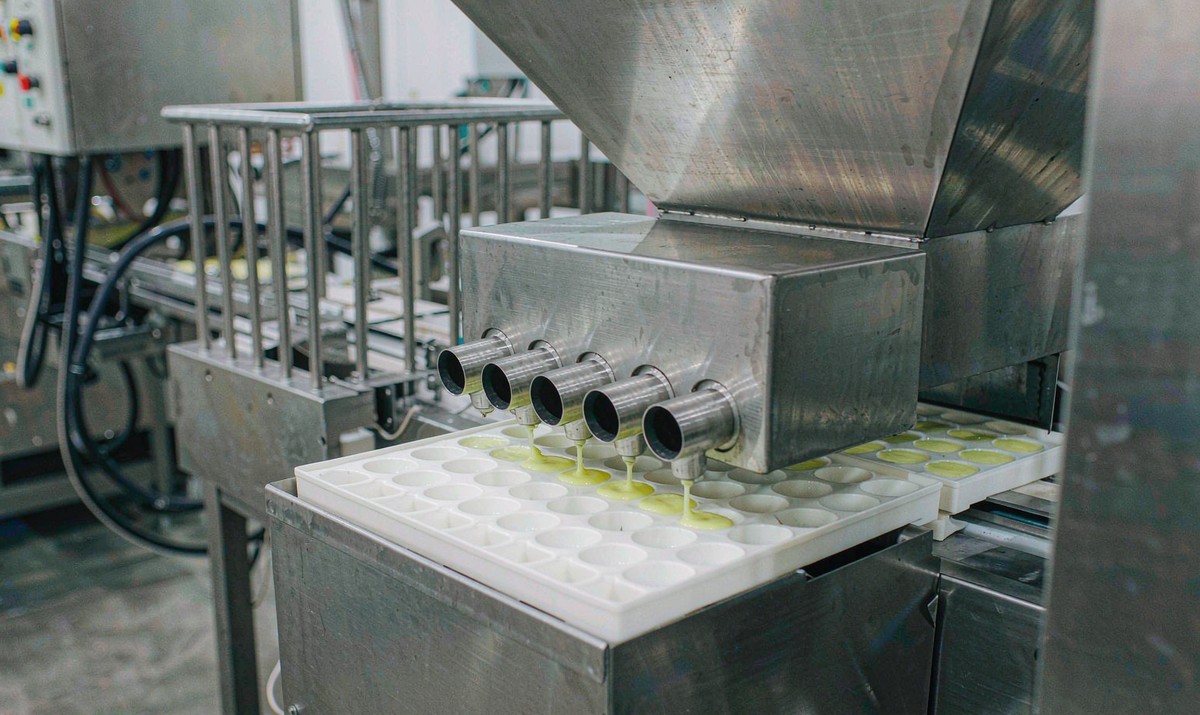
At the depositor the picture is different and that is where the trouble starts. The syrup arrives at 75 to 88 °C, where solubility is well above 100 mg/mL, so the caffeine is fully dissolved at the nozzle. It then cools inside the mould. A syrup that was saturated at 80 °C becomes several times supersaturated by the time it reaches 25 °C, and the excess has to go somewhere. It comes out as crystals, growing from whatever nuclei are present, and the size of those crystals is set by the cooling curve and by how much undissolved material was left in the batch as seed.
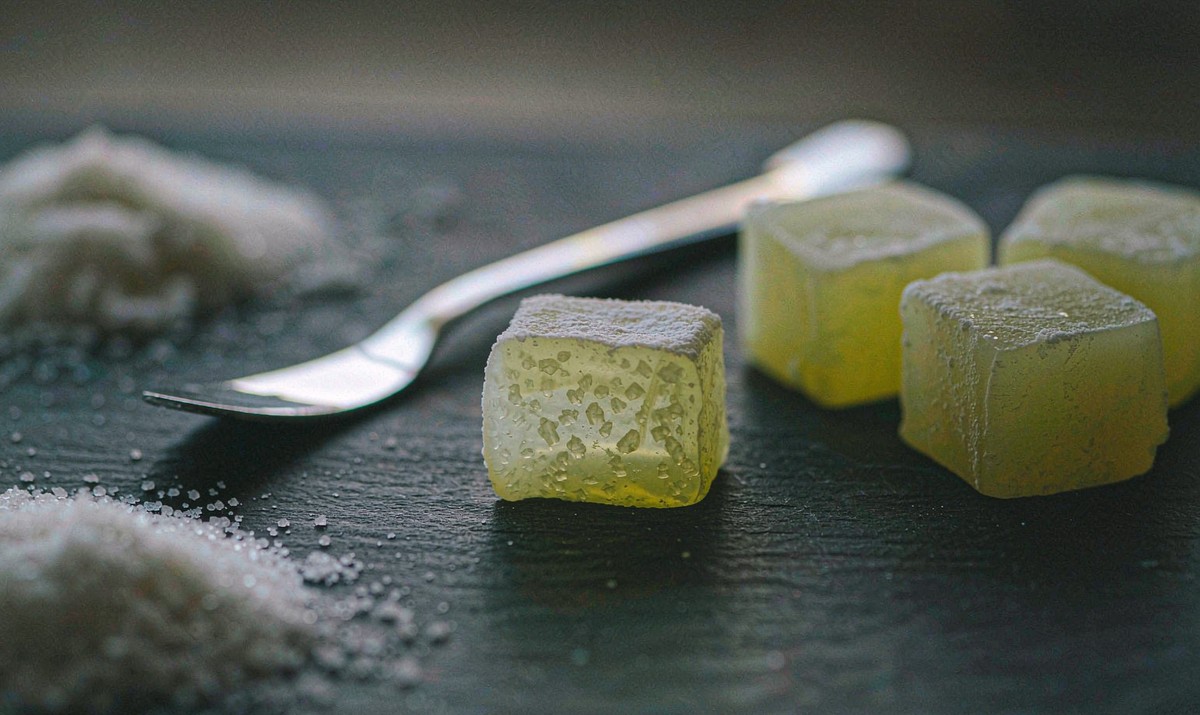
Slow cooling in a thick mould gives large crystals, and large crystals are gritty. Fast cooling gives many small ones, which read smoother but scatter light and turn a clear piece hazy. Crystals that nucleate at the surface produce the white specks that show up in a retained sample three months later and in a customer photograph at six.
The usual vitamin problem is heat. This one is not. Caffeine melts around 235 °C and sublimes near 178 °C, so a base cooked at 105 to 120 °C does not touch it. A formulator arriving from a vitamin C project will look for a loss figure and find almost none, then ship a product whose dose is uneven because the loss was never the risk.
Bitterness has numbers
Caffeine is the reference bitter standard in sensory work, which means its thresholds are well characterised. A 2017 study using a trained panel put the bitter recognition threshold at 117 ± 44 mg/L in water, and the wider literature sits between roughly 136 and 350 mg/L depending on method and panel.
Now put a piece in a mouth. Fifty milligrams of caffeine released into 10 mL of saliva is 5,000 mg/L, about forty times the recognition threshold, and the release is not gradual. A gummy is chewed, so the whole dose meets the tongue within seconds.
The masking inventory is short and each option costs something:
- Acid —— citric or malic acid at the levels a sour gummy already needs shifts perception and buys real headroom, which is why so many energy gummies are sour rather than sweet.
- Cooling and flavour —— menthol and mint-type systems mask bitterness by competing for attention, but they also fix the flavour direction to mint, which limits the range.
- Encapsulation —— a fat-coated caffeine releases later and lower, at the cost of a slower onset and a coating that has to survive the cook.
- Caffeine citrate —— about half caffeine by mass, so the powder load doubles to deliver the same milligram, and the citrate brings its own sourness.
Sugar-free makes all of it harder. Sucrose competes with bitterness directly; remove it and the caffeine sits on an empty palate, with a high-intensity sweetener that carries its own bitter or metallic tail. That is a flavour-brief problem with a chemical cause, and it is the reason a sugar-free energy gummy usually tastes more sour than the sugared version rather than less. The sugar-free base itself has its own set of constraints, covered in sugar-free gummy manufacturing.
Polyols add a labelling consequence. Above 10% added polyols, Regulation (EU) No 1169/2011 requires the statement that excessive consumption may produce laxative effects, which sits badly next to a product positioned for a gym bag.
What the release test has to sample
A composite assay of ten pieces blended together will pass a product in which individual pieces vary by 30%. That is not a criticism of the laboratory. It is what averaging does.
The test that sees the problem takes single pieces from different mould rows, and from the beginning, middle and end of the run. A depositor hopper with a suspended solid is a settling column: the first pieces off a run and the last pieces off the same run do not have to carry the same milligram, and no composite sample will say so.
Three numbers belong on the specification beside the assay: piece weight, moisture or water activity, and a visual count of surface specks on a defined sample. The sampling logic is the same one set out in gummy quality control testing, applied to an active that fails visibly rather than invisibly. Piece weight ties back to the caffeine load, moisture sets how much of the dose can stay in solution, and specks are the visible end of the crystallisation described above.
The stability protocol asks a different question from the release test, and it should be written at the same time. Caffeine itself is not the variable: it does not oxidise like a vitamin, and twelve months at 25 °C will not move the total much. What moves is its position. Moisture migrating through the gel carries dissolved caffeine outward, and the water that leaves through the pack leaves the caffeine behind at the surface, where it recrystallises. Pull samples at 0, 3, 6 and 12 months, assay whole pieces rather than brushed ones, and photograph the surface under the same light each time. A product that reads clean at release and speckled at six months passed every test it was given.
The dose on the label is not the dose in the study
Take the 3 mg/kg figure seriously for a moment. A 70 kg adult needs 210 mg. A two-piece serving at 50 mg a piece delivers 100 mg, which is 1.4 mg/kg, less than half the dose in the endurance studies EFSA reviewed, while still sitting forty times above the bitterness threshold.
To reach 3 mg/kg from 50 mg pieces takes four pieces and 200 mg. That number, 200 mg, is also the single dose EFSA's 2015 safety opinion treats as raising no concern for healthy adults, alongside 400 mg a day spread across the day, 200 mg a day in pregnancy and an acknowledgement that 100 mg close to bedtime can disturb sleep in some people.
So the four-piece serving is the only configuration that reaches the studied dose, and it arrives exactly at the safety ceiling. That is not a coincidence anyone planned. It is what happens when a dose derived from body weight meets a piece size derived from confectionery.
Europe: the science is positive and the claim is absent
EFSA gave favourable opinions on caffeine and alertness, concentration, endurance performance and endurance capacity in 2011. The Commission drafted a regulation to add four of those claims to the Union list. On 7 July 2016 the European Parliament vetoed it, on the argument that an alertness claim on a caffeinated product would function as a health halo over sugary drinks consumed mostly by adolescents.
The practical result, still true today: the consolidated text of Regulation (EU) No 432/2012 contains no permitted health claim for caffeine. The transitional arrangements that once allowed on-hold claims have largely lapsed. A jar can carry the word Energy as a brand name, because a brand name is not automatically a claim, and it cannot carry a statement that caffeine improves concentration, because that claim has no entry in the register.
Enforcement attention follows the gap. A 2024 German market survey of 188 products and 136 official samples found caffeine health claims most often on food supplements, at 31% of the products examined, more often on websites than on packs. The category with the strongest scientific file is the one with the least legal room to use it.
Canada: a serving cap, and a label that changed this year
Canada separates the two product types. Caffeinated energy drinks sit inside the supplemented foods framework with a cap of 180 mg of caffeine per serving, counting every source including guarana and yerba mate. Caffeinated energy shots are licensed as natural health products, capped at 200 mg per shot and 400 mg a day, restricted to adults 18 and over.
The labelling changed on 1 January 2026. Supplemented foods now carry a Supplemented Food Facts table in place of the Nutrition Facts table, listing each supplemental ingredient and its amount, and those with a caution carry the exclamation-mark identifier on the front pointing to the cautions on the back.
A caffeinated gummy does not slide neatly into either slot, and that is a decision to take before the artwork: which framework the product lives in determines the cap, the caution statements and the table on the back.
The United States: the piece is the measuring spoon
Under DSHEA a caffeine gummy is a dietary supplement. Structure and function language is available with the disclaimer, there is no federal milligram cap, and the enforcement line FDA has drawn is about the opposite product. One teaspoon of pure powdered caffeine is roughly 2.7 g, about the amount in 28 cups of coffee, and the agency's 2018 guidance treats bulk pure and highly concentrated caffeine as adulterated because a consumer cannot measure a safe serving out of a container holding hundreds of them.
A 50 mg gummy inverts that hazard. The mould is the measuring spoon, the dose is fixed before the customer touches it, and the failure mode is not an overdose but a label claim that does not match the piece. That is a manufacturing problem, and it is the one worth spending the assay budget on.
B vitamins carry the word energy legally
The one part of an energy gummy that is easy to make compliant is the vitamin panel. Regulation (EU) No 432/2012 permits the claim that a vitamin contributes to normal energy-yielding metabolism, and the threshold is 15% of the nutrient reference value: 0.375 µg of B12, 0.21 mg of B6, 2.4 mg of niacin, 0.165 mg of thiamin, 0.21 mg of riboflavin, 0.9 mg of pantothenic acid, 7.5 µg of biotin.
Those claims describe coenzyme roles in metabolism. They do not describe feeling anything, and they will not carry a product whose caffeine dose is too low to notice. What they do is make the word energy defensible on a pack in a market where the stimulant itself cannot be claimed.
Niacin is the vitamin to watch. Flushing is dose-dependent and immediate for nicotinic acid, the EU tolerable upper intake level for nicotinic acid is 10 mg a day while nicotinamide is set at 900 mg, and the US upper level is 35 mg a day for either form. A B-complex built for a flush-free product uses nicotinamide and stays well under all three.
Why the format sells anyway
None of the above explains why energy gummies sell, so it is worth saying what the format is genuinely good at.
A gummy is portion-controlled by construction. The customer cannot scoop a heaped teaspoon of it, cannot mix it too strong, and cannot leave a half-finished shaker in a gym bag. It travels at ambient temperature and does not need water, which matters more than it sounds for a product taken in a car park before a 6 a.m. session. It is also the only supplement format a large share of adults will take without a glass and without reading a serving table.
Those are real advantages and they are properties of the mould, not of the marketing. The confusion starts when the same mould is asked to carry a protocol designed for a powder: 3.2 g of beta-alanine, 6 g of citrulline, 200 mg of caffeine. A gummy can carry one of those numbers at the studied level. It cannot carry the set, and a product that claims the set is selling a powder's identity in a gel's body.
What the buyer is deciding
By the time a brief reaches a factory, four choices have usually been made implicitly and need to be made explicitly instead.
- Pieces per serving —— 2 or 4 sets both the caffeine dose and the sugar, and the front panel has to say which.
- Caffeine source —— anhydrous caffeine is the pure molecule; guarana runs around 10% caffeine, so 50 mg needs roughly 500 mg of extract, and every source counts toward the declared total.
- Sugar or sugar-free —— the sugar-free route costs bitterness headroom and adds the polyol statement above 10%.
- Pack barrier —— moisture migration through the pack moves caffeine toward the surface and produces the specks that a stability photo will find, and the pack formats that cause it are covered in gummy packaging issues.
Where full service becomes a specification
A full service supplement manufacturer is a claim about buildings until it is a claim about one line. The value is that the base kitchen, the depositor, the curing room, the packaging line and the laboratory sit inside the same quality system, so piece weight, caffeine milligrams, moisture and water activity are set and verified in one place rather than negotiated between three suppliers who each blame the other's specification.
Our own scope is documented rather than implied. Food production licence SC11434160205012 covers eight dosage forms including sports nutrition supplements, valid to 25 August 2030. The SGS certification CN23/00007035 covers substitute tea, solid beverages, instant cereal powder and gelled candy, valid to 24 December 2026. A caffeinated gummy is made under the gelled candy scope; a caffeinated powder sachet would sit under solid beverages and be a different file.
What changes when the piece weight changes is worth stating plainly, because it catches brands in the second production run. A move from 2.5 g to 3 g raises the caffeine per piece by 20% if the percentage load stays constant, raises the sugar the same way, changes the drying time, and invalidates the flavour submission that was approved at the old weight. The specification has to be re-issued before the artwork, not after. The gummy range this line produces is listed on functional gummies, and a brief can start from there or from the contact form.
Ding Shaohua, Foreign Trade Manager at WANHUACAO, works with brands and distributors on energy, sports nutrition and functional gummy programmes from brief to first shipment, in bulk and in private label. The plant operates under SGS CN23/00007035 for gel confectionery and SC11434160205012 covering eight dosage forms, sports nutrition supplements among them. Reach him on WhatsApp, TikTok, LinkedIn and Facebook.
Frequently asked questions
Can one gummy hold 200 mg of caffeine?
Physically yes. At 2.5 g a piece, 200 mg is an 8% load, which is a deposit that can be run. The constraints arrive together rather than one at a time: the bitterness at that concentration needs a sour or encapsulated system, the crystals have more material to work with, and a single piece at the EFSA single-dose ceiling leaves no room for a second one in the day. Two pieces at 100 mg, or four at 50 mg, is how the market solves it.
Is a caffeine gummy the same as an energy drink?
Not in the regulations that set limits. Canada caps a caffeinated energy drink at 180 mg of caffeine per serving and licenses energy shots separately at 200 mg per shot for adults 18 and over. The EU labelling rule that puts a high-caffeine warning on drinks above 150 mg/L is written for beverages and does not automatically attach to a supplement. The milligram can be identical while the obligations around it differ by product form and by country.
Does a sugar-free base make caffeine taste more bitter?
It exposes it. Sucrose competes with bitterness on the palate, so removing it leaves the caffeine unreduced with less in the way. High-intensity sweeteners bring their own bitter or metallic tail, and polyols above 10% add a laxative statement to the label. The usual answer is more acid and a sour flavour direction, which is why sugar-free energy gummies tend to taste sharper than the sugared version rather than milder.
Can a gummy carry beta-alanine at the studied dose?
Not in two pieces. The loading protocol is 4 to 6 g a day for two to four weeks, which is eight to twelve pieces at 500 mg each, or four to six at 1 g. A two-piece serving can hold a token amount, and the tingling it produces arrives on a schedule that looks like the product is working. Whether that is enough depends on what the label says, not on the chemistry.