
A sachet of chamomile was torn open on the counter and the smell arrived before the bag did. Half a kilo of the same blend, from the same delivery, had been sitting in a tin two shelves away for four months, and it smelled of hay.
The customer's first assumption was that the tea had changed. Nothing had changed except the wall between the tea and the room. A filter bag is a wall with a purpose other than keeping air out: it has to let water through in seconds. The overwrap is the only part of the pack that was ever asked to keep something in.
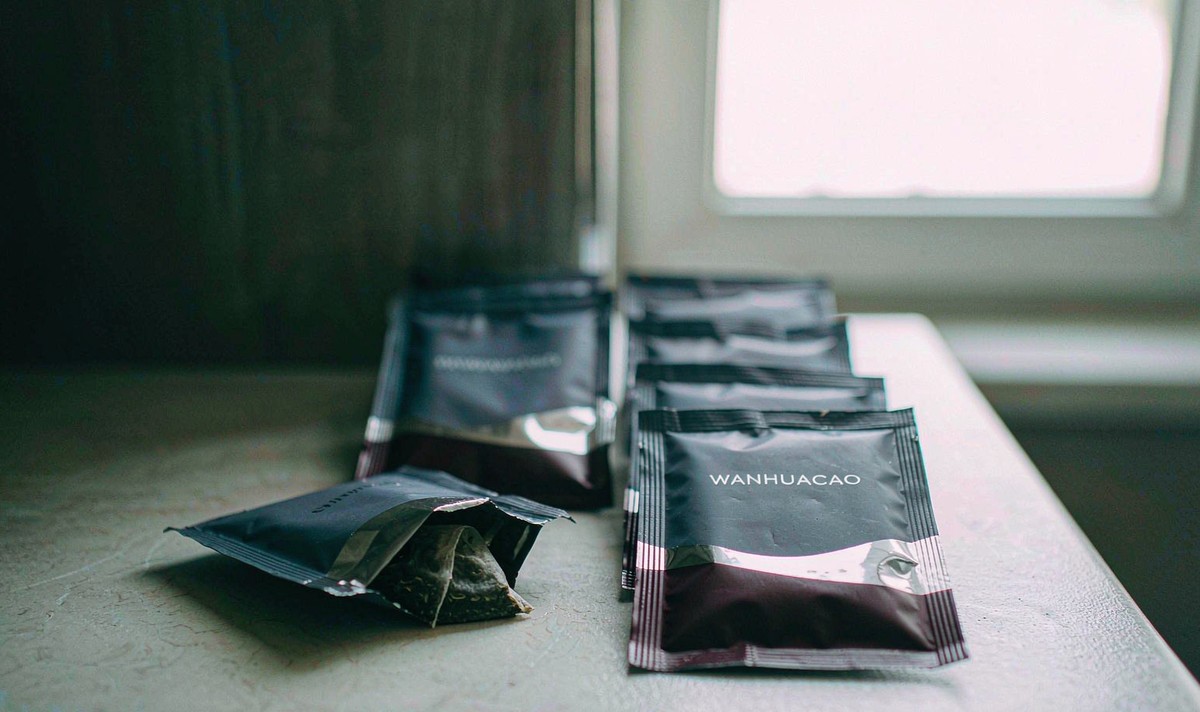
What the film buys
Four things, and the last is the one that gets discussed in meetings.
- A slower exchange of water and aroma. The film lowers the rate at which moisture enters and volatile compounds leave. It does not stop either one. It changes how long the bag stays recognisable as the blend that was approved.
- A dose that is already counted. Foodservice and hotel rooms buy portions, not packs. A wrapped bag can be dropped into a cup by someone who is not reading a label, and the count on the carton is the count in the room.
- A cushion in the shipping carton. An unwrapped bag in a box is a bag pressed against its neighbours for a thousand kilometres. The sachet takes that abrasion, and a tag that would have been bent arrives flat.
- The look, which is real, sells, and is the cheapest of the four to produce.
Three films, ranked by what they block
The choice is usually made on cost per sachet and should be made on the material the marketing sentence can survive.
- Coated paper, cold-sealed. The best recycling story and the weakest barrier. Paper transmits aroma, so the blend is protected by the carton rather than by the sachet. It needs a cold-seal adhesive rather than heat, because a printed paper face will not seal to itself under a hot jaw, and that adhesive is part of the same food-contact and compostability question as the paper.
- Aluminium-laminated or metallised composite. PET/AL/PE or PET/VMPET/PE. The strongest barrier on the shelf: the metal layer blocks light as well as moisture, and a metallised layer also blocks light at a fraction of the foil weight. Water vapour transmission for these structures is typically below 1 g/m²/day at 38 °C and 90 % relative humidity. It is also the film that cannot be composted and cannot be recycled with paper.
- High-transmission PLA or a coated paper with a high-barrier dispersion. The compostable direction. Barrier sits between the other two, the heat-seal window is narrow, and the coating is the part that decides the claim, not the base sheet.
A fourth option is used more than it is quoted: no overwrap, and a carton with an inner liner. It is cheaper per unit and it moves the barrier question to the box, where the material is heavier and the printing is already paid for.
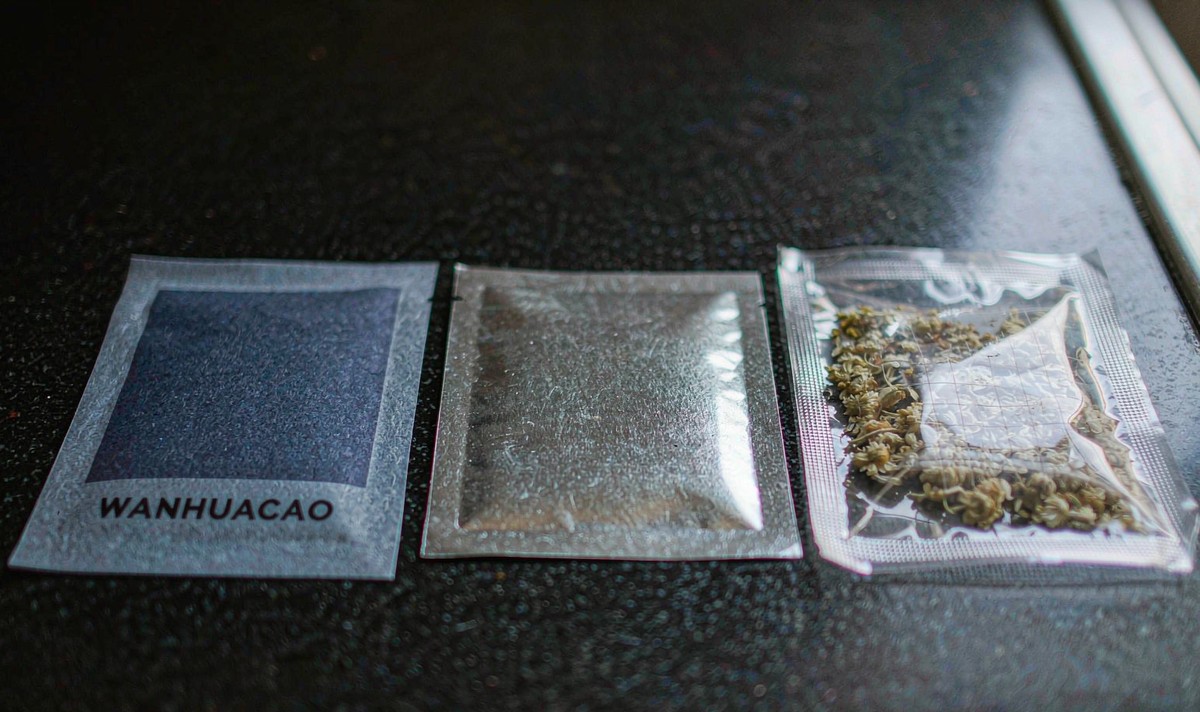
Where the aroma goes
The compounds that make a herbal blend smell like itself are the small, volatile ones, and they leave through any wall that is not built to hold them.
- The head note is the first loss. In chamomile it is the terpene fraction around alpha-bisabolol; in mint it is menthol, which is volatile enough to migrate into a polyethylene liner and stay there. A blend can pass a sensory panel at packing and be flat inside a year without anything being wrong with the tea.
- An unwrapped bag is protected by its carton, not by itself. Filter paper is chosen for wet strength and flow rate, not for barrier, and a paper bag in an open tin is a bag in a room.
- A wrapped bag saturates its own headspace. The volume inside the sachet is small, the volatile concentration rises until the net loss slows, and that is why the sachet smells stronger than the tin when it is opened. That intensity is four months of accumulation released at once.
- The same mechanism runs the other way with water. A sealed sachet holds whatever moisture was in the bag when it was closed, which is why the fill moisture matters more in a wrapped product than in an open one. The published figures for this line are 8.5 per cent for leaf and 13.0 per cent for flower under GH/T, and a flower blend packed at the top of its range into a sealed film has nowhere for that water to go.
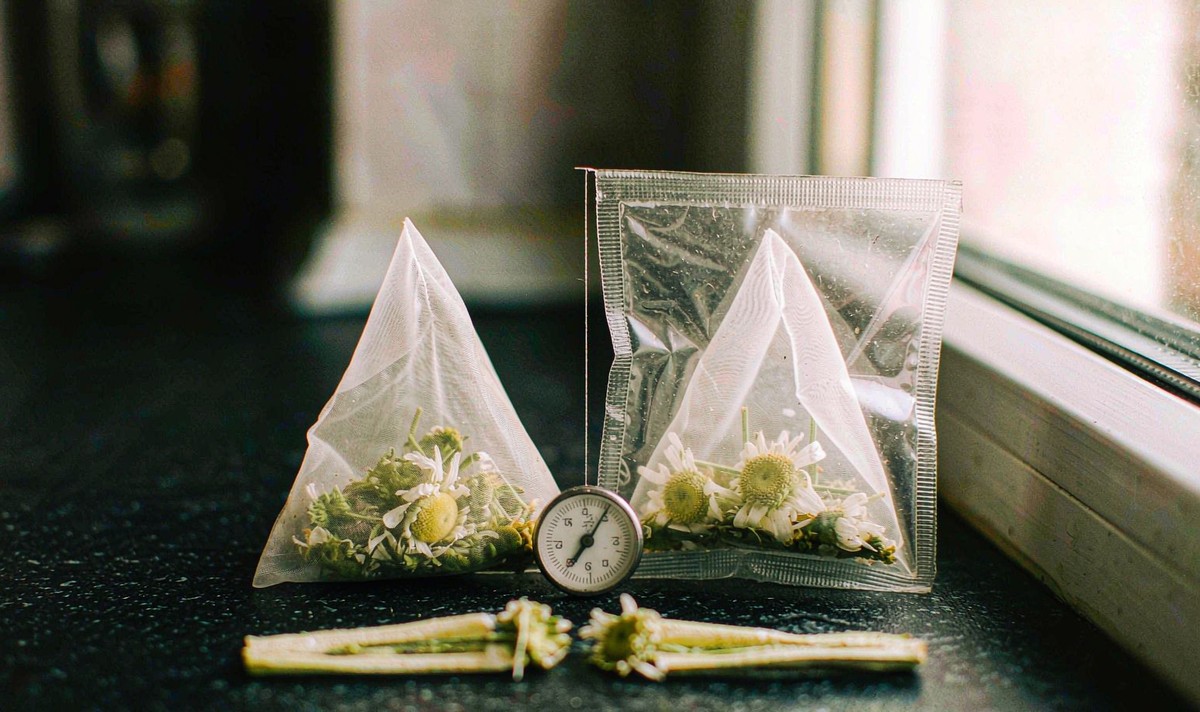
The machine sets the order of decisions
An envelope machine forms the inner bag, fills it, seals it, cuts it, wraps it, seals the outer sachet, and attaches the string and tag if the format has one. Every step after the first is constrained by the step before it, and the constraint that surprises buyers is at the end.
- The outer sachet sets the inner bag. The sachet width is fixed by the forming collar and the film reel, so the largest inner bag that fits is a consequence of the outer dimension. Buyers usually specify the bag first and the sachet second, which is the reverse of how the machine is built.
- A narrow heat-seal window costs speed, not quality. PLA and coated paper need a tighter temperature band than a PET/PE laminate, and a machine running inside a narrow band runs slower. The quotation reflects machine time, so the compostable film is dearer for a reason that has nothing to do with the film price per kilo.
- Paper film needs a cold-seal station. That is a piece of tooling, not a setting. A converter without it will offer a heat-sealed paper sachet that opens along the seal in a pocket.
- Volume is a cost that arrives later. A wrapped bag takes more space than an unwrapped one, so a container holds fewer cartons, and freight per unit rises. On a light product shipped long distances, this line item can exceed the film.
The claim has to cover the film
A sachet is the item a drinker drops in a bin, and a compostability claim is about that item in the state it is thrown away.
- Certification is issued on the whole item. A bag tested without its overwrap is a bag whose claim stops at the sachet. If the film is a laminate with aluminium, the claim cannot be made at all, however compostable the bag inside it is.
- Metal film has no exit. Aluminium-laminated sachets are not compostable and are not accepted with paper in recycling. A brand that wants a compostable bag and a foil sachet is buying two claims that cancel each other at the point of disposal.
- Food contact is a separate file. The framework regulation 1935/2004 and the plastics measure 10/2011 govern the film, the adhesive and the ink, and paper films are additionally covered by national fibre rules in each market. None of that travels with a certificate for tea.
- The printed surface is part of the barrier conversation. Surface printing puts ink on the outside of the film where it scuffs; reverse printing puts it under the film where it is protected and needs registration tight enough to keep the copy readable through the layer.
What our documents cover, and what they do not
- SGS CN23/00007035 —— issued to Anhui Wanhuacao Biological Technology Co., Ltd. against Codex CXC 1-1969 as revised in 2020, covering substitute tea, solid drinks, instant cereal powder and gel candy. A bagged herbal blend is substitute tea.
- Production licence SC11434160205012 —— eight dosage forms, tea in bag among them. Bagged tea is a manufacturing category under this licence.
- What neither covers —— the film, the cold-seal adhesive, the ink, or a compostability statement. Those documents belong to the converter and to the destination market, and they are the first thing to ask for on an overwrap project.
What to put in the brief
- The channel. Foodservice portions, hotel amenity, retail carton or gift box, because the channel decides the sachet size and whether a tag is fitted.
- The shelf life you need to defend, with the market and the storage condition, since the film is chosen against a target rather than a preference.
- Whether a compostability claim is intended, because it eliminates the strongest barrier on the list before anyone prices it.
- The inner bag specification, format and fill weight, so the sachet can be sized around it instead of the other way round.
- The print sides and the copy that has to stay legible, including the lot code area, which is usually the last thing to be given space.
Send the channel and the shelf-life target and the film can be chosen against both. The piece on custom tea bag tags covers the part of the pack that is fitted at the same station, and eco-friendly tea bag materials sets out what the bag itself can and cannot be called. For the wider comparison of two quotations on the same brief, the guide to private label herbal tea manufacturers is the place to start.
Ding Shaohua, Foreign Trade Manager, takes enquiries for this line. The same person answers on WhatsApp, TikTok, LinkedIn and Facebook.
FAQ
Does the overwrap really extend shelf life?
It changes the rate of two exchanges rather than stopping either. Aroma leaves more slowly and moisture enters more slowly, and how much slower depends on the film, the initial moisture of the fill, the headspace inside the sachet and the temperature the carton sits in. That is why a shelf-life figure has to be stated with the storage condition attached: the same sachet gives different answers in a warehouse in Singapore and a shop in Oslo.
Which film should I pick if I want a compostable claim?
A coated paper with a high-barrier dispersion, or a PLA-based structure, tested as the whole item with the bag, the string, the tag and the adhesive. The aluminium laminate is out: it is the best barrier on the list and the one that makes the claim impossible. Ask the converter for the certification on the finished sachet rather than on the film alone, because the seal and the adhesive are where these projects usually fail.
Can the sachet be printed on both sides?
Yes, in two different ways that are not equivalent. Surface printing puts the ink outside, which is cheaper and scuffs; reverse printing puts it behind the film, which protects it, needs registration accurate enough to read the copy through the layer, and costs more in make-ready. The back of a sachet is usually left partly blank for the lot code and the best-before date, and that space should be reserved in the artwork rather than found on press.
Does wrapping raise the cost per cup?
It does, on three lines: the film, the machine time for the second seal, and the volume the carton takes in a container. The film is the smallest of the three at retail volumes. What reduces the figure is not a cheaper film but a standard sachet size shared across blends, because the film reel, the forming collar and the print plate are then amortised over the whole range instead of one SKU.